Agile Elephant making sense of digital transformation

innovation | digital transformation | value creation | (r)evoloution

  • Email
  • Facebook
  • Google+
  • LinkedIn
  • Twitter
  • Home
  • Manifesto
  • Services
    • Our Approach
    • Our Services
    • Making Collaboration Work Packages
    • Collaboration Solutions
    • Our Experience
    • Workshops
    • Innovation
  • About Us
    • The Team
    • Why we do what we do
    • Why are we called Agile Elephant?
    • Our Partners
    • Our Clients
  • Get Involved
    • Events
    • Meetups
    • Unconference
    • Newsletter
  • Resources
    • What is Digital Transformation?
    • What is the Digital Enterprise Wave?
    • Our Research
    • Case Studies
    • People We Follow
    • Articles & Links
    • Books That Inspire
  • Blog
  • Contact Us
Home Archives for social business
Luis Suarez on the state of social business in the UK – #e20s interview series

October 9, 2014 By David Terrar

Luis Suarez on the state of social business in the UK – #e20s interview series

This is the first in a series of posts which present different views on the state of Social Business in the UK from a video interview series compiled by our friends at Kongress Media.  At our #e20s Meetup sessions Bjoern Negelmann asked well known consultants, practitioners and thought leaders in this space where we are with digital and social collaboration compared to the rest of Europe and elsewhere.

Here is Luis Suarez, well known for being the IBM champion of social collaboration and knowledge sharing, who lives “outside of the inbox“! Luis made the break from IBM just a few months ago and is working as an independent consultant and change agent.

Watch the video, but here are some highlights:

I’m taking for granted that digital transformation is happening across the board

Technology is driving innovation. It’s happening, but it’s not why, but how we do it in way that matters for my business!

We’re spending a disprotionate amount of time talking, not enough time doing.

The UK market is realising their clients ar not restricted geagraphically – we can get to Europe, the USA and emerging markets… …the UK has more a leading role to play

It’s happening all over, even the traditional world of government is back in the game digitising the conversation.

Not questioning why, but doing, diving in and learning

If government is doing it, what’s your excuse?

The rest of the countries in Europe may be saying we’re not ready

We might not be ready to kill the hierarchy but we need to challenge the status quo

10 years ago no-one was questioning the hierarchy. Can we flatten (our organisations) and change?

It’s’ going to a gradual transition to a more flat world, but both will exist for a long time.

If you want to find out more and about what works, what doesn’t and what next then take a look at the Enterprise 2.0 Summit London on November 26. More information here.
e20s_london_banner


More #e20s state of UK social business interviews in the series here.
Share this:

  • Tweet
  • Email

Filed Under: #EntDigi interview series, digital disruption, enterprise 2.0, social business

Dealing with Digital Disruption

October 8, 2014 By David Terrar

Dealing with Digital Disruption

Riding the Digital Enterprise Wave

Your business model is under threat from what we call the Digital Enterprise Wave. Are you going to ride it or go under?

The digital enterprise wave from David Terrar

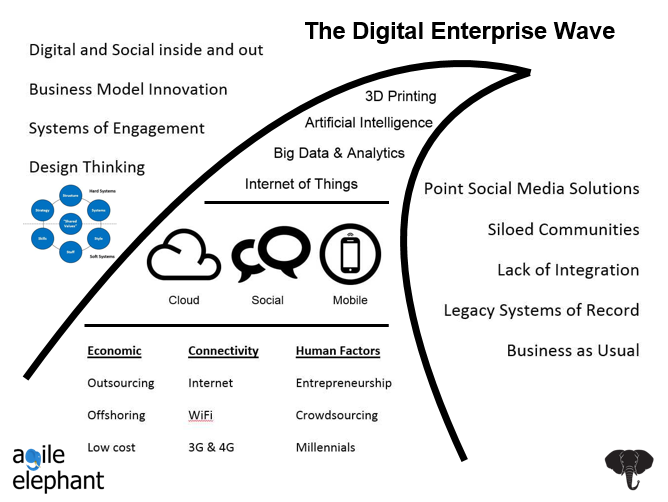
Take a look at these slides and let me explain how the business landscape is changing. It’s driven by significant changes in infrastructure and things that we already know about. There are Global economic pressures where access to low wage costs in Asia, Eastern Europe, or South America are facilitating outsourcing and offshoring, all supported by the connectivity provided by the Internet, extended by the huge rise in Wi-Fi access, 3G and 4G so that we now live in an “always on” World. Those things have dramatically lowered the costs and barrier to entry for any business start-up idea. It’s fostering an explosion in entrepreneurship. It’s enabling crowd-sourcing of expertise from Wikipedia to Waze. It’s giving us a new generation of Millennials who have grown up digital so that they think differently, communicate and multi-task in ways that are changing the expectations of the (digital) workplace forever. These are the factors that underpin the ideas in Thomas L. Friedman’s The World is Flat, or that facilitate the access to niche markets behind Chris Anderson’s The Long Tail, or give us Clay Shirky’s Here Comes Everybody. These factors form the foundation of the wave.

Next we have the Big Shift. For the last 50 years Moore’s Law has driven change and innovation in technology. Every 5-10 years we’ve had a major technology disruption that has changed the way we do business, created new companies, and seen the demise of others. We moved from the mainframe to the minicomputer, and then to the advent of the IBM PC back in 1981. We’ve networked computers and created the era of client/server applications and then seen the start of the Internet, web 1.0 and the Dot-com boom and bust. Then things started to get interactive with Web 2.0. However, we’ve never had more than one technology disruption happening at once, until now. Now we have three major technology disruptions happening simultaneously, and that’s never happened before. The shift to the Cloud and web apps is happening at the same time as the shift to social media where all markets are conversations, and that’s happening at the same time as the shift to mobile – smart-phones and tablets mean that most of us are carrying around the Internet in our hands. That Big Shift is the next layer of the wave.

Then on top of that there are emerging technologies like the Internet of Things, Big Data & Analytics, Artificial Intelligence and 3D Printing. Each one of these has the potential for an even more profound effect on the World economy, the global supply chain and the way business works. Today’s marketplace has more demanding customers, faster changing technology and more competition than ever before, and the rate of change is getting faster. These emerging technologies form the top of the wave. Whatever business you are in your business model is under threat by a smarter, nimbler competitor who will be using technology to skip past you in to a new field of play.

The problem is that most companies are too focused on the day to day. They think business as usual. They have legacy business systems, with tired old style user interfaces – systems of record that keep score for the business. There is often a lack of integration. Where social media initiatives or communities have been started, using the new web tools, they slide over the top of existing systems rather than connect properly. They’re alternatives to email for communication instead of changing the game. They are point solutions or provide siloed information, when you need to think in a holistic way about the business. Business as usual will get swamped by the wave.

To ride the wave we need think differently. We need to think “digitally”. We need design thinking and business model innovation. We need to create systems of engagement which connect and engage with our customers and partners. We need to think in terms of using digital and social tools outside, but more importantly inside our businesses to create the connected digital workplace and a new way of working. Digital thinking will help you ride the wave, but it has to be applied to the whole business. We use the McKinsey 7 “S” framework to look at every aspect of the business – it doesn’t matter so much which framework and approach you use, as long as you think beyond just “putting lipstick on a pig” with a dash of digital and social sitting on top of your “business as usual”.

We’re now moving to an “Everything as a Service” World where companies like AirBnB are changing the hotel industry, Uber is changing the taxi business and Apple is about to change the card payment industry. As I said before, I don’t care who you are and what business you are in, your business model is under threat and you need to be using tools like the Business Model Canvas and the Value Proposition Canvas to rethink and refocus what it is that you do.

We are talking Digital Transformation – what is that?

You will have noticed that companies that have been talking social media in business, or enterprise 2.0 or social business have just started to talk digital instead. Social collaboration tools and platforms are an important component that you might use in your evolution or transformation to doing better business. By using the term digital we are highlighting that you need to think further than just adding social and mobile technologies on top of your legacy systems. You have to harness your existing technology, those systems of record, and make them work better. You have to think of using technology to help you go to market faster with new offerings and to reach your customers in new ways. You have to re-evaluate your business and your value proposition and stop thinking business as usual. You have to start thinking “digitally” for your business and an entire new generation of technologies as well as looking at the culture of the way your company communicates and interacts. You don’t have to change your company structure, but you do have to recognise that we now live in a networked World where every person in your organisation can be involved and engaged in the same way that they connect with brands in their personal lives. Smart companies can evolve a digital strategy. Business as usual will get left behind. If you are behind the curve like a Kodak or Blockbuster or even a Phones 4U, you have to think in terms of a more significant digital transformation. But going digital to survive is a given.

Sounds quite interesting, but why bother?

If this still sounds nice to have as an add-on rather than vital, the most important thing is that it works! Take a look at these survey results from Capgemini Consulting and MIT Sloan Management from their report “How digital leaders outperform their peers in every industry“. They split the surveyed organisations in to 4 categories, with the most digitally savvy being called the “Digirati”. Companies in that most advanced category generate 9% more revenue, create 26% more profit and have 12% higher market valuation than the rest. Going Digital makes a direct contribution to the bottom line.

This post was first published on diginomica.com as Riding the Digital Enterprise Wave

Share this:

  • Tweet
  • Email

Filed Under: agile business, business innovation, digital disruption, enterprise 2.0, future, high performance, organisational culture, social business, strategy

Social Business – Europe vs UK

September 29, 2014 By Alan Patrick

Social Business – Europe vs UK

We attended the IoM conference in Cologne last week, at the same time London Social Media Week was happening. (David gave a keynote talk, the slides are over here). It was interesting to juxtapose the core themes of these 2 events (incidentally, it was our  Patchwork Elephant Conference held during last year’s Social Media Week London that persuaded us to set up Agile Elephant).

In a nutshell, I noted the following large differences in themes on my twtstreams:

  • In Europe, a large amount of the case studies are based around improving operations, all over the business.
  • In the UK, most of the focus is on customer attraction – marketing, lead generation and sales.
  • Where the UK is looking at operation improvement, it tends to be around customer facing operations, typically serving existing customers.

Now to be fair, IoM is about “social business” whereas “Social Media Week” has a wider remit, but it’s interesting to note that even “Social Business” conferences in the UK are often focussed much more heavily on the sales/marketing arena. (Which is why we are running a more operations & customer related conference in November – see last paragraph of this post)

When we were kicking around the “why” this might be so, we came to the following hypotheses:

  • The UK has a more mercantile industry structure, but Europe has retained a lot more of its manufacturing industry – so by definition there are more European companies interested in operations improvement.
  • It is very likely that the CXO power base area is different – UK companies tend more often to be run by ex salesmen or accountants, European by ex operations people – the path to the CEO office usually tells you where the major power in the organisation lies, so its more likely that new projects in these areas are seen as priorities.
  • It may be cultural as well – in the UK my observation over many years’ consulting is the culture is more “sell it first, we’ll work out how to deliver it then” than European comapnies. As one delegate at IoM told us, to not have its operational side ticking along like a well made clock is painful for for a Germanic or Nordic company.

Whetever the reasoning, it leads to an interesting conclusion – best practice on customer attraction areas is in our observation coming from the UK and US, best practice in operational areas from Europe. Customer service examples seem to be coming from everywhere (it was after all a Swede who invented the concept of Moments of Truth in the customer value chain).

On implementation of social business projects, it seems that the same lessons are being laerned no matter where you are in the world, in that:

  • Projects should address an area of real business need
  • Pilot first
  • Use enthusiasts from the Pilot process to help spread the new system
  • Nothing will take off easily without CXO involvement
  • Nothing will scale easily without IT involvement
  • These projects put pressure on existing organisation structures, so education, and careful and sensitive change management is required.

There is a lot of discusion about what future organisation structures could or should be, in the UK and Europe, but after speaking to Jane McConnell, who has done quite a lot of research on this issue, I am increasingly coming to the conclusion that it’s more the culture than the structure or anything else that make the major difference in an organisation. As one person noted at IoM, “Culture eats Strategy for breakfast” (Peter Drucker).

The speaker roster at our Social Enterprise Summit in November tries to reflect this observation, in that we have invlited some real “best of” practitioners from Europe and the UK to speak. We are also giving a 1 day workshop the day before where we will present a wide array of “best practice” case studies from all over Europe as well as the UK.

Update – interesting article over here by Gloria Lombardi on the Northern European view od Social collaboration


Share this:

  • Tweet
  • Email

Filed Under: employee engagement, enterprise 2.0, social business, strategy, workplace

Behind the scenes – how IBM supports Wimbledon

July 3, 2014 By David Terrar

Behind the scenes – how IBM supports Wimbledon

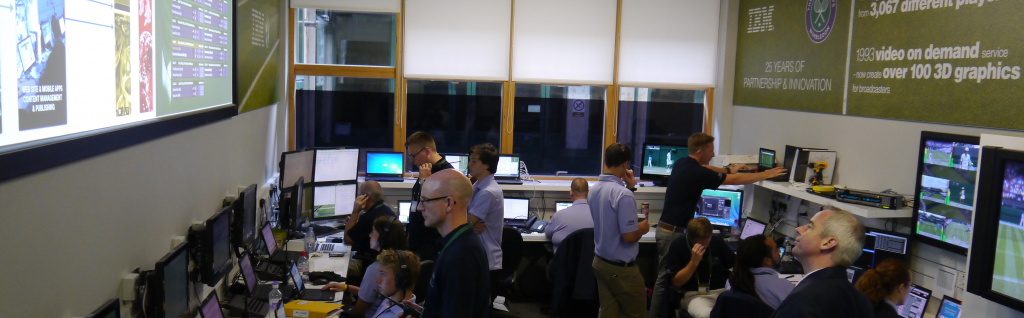
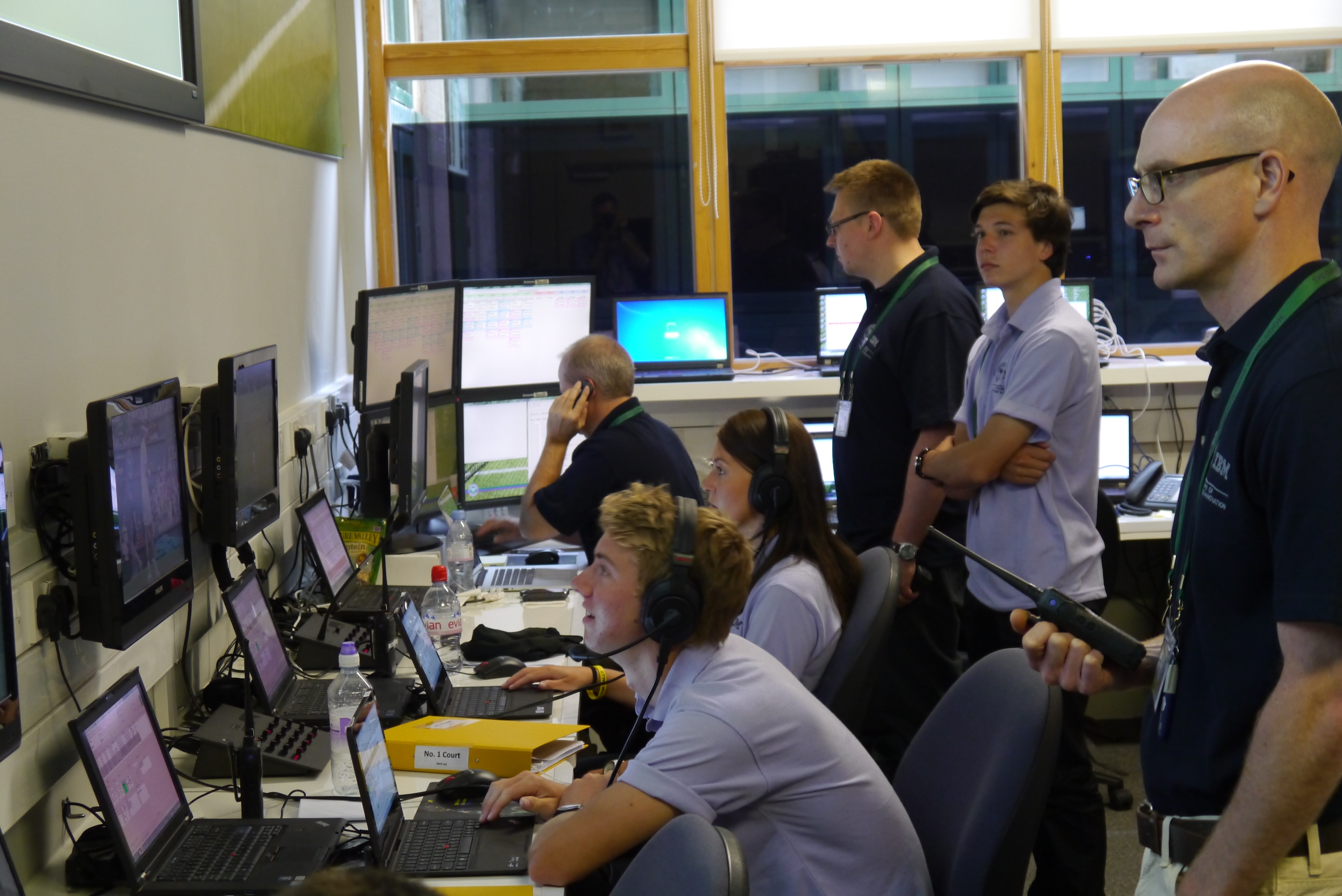
Last week I was privileged to be invited behind the scenes to IBM’s Social Media Command Centre at Wimbledon to see how cloud, social and mobile technology can combine to make a really significant impact for everyone involved in one of the premier World sporting events of the year. I actually spent 2 or 3 hours talking to people and looking at an array of state of the art software solutions in “the bunker”, accessed from the basement of the broadcast centre right under some of the Wimbledon tennis courts.  I must thank Andrew Grill, IBM’s Global Partner, Social Business who invited me, and Sam Seddon, the IBM Client Executive for Wimbledon, who showed me around. I did get to see some great Tennis from Nick Kyrgios and Eugenie Bouchard (two stars of the future!) while I was there, but being a Tennis fan was secondary to the rather awesome, geeky stuff underground.

IBM's Social Media Command CentreSam has a team of around 200 supporting Wimbledon using an impressive array of terminals and technology on site, supplemented by an enormous amount of Cloud compute power from data centres in Amsterdam and the USA.  They are providing a service to the All England Lawn Tennis Club to help make Wimbledon the premier sporting event, but in doing so they are serving the audience at the ground, fans around the World, the radio and TV broadcasters of the event, the event sponsors, the Club itself, and even the players directly.

On each court they have experienced tennis players with special terminals collecting near real time data of each match, point by point – 3 on Centre and number 1 court, down to 1 person on the outside courts.  They need a tennis savvy operator to differentiate a forced error from an unforced error and that kind of thing.  On courts where Hawk-Eye technology is used they take a direct feed from that too. This year, for the first time, they are tracking the speed of the ball, how near it bounces to the line, how far a player is pulled out of position so they can classify aggressive play versus passive play.  They manage all of the video feeds from every court and add data feeds to them for external broadcasters.   They take social media data from Twitter’s Gnip feed – this is the “firehose” of data that gives them batches of geotagged Tweets every 5 minutes which can be tracked to their country of origin, or right down to the actual court within Wimbledon itself.  On top of that they have all of the historical data collected on every player and every match during the 25 years they have working with Wimbledon, plus the club data going back to the very start of the event.

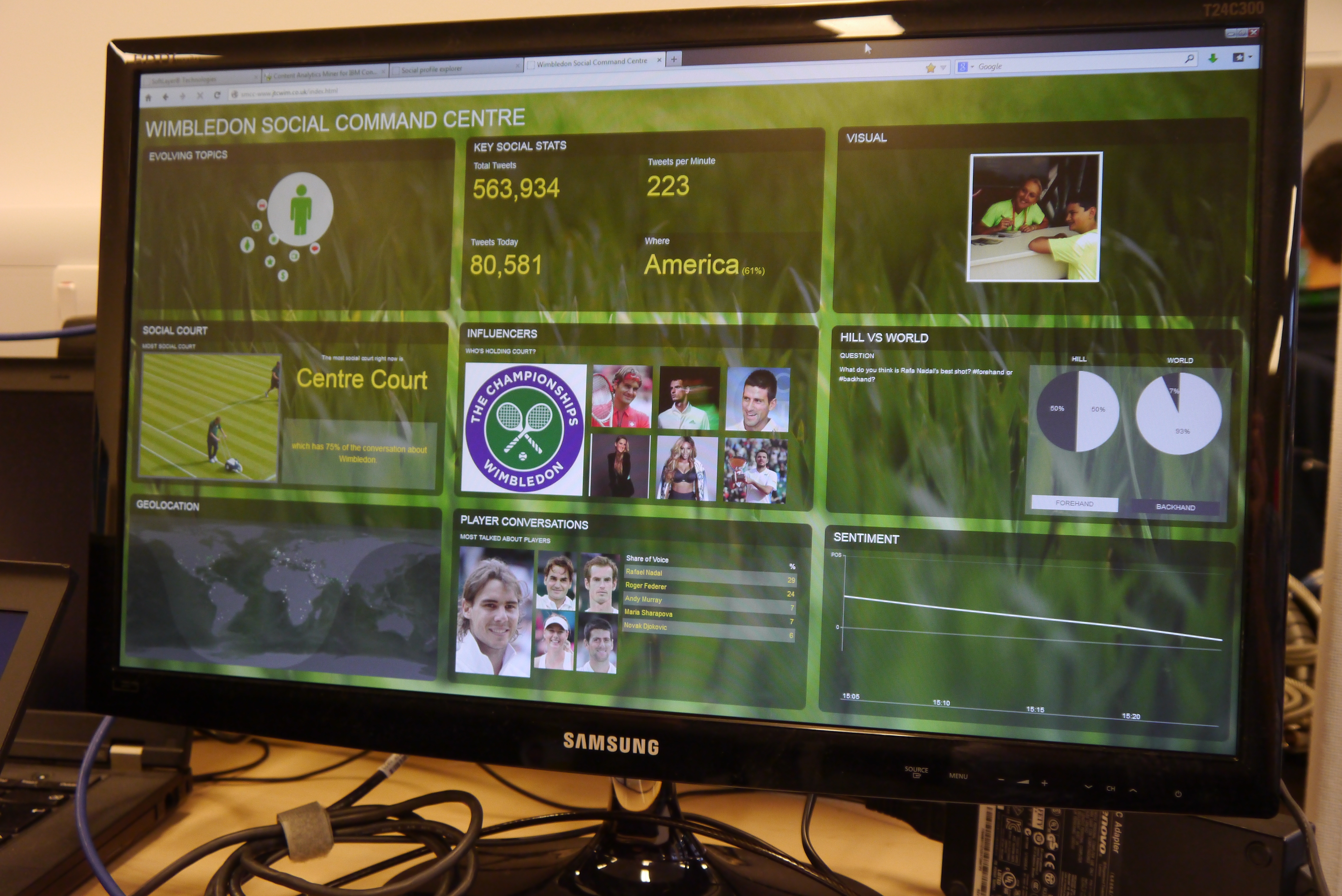
I spoke with Chris Thomas, Solution Architect – Big Data and Analytics at IBM, who is the guy in charge of the team and analytic technology making sense of this huge mass of social and digital raw material.  They use IBM Watson Content Analytics and other software components to provide the club, broadcasters and other users a dashboard with 9 views – Evolving Topics, Key Social Statistics, Visual, Social Court, Influencers, Hill vs The World, Geolocation, Player Conversations, and Sentiment.  Chris has created a collection of simple but powerful queries which then provide a visualisation of what is happening, and trends over time.  From the dashboard a user can dive in to the detail, and then track back through the history to a Tweet conversation on particular date/time or to player statistics at previous tournaments right back to the start.  All incredibly impressive and in terms of business analytics or social media monitoring this is deep functionality, directly applicable to just about any business.

They track Tweets by geography and can see how a particular social media conversation goes viral, and spreads country by country over time.  They can see who are the most influential on Twitter, be it players, fans, journalists or pundits, and track the engagement around particular players, matches or specific incidents happening in real time. They look at timeliness, authority, followers, and global reach.  For example, one Tweet from Roger Federer was retweeted 1,520 times within 30 minutes. Each tweet from the Gnip feed contains a lot of meta-data. They track time, latitude, longitude, sentiment, the relative volume from that location and filter by player.  There are bursts of activity they need to handle – in the final they will be collecting 6-700 Wimbledon related tweets a second!  In terms of sentiment analysis, Watson uses natural language processing to help them identify, understand and categorise things properly.  As well as tracking players and fans they have introduced a couple of new concepts this year.  The Social Court assigns tweets to a particular court and shows the user when something special is happening.  Hill versus The World is a great new idea.  The audience sitting on Wimbledon’s Henman Hill, Murray Mound or whatever you call it can be asked questions on the big screen.  The same questions get asked on social media around the World.  Then they track the difference in sentiment and engagement between the audience on the hill in the ground versus the audience in the rest of the World.  They’ve also added a visual feed, from trusted photographic sources, which provides extra player and fan related content for the users.  They’re being very cautious with this as Wimbledon.com and the AELTC can only be described as conservative when it comes to some of the images people put out there!

Chris’s team provide the dashboard to users on site, XML feeds out to the World, data feeds that combine with video for the broadcasters, and feeds that go directly to the Wimbledon.com website and the Wimbledon mobile app. IBM provide the website and the app, and you should compare Wimbledon to other tournaments and Grand Slams around the World. As a Tennis fan I have no doubt that the site and app have by far the best user experience for finding your way around and answering the key questions about a particular player, where they are at in the draw, order of play and the like.  They do the basics right, but then add a huge amount of great content on top of that.

P1030362I spoke to Alexandra Willis, the Club’s Editorial Content Manager.  She is probably the key customer being served by that analytics dashboard.  She uses it to make real time decisions on what content she should be providing to the website, the mobile app, and Live @ Wimbledon – their on site radio and TV channel that also gets published on the website.  It helps her spot problems that might be happening, say, in the queue or around the ground so they can be actioned.  She can spot an incident happening which might be a great opportunity to pull in one of the sponsors for more exposure or to help solve an issue.  They want to do much more than just recycling Tweets on a screen (which is the social media “monitoring” norm for so many events).  She is particularly delighted with how she can use Hill versus The World, or use the visual feed to pull in fan photos from around the ground (and elsewhere) to add another dimension to their content.  The day I was there there was a still lot of buzz about Shaquille O’Neal (who doesn’t tweet much, and didn’t at all from Wimbledon) but he was on centre court the day before.  Actually the tweet buzz had been generated by an Andy Murray BBC article about meeting him the day before, but just published that morning.  Alex tracks activity, events and sentiment like that by country – so far America has been the most engaged social media audience from day one and the male players get significantly more attention than the females.  She uses the reports produced by IBM around share of the voice to feed the Live @ Wimbledon channel and help serve the audience, fans, her sponsors and the club to keep her event right on top.

The players aren’t ignored in all of this.  I met some of the many young and enthusiastic, IBMers in their twenties who put themselves forward to a heavily oversubscribed list to come and support the event.  They have relaxed periods where they can hang around and watch tennis, but at the end of each allotted match they dive in to action for an intense half an hour of work.  They edit all of the match footage for the player, and collate all of the match statistics and social media data on to memory stick, which they have to get to that player within 30 minutes of the end of the match.  The player can then track back to particular points in the match, see what was going on, their errors, how aggressively they were playing or not, and learn from it to prepare for the next match.

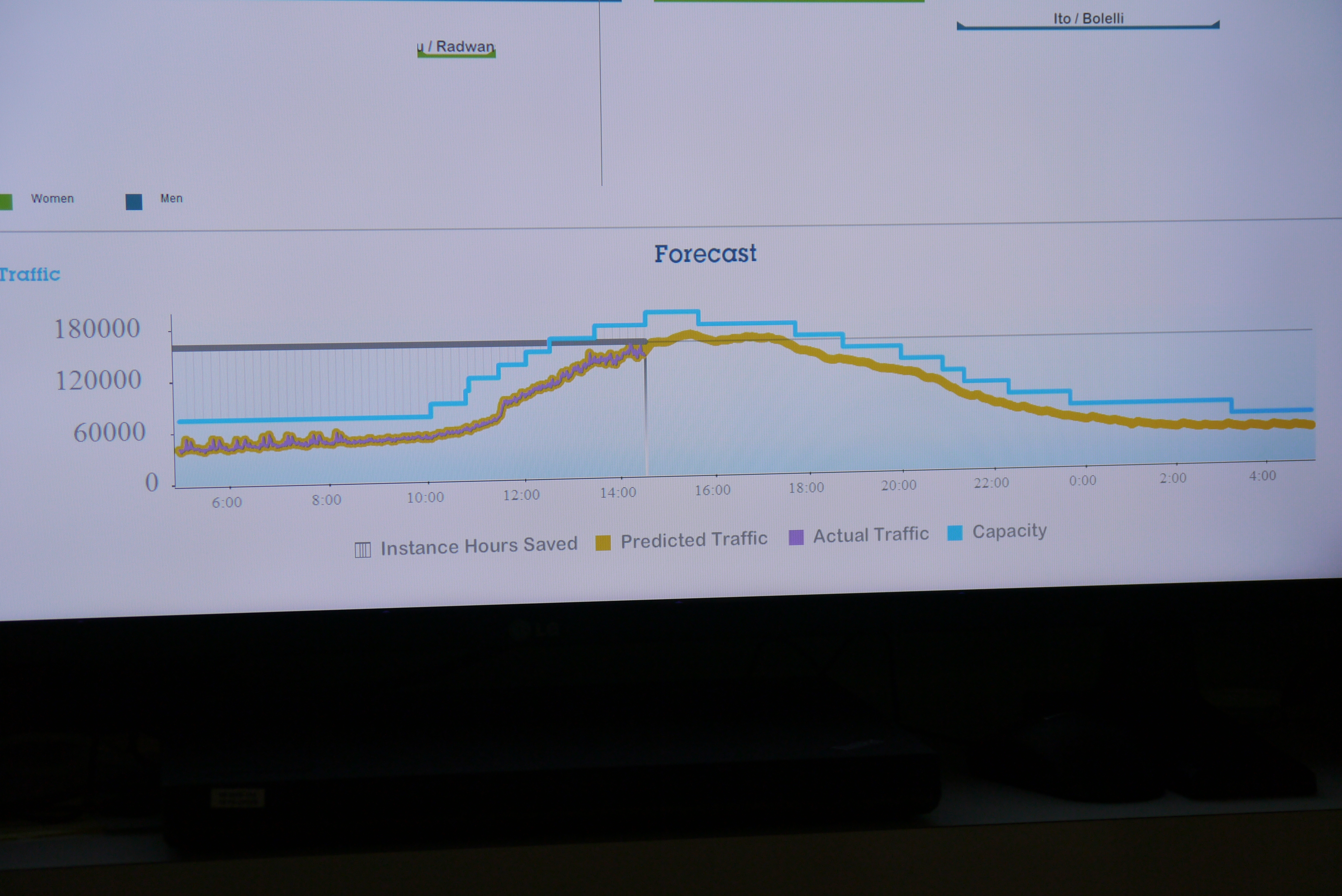
P1030359Here are my Flickr photos of the bunker, with all of the kit and example screen displays.  IBM install a lot of equipment on site for the two week event, but the lion’s share of the horsepower required to drive the website, the dashboards and the underlying analytics come from the Cloud.  Much of the Social Media monitoring is handled by Softlayer, supported from Data Centres in the Netherlands.  The compute power for the website and the analytics comes from 3 data centres in the USA.  This photo shows the monitoring screen in the command centre where the actual capacity used is being tracked, then a prediction of what capacity required is being calculated, and then the blue line above those two shows the actual resources that are in place so that the operators ramp up the capacity in line with peaks well before they happen.  A fine example of what is behind elastic computing in practice.

So the Wimbledon tennis, atmosphere, strawberries and cream were all great, I was more impressed by IBM’s Social Media Command Centre.  It’s a real showcase of how the latest technology can be applied to add real value for all of the stakeholders in an organisation.  It happens to be supporting a sporting event, but the key messages are generally applicable.

(Disclosure: IBM provided me access to the Ground and a fine Court 1 ticket, but no other expenses/fees) 

Share this:

  • Tweet
  • Email

Filed Under: agile business, data analysis, social business, social media monitoring, software tools

Salary Transparency: The Cultural Dilemma

March 4, 2014 By Janet Parkinson

Salary Transparency: The Cultural Dilemma

Buffer , a social-sharing app and site, recently announced that as part of its strategy towards workplace transparency it has decided to open up every single employee’s salary on its website:

“Its salaries formula, used to calculate what each worker will earn as they join the company, has become more nuanced and is being emulated by startups such as Groove and CustomerIO, says Gascoigne. Buffer also plans an “open equity” program where everyone knows how shares are divided…  It takes a certain kind of person to work at Buffer, Gascoigne says, listing traits such as empathy and gratitude – in addition to being very good at the core job skills…  “The percent of people who were a good culture fit was a lot higher after all the media coverage of sharing the salary of every person on the payroll,” he said. And of workers turned off by it, he says, “it scares the right people away.”  Qz.com

The question is whether the move towards workplace transparency should include transparency of salaries and what the implications could be.  Will this eventually become normal across businesses around the globe or is it just a fad?  One year ago I wrote about this question and doing an update today has highlighted some interesting developments in a country which has had some level of salary transparency since 1863 – Norway.

Cultures and  Transparency

A country’s culture usually dictates what is considered acceptable in its society and what is not.  Certainly the UK culture regarding salaries has always been – until now at least – a pretty taboo subject – even amongst the best of friends.

Last February I compared the UK’s attitude towards this with Norway where at the time anyone could go to the Norwegian mainstream newspaper Aftenposten’s website and with one click check out the norwegian tax list which shows a large proportion of the country’s tax payers’ details including their annual income, tax paid, value of investments and date of birth. For those in the UK this would seem a gross intrusion into private lives but for norwegians they have never really had much choice – tax and income records have been publicly available since 1863.  This transparency dates back to the deeply rooted Norwegian culture which prescribes egalitarianism, collectivism and conformity as values to be protected and practiced by its citizens – Janteloven (Jante Law).

Until 2001 the norwegian tax and revenue list was openly available but only via the tax office in paper format, therefore it was an effort to go and search through it.  But in 2008 the government made the list available to the media enabling newspapers such as Aftenposten to give instant online access to all via a searchable database on their websites. As Channel 4 noted in 2012:

“Jan Omdahl, from the tabloid Dagbladet, wrote at the time: “Isn’t this how a social democracy ought to work, with openness, transparency and social equality as ideals?” However a poll carried out in 2007 found most of his countrymen disagreed: just 32% thought the list should be published, while 46% were opposed…  What some see as an honest commitment to fairness is for others, an invasion of personal privacy, and a licence for what the Norwegian tabloid Dagbladet described as “tax porno”…”

As if this wasn’t bad enough it was Dagbladet who in 2009 even offered their readers the chance to automatically check and compare the income of their Facebook friends and to offer the service as an iPhone application – leaving Trine Skei Grane of the green party Venstre to comment how:

“We took part in opening up the system, but now the principle of openness is totally out of proportion”  BBC, 2009 

So even in a country where salary transparency was generally accepted people do have their limits.  The ease of availability and what can now be done with personal data proved to be a step too far. When I wrote my post last year the media still gave direct online access to tax and salary details – but following much controversy the Norwegian government has now stopped access of online information via the media – you now have to enter the Tax Administrator’s website to find out the information instead:

 “Today, the tax assessment for 2012 laid out, and we can probably immediately seek to arrive at what neighbors, friends and colleagues in income and wealth and what they paid in taxes. Certainly, the search has become more complicated since one must now enter the Tax Administration’s website and log in with MinID to access the information. But despite the fact that one can no longer use the readily available search engines on the newspapers’ websites, the search activity still great. The IRS reported, for example, that in 2011 was over 700,000 users conducted 13 million searches on the tax rolls for 2010…  Knowing that your neighbor can see what you earn, prevents any cheating. If there is a large gap between income and living standards observed that consumption of cars, boats and cabins, a risk being suspected of evading income from taxation. Such suspicion means lost reputation in the family and community, and some also possible to call phoning the Norwegian authorities.’  Aftenposten, October 2013, translated by Google Translate

The Norwegian government holds the view that the ability for everyone to check out their neighbour’s details easily through the internet must be a positive thing as it leads to less tax cheating and reduces the shadow economy…

Interestingly Valve who are adopting the ‘radical transparency’ approach recently introduced the holacracy model by eliminating the typical corporate hierarchy and have a stack ranking system where staff working on the same project rank each others’ technical skills, productivity and other contributions which helps determine who gets paid what – so salaries are, to a certain extent, open.  Professor Oswick of Cass Business School warns that it could go awry were the firm to face a financial setback:

“Peer-pressure is a fantastic way of organising a business,” he says. “And so long as everyone is well paid people don’t mind being in the bottom earning quartile.  But as soon as resources become more scarce, then competition increases, which creates conflicts, which creates tensions, which creates hierarchies, which creates concern about relative positioning.”

And bear in mind that this scenario could occur when employee salaries are known by only those within the company let alone being displayed openly to the public.

So perhaps ask yourself again – it may seem quite cool to some, but is having your salary details made available on your employer’s website really what you want?


Share this:

  • Tweet
  • Email

Filed Under: business innovation, corporate culture, digital disruption, social business, transparency

Agile Elephant – What’s In A Name?

February 18, 2014 By David Terrar

Agile Elephant – What’s In A Name?

Ever since we started the team have been explaining to people the various elements of our company name.  Some of the ingredients of the Agile Elephant are mentioned around the site, but I thought the fuller explanation deserved a post of it’s own.

We ran a sequence of social business events that we branded the Patchwork Elephant, but when we were thinking of a name for our new company we decided to upgrade to agile.

WHY ELEPHANT?
Elephant 2There are a number of layers to the elephant:

  • For most enterprises today we believe the shift to Digital, transforming the organisation and changing business model is the Elephant in the room!
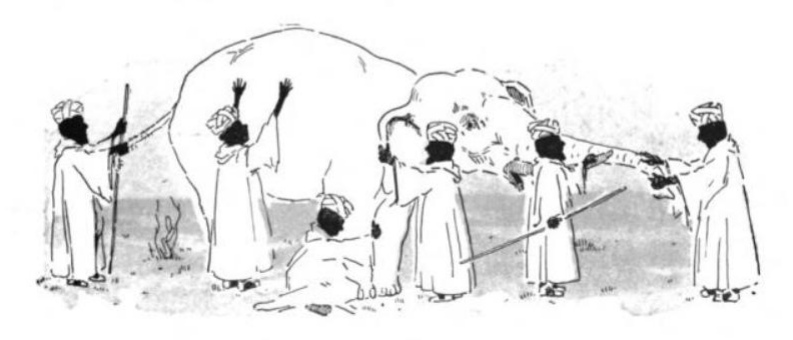
  • We also use the Indian subcontinent parable of the Elephant and the blind men.  Each one feels the Elephant and “sees” something different – one thinks it’s a snake, one a fan, one a wall, one a pillar, one a tree branch, one a rope – the digital transformation, new ways of working and social collaboration topics are complex and people see them in different ways from different perspectives.
  • We wanted to echo the great ideas from three books:
    • Rosabeth Moss Kanter’s excellent When Giants Learn To Dance which even back in 1989 talked about the demise of beuracracy and hierarchy in business.
    • Louis Gerstner’s Who Says Elephants Can’t Dance? – the 2002 book which described his successful turnaround of a giant of the technology industry.
    • Charles Handy’s The Elephant and The Flea from 2001 – part autobiography, partly a book on the changing nature of employment, and of the small independent going up against or working with the giant corporation.
  • We see the Elephant as a metaphor for the significant mass and associated inertia in a typical medium or large organisation.  They can be slow to change.  We believe they can become at least as nimble as their smaller, newer competitors, but only if they adopt new thinking, new styles of leadership and a different, more open culture of teamwork and collaboration.
  • We also need to tackle this complex, big issue of Digital Transformation in easily digestible chunks – eating the Elephant one bite at a time.

WHY AGILE?
Photo owned by questionforthekeeper - follow the linkPeople say Agile Elephant – surely that’s an oxymoron?  To that I say, if you’ve seen an Elephant in the wild up close and personal, you’ll know how agile they can be!

As well as highlighting how we can make business, the Elephant, dance, we ourselves need a more nimble way of working too.

We want to move away from the traditional cascading waterfall approach for these kinds of transformational projects.  We are Agile.  Instead we believe in an iterative, distributed approach to managing projects and getting the job done with lean efficiency.

We need to consider ways we can make our organizations become more adaptive.  We need to change how we think about change.  An Agile approach is fundamental to the new mindset required, for achieving better results, and faster.  Agile underpins all of our thinking.

So we are the Agile Elephant and we would love to be working with you and your company!  Contact us to find out more or start a dialogue with us around the possibilities of the new Digital landscape.

Share this:

  • Tweet
  • Email

Filed Under: agile business, corporate culture, social business Tagged With: Agile, Agile Elephant, business books, metaphor, parable, Patchwork Elephant, smart thinking

Employee Engagement :  The New Heart of Enterprise 2.0?

February 17, 2014 By Janet Parkinson

Employee Engagement : The New Heart of Enterprise 2.0?

‘7 out of 10 of your colleagues don’t give a sh*t about your company.  The biggest problem is employee engagement”  Luis Suarez at the Enterprise 2.0 Summit, Paris 2014

Luis was using figures from this Gallup survey which highlights how only 13% of employees worldwide are engaged at work. He’s right – but why is this?  You only have to look at the rise in volume of Google searches for the term over the last 5 years to see just what a buzzword ’employee engagement’ it is becoming, and it does lie at the heart of  the Social Business / Business Transformation / Enterprise 2.0 ethos – so why the poor figures?

There has been so much research produced over the years showing that employee engagement really does help the bottom line that no one can deny that benefits really do exist.  Take just one set of results by Gallup of meta-analysis of 1.4 million employees which shows that organizations with a high level of engagement do report 22% higher productivity, and Harvard Business Research which states:

‘strong employee engagement promotes a variety of outcomes that are good for employees and customers. For instance, highly engaged organizations have double the rate of success of lower engaged organizations. Comparing top-quartile companies to bottom-quartile companies, the engagement factor becomes very noticeable. For example, top-quartile firms have lower absenteeism and turnover. Specifically, high-turnover organizations report 25% lower turnover, and low-turnover organizations report 65% lower turnover.”

Social tools have been shown to be some of the most powerful enablers of employee engagement over the last few years as reports by McKinsey have shown.

Yet it seems that only now companies are catching up with the technology and beginning to take on board the true power of the social tools available to them. Having spent the last 5 years or so adapting their external marketing mix to absorb the power of social media, they are beginning to realise the full potential of internal social tools which are speeding up business processes and breaking down silos allowing employees to collaborate more effectively and at greater speeds.  Happier employees providing customer service support really does produce better customer service results. Companies now realise that with social tools which run in realtime they cannot remain hidden behind a wall.  They therefore no longer have the option to ignore it – employee engagement is about to hit big time.

As Luis notes in the interview below it is only in the last 2 years that we are beginning to hear more about behavior and how to influence mindsets rather than just hearing about the social tools.  “We are not there yet…  but now that we are talking about behavior we will begin to see a massive shift in the way that employees are engaged in the work that they do”.

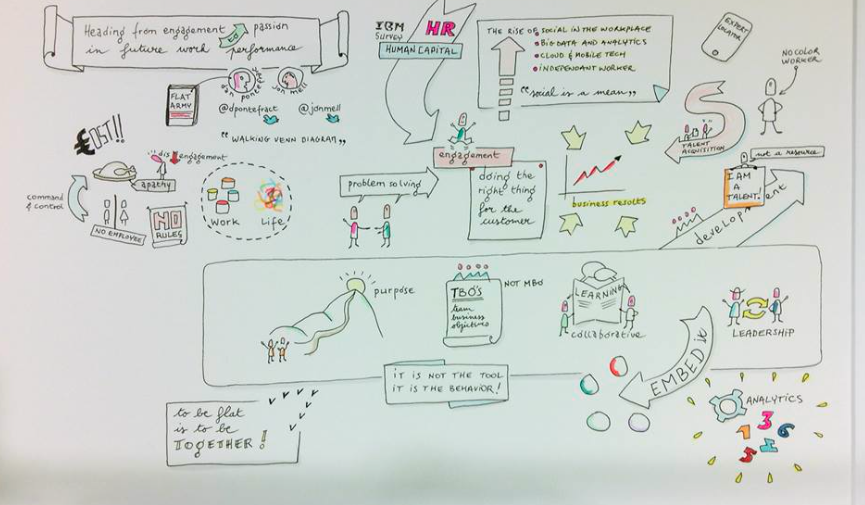
It was great to see though that employee engagement appeared as a key component of the Summit (which was after all traditionally a technology conference).  Yet it was right up front with both headliners. Dan Pontefract of Telus stated:

  • It’s not the tools it’s the behaviour
  • Engagement is a big driver of profitability which in turn is driving HR activity now
  • You can tie engagement to KPI drivers

and Jon Mell of IBM who noted:

  • Employee engagement drives customer satisfaction which drives profits
  • There are analytics now behind employee engagement which are key to the whole process, from interview questions to the proactive retention of the best employees
  • HR now has a seat at the table and has the power.

Many of the case studies touched upon engagement – though more often in terms of collaboration than specifically in terms of engagement.

Emanuele Quinterelli of Ernst & Young noted how in a survey of 300 Italian firms:

  • Currently the laggards tend to have no one in charge of collaboration as such
  • 56% of laggards have virtually no budget for collaboration while the top performers have at least 100k Euros of yearly budget and use business metrics 3 times more
  • 50% of laggards have no measurement, though only 9% of leaders have measurement in place
  • Leaders are engaging employees to engage customers

Martin Risgaard Rasmussen described how Grundfoss have deployed a program of culture change called Global Working Culture – run by HR.

HR – the company leaders of the future?

Following on from Jon Mell’s remark there are others who agree that HR really does have a seat at the table and Mar.  Oracle president Mark Hurd last October called for HR to transform itself and start to lead and drive businesses:

‘I want HR to help me run the company, to help with insight that will allow me to make the key business decisions, which will help the company grow…  Over the next decade HR as a function needs to lead and drive the business rather than react to it… It’s going to have to drive it in a way that’s more complicated than anyone has ever experienced before…  Turning from a support function to a leadership function will be core to what HR does in the next decade”

But in addition to HR let’s not forget the role of community managers.  At the Summit Rachel Happe discussed how to drive engagement and adoption on social platforms.  “A Community Manager has to inspire, establish and normalize a behavior change, this drives ROI” she said in a recent interview.  Community managers do act as lynchpins to networks which are increasingly crucial to the whole social business process.  Their role can encompass not just the monitoring and enhancement of engagement right across a company but also can provide and evaluate what can work better for the success of engagement across the whole community.

Employee Engagement – The Vision

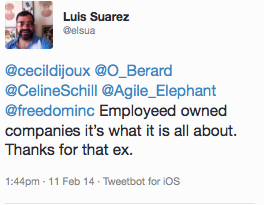
But perhaps the killer statement for me in terms of employee engagement came from a casual tweet by Luis on the second day of the Summit:

Screen Shot 2014-02-16 at 12.28.01

To truly engage employees to increase the performance and profitability of companies isn’t the ultimate deal to enable employees to own shares in the company?

Employee ownership is indeed on the rise:

“Employee ownership, where workers have a voice as well as a stake in the success of their business, is recognised as a sustainable business model which helps drive staff commitment, productivity, resilience and innovation.”  Real Business

And:

“Total return for shareholders in FTSE companies with employee share ownership rose by 53% in 2013, compared to 21% for companies in the FTSE All-share index, according to research by corporate finance firm Capital Strategies and the London Stock Exchange.” Employee Benefits

It’s becoming clearer that the way companies currently structure measurement and reward just isn’t working.  If you want employees to be truly engaged and really feel part of the big picture then treating them as cogs in the wheel and rewarding them for just being good cogs is never going to be enough.  Having a stake in the business will motivate them to take a business sized view.

Best of all it appears that Luis even has the UK government on his side…

 “Policy makers are increasingly embracing employee ownership as a key sustainable business model, and over the last 18 months we have seen a significant increase in support for this sector. In his budget in April this year (2013), George Osborne announced that, with effect from 2014, the Treasury would set aside £50m in tax reliefs for the employee ownership sector.  On top of this, in yesterday’s Autumn Statement George Osborne put the Government’s money where its mouth is, pledging a further £25m in support of this fast-growing sector of the UK…”  Real Business

Well, we’re not sure how many years we’ll have to wait for employee ownership to really take off and become the norm – but perhaps Luis should come over to London to give George a helping hand 😉

Image by Frederic Williquet: @fredericw : https://twitter.com/fredericw/media

Share this:

  • Tweet
  • Email

Filed Under: business innovation, collaboration, employee engagement, enterprise 2.0, HR, social business, social tools

Agile Elephant at Enterprise 2.0 Summit Report

February 17, 2014 By David Terrar

Agile Elephant at Enterprise 2.0 Summit Report

My first post introduced the Enterprise 2.0 Summit, the social business topic in general and speakers at the event at ESCP Europe.  This is my conference report.  I’ll start by setting the scene with my impressions, then pick out highlights, draw some conclusions and finally link to the other Agile Elephant posts about the Summit.

IMPRESSIONS

  • From where we were in 2006 at the Office 2.0 show or in 2007 at Open Knowledge’s first Enterprise 2.0 Forum in Varese, I could be depressed that we aren’t further forward with enterprise 2.0 and social business.  However, that’s more to do with the fact that we are in the middle of a change in business behavior that may take 10-30 years.
  • I’m incredibly optimistic about what is happening now. That’s why we just made a leap of faith and started Agile Elephant as a new social business consultancy a few weeks ago. The mood at the conference confirmed our feeling that this topic is poised to cross the chasm and go mainstream.
  • Enterprise 2.0/Social Business is a complex topic. The elephant in the enterprise room. There is a definite divide in thinking between two camps. Those of us at the summit who want to get top down executive commitment and a focus on hard business numbers and real ROI, versus those that focus on the culture change required to move to a more sharing, open business combined with the structural change required to move companies to more networked rather than hierarchical organisational structures. Both of these are important. Both of these require new or different leadership thinking.
  • Most of us attending the conference are somewhere at the leading edge of this topic. As a movement, we need to get organised to spread the word and break through to the average business person in the average company so they understand the benefits of social business.

CONFERENCE HIGHLIGHTS

Dan Pontefract of Telus opened the conference eloquently explaining his company’s journey in to social business.  Key things he said or described:

  • It’s not the tool it’s the behaviour
  • It’s about collaborative behaviour aided and abetted by social tools
  • A woman adding a 6 minute video to the community of her 10 coaching tips, it got 1000 hits and 62 comments, and she answered every one individually
  • He used a metaphor of Canada geese flying in a scheme, a V formation, rotating the leadership – our orgs need to be like that
  • There is potential energy in everyone, how do you convert that in to kinetic energy?

Jon Mell of IBM called out to me from the stage remembering Varese 2007 making the point we’ve been at this a long time.  Some key things he said

  • Think of the best manager and the worst manager you’ve had, and that their good/bad behaviours aren’t easily found on their CV
  • That means when you’re hiring someone, how they might fit your culture can’t be see on a CV
  • He explained how Caterpiller have seen that where employees are highly engaged, there are 3 times less accidents and that translates straight to the bottom line
  • He talked about AMC – they focus on popcorn sales as a key metric – what makes great popcorn sellers, and good managers of popcorn sellers, how do we hire and attract them, share the learning – getting it right translated in to a 1.2% increase in profit per customer

The best case study at the summit was Joachim Heinz explaining Social Business @ Bosch.  He explained how they have 300,000 associates, create more than 16 patents a day, have been taking Bosch to 2.0 and now have 60,000 people on boarded to their social platform.  80% of their communities are open – you have to apply for a private group.  It’s called Bosch Connect – you can “go there, make a wiki and you’re done in 30 minutes”.  They have created 13 different use cases and he explained they are:

  • Shifting core processes in to social
  • Using social to enable leadership
  • Providing senior managers with Enterprise 2.0 mentoring using digital natives, but they are discovering that ideas are going both ways, it’s not a monologue
  • And that the wake up call for Bosch management was the fact that Tesla could design a new car in 2 years, whereas BMW/Mercedes take 6 years – that’s digital disruption!

Emanuele Quinterelli of Ernst & Young, who I first met when he invited me to speak at that E2.0 Forum in Varese in 2007, set the scene for our panel discussion on Strategic Enablement.  He presented the results of their survey of 300 Italian firms where 54% of them have between 10% and 30% adoption of social business.  He presented the 6 key findings:

  1. Top down commitment – if top executives are on board, nobody in middle management can sabotage the shift to social business – a very tough but crucial message
  2. Strategy – a well structured roll out strategy is key, hybrid works, but top down is 2 times more successful in achieving adoption
  3. The people factor – laggards tended to have no-one in charge of collaboration, leadership of collaboration works
  4. Money where it matters – the leaders had budget balanced between strategy, tech and change management, and 50% more than others
  5. Measurement is important to steer and sell it – half of laggards have no measurement at all, 91% of leaders have measurement in place, top performers use business metrics 3 times more
  6. Social business is here already – leaders are engaging employees to engage customers, internally and externally – 23% of the top performers are planning end to end social business projects in the next 2 years

Martin Risgaard Rasmussen explained the Grundfos story, but also that he is in the process of leaving to join Yammer.  Grundfos has been around since 1945, has 18,000 people and is the World’s biggest pump manufacturer – take a look at your central heating system next time you open the airing cupboard.  They have deployed a program of culture change they call Global Working Culture run by HR.  They are moving to social business to get more out of the work they already do.  It’s all explained in a brilliant hard copy white paper called “Social Business Cooking at Grundfos”, there is more at socialbusinessjourney.com, and I’ll post a link to a PDF when I find one.  Some of the things Martin said:

  • Participation inequality, the 1-9-90 rule is real
  • You need at least 1 designated community manager otherwise it won’t work
  • He emphasised the importance of a clear purpose and finding use cases
  • He explained how they integrate social into their business process
  • They focus on culture
  • He talked Simon Sinek’s Start with why (and we love that!)
  • He explained how they looked at Chatter, Yammer, and Socialcast, but chose Yammer

Joachim Niemeyer of centrestage talked about leading the transformation required.  He talked about needing the active support of top management, the need for a clearly defined target audience, about capability, having a clear vision, defined business objectives and a well developed roadmap.  He highlighted the importance of use cases with high potential business value and a toolbox for systematic change.  He was another one who emphasised integration in to business process.

I missed Claire Flanagan of Jive talking about proven social business adoption strategies, but her slides have some great messages

I missed great presentations by Rachel Happe and Jane McConnell too.

On day 2, Lee Bryant of Postshift said a lot I could agree with, and some things I might argue with.  He doesn’t agree that social business should be about process.  He worries that some of us are adopting an approach that is all about a market for consulting services and software, that’s aligned to the way companies are used to buying.  He worries that the approach is not about new business models or new types of organisation.  He talked about killing the org chart with social tools.  Some of the things he said:

  • We’ve move beyond Taylorism – productivity has gone quantum
  • He talked about the effectiveness of small co-ordinated, agile teams
  • Knowledge sharing beats cascaded best practice
  • He worried that so many companies have too many generic managers – they don’t have skills, they’re just politicians
  • Communities and networks are the fabric of the organisation (right on!)
  • He quoted our friend Dave Gray‘s The Connected Company – popular working needs an underpinning service, as well as about fractal structured organisations
  • He went through a selection of companies that have adopted a completely different, often decentralised organisation and leadership approach – including Morning Star, Valve, Kyocera and one of my favourites WL Gore
  • He talked Holacracy, Sociocracy, and the Kotter dual operation system
  • He talked agile work group of 5-8, then Pod groups of 12, then group of pods totalling 140 (see Alan’s recent post on Dunbar numbers – there are more than one!)
  • He mentioned how you need an influencer, a keeper of stories – like Marc Benioff who is brilliant at that
  • He referenced the fantastic changes that the UK’s Cabinet Office have done reorganising government IT functions
  • He said he wasn’t arguing for flat structures or the end of leadership, but for for the end of managers
  • He also said it doesn’t matter what we call this topic with a slide full of socbiz and 2.0 hashtags (see thesis 9 of our Manifesto)

BernardMarie Chiquet of iGi Partners extended the discussion further in to Holacracy.  He suggested we have to go to the motherboard of the organisation structure (I like that!).  He talked about a move to “purpose driven” not “for profit or not for profit”.  He argued that order doesn’t require bosses.  He talked of needing a constitution for the organisation, like the king handing over power to a new form democracy enshrined in the constitution.  He talked about organising the work, not the people.  He wanted to break down the purpose in to functions and the functions in to roles – that being the basic brick, element where work needed to be done.  He suggested:

  • There are 3 dimensions – purpose, accountabilities, domains
  • You need a governance process – but that might be a 2 hours meeting every 2 weeks
  • It takes a village to raise an organisation with organisation, people and a purpose

At a about this point Jon Husband tweeted “The Holacracy tension a notion that comes from Robert Fritz’s concept of Structural tension, from OD world of the early to mid-90’s #e20s“.  Jon clearly thinks that holacracy is 90s OD and other thinking re-presented for this new century.  He joined the panel discussion, which was really entertaining.  They talked more about the org chart being roles and not people.  They talked about the time span of decision making and how far out you can look for strategic decision making.  We now we live in a World where a few tweets can put your business in deep trouble – difficult to be strategic with change happening in near real time.  Jon talked Transactional Analysis, the book “I’m OK, Your OK” and how the goal is to move from parent-child to adult-adult negotiations.  He believes the next stage of social business is a deep movement, that is a 20-30 year process, but he characterised the stage we are at in the journey by the pilot coming on the intercom and saying:

“Buckle up your seatbelts, there’s turbulence ahead!”

Back in the main hall, Celine Schillinger of Sanofi-Pasteur told the inspirational story of her journey in to social business and being a change agent.  She talked vision, openness, information and cultures.  She explained how things changed for her when she sent an email to her CEO back in 2011 around the issue of gender diversity.  That went viral, and triggered her creating a community on their internal social platform that has grown beyond 2,500 members in 50 countries, with concrete measures to achieve gender balance that changed her company.  She went on to explain how Sanofi are using the same type of community approach to fight Dengue Fever, but lifting it beyond a company initiative to a global fight against the enemy/disease.

Dion Hinchcliffe of Dachis Group closed the formal presentations with a final keynote.  He suggested we should let the network do the work.  He asked if we can apply social business frameworks in most industry sectors, across different geographies, and even differing corporate cultures?  Will they work, will they lower the risk, get faster results, get better results?  He talked about T-mobile cutting customer defections in half.  He talked of advocate programs becoming a major new element of organisation structure.  He wondered who should own the social business topic?  He explained that a framework is a pre-built approach with holes cut out for the details of your business.  He used Rachel Happe’s Community Model as an example.  He suggested that:

  • It’s easier to add social rather than change the fundamentals of the existing systems
  • Business models need to be updated
  • The move to Social Business is inevitable, and a good thing
  • We should take care as it is easy to be far too technology centric

CONCLUSIONS

So, it was a great conference full of good content, strong case studies and inspirational speakers (with only one low point).  My key takeaways from the Summit:

  • There is a shift happening.  We may be in the middle of a 20-30 year change but as a community we can feel the rate of change accelerating and Social Business is set to cross the chasm and go mainstream.
  • For Social Business projects to improve their chances of success we need top level executive commitment – a message that was repeated in many of the sessions.
  • The way to get that commitment is to talk hard business numbers and real return on investment, picking up on the case study stories from Bosch, Grundfos, Caterpiller, T-Mobile and others mentioned at the show.
  • The culture change required to move to a more sharing, open business model combined with the structural change required to move companies to more networked rather than hierarchical organisational structures is crucially important too.
  • The frameworks, techniques and behaviours around community building are still vital to this topic.
  • We’ve been talking social business around CRM for a while.  The talk has shifted to leadership and employee engagement, bringing social business firmly inside the organisation.
  • The enterprise 2.0/social business community needs to take the message to the wider business community.  We need to talk less jargon and more business benefits.  We need a clear message in an easily digestible format.  Social business works and produces real business benefits – let’s get on with it!

OTHER AGILE ELEPHANT POSTS

E2.0 Summit Case Studies – Day 1
Agile Elephant goes Enterprise 2.0 in Paris
Key factors for Strategic Enablement
Day 2 Case Study Summary at Enterprise 2.0 Summit
Employee Engagement : The New Heart of Enterprise 2.0?

And don’t forget Jim Worth’s great wiki resource which lists everyone who tweeted at the event, their tweets, the posts the photos and more.  See you next year?

Share this:

  • Tweet
  • Email

Filed Under: enterprise 2.0, events, leadership, manifesto, social business Tagged With: Bosch, centrestage, CRM, Dachis, Grundfos, Holacracy, PostShift, Sanofi-Pasteur, T-Mobile, Tesla

Agile Elephant goes Enterprise 2.0 in Paris

February 14, 2014 By David Terrar

Agile Elephant goes Enterprise 2.0 in Paris

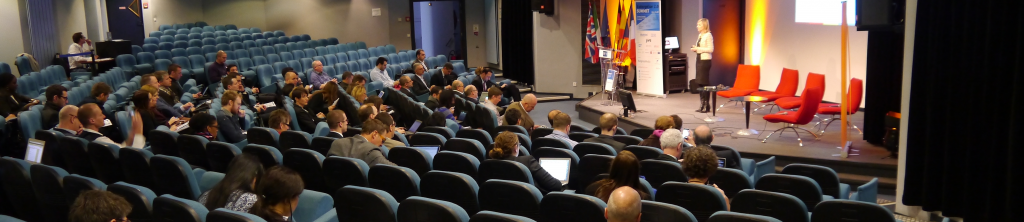
The Agile Elephant team attended Kongress Media‘s Enterprise 2.0 Summit in Paris on Tuesday & Wednesday this week – I was speaking on a panel on strategic engagement and running a workshop session on project management and governance.  Alan Patrick and Janet Parkinson will each be blogging their own thoughts, but this will be the first of two posts from me.  It will be an introduction to both the topic and the event, followed by my conference report as part 2.  We spent the two days at the World’s oldest business school, ESCP Europe in Paris, talking enterprise 2.0, social business and open business… OK, what’s that all about then, and why should you be interested?  Let me start by explaining a little of the background.

Where to start?  Back in May 2006, Andrew McAfee of the Harvard Business School started the wider use of the term Enterprise 2.0 as a kind of business oriented evolution of the web 2.0 term that was around at the time. He defined it as:

“Enterprise 2.0 is the use of emergent social software platforms within companies, or between companies and their partners or customers.”

At that stage, the emergent tools were blogs, wikis, forums, document sharing, RSS feeds, microblogging and activity streams.

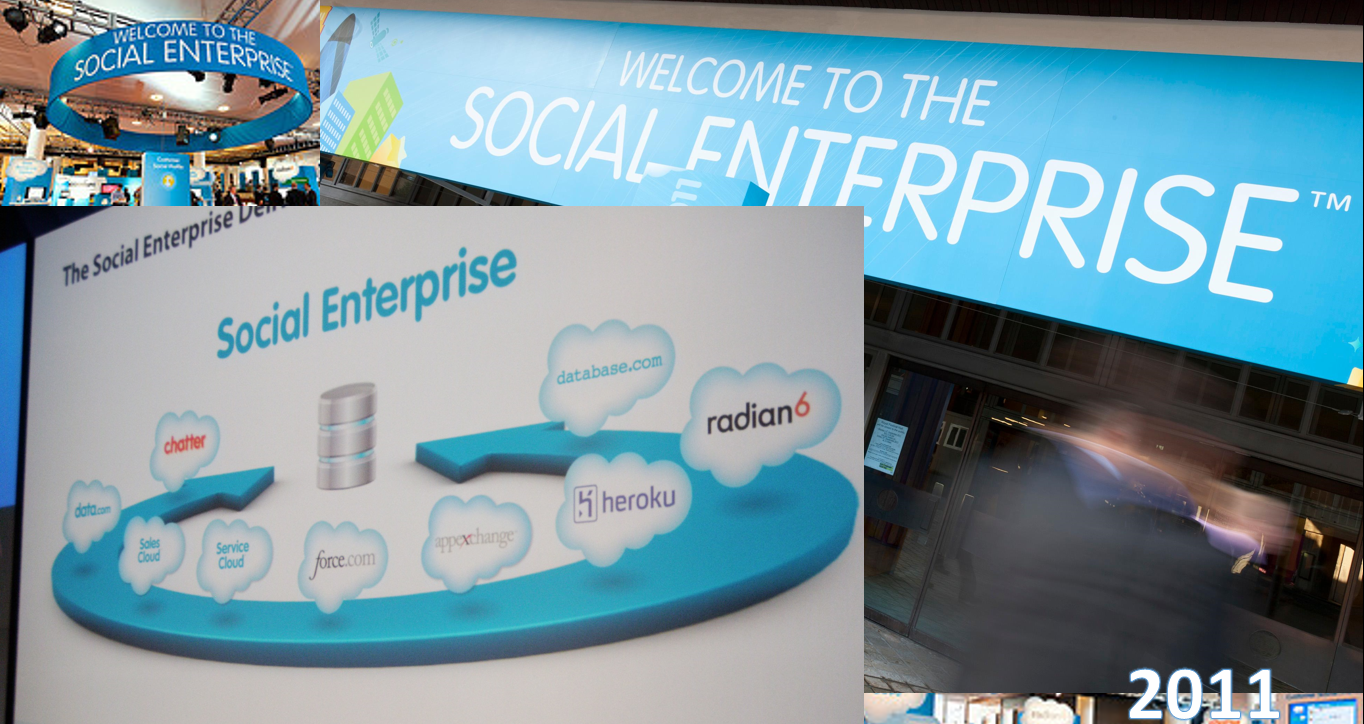
Salesforce London 2011So the term has been around for over 8 years, but during this current decade the concept has evolved, and people have started to use the terms social business and social enterprise instead.  This is problematic as the term social enterprise had already been coined by Professor Muhammad Yunus to mean a business with a social rather than financial purpose.  That didn’t stop Salesforce, in 2011, branding their major customer and partner events with “Welcome to the Social Enterprise” and even trying (and failing) to trademark the term.  Their definition of a Social Enterprise was one where social tools like Salesforce Chatter are used to connect and collaborate in new ways inside as well as outside of the organisation.  These social tools, and there are many of them, can provide a very different platform for teamwork compared to sending files by email, which is the default collaboration approach in most organisations, albeit occasionally modified by having some sort of shared drive or intranet as the file repository.  By 2012 Salesforce had dropped the term, but their shows declared “Business is Social”.

We’ve also used terms like knowledge management, corporate social networking, social collaboration, or social media in business. Social Business should not be confused with the term Social Media, although it uses social media channels. Social Media incorporates social networking, blogging, microblogging, forums, user generated content, crowd sourcing, RSS feeds and more. All of those communication channels might be used in a Social Business approach, but it will involve other social collaboration tools along with a major change of mindset and culture for the organisation. A culture of openness, sharing and collaboration that goes hand in hand with today’s digital disruption.  It’s the antithesis of the old, corporate, command and control hierarchy where knowledge was power, and you were motivated to hang on to information, a valuable currency to keep private for your own use.

Enterprise 2.0, Social Business – part of our current problem is that neither of those terms work well, but the actual concept they are trying to describe can add real value to the bottom line in any organisation.

The Summit had some great speakers – Dion Hinchcliffe from Dachis, Rachel Happe of the Community Roundtable, Dan Pontefract of Telus, John Mell of IBM, Emanuele Quintarelli from Ernst & Young, Bertrand Duperrin of NextModernity, Lee Bryant of Postshift, and Luis Saurez just starting his journey having left IBM only days ago.  It was a packed agenda covering:

  • Success factors for social workplace adoption
  • Key drivers for leveraging social value generation & business transformation
  • Best practices for enhancing business performance and employee engagement
  • Visions for future work & process organization

The event was sponsored by IBM (who have the Connections platform), SAP (with their Jam platform), Jive and a number of other players – Sitrion, Bluekiwi, Xwiki, NextModernity, Lecko.  There might be over 100 social business platforms on the market, some of them are very good, but the players you’ll come across more often with the larger customers or number of implementations are IBM, SAP, Jive and Yammer from Microsoft.

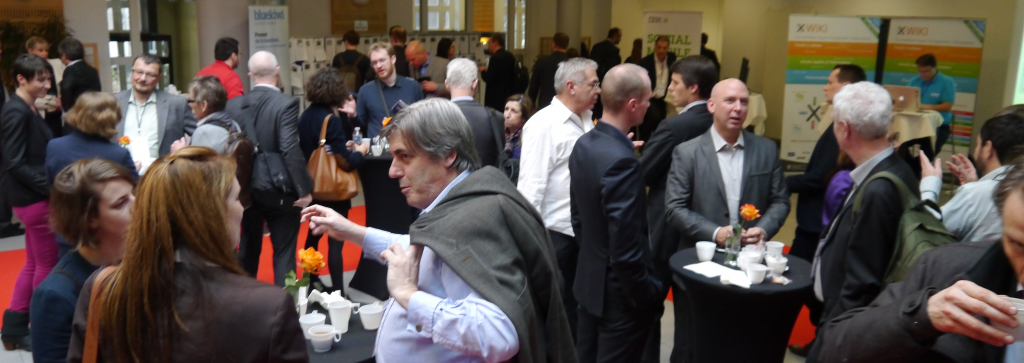
It was great meeting our friends across from USA and Canada, as well as meeting all of the key European social business practitioners in one place and learning from some great customer case studies.  Janet Parkinson, Alan Patrick and I were contributing to the tweet stream at #e20s and flying the Agile Elephant flag.  All of the tweets, tweeters, blogs and photos from the show so far have been collected together by Jim Worth (and the crowd) in this wiki.  Everyone will add links over the next week or so as we all catch up.  Bjoern Negelmann & Thomas Koch, the organisers, and their team did a great job of putting on a very valuable social business event.  Right at the end  Bjoern grabbed me to ask me my thoughts about the hackathon case study I had just presented on behalf of my team, along with my key takeaways from the conference:

My part 2 conference report is here.

Share this:

  • Tweet
  • Email

Filed Under: collaboration, digital disruption, enterprise 2.0, events, social business Tagged With: Andrew McAfee, Bluekiwi, digital disruption, ESCP Europe, IBM Connections, Jive, Microsoft, Paris, Professor Muhammad Yunus, Salesforce, SAP Jam, Sitrion, Xwiki, Yammer

Thesis 3 – There are no one size fits all solutions

February 7, 2014 By Alan Patrick

Thesis 3 – There are no one size fits all solutions

Why do we need a Manifesto?
We’ve been talking about applying social tools inside business since 2006 or before and we are no where near realising the potential for real social collaboration to make business more effective. We need a roadmap to set us on the right course, we need to think differently and to change culture. The Agile Elephant Manifesto encapsulates our blueprint for making Social Business work in thirteen theses. This post is the third in a sequence of 13 which explains each thesis in sequence.

Why Social Business?
We don’t mean the Professor Muhammad Yunus definition of a business which has a social rather than financial objective. We do mean a business adopting social tools and a different, more open and collaborative approach. We’ve been using terms like Web 2.0, Office 2.0, Collaboration, Knowledge Management, Enterprise 2.0, Social Enterprise or Social Business. Social Business is probably the best term currently, but the language is of minor importance compared to the real objective of changing business culture to add value.

3 of 13 – There are no one size fits all solutions – an appropriate technology approach is key.
All businesses are different and evolve at different rates – our approach to helping them innovate, change and transform needs to be adaptable, an evolution not a revolution.

Businesses are different – a marketing consultancy is completely different in its ways of working, culture and systems compared to a high volume retailer or a high tech machinery manufacturer.  The types of business problems they encounter and systems they use will differ,  so it is very unlikely that social business technologies will be a one size fits all solution. Even if they use the same software systems – Oracle, SAP, Microsoft etc etc – they tend to be implemented differently, and have different workflows and processes, and business cultures. This is important, as most businesses are not startups and do have legacy systems.  Unless the Social Business system is a specific point-of-use system, it needs to integrate with these other systems and processes in the business as they have a lot of the data and operational processing capability.  Also, businesses and their industries are often in different lifestages.  Some are expanding,  some are downsizing.  Some industries are cyclical,  some are very event driven. These factors also change strategy, systems, skills and culture.

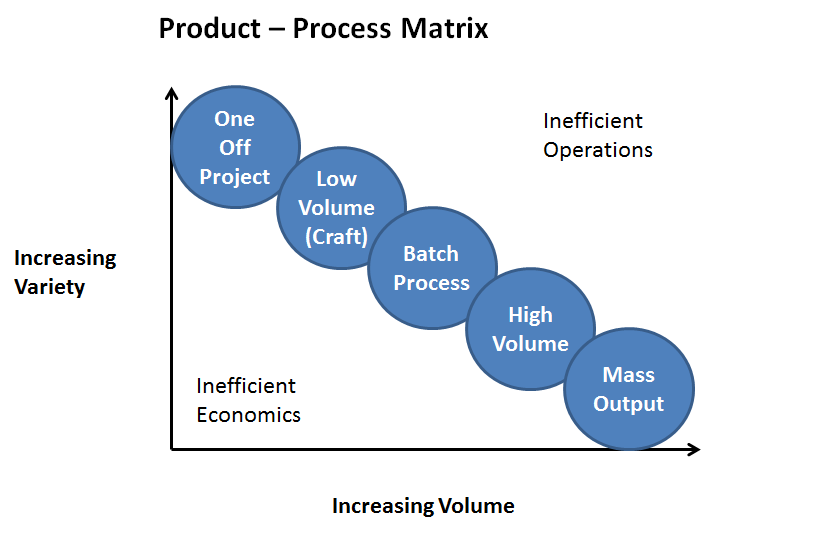
However, there are similarities between businesses, and lessons can be drawn from elsewhere.  Businesses, and parts of businesses, in different fields may actually work in similar ways depending on how they produce their services. The diagram at the top of the page shows the good old Product-Process matrix,  its still a good way of describing different types of business, or operations within a business. It ranges from project based operations, where everything is a one off bespoke product (top left), to dedicated continuous production (bottom right).  An architectural design practice is an example of the one-off project type of enterprise, a design bureau is an example of an in-company department that works this way.  In general, as product volumes increase, the processes become more and more standardised until at the opposite end the mass production operation exists, with everything dedicated to making one product only.  A cement plant is an example of such an enterprise, a bank’s backoffice cheque processing unit is an example of an in-company mass production operation.

[About the white space areas in the diagram above – in general, operations making low variety products (i.e. commodities) with  low volume processes (expensive to run) are economically inefficient – making bulk cement in an artisanal workshop for example – and don’t survive.  Similarly, trying to make high variety, one off products on mass production equipment is operationally very hard.  Try making artisanal bread in a huge industrial bakery for example.  In general these sorts of operations don’t survive without changing their approach.  While new technology – the social web as a market, home machining and 3D printing etc., may shift the limits at the margins here, by and large the concept remains true.]

An adaptable model is best for businesses starting to use social technologies.  Recognise that although each business is different, there are some generic rules that apply in certain sorts of business type.  Look for appropriate lessons and technologies from those sorts of businesses.  A project based organisation uses project management systems whether it’s in architecture, accounting or aerospace. The sort of culture (knowledge workers dealing with complex one off projects) are similar, and appropriate  social business systems will also probably have strong similarities. Similarly, a textile business working in cell workgroups making a variety of clothing has a similar set of processes to a telephone helpdesk operation structured in a number of small teams dealing with a variety of customer issues.  Businesses in one very cyclical industry (say semiconductors) have lessons that another cyclical industry (say retail) can learn from. It is likely that Social Business systems will also be similar in these cases.

Our approach is to look at the current systems, look at the social systems that will be overlaying them, and understand where they need to integrate to achieve the businesses’ goals. That also gives the strongest indications about where cultures and processes need to change dramatically, and where not.  At that point, and that point only, is it worth thinking about innovation and transformation, as you know then what your boundary conditions are and what the impact – good and bad – of any changes will be.

Revolutions are messy, Evolution is better.  Most “revolutionary” business moves are value negative.  Revolutions tend to spill a lot of blood, a lot of babies get thrown out with the bathwater, and it usually takes quite some time to get back on ones’ feet. Evolution is less drastic and more sustainable – a shifting of the organism to grow into new areas, adopt new habits,  move out of old areas.  Not dramatic nor the stuff that makes for hero CEO’s and front page headlines*, but much sounder strategically. This is true for social technology implementations as well.  We think social technology favours an organic, not a mechanistic approach to operating a business. Implement, let it grow and find its niches, prune and fertilise judiciously.

* It is possible though – Steve Jobs was a past master at stealing headlines, even though Apple has had the same overall strategy for decades (enter poorly served market areas early, capture top 25% of spenders) and all its moves are evolutionary – though sometimes it does use evolutionary “jumps”, but that is the subject of another post.

You can find the full Manifesto here, and contact us if you want to find out more.

Thesis Two

Back to the Manifesto

Share this:

  • Tweet
  • Email

Filed Under: agile business, corporate culture, digital disruption, manifesto, social business

« Previous Page
Next Page »

Sign up for our regular Agile Elephant Newsletter - news, posts, ideas and more.

My Tweets

From the Agile Elephant Blog

  • The Metaverse doesn’t exist yet, but…
  • Impossible Things get Disruptive
  • Clarity, Cloud, and Culture Change at IBM

What Next?
Take a look around our site, check out our approach, see how we can help, join the conversation on our blog or contact us to find out more.

About Us

Agile Elephant is a new kind of consultancy designed to help companies embrace the new digital culture of social collaboration, sharing and openness that is changing business models and the world of work.

Contact us to find out more!

Our founder's blogs:

broadstuff

@DT on Medium

Technotropolis

Our blog:

The Agile Elephant Blog

Site Log In | Site Log Out

Subscribe to Site RSS

Subscribe to our Blog via Email

Enter your email address to subscribe

Join 30 other subscribers

Copyright © 2026 ·Streamline Pro Theme · Genesis Framework by StudioPress · WordPress · Log in