Agile Elephant making sense of digital transformation

innovation | digital transformation | value creation | (r)evoloution

  • Email
  • Facebook
  • Google+
  • LinkedIn
  • Twitter
  • Home
  • Manifesto
  • Services
    • Our Approach
    • Our Services
    • Making Collaboration Work Packages
    • Collaboration Solutions
    • Our Experience
    • Workshops
    • Innovation
  • About Us
    • The Team
    • Why we do what we do
    • Why are we called Agile Elephant?
    • Our Partners
    • Our Clients
  • Get Involved
    • Events
    • Meetups
    • Unconference
    • Newsletter
  • Resources
    • What is Digital Transformation?
    • What is the Digital Enterprise Wave?
    • Our Research
    • Case Studies
    • People We Follow
    • Articles & Links
    • Books That Inspire
  • Blog
  • Contact Us
Home Archives for Microsoft
Lecko on collaboration and Microsoft on Teams at SMILE

November 16, 2016 By David Terrar

Lecko on collaboration and Microsoft on Teams at SMILE

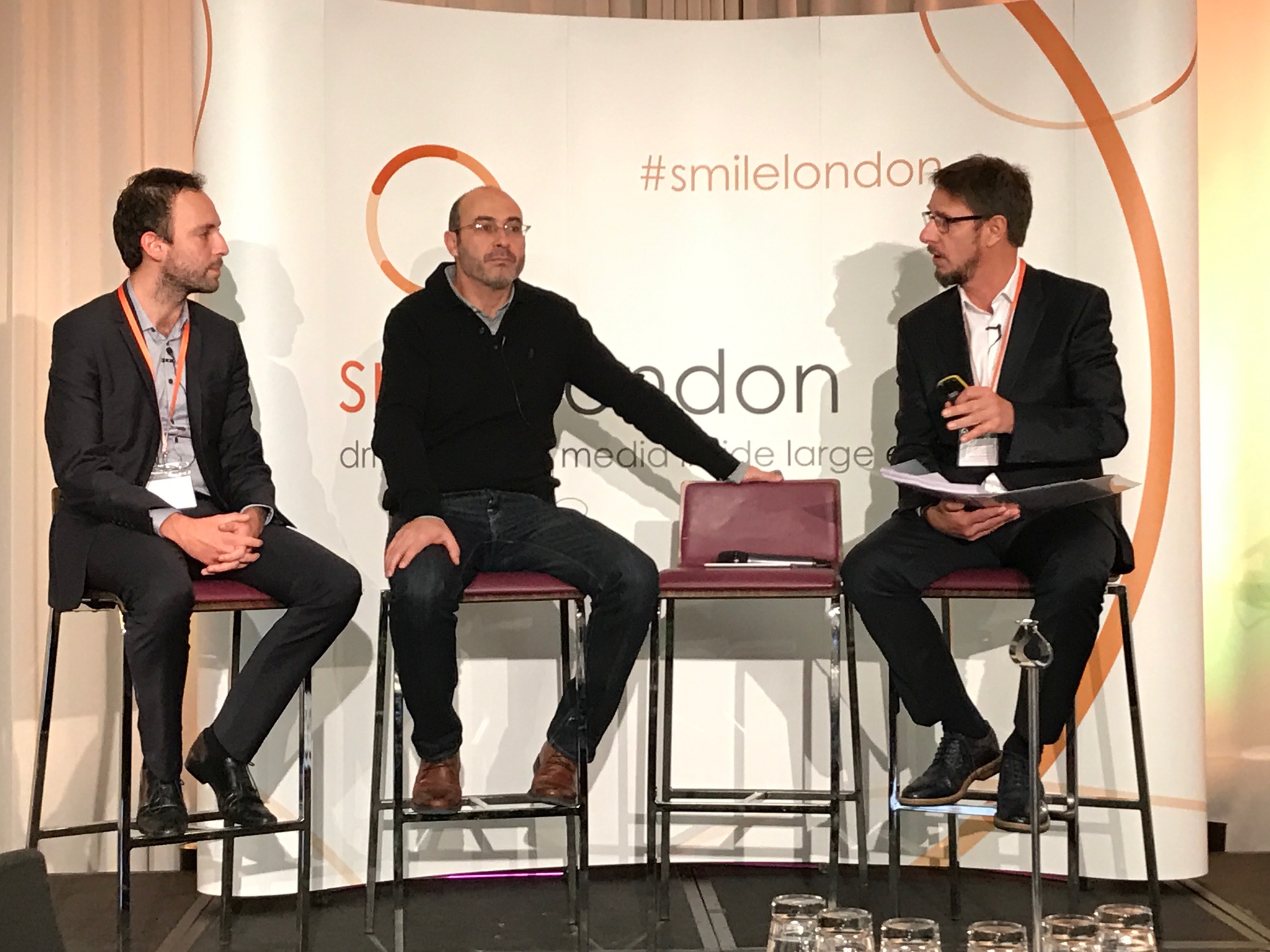
Marc Wright invited us to join in the simply communicate fun at Social Media In Large Enterprise London yesterday – follow #smilelondon to see the great tweet stream.  This is the first of a set of posts from the Agile Elephant team reporting on what was an inspiring and well organised day, packed with good stories and networking.  I’ll cover thoughts from our research partners Lecko combined with observations on Office365, Microsoft and Teams.
img_1197

Michel Ezran and Bastien Le Lann of Lecko were Marc’s first victims of the day.  Lecko have been reporting on the enterprise social network and collaboration space for 8 years.  We’ve been working with them for the last 2 years.  Amongst a lot of research reports and analysis they publish an annual report which analyses the market to show how companies are using enterprise social networks, social collaboration and productivity products, and then provides a detailed comparison of the platforms available – they survey 30 products against 550 criteria.  They cover every significant solution from Jive and IBM Connections to products like Office365 and Slack.  Yesterday they explained their 4 headline findings from the report:

  1. Collaboration and use of social software is steadily on the increase,  more than 15 % up in 2015 over 2014.
  2. Managers have a significant level of awareness of the benefits (and risks) of digital transformation, but they still lack practical knowledge
  3. Digital Leaders are engaged in a sustainable way – they represent a new asset for the more digitally savvy companies
  4. Use of social collaboration is happening and helping at the heart of the value chain.
screenshot-2016-11-16-09-43-46

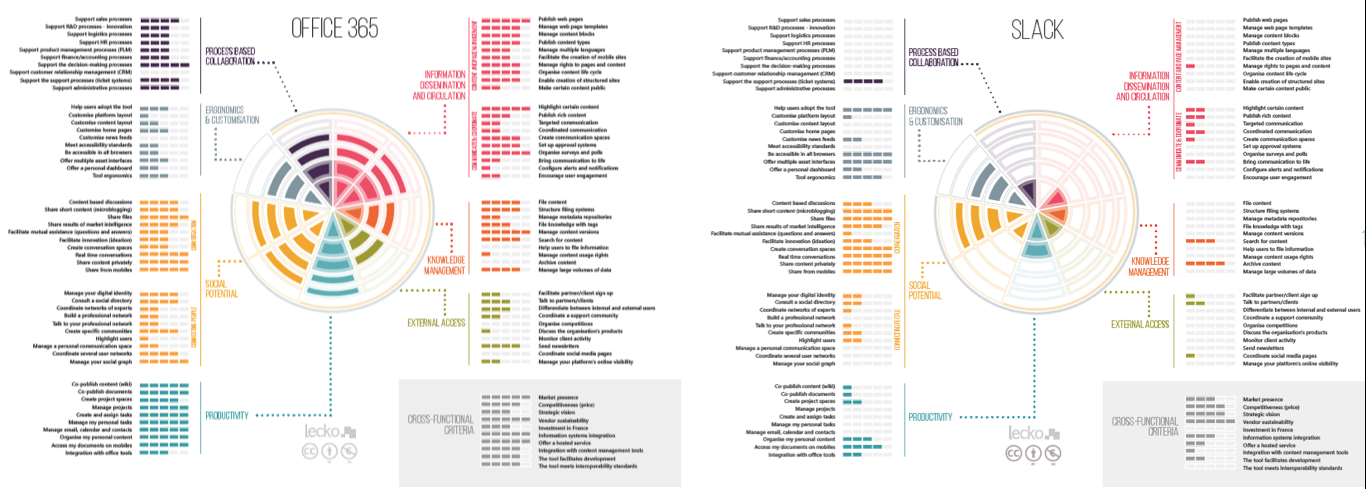
Take look at the detailed data sheets they produce in their product comparison.  (I’m not expecting you to read the detail above, just get a flavour of how they show a product’s strengths and weaknesses – download the report to get to the detail.) The charts for Office365 versus Slack quickly show you the scope and strengths of each.  They went on to present a separate report, also available for free download – their latest deep dive in to Office365 which was published at the end of last month, a few days before Microsoft announced Teams.  It provides a detailed review of Microsoft’s strategy and multiple, overlapping product set.  I particularly like their “London Underground” influenced map showing how the Office365 City fits together.  Their conclusion is that they see a very good product, but it hasn’t yet realised a true digital workplace and they don’t see integration or an app layer.  The report will be updated to reflect Teams, which is actually built on the Office Groups functionality which is at the centre of the map.
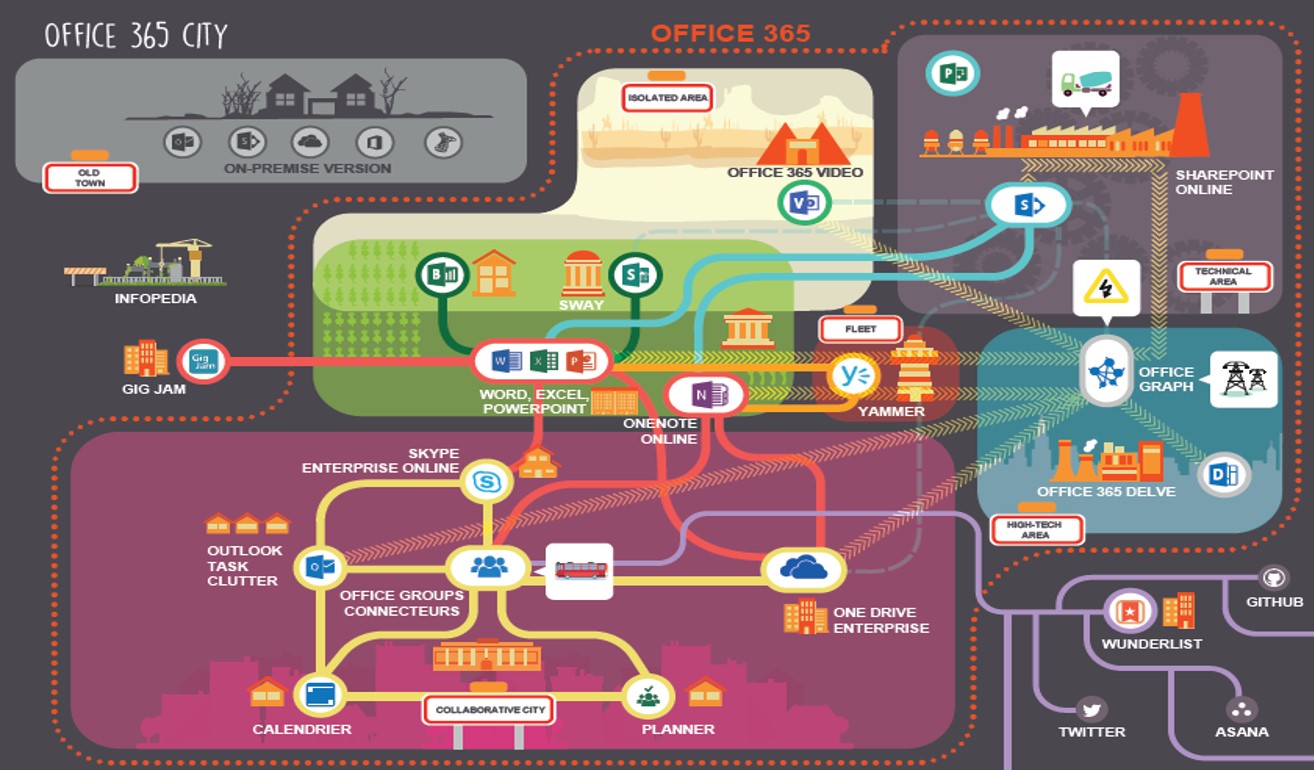
lecko-office-365-city

Later in the day Rich Ellis of Microsoft talked with Marc about the new Teams product and how it fits in to their strategy.  Rich was at Yammer before they were acquired, and was very clear in explaining that “Yammer is going nowhere!”.  There were a few chuckles around the room, but he went on to explain Yammer is a key part of their strategy and onward development, providing broad collaboration across work groups.  He commented that Satya (Nadella, the Microsoft CEO) jumps in to Yammer to connect and join in the conversations happening across the company.

Rich explained how Teams is powered by Office Groups and how the Office graph sits below mapping what is relevant to us, listening to what we are working on and seeing what we are doing  When you set up a Team it generates a team email address, chat space, with a team OneNote and team sharepoint.  He explained how you might start with a group which is private or closed, and how groups are searchable and you chose chose which ones to join.  The idea is to let users gravitate to the tools they want to use, and cater for all the options.  So Teams doesn’t replace Yammer.  It provides small team collaboration while Yammer allows broad collaboration across groups and will continue to be developed.

He talked about early customers like Accenture, who already have 750 TB of teams data on their OneDrive. He talked of the the compute capacity available to customers and how you can do real time language translation within Skype for Business.  He highlighted the openness of Microsoft’s approach commenting that they even have a connector in Teams for Google analytics. In answers to questions from the audience he alluded  to future developments in Yammer to allow external sharing beyond internal users, saying “stay tuned, it’s coming”.  He explained how Teams is a public cloud based app, but that there would be extensibility to connect to hosted and on premise solutions.  Inevitably he was also asked about Microsoft’s reaction to Workplace by Facebook.  With a wry smile he explained how they are excited by the breadth available in the marketplace.

He made a strong case for how Teams provides a big step towards the digital workplace and is a very significant addition the Office 365 product family positioned alongside Yammer.

We’ll publish more on SMILE London soon, and if you want to know more about distributing digital across the enterprise, join us at the Enterprise Digital Summit London next week on 24 November.  Follow the link here or below to find out more.

eds_blogteaser16

Share this:

  • Tweet
  • Email

Filed Under: collaboration, Enterprise Social Network, office software, social business Tagged With: digital transformation, Lecko, Microsoft, Microsoft Teams, Office365

Agile Elephant goes Enterprise 2.0 in Paris

February 14, 2014 By David Terrar

Agile Elephant goes Enterprise 2.0 in Paris

The Agile Elephant team attended Kongress Media‘s Enterprise 2.0 Summit in Paris on Tuesday & Wednesday this week – I was speaking on a panel on strategic engagement and running a workshop session on project management and governance.  Alan Patrick and Janet Parkinson will each be blogging their own thoughts, but this will be the first of two posts from me.  It will be an introduction to both the topic and the event, followed by my conference report as part 2.  We spent the two days at the World’s oldest business school, ESCP Europe in Paris, talking enterprise 2.0, social business and open business… OK, what’s that all about then, and why should you be interested?  Let me start by explaining a little of the background.

Where to start?  Back in May 2006, Andrew McAfee of the Harvard Business School started the wider use of the term Enterprise 2.0 as a kind of business oriented evolution of the web 2.0 term that was around at the time. He defined it as:

“Enterprise 2.0 is the use of emergent social software platforms within companies, or between companies and their partners or customers.”

At that stage, the emergent tools were blogs, wikis, forums, document sharing, RSS feeds, microblogging and activity streams.

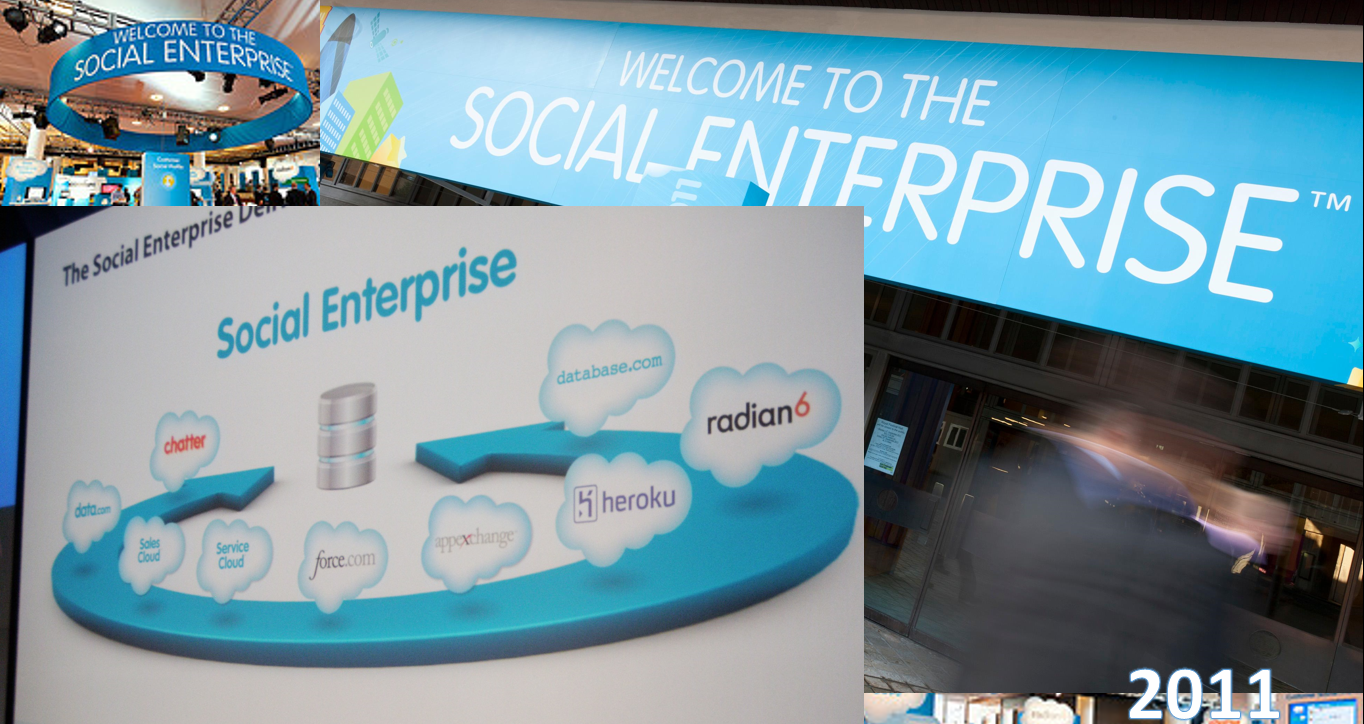
Salesforce London 2011So the term has been around for over 8 years, but during this current decade the concept has evolved, and people have started to use the terms social business and social enterprise instead.  This is problematic as the term social enterprise had already been coined by Professor Muhammad Yunus to mean a business with a social rather than financial purpose.  That didn’t stop Salesforce, in 2011, branding their major customer and partner events with “Welcome to the Social Enterprise” and even trying (and failing) to trademark the term.  Their definition of a Social Enterprise was one where social tools like Salesforce Chatter are used to connect and collaborate in new ways inside as well as outside of the organisation.  These social tools, and there are many of them, can provide a very different platform for teamwork compared to sending files by email, which is the default collaboration approach in most organisations, albeit occasionally modified by having some sort of shared drive or intranet as the file repository.  By 2012 Salesforce had dropped the term, but their shows declared “Business is Social”.

We’ve also used terms like knowledge management, corporate social networking, social collaboration, or social media in business. Social Business should not be confused with the term Social Media, although it uses social media channels. Social Media incorporates social networking, blogging, microblogging, forums, user generated content, crowd sourcing, RSS feeds and more. All of those communication channels might be used in a Social Business approach, but it will involve other social collaboration tools along with a major change of mindset and culture for the organisation. A culture of openness, sharing and collaboration that goes hand in hand with today’s digital disruption.  It’s the antithesis of the old, corporate, command and control hierarchy where knowledge was power, and you were motivated to hang on to information, a valuable currency to keep private for your own use.

Enterprise 2.0, Social Business – part of our current problem is that neither of those terms work well, but the actual concept they are trying to describe can add real value to the bottom line in any organisation.

The Summit had some great speakers – Dion Hinchcliffe from Dachis, Rachel Happe of the Community Roundtable, Dan Pontefract of Telus, John Mell of IBM, Emanuele Quintarelli from Ernst & Young, Bertrand Duperrin of NextModernity, Lee Bryant of Postshift, and Luis Saurez just starting his journey having left IBM only days ago.  It was a packed agenda covering:

  • Success factors for social workplace adoption
  • Key drivers for leveraging social value generation & business transformation
  • Best practices for enhancing business performance and employee engagement
  • Visions for future work & process organization

The event was sponsored by IBM (who have the Connections platform), SAP (with their Jam platform), Jive and a number of other players – Sitrion, Bluekiwi, Xwiki, NextModernity, Lecko.  There might be over 100 social business platforms on the market, some of them are very good, but the players you’ll come across more often with the larger customers or number of implementations are IBM, SAP, Jive and Yammer from Microsoft.

It was great meeting our friends across from USA and Canada, as well as meeting all of the key European social business practitioners in one place and learning from some great customer case studies.  Janet Parkinson, Alan Patrick and I were contributing to the tweet stream at #e20s and flying the Agile Elephant flag.  All of the tweets, tweeters, blogs and photos from the show so far have been collected together by Jim Worth (and the crowd) in this wiki.  Everyone will add links over the next week or so as we all catch up.  Bjoern Negelmann & Thomas Koch, the organisers, and their team did a great job of putting on a very valuable social business event.  Right at the end  Bjoern grabbed me to ask me my thoughts about the hackathon case study I had just presented on behalf of my team, along with my key takeaways from the conference:

My part 2 conference report is here.

Share this:

  • Tweet
  • Email

Filed Under: collaboration, digital disruption, enterprise 2.0, events, social business Tagged With: Andrew McAfee, Bluekiwi, digital disruption, ESCP Europe, IBM Connections, Jive, Microsoft, Paris, Professor Muhammad Yunus, Salesforce, SAP Jam, Sitrion, Xwiki, Yammer

Sign up for our regular Agile Elephant Newsletter - news, posts, ideas and more.

My Tweets

From the Agile Elephant Blog

  • The Metaverse doesn’t exist yet, but…
  • Impossible Things get Disruptive
  • Clarity, Cloud, and Culture Change at IBM

What Next?
Take a look around our site, check out our approach, see how we can help, join the conversation on our blog or contact us to find out more.

About Us

Agile Elephant is a new kind of consultancy designed to help companies embrace the new digital culture of social collaboration, sharing and openness that is changing business models and the world of work.

Contact us to find out more!

Our founder's blogs:

broadstuff

@DT on Medium

Technotropolis

Our blog:

The Agile Elephant Blog

Site Log In | Site Log Out

Subscribe to Site RSS

Subscribe to our Blog via Email

Enter your email address to subscribe

Join 30 other subscribers

Copyright © 2026 ·Streamline Pro Theme · Genesis Framework by StudioPress · WordPress · Log in