Agile Elephant making sense of digital transformation

innovation | digital transformation | value creation | (r)evoloution

  • Email
  • Facebook
  • Google+
  • LinkedIn
  • Twitter
  • Home
  • Manifesto
  • Services
    • Our Approach
    • Our Services
    • Making Collaboration Work Packages
    • Collaboration Solutions
    • Our Experience
    • Workshops
    • Innovation
  • About Us
    • The Team
    • Why we do what we do
    • Why are we called Agile Elephant?
    • Our Partners
    • Our Clients
  • Get Involved
    • Events
    • Meetups
    • Unconference
    • Newsletter
  • Resources
    • What is Digital Transformation?
    • What is the Digital Enterprise Wave?
    • Our Research
    • Case Studies
    • People We Follow
    • Articles & Links
    • Books That Inspire
  • Blog
  • Contact Us
Home Archives for manifesto
Agile Elephant at Enterprise 2.0 Summit Report

February 17, 2014 By David Terrar

Agile Elephant at Enterprise 2.0 Summit Report

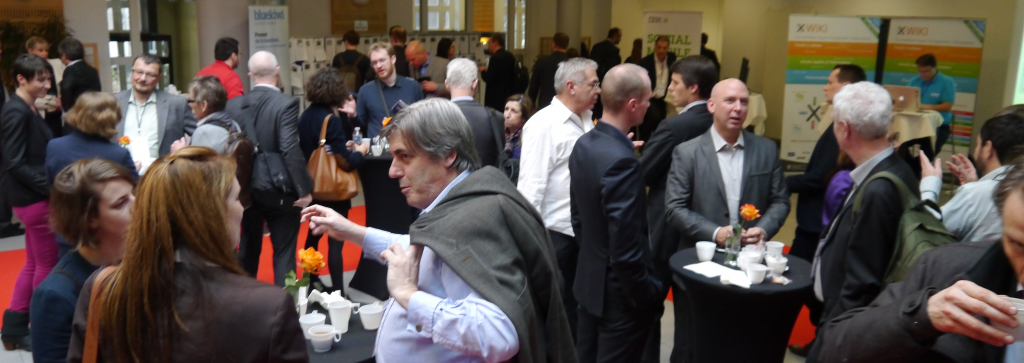
My first post introduced the Enterprise 2.0 Summit, the social business topic in general and speakers at the event at ESCP Europe.  This is my conference report.  I’ll start by setting the scene with my impressions, then pick out highlights, draw some conclusions and finally link to the other Agile Elephant posts about the Summit.

IMPRESSIONS

  • From where we were in 2006 at the Office 2.0 show or in 2007 at Open Knowledge’s first Enterprise 2.0 Forum in Varese, I could be depressed that we aren’t further forward with enterprise 2.0 and social business.  However, that’s more to do with the fact that we are in the middle of a change in business behavior that may take 10-30 years.
  • I’m incredibly optimistic about what is happening now. That’s why we just made a leap of faith and started Agile Elephant as a new social business consultancy a few weeks ago. The mood at the conference confirmed our feeling that this topic is poised to cross the chasm and go mainstream.
  • Enterprise 2.0/Social Business is a complex topic. The elephant in the enterprise room. There is a definite divide in thinking between two camps. Those of us at the summit who want to get top down executive commitment and a focus on hard business numbers and real ROI, versus those that focus on the culture change required to move to a more sharing, open business combined with the structural change required to move companies to more networked rather than hierarchical organisational structures. Both of these are important. Both of these require new or different leadership thinking.
  • Most of us attending the conference are somewhere at the leading edge of this topic. As a movement, we need to get organised to spread the word and break through to the average business person in the average company so they understand the benefits of social business.

CONFERENCE HIGHLIGHTS

Dan Pontefract of Telus opened the conference eloquently explaining his company’s journey in to social business.  Key things he said or described:

  • It’s not the tool it’s the behaviour
  • It’s about collaborative behaviour aided and abetted by social tools
  • A woman adding a 6 minute video to the community of her 10 coaching tips, it got 1000 hits and 62 comments, and she answered every one individually
  • He used a metaphor of Canada geese flying in a scheme, a V formation, rotating the leadership – our orgs need to be like that
  • There is potential energy in everyone, how do you convert that in to kinetic energy?

Jon Mell of IBM called out to me from the stage remembering Varese 2007 making the point we’ve been at this a long time.  Some key things he said

  • Think of the best manager and the worst manager you’ve had, and that their good/bad behaviours aren’t easily found on their CV
  • That means when you’re hiring someone, how they might fit your culture can’t be see on a CV
  • He explained how Caterpiller have seen that where employees are highly engaged, there are 3 times less accidents and that translates straight to the bottom line
  • He talked about AMC – they focus on popcorn sales as a key metric – what makes great popcorn sellers, and good managers of popcorn sellers, how do we hire and attract them, share the learning – getting it right translated in to a 1.2% increase in profit per customer

The best case study at the summit was Joachim Heinz explaining Social Business @ Bosch.  He explained how they have 300,000 associates, create more than 16 patents a day, have been taking Bosch to 2.0 and now have 60,000 people on boarded to their social platform.  80% of their communities are open – you have to apply for a private group.  It’s called Bosch Connect – you can “go there, make a wiki and you’re done in 30 minutes”.  They have created 13 different use cases and he explained they are:

  • Shifting core processes in to social
  • Using social to enable leadership
  • Providing senior managers with Enterprise 2.0 mentoring using digital natives, but they are discovering that ideas are going both ways, it’s not a monologue
  • And that the wake up call for Bosch management was the fact that Tesla could design a new car in 2 years, whereas BMW/Mercedes take 6 years – that’s digital disruption!

Emanuele Quinterelli of Ernst & Young, who I first met when he invited me to speak at that E2.0 Forum in Varese in 2007, set the scene for our panel discussion on Strategic Enablement.  He presented the results of their survey of 300 Italian firms where 54% of them have between 10% and 30% adoption of social business.  He presented the 6 key findings:

  1. Top down commitment – if top executives are on board, nobody in middle management can sabotage the shift to social business – a very tough but crucial message
  2. Strategy – a well structured roll out strategy is key, hybrid works, but top down is 2 times more successful in achieving adoption
  3. The people factor – laggards tended to have no-one in charge of collaboration, leadership of collaboration works
  4. Money where it matters – the leaders had budget balanced between strategy, tech and change management, and 50% more than others
  5. Measurement is important to steer and sell it – half of laggards have no measurement at all, 91% of leaders have measurement in place, top performers use business metrics 3 times more
  6. Social business is here already – leaders are engaging employees to engage customers, internally and externally – 23% of the top performers are planning end to end social business projects in the next 2 years

Martin Risgaard Rasmussen explained the Grundfos story, but also that he is in the process of leaving to join Yammer.  Grundfos has been around since 1945, has 18,000 people and is the World’s biggest pump manufacturer – take a look at your central heating system next time you open the airing cupboard.  They have deployed a program of culture change they call Global Working Culture run by HR.  They are moving to social business to get more out of the work they already do.  It’s all explained in a brilliant hard copy white paper called “Social Business Cooking at Grundfos”, there is more at socialbusinessjourney.com, and I’ll post a link to a PDF when I find one.  Some of the things Martin said:

  • Participation inequality, the 1-9-90 rule is real
  • You need at least 1 designated community manager otherwise it won’t work
  • He emphasised the importance of a clear purpose and finding use cases
  • He explained how they integrate social into their business process
  • They focus on culture
  • He talked Simon Sinek’s Start with why (and we love that!)
  • He explained how they looked at Chatter, Yammer, and Socialcast, but chose Yammer

Joachim Niemeyer of centrestage talked about leading the transformation required.  He talked about needing the active support of top management, the need for a clearly defined target audience, about capability, having a clear vision, defined business objectives and a well developed roadmap.  He highlighted the importance of use cases with high potential business value and a toolbox for systematic change.  He was another one who emphasised integration in to business process.

I missed Claire Flanagan of Jive talking about proven social business adoption strategies, but her slides have some great messages

I missed great presentations by Rachel Happe and Jane McConnell too.

On day 2, Lee Bryant of Postshift said a lot I could agree with, and some things I might argue with.  He doesn’t agree that social business should be about process.  He worries that some of us are adopting an approach that is all about a market for consulting services and software, that’s aligned to the way companies are used to buying.  He worries that the approach is not about new business models or new types of organisation.  He talked about killing the org chart with social tools.  Some of the things he said:

  • We’ve move beyond Taylorism – productivity has gone quantum
  • He talked about the effectiveness of small co-ordinated, agile teams
  • Knowledge sharing beats cascaded best practice
  • He worried that so many companies have too many generic managers – they don’t have skills, they’re just politicians
  • Communities and networks are the fabric of the organisation (right on!)
  • He quoted our friend Dave Gray‘s The Connected Company – popular working needs an underpinning service, as well as about fractal structured organisations
  • He went through a selection of companies that have adopted a completely different, often decentralised organisation and leadership approach – including Morning Star, Valve, Kyocera and one of my favourites WL Gore
  • He talked Holacracy, Sociocracy, and the Kotter dual operation system
  • He talked agile work group of 5-8, then Pod groups of 12, then group of pods totalling 140 (see Alan’s recent post on Dunbar numbers – there are more than one!)
  • He mentioned how you need an influencer, a keeper of stories – like Marc Benioff who is brilliant at that
  • He referenced the fantastic changes that the UK’s Cabinet Office have done reorganising government IT functions
  • He said he wasn’t arguing for flat structures or the end of leadership, but for for the end of managers
  • He also said it doesn’t matter what we call this topic with a slide full of socbiz and 2.0 hashtags (see thesis 9 of our Manifesto)

BernardMarie Chiquet of iGi Partners extended the discussion further in to Holacracy.  He suggested we have to go to the motherboard of the organisation structure (I like that!).  He talked about a move to “purpose driven” not “for profit or not for profit”.  He argued that order doesn’t require bosses.  He talked of needing a constitution for the organisation, like the king handing over power to a new form democracy enshrined in the constitution.  He talked about organising the work, not the people.  He wanted to break down the purpose in to functions and the functions in to roles – that being the basic brick, element where work needed to be done.  He suggested:

  • There are 3 dimensions – purpose, accountabilities, domains
  • You need a governance process – but that might be a 2 hours meeting every 2 weeks
  • It takes a village to raise an organisation with organisation, people and a purpose

At a about this point Jon Husband tweeted “The Holacracy tension a notion that comes from Robert Fritz’s concept of Structural tension, from OD world of the early to mid-90’s #e20s“.  Jon clearly thinks that holacracy is 90s OD and other thinking re-presented for this new century.  He joined the panel discussion, which was really entertaining.  They talked more about the org chart being roles and not people.  They talked about the time span of decision making and how far out you can look for strategic decision making.  We now we live in a World where a few tweets can put your business in deep trouble – difficult to be strategic with change happening in near real time.  Jon talked Transactional Analysis, the book “I’m OK, Your OK” and how the goal is to move from parent-child to adult-adult negotiations.  He believes the next stage of social business is a deep movement, that is a 20-30 year process, but he characterised the stage we are at in the journey by the pilot coming on the intercom and saying:

“Buckle up your seatbelts, there’s turbulence ahead!”

Back in the main hall, Celine Schillinger of Sanofi-Pasteur told the inspirational story of her journey in to social business and being a change agent.  She talked vision, openness, information and cultures.  She explained how things changed for her when she sent an email to her CEO back in 2011 around the issue of gender diversity.  That went viral, and triggered her creating a community on their internal social platform that has grown beyond 2,500 members in 50 countries, with concrete measures to achieve gender balance that changed her company.  She went on to explain how Sanofi are using the same type of community approach to fight Dengue Fever, but lifting it beyond a company initiative to a global fight against the enemy/disease.

Dion Hinchcliffe of Dachis Group closed the formal presentations with a final keynote.  He suggested we should let the network do the work.  He asked if we can apply social business frameworks in most industry sectors, across different geographies, and even differing corporate cultures?  Will they work, will they lower the risk, get faster results, get better results?  He talked about T-mobile cutting customer defections in half.  He talked of advocate programs becoming a major new element of organisation structure.  He wondered who should own the social business topic?  He explained that a framework is a pre-built approach with holes cut out for the details of your business.  He used Rachel Happe’s Community Model as an example.  He suggested that:

  • It’s easier to add social rather than change the fundamentals of the existing systems
  • Business models need to be updated
  • The move to Social Business is inevitable, and a good thing
  • We should take care as it is easy to be far too technology centric

CONCLUSIONS

So, it was a great conference full of good content, strong case studies and inspirational speakers (with only one low point).  My key takeaways from the Summit:

  • There is a shift happening.  We may be in the middle of a 20-30 year change but as a community we can feel the rate of change accelerating and Social Business is set to cross the chasm and go mainstream.
  • For Social Business projects to improve their chances of success we need top level executive commitment – a message that was repeated in many of the sessions.
  • The way to get that commitment is to talk hard business numbers and real return on investment, picking up on the case study stories from Bosch, Grundfos, Caterpiller, T-Mobile and others mentioned at the show.
  • The culture change required to move to a more sharing, open business model combined with the structural change required to move companies to more networked rather than hierarchical organisational structures is crucially important too.
  • The frameworks, techniques and behaviours around community building are still vital to this topic.
  • We’ve been talking social business around CRM for a while.  The talk has shifted to leadership and employee engagement, bringing social business firmly inside the organisation.
  • The enterprise 2.0/social business community needs to take the message to the wider business community.  We need to talk less jargon and more business benefits.  We need a clear message in an easily digestible format.  Social business works and produces real business benefits – let’s get on with it!

OTHER AGILE ELEPHANT POSTS

E2.0 Summit Case Studies – Day 1
Agile Elephant goes Enterprise 2.0 in Paris
Key factors for Strategic Enablement
Day 2 Case Study Summary at Enterprise 2.0 Summit
Employee Engagement : The New Heart of Enterprise 2.0?

And don’t forget Jim Worth’s great wiki resource which lists everyone who tweeted at the event, their tweets, the posts the photos and more.  See you next year?
Share this:

  • Tweet
  • Email

Filed Under: enterprise 2.0, events, leadership, manifesto, social business Tagged With: Bosch, centrestage, CRM, Dachis, Grundfos, Holacracy, PostShift, Sanofi-Pasteur, T-Mobile, Tesla

Thesis 3 – There are no one size fits all solutions

February 7, 2014 By Alan Patrick

Thesis 3 – There are no one size fits all solutions

Why do we need a Manifesto?
We’ve been talking about applying social tools inside business since 2006 or before and we are no where near realising the potential for real social collaboration to make business more effective. We need a roadmap to set us on the right course, we need to think differently and to change culture. The Agile Elephant Manifesto encapsulates our blueprint for making Social Business work in thirteen theses. This post is the third in a sequence of 13 which explains each thesis in sequence.

Why Social Business?
We don’t mean the Professor Muhammad Yunus definition of a business which has a social rather than financial objective. We do mean a business adopting social tools and a different, more open and collaborative approach. We’ve been using terms like Web 2.0, Office 2.0, Collaboration, Knowledge Management, Enterprise 2.0, Social Enterprise or Social Business. Social Business is probably the best term currently, but the language is of minor importance compared to the real objective of changing business culture to add value.

3 of 13 – There are no one size fits all solutions – an appropriate technology approach is key.
All businesses are different and evolve at different rates – our approach to helping them innovate, change and transform needs to be adaptable, an evolution not a revolution.

Businesses are different – a marketing consultancy is completely different in its ways of working, culture and systems compared to a high volume retailer or a high tech machinery manufacturer.  The types of business problems they encounter and systems they use will differ,  so it is very unlikely that social business technologies will be a one size fits all solution. Even if they use the same software systems – Oracle, SAP, Microsoft etc etc – they tend to be implemented differently, and have different workflows and processes, and business cultures. This is important, as most businesses are not startups and do have legacy systems.  Unless the Social Business system is a specific point-of-use system, it needs to integrate with these other systems and processes in the business as they have a lot of the data and operational processing capability.  Also, businesses and their industries are often in different lifestages.  Some are expanding,  some are downsizing.  Some industries are cyclical,  some are very event driven. These factors also change strategy, systems, skills and culture.

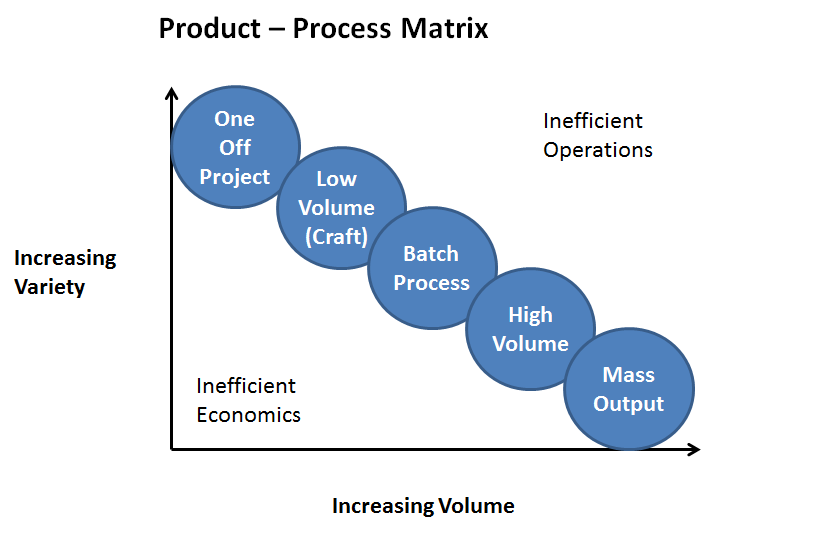
However, there are similarities between businesses, and lessons can be drawn from elsewhere.  Businesses, and parts of businesses, in different fields may actually work in similar ways depending on how they produce their services. The diagram at the top of the page shows the good old Product-Process matrix,  its still a good way of describing different types of business, or operations within a business. It ranges from project based operations, where everything is a one off bespoke product (top left), to dedicated continuous production (bottom right).  An architectural design practice is an example of the one-off project type of enterprise, a design bureau is an example of an in-company department that works this way.  In general, as product volumes increase, the processes become more and more standardised until at the opposite end the mass production operation exists, with everything dedicated to making one product only.  A cement plant is an example of such an enterprise, a bank’s backoffice cheque processing unit is an example of an in-company mass production operation.

[About the white space areas in the diagram above – in general, operations making low variety products (i.e. commodities) with  low volume processes (expensive to run) are economically inefficient – making bulk cement in an artisanal workshop for example – and don’t survive.  Similarly, trying to make high variety, one off products on mass production equipment is operationally very hard.  Try making artisanal bread in a huge industrial bakery for example.  In general these sorts of operations don’t survive without changing their approach.  While new technology – the social web as a market, home machining and 3D printing etc., may shift the limits at the margins here, by and large the concept remains true.]

An adaptable model is best for businesses starting to use social technologies.  Recognise that although each business is different, there are some generic rules that apply in certain sorts of business type.  Look for appropriate lessons and technologies from those sorts of businesses.  A project based organisation uses project management systems whether it’s in architecture, accounting or aerospace. The sort of culture (knowledge workers dealing with complex one off projects) are similar, and appropriate  social business systems will also probably have strong similarities. Similarly, a textile business working in cell workgroups making a variety of clothing has a similar set of processes to a telephone helpdesk operation structured in a number of small teams dealing with a variety of customer issues.  Businesses in one very cyclical industry (say semiconductors) have lessons that another cyclical industry (say retail) can learn from. It is likely that Social Business systems will also be similar in these cases.

Our approach is to look at the current systems, look at the social systems that will be overlaying them, and understand where they need to integrate to achieve the businesses’ goals. That also gives the strongest indications about where cultures and processes need to change dramatically, and where not.  At that point, and that point only, is it worth thinking about innovation and transformation, as you know then what your boundary conditions are and what the impact – good and bad – of any changes will be.

Revolutions are messy, Evolution is better.  Most “revolutionary” business moves are value negative.  Revolutions tend to spill a lot of blood, a lot of babies get thrown out with the bathwater, and it usually takes quite some time to get back on ones’ feet. Evolution is less drastic and more sustainable – a shifting of the organism to grow into new areas, adopt new habits,  move out of old areas.  Not dramatic nor the stuff that makes for hero CEO’s and front page headlines*, but much sounder strategically. This is true for social technology implementations as well.  We think social technology favours an organic, not a mechanistic approach to operating a business. Implement, let it grow and find its niches, prune and fertilise judiciously.

* It is possible though – Steve Jobs was a past master at stealing headlines, even though Apple has had the same overall strategy for decades (enter poorly served market areas early, capture top 25% of spenders) and all its moves are evolutionary – though sometimes it does use evolutionary “jumps”, but that is the subject of another post.

You can find the full Manifesto here, and contact us if you want to find out more.

Thesis Two

Back to the Manifesto

Share this:

  • Tweet
  • Email

Filed Under: agile business, corporate culture, digital disruption, manifesto, social business

Thesis 2 – Business has become a Social Object

February 3, 2014 By Janet Parkinson

Thesis 2 – Business has become a Social Object

Why do we need a Manifesto?
We’ve been talking about applying social tools inside business since 2006 or before and we are no where near realising the potential for real social collaboration to make business more effective. We need a roadmap to set us on the right course, we need to think differently and to change culture. The Agile Elephant Manifesto encapsulates our blueprint for making Social Business work in thirteen theses. This post is the second in a sequence of 13 which explains each thesis in sequence.

Why Social Business?
We don’t mean the Professor Muhammad Yunus definition of a business which has a social rather than financial objective. We do mean a business adopting social tools and a different, more open and collaborative approach. We’ve been using terms like Web 2.0, Office 2.0, Collaboration, Knowledge Management, Enterprise 2.0, Social Enterprise or Social Business. Social Business is probably the best term currently, but the language is of minor importance compared to the real objective of changing business culture to add value.

2 of 13 – Business has become a social object

It’s our belief that although business has always been social, it is now becoming a social object and we need to foster and facilitate those networks to add both tangible and intangible value.

Business as a Social Object:  Social networks are acting as platforms for individuals to coordinate all the activities businesses used to do. The collaborative economy is now making headlines. Companies like Airbnb and Uber which rely on trusted parties are completely bypassing traditional hierarchical capitalist business models. Airbnb has risen in 6 years from a concept (dreamt up by 2 people when they rented out their apartment floor for the night) to a social platform which will potentially become the world’s largest hotelier within the next year. We believe that many – even all – markets could become just nodes in this social mesh – business is becoming a social object.

World as a Social Market:  Social networks will allow any capacity to find any demand. Transaction costs will be minimised between buyers, sellers and information holders as the cost of bringing buyer and seller together falls to insignificant numbers. Ronald Coase predicted this in the 1930’s. The size of the firm in the case of a supplier to Airbnb is nothing more than your spare room and an internet connection.

Trust and transparency:  We foresee that trust and transparency will be maximized. Any business which tries to limit transparency and remain opaque or tries to create arbitrage where there is none will find it difficult to compete and maintain their strategic position.

Regulation:  The social mesh will become part of the infrastructure – just like the Internet itself has become part of the infrastructure. Over time, this mesh will be regulated – infrastructures always do. Regulation will be complex and we need to ensure that the regulations introduced have society’s best interests at heart.

You control your network:  The sheer scale of the mesh will be vast and we will need tools to navigate it. Some tools will come from the infrastructure but we imagine that some will come from yourself.  Think VRM , the concept of tools being created for individuals to manage and control their own data, allowing access only to those to whom they give permission.  We imagine that we could all own our own smart systems with data controlled by ourselves – like owning an electric appliance which you plug into the mesh. It could source the relevant data, barter the deal and present the options in order of importance, then automatically make all the necessary arrangements for you.  The opportunity for profiteering in these transactions would be minimal.

Utopian dream?:  May be. It would rely very much on total trust and could go very wrong in bad hands. Be prepared for the shadows.

“The Future is here, it’s just not evenly distributed” – William Gibson, 1993

You can find the full Manifesto here, and contact us if you want to find out more.

Thesis One

Thesis Three

Share this:

  • Tweet
  • Email

Filed Under: business innovation, collaboration, digital disruption, future, manifesto, social business

Thesis 1 – We want to transform “business as usual”

January 22, 2014 By David Terrar

Thesis 1 – We want to transform “business as usual”

Why do we need a Manifesto?
We’ve been talking about applying social tools inside business since 2006 or before and we are no where near realising the potential for real social collaboration to make business more effective. We need a roadmap to set us on the right course, we need to think differently and to change culture. The Agile Elephant Manifesto encapsulates our blueprint for making Social Business work in thirteen theses. This post is the first in a sequence of 13 which explains each thesis in sequence.

Why Social Business?
We don’t mean the Professor Muhammad Yunus definition of a business which has a social rather than financial objective. We do mean a business adopting social tools and a different, more open and collaborative approach. We’ve been using terms like Web 2.0, Office 2.0, Collaboration, Knowledge Management, Enterprise 2.0, Social Enterprise or Social Business. Social Business is probably the best term currently, but the language is of minor importance compared to the real objective of changing business culture to add value.

1 of 13 – We want to transform “business as usual”Business is changing faster than ever. Every organisation’s business model is under threat from new technology, new challengers and new, more agile ways of getting the job done. We now live in a landscape of digital disruption caused by three new technology paradigms – the simultaneous rise of Cloud, Social, and Mobile technologies have the potential to change the way we do things in every part of our lives.

It’s our belief businesses have no option – adapt and change or risk being leapfrogged by a more nimble competitor.

In this era of rapid technological evolution, managing services effectively has become crucial for businesses striving to stay competitive. Cloud, Social, and Mobile technologies are not just tools but drivers of transformation that necessitate a strategic approach to service management. Organizations must harness these technologies to streamline operations, enhance customer engagement, and drive innovation.
A key player in this landscape is DataTel, which provides cutting-edge solutions designed to integrate seamlessly with these emerging paradigms. By leveraging their expertise, businesses can optimize their service management processes, ensuring they remain agile and responsive in an ever-changing environment.

It’s our belief that enterprise social software and enterprise social networks have a key role to play in driving efficiency and adding value to the bottom line. These platforms include key functionality like profiles, activity streams, document sharing, blogs, and wikis but the best implementations do more than just providing a social media replacement for email, or an extra layer of communication over the top of the business. What is needed is a set of services that offer the integration of these internal capabilities to both structured and ad hoc business processes as well as to external customer-facing solutions. The key to success is connecting social to the heart of the business process.

Social software can operate as a distinct layer, but companies will increasingly look to social solutions as decision support and ad hoc work facilitators to support current workflow and enterprise application tasks. To enable the core features of enterprise social software to be surfaced inside enterprise workflow, open APIs need to be provided to enable information assets to become productized, syndicated, and distributed as callable IP assets via an API. These are the kinds of social collaboration solutions that our business experience and deep knowledge of social technologies and behaviours can help you deploy.

We want to move beyond business as usual. We want to put “social media” to work inside business as well as out.

You can find the full Manifesto here, and contact us if you want to find out more.

Back to the Manifesto

Thesis Two

Share this:

  • Tweet
  • Email

Filed Under: business innovation, digital disruption, manifesto, social business

Sign up for our regular Agile Elephant Newsletter - news, posts, ideas and more.

My Tweets

From the Agile Elephant Blog

  • The Metaverse doesn’t exist yet, but…
  • Impossible Things get Disruptive
  • Clarity, Cloud, and Culture Change at IBM

What Next?
Take a look around our site, check out our approach, see how we can help, join the conversation on our blog or contact us to find out more.

About Us

Agile Elephant is a new kind of consultancy designed to help companies embrace the new digital culture of social collaboration, sharing and openness that is changing business models and the world of work.

Contact us to find out more!

Our founder's blogs:

broadstuff

@DT on Medium

Technotropolis

Our blog:

The Agile Elephant Blog

Site Log In | Site Log Out

Subscribe to Site RSS

Subscribe to our Blog via Email

Enter your email address to subscribe

Join 30 other subscribers

Copyright © 2026 ·Streamline Pro Theme · Genesis Framework by StudioPress · WordPress · Log in