Agile Elephant making sense of digital transformation

innovation | digital transformation | value creation | (r)evoloution

  • Email
  • Facebook
  • Google+
  • LinkedIn
  • Twitter
  • Home
  • Manifesto
  • Services
    • Our Approach
    • Our Services
    • Making Collaboration Work Packages
    • Collaboration Solutions
    • Our Experience
    • Workshops
    • Innovation
  • About Us
    • The Team
    • Why we do what we do
    • Why are we called Agile Elephant?
    • Our Partners
    • Our Clients
  • Get Involved
    • Events
    • Meetups
    • Unconference
    • Newsletter
  • Resources
    • What is Digital Transformation?
    • What is the Digital Enterprise Wave?
    • Our Research
    • Case Studies
    • People We Follow
    • Articles & Links
    • Books That Inspire
  • Blog
  • Contact Us
Home Archives for digital disruption
Jon Ingham on the state of social business in the UK – #e20s interview series

October 15, 2014 By David Terrar

Jon Ingham on the state of social business in the UK – #e20s interview series

This is the next in a series of posts which present different views on the state of Social Business in the UK from a video interview series compiled by our friends at Kongress Media. Around our #e20s Meetup sessions Bjoern Negelmann asked well known consultants, practitioners and thought leaders in this space where we are with digital and social collaboration compared to the rest of Europe and elsewhere.

Here is Jon Ingham. Jon’s a well know human resources and human capital management expert who has been blogging around the topic since 2007, and before that authored Strategic Human Capital Management: Creating Value Through People. Our paths have been crossing regularly in the social media, social business and digital workplace space and so we were delighted to get his viewpoint.

Watch the video, but here are some highlights:

very positive, very dynamic

I feel, in one way, that we talk less about social business than we perhaps we were a few years ago

but there are more social businesses around – there are more organisations that know their sucesss depends on being social, doing collaboration, bringing their people together

HR is very much at the heart of creating that type of organisation

I still think the main driver tends to be technology, the move to digital, the move to mobile

I think that tends to be the wrong the idea – we were talking about 5 years ago that we could bring social technology in to the organisation and experiment, about using wikis and different things, and that would help me become more social – I think that’s largely been disapproved

the attempt to introduce social in to process, in the workflow – I don’t think that’s getting there either

I think what works is being a social business, introducing social in to the culture

but that’s not what it’s about, the driver is to improve the effectiveness of the organisation, the collaboration of the people, the connectedness of all of the people across departments, across functions – when the driver is that social business works more effectively

HR people who really do understand the power of the culture, how engagement can be shaped, how collaboration can be enhanced and doing terrific things in this area

but are also involved in organisation design, team design, organisation development, reward policies that ensure everybody is collaborating, in reshaping their performance management

a lot going on and I’m very proud of what we accomplish in HR

I would appoint HR as the head of that effort

I’m biased as I work mainly with HR… …a lot of HR people understand what social business is all about… … but (some of) their CEOs don’t get the plot

If you want to find out more and about what works, what doesn’t and what next then take a look at the Enterprise 2.0 Summit London on November 26.  More information here.

e20s_london_banner


More #e20s state of UK social business interviews in the series here.

Share this:

  • Tweet
  • Email

Filed Under: #EntDigi interview series, digital disruption, enterprise 2.0, social business

Jon Mell on the state of social business in the UK – #e20s interview series

October 14, 2014 By David Terrar

Jon Mell on the state of social business in the UK – #e20s interview series

This is the next in a series of posts which present different views on the state of Social Business in the UK from a video interview series compiled by our friends at Kongress Media.  Around our #e20s Meetup sessions Bjoern Negelmann asked well known consultants, practitioners and thought leaders in this space where we are with digital and social collaboration compared to the rest of Europe and elsewhere.

Here is Jon Mell.  Jon and I first met when we were both speaking at the International Forum on Enterprise 2.0 in Varese in Italy back in 2008.  He was in IBM, after that leading sales for Headshift, before going back to IBM to be their Social Business Leader UK and Ireland.  Back in February Jon was keynoting at the Paris edition of the Enterprise 2.0 Summit.  He’s a social collaboration expert who has been around in this space for a long time and brings a practical perspective to using social to drive business.

Watch the video, but here are some highlights:

I think it’s going pretty well

companies aren’t thinking of it necessarily in terms of social, they’re thinking in terms how do they improve their customer care process, how do they get products to market more quickly, how are they looking at recruiting and on-boarding new talent and they’re looking at social as a way to do that

they’re not looking at social as something in its own right

I don’t think they’re necessarily concious that they’re even thinking about social business

when an organisation looks at how do they attract the right talent, how do we break down silos and barriers in our organisation they’re thinking about solving those problems, they might use social to do it but they aren’t waking up in the morning and thinking “I want to collaborate using social business”

how can they get closer to their customers, how can the be more valuable in their marketplace and they’re looking at social as a way of doing that

we’re seeing a lot of interest from internal communications, we’re seeing a lot of interest from CHROs, but also lines of business, heads of sales, heads of R&D

how can I increase the innovation pipeline and get new products to market more quickly

seeing smaller companies get involved, using social as a way to punch above their weight


If you want to find out more and about what works, what doesn’t and what next then take a look at the Enterprise 2.0 Summit London on November 26.  More information here.

e20s_london_banner


More #e20s state of UK social business interviews in the series here.

Share this:

  • Tweet
  • Email

Filed Under: #EntDigi interview series, digital disruption, enterprise 2.0, social business

Lee Bryant on the state of social business in the UK – #e20s interview series

October 13, 2014 By David Terrar

Lee Bryant on the state of social business in the UK – #e20s interview series

This is the next in a series of posts which present different views on the state of Social Business in the UK from a video interview series compiled by our friends at Kongress Media.  Around our #e20s Meetup sessions Bjoern Negelmann asked well known consultants, practitioners and thought leaders in this space where we are with digital and social collaboration compared to the rest of Europe and elsewhere.

Here is Lee Bryant.  Lee was one of the pioneers of using social tools inside the enterprise in the UK, starting Headshift way back in 2002, well before people were talking social business consultancy or digital transformation.  Over the years we’ve supported each other’s events from London Wiki Wednesdays to SOMESSO (which used to be a conference) to the Dachis Business Summit. Headshift was acquired by Dachis Group in 2009, became Dachis Group London, but then Lee and Livio Hughes rebooted with Postshift, a foundry for new business structures, a consultancy and a place for learning in 2013.  Lee will be contributing and running a workshop session at the Enterprise 2.0 Summit London.

Watch the video, but here are some highlights:

in an interesting place

a lot of companies have gone through the phase of building a platform or putting a platform in place and beginning to see a little spike of collaboration and sharing

many of them have got to the point where they’re asking what that’s for and maybe in some cases lost a little bit of purpose and so they’re starting to ask questions about organizational transformation and what comes next, you know how do we make this more business relevant?

many of these projects began with CIOs or IT departments, but I think now they’re being owned more by the organisation so we are seeing more communications leads, more HR leads, more knowledge leads

and also executives, which is the really important thing, are starting to take over these projects and to try and define their purpose for the future

interesting times!

gone past the initial excitement, just beginning the next phase which is about what is the impact on the organisation, how does this really improve the business, and how does this change the way we’re organised and structure?

people are tempted to link them to business objectives

but we are zooming out now to look at the wider impact on the organisation and that’s what makes it really interesting… …in terms of business purpose

OD and HR are starting to understand they have some some skills and some experience that could really help push this forward, but I think it’s still in the realm of enlightened executives

where we are seeing real change, it’s enlightened leaders who are leading that

digital transformation is probably the overall goal

you need a base of a more socially connected organisation on the inside


If you want to find out more and about what works, what doesn’t and what next then take a look at the Enterprise 2.0 Summit London on November 26.  Lee will be on an expert panel and running a workshop session called “Building the next generation organizational chart”.   More information here.

e20s_london_banner


More #e20s state of UK social business interviews in the series here.

Share this:

  • Tweet
  • Email

Filed Under: #EntDigi interview series, digital disruption, enterprise 2.0, social business

Benjamin Ellis on the state of social business in the UK – #e20s interview series

October 12, 2014 By David Terrar

Benjamin Ellis on the state of social business in the UK – #e20s interview series

This is the next in a series of posts which present different views on the state of Social Business in the UK from a video interview series compiled by our friends at Kongress Media. At our #e20s Meetup sessions Bjoern Negelmann asked well known consultants, practitioners and thought leaders in this space where we are with digital and social collaboration compared to the rest of Europe and elsewhere.

Here is Benjamin Ellis. We’ve known Benjamin from the London start-up, social media and social business scene (OpenCoffee, Tuttle Club, etc.) for around 10 years.  Benjamin, like us, is on Microsoft’s list of leading social business influencers for the UK, and runs two businesses – Redcatco which develops, builds and delivers social technology solutions for business, and SocialOptic which provides provide SaaS and Cloud-based applications and in particular Milestone Planner, a combined cloud/social/mobile approach to planning which gives you a new way to agree, track, and manage who does what, by when on a project.

Watch the video, but here are some highlights:

at a particularly interesting time right because the early adopters of social media technology are quite mature and starting to think about what’s the next step for them

at the same the bigger majority of businesses are now just getting kick started with their projects so you’ve got this dynamic of one set of people looking at what is the second generation of what they do with these tools, and whole other set of business saying we’re just starting off, what can we learn from what those other businesses have done?

first group were more entrepreneurial, tended to experiment, try social t0ols in certain areas of the business before rolling it out across the whole organisation, and so experiment and pivot and learn

some of them have been through multiple tools already

people starting with their first adoption are much more structured, and they’re really looking to deploy across the whole of the organisation, and they tend to have settled on one tool… …so quite different approaches

more of an uphill push to get people using the tools and incorporating them in their business process

interesting thing about organisation change is that it is a phenomenally slow process and you have to be realistic about that

talking to the CEOs they talk about 5 years, 7 years sometimes even 10 years

we can deploy a Software as a Service tool within minutes or weeks but the change in business culture, you’ve really got to allow time for that

the interesting thing for me is that you can use social tools to change the culture, so a combination of change of culture and using the tools to accelerate that change

If you want to find out more and about what works, what doesn’t and what next then take a look at the Enterprise 2.0 Summit London on November 26.  Benjamin will be one of our panel speakers.   More information here.

e20s_london_banner


More #e20s state of UK social business interviews in the series here.

Share this:

  • Tweet
  • Email

Filed Under: #EntDigi interview series, digital disruption, enterprise 2.0, social business

Luis Suarez on the state of social business in the UK – #e20s interview series

October 9, 2014 By David Terrar

Luis Suarez on the state of social business in the UK – #e20s interview series

This is the first in a series of posts which present different views on the state of Social Business in the UK from a video interview series compiled by our friends at Kongress Media.  At our #e20s Meetup sessions Bjoern Negelmann asked well known consultants, practitioners and thought leaders in this space where we are with digital and social collaboration compared to the rest of Europe and elsewhere.

Here is Luis Suarez, well known for being the IBM champion of social collaboration and knowledge sharing, who lives “outside of the inbox“! Luis made the break from IBM just a few months ago and is working as an independent consultant and change agent.

Watch the video, but here are some highlights:

I’m taking for granted that digital transformation is happening across the board

Technology is driving innovation. It’s happening, but it’s not why, but how we do it in way that matters for my business!

We’re spending a disprotionate amount of time talking, not enough time doing.

The UK market is realising their clients ar not restricted geagraphically – we can get to Europe, the USA and emerging markets… …the UK has more a leading role to play

It’s happening all over, even the traditional world of government is back in the game digitising the conversation.

Not questioning why, but doing, diving in and learning

If government is doing it, what’s your excuse?

The rest of the countries in Europe may be saying we’re not ready

We might not be ready to kill the hierarchy but we need to challenge the status quo

10 years ago no-one was questioning the hierarchy. Can we flatten (our organisations) and change?

It’s’ going to a gradual transition to a more flat world, but both will exist for a long time.

If you want to find out more and about what works, what doesn’t and what next then take a look at the Enterprise 2.0 Summit London on November 26. More information here.
e20s_london_banner


More #e20s state of UK social business interviews in the series here.
Share this:

  • Tweet
  • Email

Filed Under: #EntDigi interview series, digital disruption, enterprise 2.0, social business

Dealing with Digital Disruption

October 8, 2014 By David Terrar

Dealing with Digital Disruption

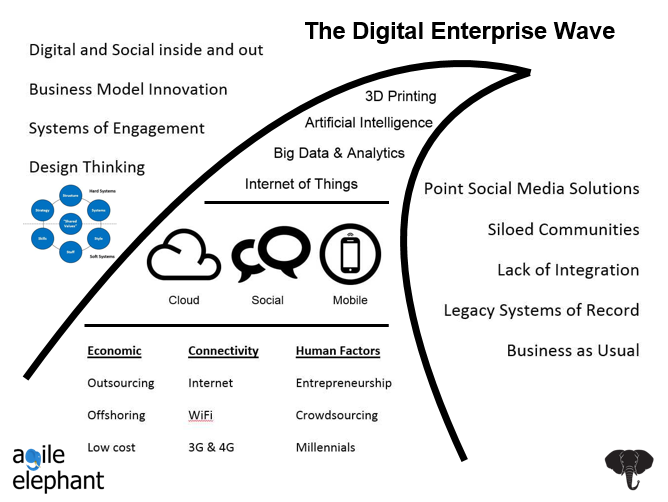
Riding the Digital Enterprise Wave

Your business model is under threat from what we call the Digital Enterprise Wave. Are you going to ride it or go under?

The digital enterprise wave from David Terrar

Take a look at these slides and let me explain how the business landscape is changing. It’s driven by significant changes in infrastructure and things that we already know about. There are Global economic pressures where access to low wage costs in Asia, Eastern Europe, or South America are facilitating outsourcing and offshoring, all supported by the connectivity provided by the Internet, extended by the huge rise in Wi-Fi access, 3G and 4G so that we now live in an “always on” World. Those things have dramatically lowered the costs and barrier to entry for any business start-up idea. It’s fostering an explosion in entrepreneurship. It’s enabling crowd-sourcing of expertise from Wikipedia to Waze. It’s giving us a new generation of Millennials who have grown up digital so that they think differently, communicate and multi-task in ways that are changing the expectations of the (digital) workplace forever. These are the factors that underpin the ideas in Thomas L. Friedman’s The World is Flat, or that facilitate the access to niche markets behind Chris Anderson’s The Long Tail, or give us Clay Shirky’s Here Comes Everybody. These factors form the foundation of the wave.

Next we have the Big Shift. For the last 50 years Moore’s Law has driven change and innovation in technology. Every 5-10 years we’ve had a major technology disruption that has changed the way we do business, created new companies, and seen the demise of others. We moved from the mainframe to the minicomputer, and then to the advent of the IBM PC back in 1981. We’ve networked computers and created the era of client/server applications and then seen the start of the Internet, web 1.0 and the Dot-com boom and bust. Then things started to get interactive with Web 2.0. However, we’ve never had more than one technology disruption happening at once, until now. Now we have three major technology disruptions happening simultaneously, and that’s never happened before. The shift to the Cloud and web apps is happening at the same time as the shift to social media where all markets are conversations, and that’s happening at the same time as the shift to mobile – smart-phones and tablets mean that most of us are carrying around the Internet in our hands. That Big Shift is the next layer of the wave.

Then on top of that there are emerging technologies like the Internet of Things, Big Data & Analytics, Artificial Intelligence and 3D Printing. Each one of these has the potential for an even more profound effect on the World economy, the global supply chain and the way business works. Today’s marketplace has more demanding customers, faster changing technology and more competition than ever before, and the rate of change is getting faster. These emerging technologies form the top of the wave. Whatever business you are in your business model is under threat by a smarter, nimbler competitor who will be using technology to skip past you in to a new field of play.

The problem is that most companies are too focused on the day to day. They think business as usual. They have legacy business systems, with tired old style user interfaces – systems of record that keep score for the business. There is often a lack of integration. Where social media initiatives or communities have been started, using the new web tools, they slide over the top of existing systems rather than connect properly. They’re alternatives to email for communication instead of changing the game. They are point solutions or provide siloed information, when you need to think in a holistic way about the business. Business as usual will get swamped by the wave.

To ride the wave we need think differently. We need to think “digitally”. We need design thinking and business model innovation. We need to create systems of engagement which connect and engage with our customers and partners. We need to think in terms of using digital and social tools outside, but more importantly inside our businesses to create the connected digital workplace and a new way of working. Digital thinking will help you ride the wave, but it has to be applied to the whole business. We use the McKinsey 7 “S” framework to look at every aspect of the business – it doesn’t matter so much which framework and approach you use, as long as you think beyond just “putting lipstick on a pig” with a dash of digital and social sitting on top of your “business as usual”.

We’re now moving to an “Everything as a Service” World where companies like AirBnB are changing the hotel industry, Uber is changing the taxi business and Apple is about to change the card payment industry. As I said before, I don’t care who you are and what business you are in, your business model is under threat and you need to be using tools like the Business Model Canvas and the Value Proposition Canvas to rethink and refocus what it is that you do.

We are talking Digital Transformation – what is that?

You will have noticed that companies that have been talking social media in business, or enterprise 2.0 or social business have just started to talk digital instead. Social collaboration tools and platforms are an important component that you might use in your evolution or transformation to doing better business. By using the term digital we are highlighting that you need to think further than just adding social and mobile technologies on top of your legacy systems. You have to harness your existing technology, those systems of record, and make them work better. You have to think of using technology to help you go to market faster with new offerings and to reach your customers in new ways. You have to re-evaluate your business and your value proposition and stop thinking business as usual. You have to start thinking “digitally” for your business and an entire new generation of technologies as well as looking at the culture of the way your company communicates and interacts. You don’t have to change your company structure, but you do have to recognise that we now live in a networked World where every person in your organisation can be involved and engaged in the same way that they connect with brands in their personal lives. Smart companies can evolve a digital strategy. Business as usual will get left behind. If you are behind the curve like a Kodak or Blockbuster or even a Phones 4U, you have to think in terms of a more significant digital transformation. But going digital to survive is a given.

Sounds quite interesting, but why bother?

If this still sounds nice to have as an add-on rather than vital, the most important thing is that it works! Take a look at these survey results from Capgemini Consulting and MIT Sloan Management from their report “How digital leaders outperform their peers in every industry“. They split the surveyed organisations in to 4 categories, with the most digitally savvy being called the “Digirati”. Companies in that most advanced category generate 9% more revenue, create 26% more profit and have 12% higher market valuation than the rest. Going Digital makes a direct contribution to the bottom line.

This post was first published on diginomica.com as Riding the Digital Enterprise Wave

Share this:

  • Tweet
  • Email

Filed Under: agile business, business innovation, digital disruption, enterprise 2.0, future, high performance, organisational culture, social business, strategy

Salary Transparency: The Cultural Dilemma

March 4, 2014 By Janet Parkinson

Salary Transparency: The Cultural Dilemma

Buffer , a social-sharing app and site, recently announced that as part of its strategy towards workplace transparency it has decided to open up every single employee’s salary on its website:

“Its salaries formula, used to calculate what each worker will earn as they join the company, has become more nuanced and is being emulated by startups such as Groove and CustomerIO, says Gascoigne. Buffer also plans an “open equity” program where everyone knows how shares are divided…  It takes a certain kind of person to work at Buffer, Gascoigne says, listing traits such as empathy and gratitude – in addition to being very good at the core job skills…  “The percent of people who were a good culture fit was a lot higher after all the media coverage of sharing the salary of every person on the payroll,” he said. And of workers turned off by it, he says, “it scares the right people away.”  Qz.com

The question is whether the move towards workplace transparency should include transparency of salaries and what the implications could be.  Will this eventually become normal across businesses around the globe or is it just a fad?  One year ago I wrote about this question and doing an update today has highlighted some interesting developments in a country which has had some level of salary transparency since 1863 – Norway.

Cultures and  Transparency

A country’s culture usually dictates what is considered acceptable in its society and what is not.  Certainly the UK culture regarding salaries has always been – until now at least – a pretty taboo subject – even amongst the best of friends.

Last February I compared the UK’s attitude towards this with Norway where at the time anyone could go to the Norwegian mainstream newspaper Aftenposten’s website and with one click check out the norwegian tax list which shows a large proportion of the country’s tax payers’ details including their annual income, tax paid, value of investments and date of birth. For those in the UK this would seem a gross intrusion into private lives but for norwegians they have never really had much choice – tax and income records have been publicly available since 1863.  This transparency dates back to the deeply rooted Norwegian culture which prescribes egalitarianism, collectivism and conformity as values to be protected and practiced by its citizens – Janteloven (Jante Law).

Until 2001 the norwegian tax and revenue list was openly available but only via the tax office in paper format, therefore it was an effort to go and search through it.  But in 2008 the government made the list available to the media enabling newspapers such as Aftenposten to give instant online access to all via a searchable database on their websites. As Channel 4 noted in 2012:

“Jan Omdahl, from the tabloid Dagbladet, wrote at the time: “Isn’t this how a social democracy ought to work, with openness, transparency and social equality as ideals?” However a poll carried out in 2007 found most of his countrymen disagreed: just 32% thought the list should be published, while 46% were opposed…  What some see as an honest commitment to fairness is for others, an invasion of personal privacy, and a licence for what the Norwegian tabloid Dagbladet described as “tax porno”…”

As if this wasn’t bad enough it was Dagbladet who in 2009 even offered their readers the chance to automatically check and compare the income of their Facebook friends and to offer the service as an iPhone application – leaving Trine Skei Grane of the green party Venstre to comment how:

“We took part in opening up the system, but now the principle of openness is totally out of proportion”  BBC, 2009 

So even in a country where salary transparency was generally accepted people do have their limits.  The ease of availability and what can now be done with personal data proved to be a step too far. When I wrote my post last year the media still gave direct online access to tax and salary details – but following much controversy the Norwegian government has now stopped access of online information via the media – you now have to enter the Tax Administrator’s website to find out the information instead:

 “Today, the tax assessment for 2012 laid out, and we can probably immediately seek to arrive at what neighbors, friends and colleagues in income and wealth and what they paid in taxes. Certainly, the search has become more complicated since one must now enter the Tax Administration’s website and log in with MinID to access the information. But despite the fact that one can no longer use the readily available search engines on the newspapers’ websites, the search activity still great. The IRS reported, for example, that in 2011 was over 700,000 users conducted 13 million searches on the tax rolls for 2010…  Knowing that your neighbor can see what you earn, prevents any cheating. If there is a large gap between income and living standards observed that consumption of cars, boats and cabins, a risk being suspected of evading income from taxation. Such suspicion means lost reputation in the family and community, and some also possible to call phoning the Norwegian authorities.’  Aftenposten, October 2013, translated by Google Translate

The Norwegian government holds the view that the ability for everyone to check out their neighbour’s details easily through the internet must be a positive thing as it leads to less tax cheating and reduces the shadow economy…

Interestingly Valve who are adopting the ‘radical transparency’ approach recently introduced the holacracy model by eliminating the typical corporate hierarchy and have a stack ranking system where staff working on the same project rank each others’ technical skills, productivity and other contributions which helps determine who gets paid what – so salaries are, to a certain extent, open.  Professor Oswick of Cass Business School warns that it could go awry were the firm to face a financial setback:

“Peer-pressure is a fantastic way of organising a business,” he says. “And so long as everyone is well paid people don’t mind being in the bottom earning quartile.  But as soon as resources become more scarce, then competition increases, which creates conflicts, which creates tensions, which creates hierarchies, which creates concern about relative positioning.”

And bear in mind that this scenario could occur when employee salaries are known by only those within the company let alone being displayed openly to the public.

So perhaps ask yourself again – it may seem quite cool to some, but is having your salary details made available on your employer’s website really what you want?


Share this:

  • Tweet
  • Email

Filed Under: business innovation, corporate culture, digital disruption, social business, transparency

Agile Elephant goes Enterprise 2.0 in Paris

February 14, 2014 By David Terrar

Agile Elephant goes Enterprise 2.0 in Paris

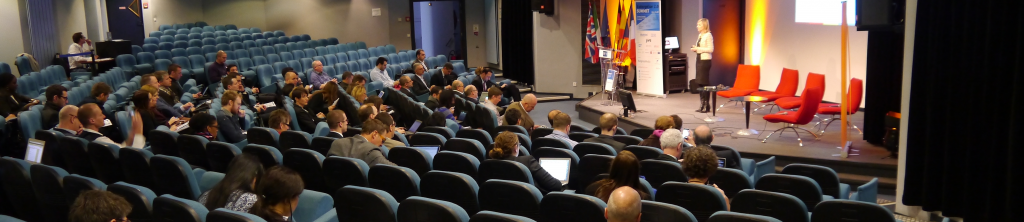
The Agile Elephant team attended Kongress Media‘s Enterprise 2.0 Summit in Paris on Tuesday & Wednesday this week – I was speaking on a panel on strategic engagement and running a workshop session on project management and governance.  Alan Patrick and Janet Parkinson will each be blogging their own thoughts, but this will be the first of two posts from me.  It will be an introduction to both the topic and the event, followed by my conference report as part 2.  We spent the two days at the World’s oldest business school, ESCP Europe in Paris, talking enterprise 2.0, social business and open business… OK, what’s that all about then, and why should you be interested?  Let me start by explaining a little of the background.

Where to start?  Back in May 2006, Andrew McAfee of the Harvard Business School started the wider use of the term Enterprise 2.0 as a kind of business oriented evolution of the web 2.0 term that was around at the time. He defined it as:

“Enterprise 2.0 is the use of emergent social software platforms within companies, or between companies and their partners or customers.”

At that stage, the emergent tools were blogs, wikis, forums, document sharing, RSS feeds, microblogging and activity streams.

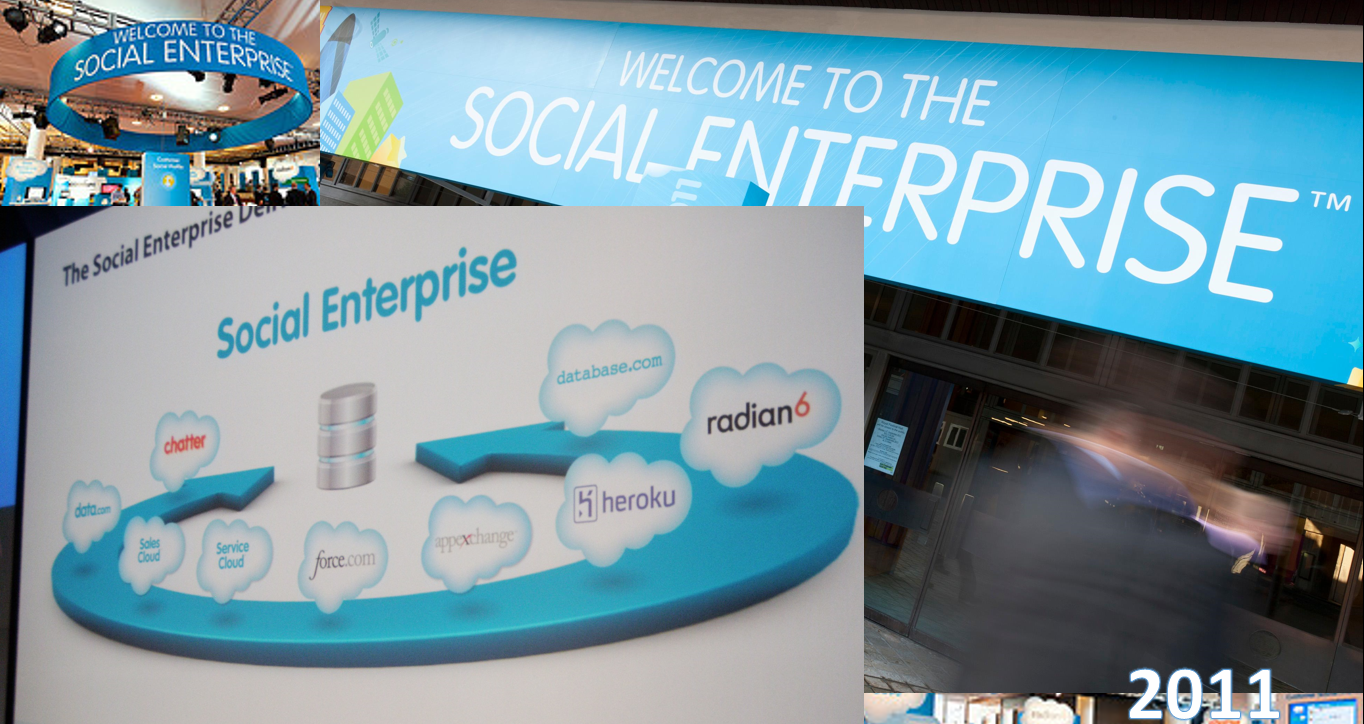
Salesforce London 2011So the term has been around for over 8 years, but during this current decade the concept has evolved, and people have started to use the terms social business and social enterprise instead.  This is problematic as the term social enterprise had already been coined by Professor Muhammad Yunus to mean a business with a social rather than financial purpose.  That didn’t stop Salesforce, in 2011, branding their major customer and partner events with “Welcome to the Social Enterprise” and even trying (and failing) to trademark the term.  Their definition of a Social Enterprise was one where social tools like Salesforce Chatter are used to connect and collaborate in new ways inside as well as outside of the organisation.  These social tools, and there are many of them, can provide a very different platform for teamwork compared to sending files by email, which is the default collaboration approach in most organisations, albeit occasionally modified by having some sort of shared drive or intranet as the file repository.  By 2012 Salesforce had dropped the term, but their shows declared “Business is Social”.

We’ve also used terms like knowledge management, corporate social networking, social collaboration, or social media in business. Social Business should not be confused with the term Social Media, although it uses social media channels. Social Media incorporates social networking, blogging, microblogging, forums, user generated content, crowd sourcing, RSS feeds and more. All of those communication channels might be used in a Social Business approach, but it will involve other social collaboration tools along with a major change of mindset and culture for the organisation. A culture of openness, sharing and collaboration that goes hand in hand with today’s digital disruption.  It’s the antithesis of the old, corporate, command and control hierarchy where knowledge was power, and you were motivated to hang on to information, a valuable currency to keep private for your own use.

Enterprise 2.0, Social Business – part of our current problem is that neither of those terms work well, but the actual concept they are trying to describe can add real value to the bottom line in any organisation.

The Summit had some great speakers – Dion Hinchcliffe from Dachis, Rachel Happe of the Community Roundtable, Dan Pontefract of Telus, John Mell of IBM, Emanuele Quintarelli from Ernst & Young, Bertrand Duperrin of NextModernity, Lee Bryant of Postshift, and Luis Saurez just starting his journey having left IBM only days ago.  It was a packed agenda covering:

  • Success factors for social workplace adoption
  • Key drivers for leveraging social value generation & business transformation
  • Best practices for enhancing business performance and employee engagement
  • Visions for future work & process organization

The event was sponsored by IBM (who have the Connections platform), SAP (with their Jam platform), Jive and a number of other players – Sitrion, Bluekiwi, Xwiki, NextModernity, Lecko.  There might be over 100 social business platforms on the market, some of them are very good, but the players you’ll come across more often with the larger customers or number of implementations are IBM, SAP, Jive and Yammer from Microsoft.

It was great meeting our friends across from USA and Canada, as well as meeting all of the key European social business practitioners in one place and learning from some great customer case studies.  Janet Parkinson, Alan Patrick and I were contributing to the tweet stream at #e20s and flying the Agile Elephant flag.  All of the tweets, tweeters, blogs and photos from the show so far have been collected together by Jim Worth (and the crowd) in this wiki.  Everyone will add links over the next week or so as we all catch up.  Bjoern Negelmann & Thomas Koch, the organisers, and their team did a great job of putting on a very valuable social business event.  Right at the end  Bjoern grabbed me to ask me my thoughts about the hackathon case study I had just presented on behalf of my team, along with my key takeaways from the conference:

My part 2 conference report is here.

Share this:

  • Tweet
  • Email

Filed Under: collaboration, digital disruption, enterprise 2.0, events, social business Tagged With: Andrew McAfee, Bluekiwi, digital disruption, ESCP Europe, IBM Connections, Jive, Microsoft, Paris, Professor Muhammad Yunus, Salesforce, SAP Jam, Sitrion, Xwiki, Yammer

Thesis 3 – There are no one size fits all solutions

February 7, 2014 By Alan Patrick

Thesis 3 – There are no one size fits all solutions

Why do we need a Manifesto?
We’ve been talking about applying social tools inside business since 2006 or before and we are no where near realising the potential for real social collaboration to make business more effective. We need a roadmap to set us on the right course, we need to think differently and to change culture. The Agile Elephant Manifesto encapsulates our blueprint for making Social Business work in thirteen theses. This post is the third in a sequence of 13 which explains each thesis in sequence.

Why Social Business?
We don’t mean the Professor Muhammad Yunus definition of a business which has a social rather than financial objective. We do mean a business adopting social tools and a different, more open and collaborative approach. We’ve been using terms like Web 2.0, Office 2.0, Collaboration, Knowledge Management, Enterprise 2.0, Social Enterprise or Social Business. Social Business is probably the best term currently, but the language is of minor importance compared to the real objective of changing business culture to add value.

3 of 13 – There are no one size fits all solutions – an appropriate technology approach is key.
All businesses are different and evolve at different rates – our approach to helping them innovate, change and transform needs to be adaptable, an evolution not a revolution.

Businesses are different – a marketing consultancy is completely different in its ways of working, culture and systems compared to a high volume retailer or a high tech machinery manufacturer.  The types of business problems they encounter and systems they use will differ,  so it is very unlikely that social business technologies will be a one size fits all solution. Even if they use the same software systems – Oracle, SAP, Microsoft etc etc – they tend to be implemented differently, and have different workflows and processes, and business cultures. This is important, as most businesses are not startups and do have legacy systems.  Unless the Social Business system is a specific point-of-use system, it needs to integrate with these other systems and processes in the business as they have a lot of the data and operational processing capability.  Also, businesses and their industries are often in different lifestages.  Some are expanding,  some are downsizing.  Some industries are cyclical,  some are very event driven. These factors also change strategy, systems, skills and culture.

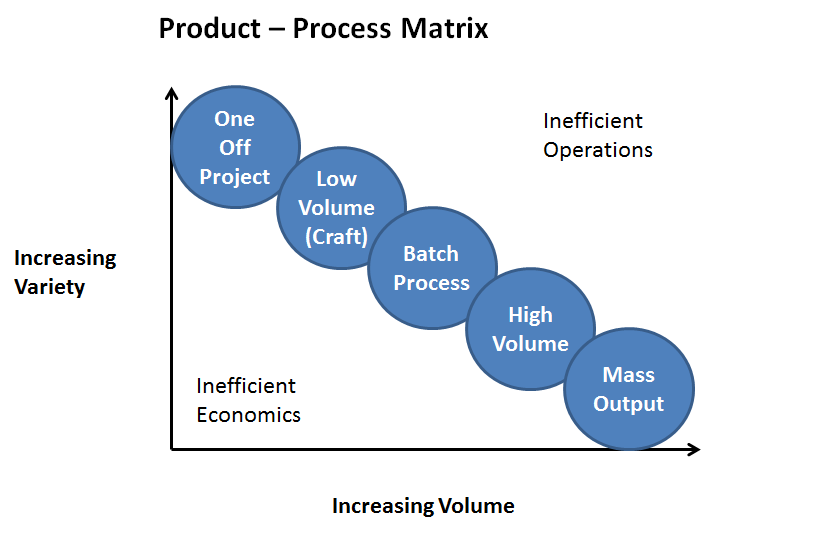
However, there are similarities between businesses, and lessons can be drawn from elsewhere.  Businesses, and parts of businesses, in different fields may actually work in similar ways depending on how they produce their services. The diagram at the top of the page shows the good old Product-Process matrix,  its still a good way of describing different types of business, or operations within a business. It ranges from project based operations, where everything is a one off bespoke product (top left), to dedicated continuous production (bottom right).  An architectural design practice is an example of the one-off project type of enterprise, a design bureau is an example of an in-company department that works this way.  In general, as product volumes increase, the processes become more and more standardised until at the opposite end the mass production operation exists, with everything dedicated to making one product only.  A cement plant is an example of such an enterprise, a bank’s backoffice cheque processing unit is an example of an in-company mass production operation.

[About the white space areas in the diagram above – in general, operations making low variety products (i.e. commodities) with  low volume processes (expensive to run) are economically inefficient – making bulk cement in an artisanal workshop for example – and don’t survive.  Similarly, trying to make high variety, one off products on mass production equipment is operationally very hard.  Try making artisanal bread in a huge industrial bakery for example.  In general these sorts of operations don’t survive without changing their approach.  While new technology – the social web as a market, home machining and 3D printing etc., may shift the limits at the margins here, by and large the concept remains true.]

An adaptable model is best for businesses starting to use social technologies.  Recognise that although each business is different, there are some generic rules that apply in certain sorts of business type.  Look for appropriate lessons and technologies from those sorts of businesses.  A project based organisation uses project management systems whether it’s in architecture, accounting or aerospace. The sort of culture (knowledge workers dealing with complex one off projects) are similar, and appropriate  social business systems will also probably have strong similarities. Similarly, a textile business working in cell workgroups making a variety of clothing has a similar set of processes to a telephone helpdesk operation structured in a number of small teams dealing with a variety of customer issues.  Businesses in one very cyclical industry (say semiconductors) have lessons that another cyclical industry (say retail) can learn from. It is likely that Social Business systems will also be similar in these cases.

Our approach is to look at the current systems, look at the social systems that will be overlaying them, and understand where they need to integrate to achieve the businesses’ goals. That also gives the strongest indications about where cultures and processes need to change dramatically, and where not.  At that point, and that point only, is it worth thinking about innovation and transformation, as you know then what your boundary conditions are and what the impact – good and bad – of any changes will be.

Revolutions are messy, Evolution is better.  Most “revolutionary” business moves are value negative.  Revolutions tend to spill a lot of blood, a lot of babies get thrown out with the bathwater, and it usually takes quite some time to get back on ones’ feet. Evolution is less drastic and more sustainable – a shifting of the organism to grow into new areas, adopt new habits,  move out of old areas.  Not dramatic nor the stuff that makes for hero CEO’s and front page headlines*, but much sounder strategically. This is true for social technology implementations as well.  We think social technology favours an organic, not a mechanistic approach to operating a business. Implement, let it grow and find its niches, prune and fertilise judiciously.

* It is possible though – Steve Jobs was a past master at stealing headlines, even though Apple has had the same overall strategy for decades (enter poorly served market areas early, capture top 25% of spenders) and all its moves are evolutionary – though sometimes it does use evolutionary “jumps”, but that is the subject of another post.

You can find the full Manifesto here, and contact us if you want to find out more.

Thesis Two

Back to the Manifesto

Share this:

  • Tweet
  • Email

Filed Under: agile business, corporate culture, digital disruption, manifesto, social business

Thesis 2 – Business has become a Social Object

February 3, 2014 By Janet Parkinson

Thesis 2 – Business has become a Social Object

Why do we need a Manifesto?
We’ve been talking about applying social tools inside business since 2006 or before and we are no where near realising the potential for real social collaboration to make business more effective. We need a roadmap to set us on the right course, we need to think differently and to change culture. The Agile Elephant Manifesto encapsulates our blueprint for making Social Business work in thirteen theses. This post is the second in a sequence of 13 which explains each thesis in sequence.

Why Social Business?
We don’t mean the Professor Muhammad Yunus definition of a business which has a social rather than financial objective. We do mean a business adopting social tools and a different, more open and collaborative approach. We’ve been using terms like Web 2.0, Office 2.0, Collaboration, Knowledge Management, Enterprise 2.0, Social Enterprise or Social Business. Social Business is probably the best term currently, but the language is of minor importance compared to the real objective of changing business culture to add value.

2 of 13 – Business has become a social object

It’s our belief that although business has always been social, it is now becoming a social object and we need to foster and facilitate those networks to add both tangible and intangible value.

Business as a Social Object:  Social networks are acting as platforms for individuals to coordinate all the activities businesses used to do. The collaborative economy is now making headlines. Companies like Airbnb and Uber which rely on trusted parties are completely bypassing traditional hierarchical capitalist business models. Airbnb has risen in 6 years from a concept (dreamt up by 2 people when they rented out their apartment floor for the night) to a social platform which will potentially become the world’s largest hotelier within the next year. We believe that many – even all – markets could become just nodes in this social mesh – business is becoming a social object.

World as a Social Market:  Social networks will allow any capacity to find any demand. Transaction costs will be minimised between buyers, sellers and information holders as the cost of bringing buyer and seller together falls to insignificant numbers. Ronald Coase predicted this in the 1930’s. The size of the firm in the case of a supplier to Airbnb is nothing more than your spare room and an internet connection.

Trust and transparency:  We foresee that trust and transparency will be maximized. Any business which tries to limit transparency and remain opaque or tries to create arbitrage where there is none will find it difficult to compete and maintain their strategic position.

Regulation:  The social mesh will become part of the infrastructure – just like the Internet itself has become part of the infrastructure. Over time, this mesh will be regulated – infrastructures always do. Regulation will be complex and we need to ensure that the regulations introduced have society’s best interests at heart.

You control your network:  The sheer scale of the mesh will be vast and we will need tools to navigate it. Some tools will come from the infrastructure but we imagine that some will come from yourself.  Think VRM , the concept of tools being created for individuals to manage and control their own data, allowing access only to those to whom they give permission.  We imagine that we could all own our own smart systems with data controlled by ourselves – like owning an electric appliance which you plug into the mesh. It could source the relevant data, barter the deal and present the options in order of importance, then automatically make all the necessary arrangements for you.  The opportunity for profiteering in these transactions would be minimal.

Utopian dream?:  May be. It would rely very much on total trust and could go very wrong in bad hands. Be prepared for the shadows.

“The Future is here, it’s just not evenly distributed” – William Gibson, 1993

You can find the full Manifesto here, and contact us if you want to find out more.

Thesis One

Thesis Three

Share this:

  • Tweet
  • Email

Filed Under: business innovation, collaboration, digital disruption, future, manifesto, social business

« Previous Page
Next Page »

Sign up for our regular Agile Elephant Newsletter - news, posts, ideas and more.

My Tweets

From the Agile Elephant Blog

  • The Metaverse doesn’t exist yet, but…
  • Impossible Things get Disruptive
  • Clarity, Cloud, and Culture Change at IBM

What Next?
Take a look around our site, check out our approach, see how we can help, join the conversation on our blog or contact us to find out more.

About Us

Agile Elephant is a new kind of consultancy designed to help companies embrace the new digital culture of social collaboration, sharing and openness that is changing business models and the world of work.

Contact us to find out more!

Our founder's blogs:

broadstuff

@DT on Medium

Technotropolis

Our blog:

The Agile Elephant Blog

Site Log In | Site Log Out

Subscribe to Site RSS

Subscribe to our Blog via Email

Enter your email address to subscribe

Join 30 other subscribers

Copyright © 2026 ·Streamline Pro Theme · Genesis Framework by StudioPress · WordPress · Log in