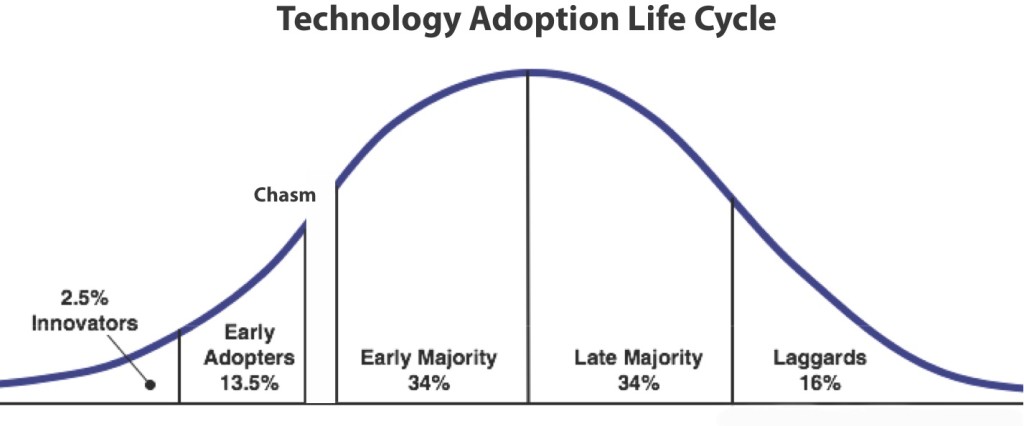
The Chasm
I came across this rather hopeful blog post from 2010, about how Enterprise 2.0 (remember that) had crossed The Chasm (The Chasm) being the gap between an early adoption technology and one that starts to go mainstream in a Technology Adoption lifecycle (see above diagram). Most New New things crash in the Chasm, however, survival rate is quite low. Broadvision’s Pehong Chen wrote a more considered piece in 2011 in Forbes, noting that for Enterprise 2.0, the Chasm was far from crossed:
Consequently, platform of engagement participants must thrive to be proactive, engaging in multiple activities in parallel to reach maximum geometric scalability, such as:
- Assemble and sustain a critical mass of active members across and beyond the enterprise.
- Build out an ecosystem of networks and communities by these members, for these members.
- Establish meaningful social business connections amongst themselves.
- Integrate fully into all aspects of systems of record.
- Maintain a reputation economy so that everyone is incentivized to contribute ideas and share knowledge at all times.
- Follow all relevant activities by anyone, from anywhere, at anytime.
- Zoom in on any actionable items timely and collaboratively.
For platforms of engagement to succeed is to transform everyone’s entrenched work habits from reactive to proactive and from linear to geometric, which is not a trivial feat by any means. But only when we cross that chasm can our platform of engagement be adopted as the essential second element in our workplace.
By 2012 Enterprise 2.0 had been re-branded Social Business (always a worrying sign, normally that a Chasm flight has been attempted and failed) and, fast forward to early 2014 and the Dachis group, which had bought up many of the emerging first wave Social Business players, had shut up shop, and it seemed the Chasm had claimed yet another New New Thing.
Or had it?
Digital Transformation
The Chasm has another name, garnered from (if I mix metamodels) the Gartner Hype Curve – it is the Trough of Disillusion that signifies the fall of the overhyped object. What is also interesting is that the Gartner model shows what happens after the crash into the Chasm – that the components are re-assembled in new ways, those that didn’t fly are rejected, new components are inserted and a new, more useful approach emerges.
In Tech, this re-shuffling often comes with a name change, and Enterprise 2.0 became Social Business. However, it also became increasingly clear that these technologies are part of a larger emerging IT infrastucture layer, which some call the SMAC (Social, Mobile, Analytics, Cloud) stack. It has been apparent to us for some time that all these technologies are stronger if combined, we are seing for example the increasing need for mobile and analytic elements for social tools, and clearly the ability to provision them via cloud services increases flexibility.
This overall stack is incraesingly being termed Digital Transformation, but we think that is a slight misnomer as Technology itself never drives Transformation. Transformation is a s much a human process as a Technoogy one. To effect Transformation requires addressing of the “Hard” and the “Soft” processes in the entity being transformed. For this raeson we have long adopted the McKInsey 7S model, as it looks at both the “hard” business ares – strategy, systems, structures and the “Soft” ones – Skills, Staffing & Style and recignises the whole approach is underpinned by the common culture and goals that allows co-ordination without continual reference to high level decision makers – the Shared Vision.
The Digital Wave
Transformation does not happen in a vacuum. Transformation happens in the context of greater forces. In terms of Techology, it normally creates new ecenomic fault lines, which are arbitraged by new plays. This in turn drives social, buisness and regulatory reactions. Some believe these changes happen in waves (like Kondratieff) some see change happens in cycles (e.g Schumpeter), some in a combined form of the two (eg Perez). We are agnostic as to whether you call it a waveform or a cycle, but we are certain that something extra and different is happening now. We’ve been used to technology disruptions happening in regular cycles, but a number of things are coinciding to increase the amplitude – multiple technology disruptions happening together, and those are sitting on top of global economic factors that are changing the supply chain and business models as well. The “Digital Transformation” people are talking about is happening within the context of this bigger shift that we call the “Digital Wave” (see a summary of our thinking on this over here).
The view from the Summit
All this brings us to explain why the themes are what they are for our London Digital Enterprise Summit on October 22nd, see details over here.
We will also be running a workshop the day before the Summit where we will spend the time looking at the detailed components of what is happening in the Digital Wave, and what an Enterprise should do to surf it rather than be rolled under by it. Key issues to understand include areas such as:
The underlying technologies driving the digital wave
- Cloud
- Mobile
- Analytics
- Social
- Localised production
The overlying economics and sociological drivers
- Human capital – ageing OECD, youthful Developing world, an era of migration
- Offshoring vs Re-shoring
- Where’s the money – literally. Changes in funding and financing
The Future of Work
- Full Time vs Part time
- Restructuring Organisations – efficiency vs responsiveness
- The Office of the future – will it exist
We’re covering all of these themes and more in the Workshop and Summit with some great speakers and case studies and we’d love you to come along and join the debate. Signup here.