Agile Elephant making sense of digital transformation

innovation | digital transformation | value creation | (r)evoloution

  • Email
  • Facebook
  • Google+
  • LinkedIn
  • Twitter
  • Home
  • Manifesto
  • Services
    • Our Approach
    • Our Services
    • Making Collaboration Work Packages
    • Collaboration Solutions
    • Our Experience
    • Workshops
    • Innovation
  • About Us
    • The Team
    • Why we do what we do
    • Why are we called Agile Elephant?
    • Our Partners
    • Our Clients
  • Get Involved
    • Events
    • Meetups
    • Unconference
    • Newsletter
  • Resources
    • What is Digital Transformation?
    • What is the Digital Enterprise Wave?
    • Our Research
    • Case Studies
    • People We Follow
    • Articles & Links
    • Books That Inspire
  • Blog
  • Contact Us
Home Archives for social business
What is Digital Transformation?

February 15, 2015 By David Terrar

What is Digital Transformation?

Summary

Everybody’s talking Digital Transformation!  The term is very definitely being hyped by some, and is in danger of becoming as diluted in meaning as the “cloud” term as it becomes a catch all for almost anything associated with our new connected, social media oriented world using emergent technology. However, we believe it’s an important idea and so this post examines the term and tries to come up with a succinct but all encompassing definition of what it is – better than the many others currently available. Finally we point to the various resources available, mostly from consultancies that we compete with, but that’s the nature of the new, open mindset that is vital to succeeding and transforming in the 21st Century business landscape.

Everybody’s Talking Digital Transformation!

When we launched Agile Elephant in January 2014 we positioned ourselves as a Social Business consultancy. Within six months we had changed the messaging on our website so that the narrative was around Digital Transformation. Something happened in 2014. Suddenly everyone was using the term, from insurgent consultancies like us, to the marketing agencies that were active in social media marketing, to the big firms like PWC, Deloitte and Accenture. Back a year ago in February 2014 at the Enterprise 2.0 Summit in Paris most of the talk was around Social Business. By our London edition in November 2014, and then two weeks ago at the 2015 Paris conference, more people’s slides had Digital Transformation as the headline than Social Business or any other language. During 2014 a shift happened. We all changed our narrative, and in part this is because the core idea is becoming a mainstream necessity for businesses to succeed, and so the way we talk about it has to mature so that the average business person or executive in the C- Suite can understand it, as a first step towards living it.

The Evolution of Terminology

We’ve actually been talking digital for 20 years, but changes like these take time. Back in 1995 Nicholas Negroponte collected together his articles for Wired in to the book Being Digital, as the World Wide Web took hold.  He was talking about moving bits instead of atoms.  I actually started blogging in 2005, and joined in the emerging London social media scene (where I met my Agile Elephant colleagues).  I learned the term Web 2.0 that was popularised by Tim O’Reilly with his conference late in 2004.  The 2.0 bit was about a second version of the Internet.  It was technospeak, using a programming metaphor to say version 1.0 of the Internet in the 90s was all about static brochure websites, but moving in to the new century the web got interactive. This new “release” of the web was all about conversation and user generated content. Reviews on eCommerce sites. Comments on blog posts. Forums where I could ask questions and get answers. Wikis where we could co-author documents in real time, or crowd-source expertise like Wikipedia – stuff that changed the World!  10 years ago this month some guys started a video dating site, then pivoted a couple of times and realised that the “loading and sharing video” part of what they had was a vital service we all needed.  Everyone’s smart phones were shooting video that needed a home on the web as well as on our personal hard drives.  And so YouTube was born and became another vital part of our new communications infrastructure.

Around about that time, fellow Enterprise Irregular, Andrew McAfee started to popularise the term Enterprise 2.0 with his blog posts and articles of spring 2006 and a seminal book. This was 2.0 applied inside business as well as external to the consumer.  An upgrade to rigid, structured legacy enterprise business systems. His idea was all about using these emergent social software platforms, blogs, forums, wikis and more, with or in place if the company Intranet so more conversations happen, with more working out loud and more ideas being generated.

Just around about this time the idea of microblogging started.  The Twitter bird opened its eyes in 2006, early adopters started using it, I jumped on board on 14 February 2007, and then things really took off when it was used as the back channel of March 2007’s SXSW event – the social media crowd jumped on board with a vengeance!   We were all experimenting with this new way of communicating, and it was the crowd that turned it in to something that has become another integral component of today’s connected World.  Twitter only incorporated as a company in September 2007.

Towards the end of 2009 Stowe Boyd blogged about the Enterprise 2.0 term being too corporate, and then he and others started to use the term Social Business. The complication with that is that the term had already been coined by Muhammed Yunus to mean a business with a social purpose, although many people tended to also use Social Enterprise for that.  In any case, it became a more accepted term and so we all started to use Social Business, and often had to explain that we meant using these social collaboration tools inside and outside the organisation to get more things done (rather than the Yunus thing).

Then to complicate matters a little, in 2011 Salesforce, the born on the cloud CRM company, made a big push with their Chatter and other collaboration tools. Marc Benioff and their conference headlines that year announced “Welcome to the Social Enterprise”.  They even tried and failed to trademark the term!  But by 2012 their messaging had moved on, although the concept is an integral part of their value proposition.

In 2013 Chris Heuer proclaimed Social Business is Dead!  That generated some conversations!  His post also talked about employee engagement, things like Adam Pissoni of Yammer developing his story of what he calls the Responsive Organizations, or about the business agile enterprise (we like that!), and about where we should be heading with this topic.  Let’s add in other terms like the digital workplace, digital disruption, open business, and working out loud.  We can also add in ideas about organisation change, with traditional hierarchies becoming wirearchies, or organisations shifting to cross functional teams, or choosing to change the organisation chart radically or to begin as self-organised, team based lattice structures.  Actually all of these different ideas are overlapping subsets of a whole concept.

The Evolution of Enterprise Systems
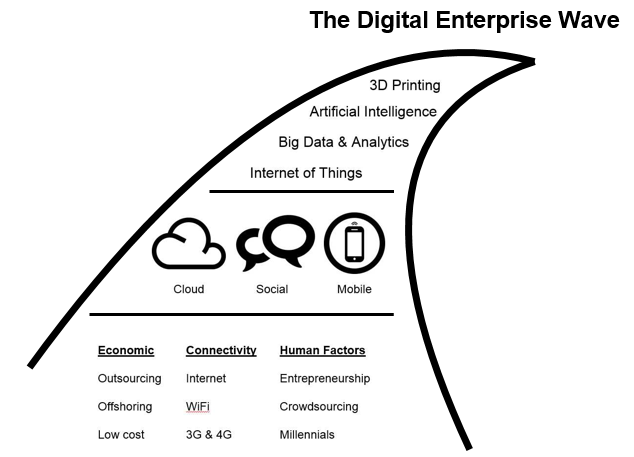
Digital Enterprise Wave simpleMost of us have grown up with legacy, rigid and structured technology based business systems.  Process oriented and mostly built around repeatable steps with a Taylorist, production line view of business.  Those core things, like raising invoices and paying suppliers and worrying about inventory, still need to be done, but the technology explosion that has been happening over the last 20 years changes everything.  It happened slowly for the first decade, but it is getting ever faster, and particularly over the last 5 years.  We call it the Digital Enterprise Wave.  It is the combination of economic and technological forces that have changed the World and disrupted whole industries, or businesses like Kodak, or Blockbuster, or Blackberry (actually, nobody is safe).  We now live in a World of instant communication and feedback, where the supply chain has changed forever, and where our reaction time has to be just as fast, or we could go out of business.  Andrew McAfee’s core idea of taking enterprise systems to the next level, making use of new and emerging technologies is still valid today.  We need to recognise that it’s not just about adding great social collaboration technology to existing legacy systems, but about evolving the whole system end to end, and doing it at the same time as changing the organisation itself.  For most organisations it isn’t easy, it’s like upgrading the London Underground or the Paris Metro – we have to make structural changes and dramatically improve things, whilst still keeping the trains running, but it has to be done.

Digital Transformation Defined

What I do know is that your business model is under threat.  Some smarter, nimbler competitor is just about to overtake you with a more innovative approach, or better use of data or clever use of technology and take your market.  Business as usual almost certainly won’t be good enough, although it may take a while for you and your balance sheet to realise that.  You need to transform, and the transformation incorporates a number equally important ideas.  For us, the definitions you can find for digital transformation don’t cover the whole story.  They don’t recognise that the transformation needs to be both end to end in the organisation, and about much more than just technology.  Here is our definition:

Digital transformation is the process of shifting your organisation from a legacy approach to new ways of working and thinking using digital, social, mobile and emerging technologies.  It involves a change in leadership, different thinking, the encouragement of innovation and new business models, incorporating digitisation of assets and an increased use of technology to improve the experience of your organisation’s employees, customers, suppliers, partners and stakeholders.

We’ll be evolving this definition and responding to feedback, so feel free to challenge us and help us refine it and get clarity.

Further Agile Elephant Posts on Digital Transformation:

Transaction Costs in the New Economy

Towards new Organisation Structures

What is the (real) future of Work

Other Resources

Digital Transformation is a big topic. As well as our own blog and resources, here are some other places you can go to get a deeper understanding and other viewpoints on what’s important.  We approach this with an open mind and we’re always looking to challenge our thinking, so we’re connecting you with what the other’s think also.  That’s the mindset you need in your particular business, sector or area of expertise too!

Accenture’s insight on Digital Transformation

Altimeter on Digital Transformation

Capgemini Consulting on Digital Transformation

Constellation Research’s Elements of Business Architecture for Digital Transformation

Econsultancy on Digital Transformation

Forrester – Accelerate Your Digital Business

IBM on Digital Transformation

McKinsey Digital

PA Consulting’s Digital Innovation Hub

PwC’s Digital IQ Survey and more

Sameer Patel (of SAP) – This Transformation Feels Different. Disruptively So.

Esteban Kolsky – The Foundation Components for Digital Transformation

Greg Verdino – What is Digital Transformation, Really?

Denovati Group on Digital Transformation of Organizations

Or better still take a look at the Agile Elephant viewpoint – read our blog, and contact us!

(top image from Altimeter 2014 State of Digital Transformation images on flickr)
Share this:

  • Tweet
  • Email

Filed Under: #EntDigi conference, agile business, digital disruption, enterprise 2.0, social business

8 Strategic Building Blocks to enable Digital Transformation

February 6, 2015 By David Terrar

8 Strategic Building Blocks to enable Digital Transformation

This is the blog post version of my lightning talk at this year’s Enterprise 2.0 SUMMIT Paris. My script for 43 slides in 10 minutes, PechaKucha style, and I finished ahead of time! My purpose was to do three things:

  • Spend five minutes giving the Agile Elephant view of the current complex and disruptive digital landscape. There is a wave of change affecting every business and some key issues to be understood that are driving the need for digital transformation in every industry, every style of business.
  • Then spend another five minutes presenting 8 strategic building blocks to enable transformation, with the emphasis on practical things you can do, and specific areas or factors that your organisation needs to address.
  • Lastly, leave you with a core message that is vital for the 21st century enterprise.

Expert talk – 8 strategic building blocks for digital transformation from David Terrar

First I need to start with this quote from Alvin Tofler, well known author of Future Shock:

“The illiterate of the 21st century will not be those who cannot read and write, but those who cannot learn, unlearn, and relearn.”

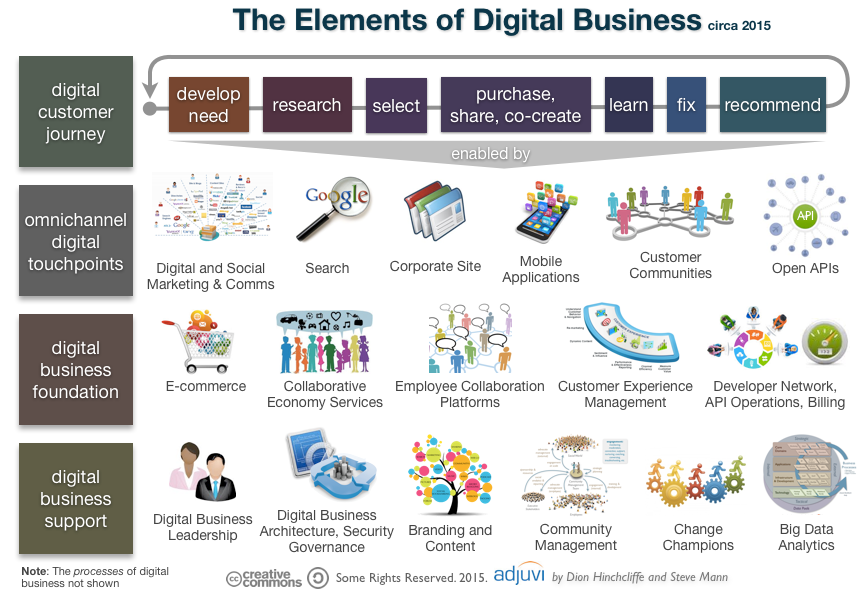
the_elements_of_digital_business_2015That idea of continuous learning is a taster for the core message, but highlights the dramatic changes that we are living through. Let me start by trying to explain the digital business landscape. We’ve been talking about it for 20 years. It was back in 1995 that Nicholas Negroponte collected together his articles for Wired in to the book Being Digital and talked of moving bits and not atoms. That is the basis for the digitisation of business that we have been living through for two decades. It affected the world of media and retail first, and then the music business and the film & TV business, but now it’s reaching every part of the business World. Fast forward to 2012 and Marc Andreesen wrote about software eating the World, and then last month my friend and fellow Enterprise Irregular Dion Hinchcliffe used this graphic to explain the complexity and many ingredients of Digital Business.

The one thing that is certain – your business model is under threat. Some smarter, more agile business is aiming to sneak past you and take your market. What are you going to do about it? Well, there is a great saying that necessity is the mother of invention. That means that when your back is to the wall, you will find a way to make it happen. Well I want to subvert that phrase and turn it in to the mantra:

“Reinvention is the mother of necessity.”

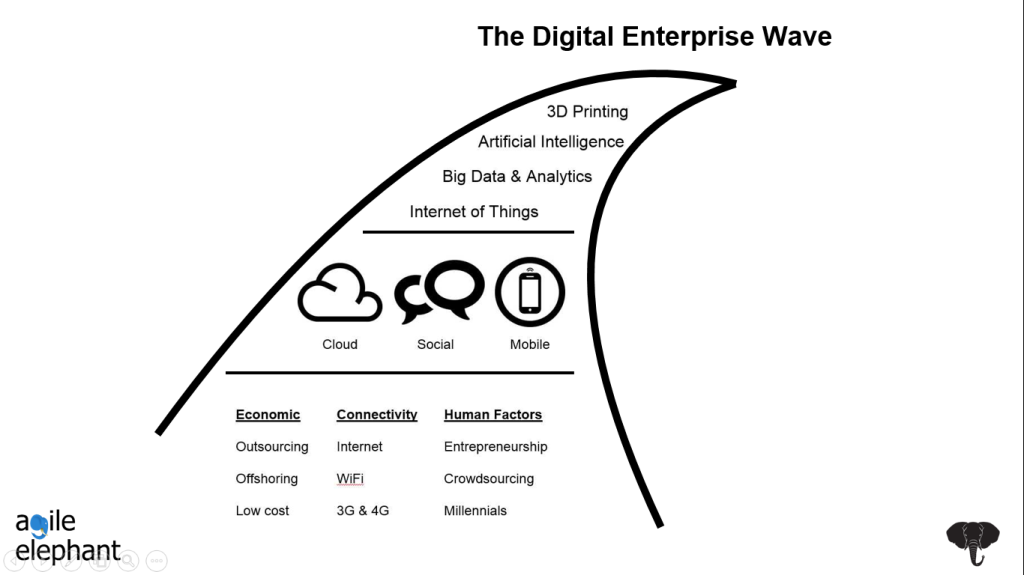
To explain the current, disruptive business landscape we think of it as a Digital Enterprise Wave. You can ride it, or go under! There is a set of economic, technological and human factors including an ageing population in the OECD countries, outsourcing, offshoring and low cost manpower in Eastern European, South & Central American, or Far Eastern countries. Add to that we can begin to access almost everyone, everywhere in our connected World, and then add entrepreneurship, crowdsourcing, and our millenial generation which is growing up digital. Together these provide the ideas underpinning books like Thomas Friedman’s The World is Flat, Chris Anderson’s The Long Tail, or Clay Shirky’s Here Comes Everybody. That’s the foundation of the wave.

Next comes the triple disruption of Cloud, Social and Mobile. For the last 5 or 6 decades we lived with Moore’s Law driving ever increasing computing power and a technology disruption every 5-10 years. We moved from mainframes, to minicomputers, to the Personal Computer. Then we networked PCs together, then we had the era of client/server computing, leading to the first version of the World Wide Web, followed by the dot-com boom and bust leading to a more interactive Internet that we called Web 2.0 for a period. During each of these disruptions large companies failed and new companies emerged from nowhere. Smart businesses thrived and made use of the new paradigm at each transition, but others couldn’t live with it and failed. However we’ve never had more than one technology disruption happening at the same time…. until now. Now we are living through a time where all IT is moving to the Cloud, at the same time as the explosion of Social Media, at the same time as the shift to Mobile. Most of the world is connected on mobile phones, and a significant proportion of us are walking around with the Internet in our hands with smart phones, iPads and tablets. The confluence of cloud, social and mobile changes everything – technology can now form a major component helping just about any type of business you can think of. We’re not in Kansas any more… this forms the middle layer of the wave.

But there’s more!  We have emerging technologies – the Internet of Things, Big Data and the associated Analytics, Artificial Intelligence and 3D Printing.  We are in the early stages of each of these, but each one of them has the potential to change things dramatically yet again. For example, when 3D Printing comes of age, the World’s supply chain will suddenly be disrupted. Predicting even the near term future of how these things will develop is incredibly difficult. These emerging technologies form the top of the wave.

All of these interrelate and combine to form what we call the Digital Enterprise Wave and they present a formidable challenge for every type and sector of business.

In the face of the Wave, business as usual has little or no future. Legacy systems of record won’t be able to cope with these new demands. Adding a dash of social on top of your conventional apps won’t cut it either. You will have to think differently. We need Digital Thinking for this Digital Transformation – that’s where the 8 building blocks come in.

But before we get to that, let me quote our great hero of business management Peter Drucker:

“The greatest danger in times of turbulence is not the turbulence – it is to act with yesterday’s logic.”

Next I want to highlight a book from 2013 by Jaron Lanier called “Who Owns the Future?“.  It looks at the impact of this digital disruption we are experiencing.  I tried to find one sentence from the book which encapsulates its thesis:

“At the height of its power, the photography company Kodak employed more than 140,000 people and was worth $28 billion. They even invented the first digital camera. But today Kodak is bankrupt, and the new face of digital photography has become Instagram. When Instagram was sold to Facebook for $1 billion, it employed only 13 people. Where did all those jobs disappear? And what happened to the wealth that all those middle-class jobs created?”

Lanier’s book highlights some key sociological and business issues around our new connected 21st Century. The way companies are now valued, the new business models and the way we are using increasing levels of technology is squeezing the middle class more than any other demographic. If content like news or music or films are “free” how do the writers and artists and their surrounding industries survive?  Those changes were just the beginning as new “sharing economy” companies like Uber and Airbnb are demonstrating.   Added to that there are what Lanier calls Siren Servers who want your data, and provide you with “free” services in return. We want those services, but if we don’t pay for them, suddenly we have become the product. This is the technology landscape and business world in which we are trying to find customers, create value, reduce costs and make a profit.

Yet another dynamic is what our friend Professor Vlatka Hlupic of Westminster University calls The Management Shift, in her book of the same name. She has researched companies who have been tackling these big shifts over a number of years. She references more than 20 companies using her approach and leadership model. They are from small to large, in various sectors and include a FTSE 100 Company. She has categorised their management styles in 5 stages or levels from Traditional to Emergent. The smart, successful companies have an emergent management style characterised by an unlimited mindset, strong team cohesion, unbounded culture, inspirational leaders, a strong sense of purpose, and a passion for the work. These are the characteristics we need in our 21st century leaders and managers.

I’d also like to recommend Leading Digital by George Westerman, Didier Bonnet and Andrew McAfee. It is one of the best books published around the digital business topic in the last 12 months. It has a wealth of good case study examples and categorises the topic in two dimensions. One is your company’s digital capability – the “what” of using digital technology to transform the business, and the other is your leadership capability – the “how” of successful transformations, where managing the change is much more important than the particular technology involved.

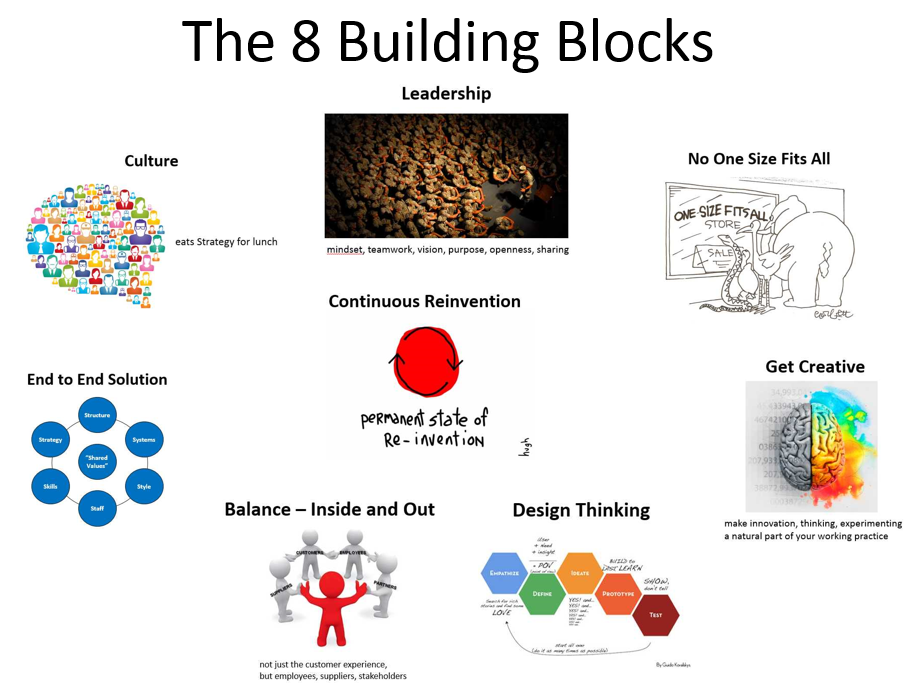
Putting all of these aspects together tells the story of the complexity of the Digital Enterprise Wave that we are facing and the resulting business turbulence that we need to surf through. How do we do it? We believe there are 8 strategic building blocks that you need to invest time and effort and resources in to enable successful digital transformation. Let’s go through them.

Culture

Peter Drucker supposedly said Culture eats Strategy for lunch. In truth your company strategy is very important too – this isn’t an either or situation. However, in transformational change the company culture is a vital factor. Successful companies have a strong identity. The founder knew their “why”, their reason for being, the core purpose of the venture they started. He or she may still be involved or they passed on the values to the new leaders, in to a set of behaviours and beliefs (or maybe they didn’t). In carrying out digital transformation you need to work with the company culture to enable change, or begin to change the culture in the right direction if it isn’t aligned to the digital shift that you need to take. In all of the companies we’ve with worked with, or the case studies we’ve seen, culture is one of the primary building blocks.

Leadership

To transform your company you need strong leadership, but it has to be the right kind of leadership. The digitally savvy companies have leaders with vision who promote a mindset encouraging teamwork, explaining their purpose with clarity, and promoting an environment of openness and sharing. The particular organisational structure that you have is less important than getting the culture and leadership to encourage the right behaviours of your managers, team members and other stakeholders. You should be looking for the emergent leadership characteristics we discussed earlier at all levels of your organisation.

No One Size Fits All

There are no one size fits all solutions. Every company is different. Every company has legacy systems, to a lesser or greater extent, that you’ll need to work with because that’s where the current, vital business data and intelligence resides. There aren’t any panaceas, or a particular social & digital business platform that has all of the answers and works well for most types of business. Actually there are a plethora of platforms, from complex to lightweight which are usually very good at a few things, but not so good at others, and as of today none of them do all of the things you’ll need. In any case you will need to integrate to data in existing systems and link the new digital approach directly to existing business processes. You need to assess the business, look for where you can generate most value, and plan to adopt new platforms and system enhancements accordingly.

End to End Solution

You need to think in terms of an end to end solution. Adding a social business platform or new digital business components on top of existing systems can provide some help, and even give short term benefits in key areas, but to really transform you need a holistic approach. We use the McKinsey 7s framework because it’s been tried and trusted over decades. It works. It covers both the hard factors and the soft factors of your business. You assess the business in terms of Strategy, Structure and Systems, and then Staff, Skills and Style, as well as looking at the Shared Values (which these days is increasingly called culture) of the company to get a complete picture. Following this approach leads us to consider all of the factors you will need to address to add value, find efficiencies and make a real difference. You don’t have to use this particular framework, there are many others you could use, but you must think end to end.  Focusing on organization structure, or people, or culture, or systems on their own is not going to work.  Focusing on one bit of the value chain won’t either.

Continuous Reinvention

In the 80s and 90s we focused on quality management and quality circles and talked continuous improvement.  For digital transformation we want you to think Continuous Reinvention.  As we said before, your business model is under threat.  If you aren’t thinking about new business models you are in danger of losing out to a smarter, more agile competitor.  Innovation has to be at the heart of your approach to your business.  You should be reinventing the business and competing with yourself to do better, and then rethinking again.  I started this post with that quote about learning, unlearning and relearning – you need to open your mind and think Continuous Reinvention.

Get Creative

In a world where there is a perception that information is free, new ideas are the weapons that add value.  In a world where your competitors can harness cheap resources, or Amazon’s Mechanical Turk online crowdsourcing marketplace, or Artificial Intelligence to automate processes, how do you compete?  All of these techniques started with the particular skill of a person and that skill has been automated or sent to the lowest cost of production.  Somebody made the first widget or carried out the first translation, and then their process was automated.  To compete you need to change the game with new ideas and different thinking.  You need to get creative.  But creativity shouldn’t be confined to some product design department.  It shouldn’t be a one off, quarterly or annual brainstorming event.  We are living in, arguably, the most disruptive time of technological change ever – we’re living with the Digital Enterprise Wave and it’s getting closer!  The last comparable time was the early industrial revolution, and that wrought huge transitions.  To compete you need creativity to become an everyday thing in your company, applied to every part of what you do.  You should encourage it and make it part of the DNA of your company, but also recognize that not everything will work.  Your approach needs to involve experimentation and recognize that some of the ideas will fail, and that’s perfectly acceptable, because others will succeed.  Innovation and idea generation should be an acceptable part of everyone’s daily work-flow.  To do that you need to be promoting thinking skills in your company. You need mechanisms in place to encourage people to speak out about doing things better.  You need tools to help you capture those ideas and the creativity of your workforce. Look at the smart companies – that’s what they do.  Change your approach and get creative.

Balance – Inside and Out

If you look at the material on digital transformation from a lot of the key consultancies, service providers and analysts you will see a lot of talk about the customer experience, omni-channel marketing, digital touchpoints, and customer facing use of digital tools.  All that is important but you have to get the balance right.  Your transformation approach needs to look inside the company as well as out.  You need to be enhancing the experience and the digital journey of not just the customers, but your employees, suppliers, partners and other stakeholders that support your business too.  We use the term “business as a social object” – unless business is as fluid as the outside world it will flounder.

Design Thinking

It’s not enough to optimise your current business.  The best way to survive the future is to invent it yourself.  For effective Digital Transformation you need to encourage Design Thinking.  Some of the building blocks we’ve already covered are key components in that mindset, but you need to pull them together in your end to end approach. Wikipedia says Design Thinking is defined as combining empathy for the context of a problem, creativity in the generation of insights and solutions, and rationality in analyzing and fitting various solutions to the problem context.  It is a formal method for practical, creative resolution of problems and creation of solutions, with the intent of an improved future result.  You need to apply that thinking not just to the product, but to all of the processes supporting your company.

The 8 Building Blocks of Digital Transformation - Agile Elephant

And finally – the Core Message

So these are the 8 building blocks which you need to work with to create a coherent, holistic, end to end strategy for the digital transformation of your organisation, but I would highlight one of them as the core message, the most significant change of mindset that you need to address, and that is Continuous Reinvention.  The successful 21st Century organisation needs to be thinking differently, and then rethinking continuously to stay ahead of the competition.

Continuous Reinvention – to survive change needs to be a constant.

Share this:

  • Tweet
  • Email

Filed Under: #EntDigi conference, business innovation, corporate culture, digital disruption, enterprise 2.0, social business, strategy

A new strapline for Agile Elephant – innovation | digital transformation | value creation | (r)evolution

November 2, 2014 By David Terrar

A new strapline for Agile Elephant – innovation | digital transformation | value creation | (r)evolution

Businesses need to be constantly evolving. We believe in continuous improvement. We believe that it doesn’t matter what type of business you are, your business model is under threat. In today’s digital business environment change is a constant and you have to deal with it. It’s Darwin’s theory of evolution for business – only the fittest, or most fit for purpose survive. Recently people have taken one of our Agile Elephant business cards or come to the web site and said “yes, but what do you really do?” So we’ve had a rethink and we’ve just changed our company strapline – for the header of our website and for what’s on our business cards, so that it encapsulates what we do in 4 things:

innovation | digital transformation | value creation | (r)evolution

First we’re about innovation. Innovation is applying new ideas, new devices, new processes – finding better solutions. We believe commercial creativity is vital. We believe fostering new ideas should be part of part of a company’s daily DNA.

What we do as a business is digital transformation. Take a look at our explanation of the Digital Enterprise Wave. A smarter, nimbler competitor is angling to use new digital and social tools to take your market, your customers. We can help analyse where you are in the digital landscape, help you take stock, decide where to start, where digital tools can really help and then take you on a journey to become digitally competent. But that’s not enough – then we help you put the necessary leadership in place to master the digital topic and make it work for you effectively.

Going digital can only be effective if it leads to value creation. You need an approach which increases your revenue, improves profitability, helps you keep more of your customers, gets products to market quicker or reduces your operational costs – it has to be about doing what you do better and about adding to the bottom line. Take a look at these survey results from Capemini Consulting and MIT Sloan Management from their report “How digital leaders outperform their peers in every industry“. They split the surveyed organisations, all larger that $500m turnover, in to 4 categories, with the most digitally savvy being called the “Digirati” or digital masters. Companies in that most advanced category generate 9% more revenue, create 26% more profit and have 12% higher market valuation than the rest. Becoming a digital master works.

In taking you on this journey we believe in evolution not revolution. We believe many consultants and practitioners talking about “digital” and “social” focus too much on a grass roots revolution to change the culture in organisations. To dismantle hiearchical structures and recast the way of working for the new world. We don’t think that sort of revolution is productive. We believe any structure of organisation can become a digital master with the right core competence and the right leadership. Even huge companies like IBM can empower their employees and change, and using social tools helps them do it. We believe the Elephant can dance, but we don’t need to break it to make the changes.

innovation | digital transformation | value creation | (r)evolution

To find out more consider coming to our conference next month – The Enterprise 2.0 Summit London, or contact us to start talking sense about digital.
 
e20s_london_banner

Share this:

  • Tweet
  • Email

Filed Under: business innovation, change management, corporate culture, digital disruption, leadership, social business, strategy

The Agile Elephant Unconference – 27 November at Metro Bank HQ, Holborn

October 29, 2014 By David Terrar

The Agile Elephant Unconference – 27 November at Metro Bank HQ, Holborn

We are delighted to announce The Agile Elephant Unconference on digital transformation, social business, the future of work and the digital workplace – an all day event on 27 November 2014, hosted at Metro Bank’s London HQ, One Southampton Row, London WC1B 5HA – opposite Holborn Tube Station.

The Agile Elephant team, hosted at a Central London location, are facilitating a self-organised conference designed to bring together specialists, consultants, practitioners and change agents to discuss:

  • digital transformation
  • social business
  • next generation enterprise
  • the future of work
  • how to do more, and do it better

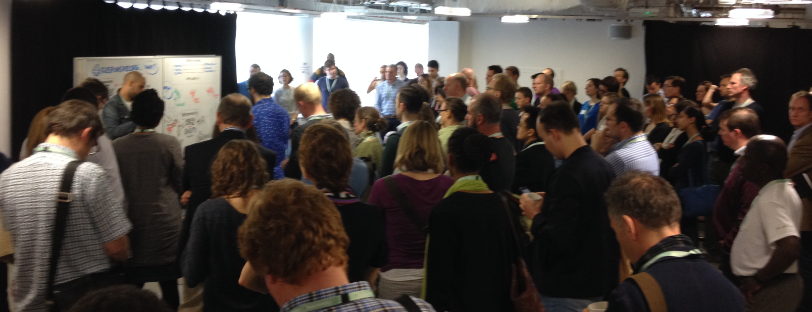
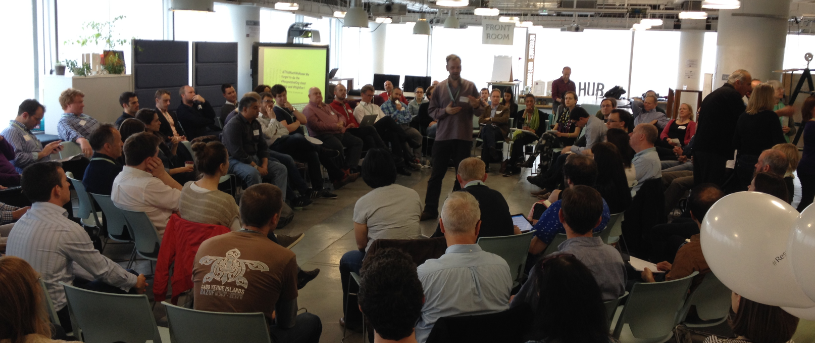
Responsive Org Unconference 1The Agile Elephant Unconference will be a full day from 9:00 to 17:30 at a Central London location close to the Underground and other transport links.  The Unconference follows, and is connected to, the Enterprise 2.0 Summit London on November 25 and 26 at The British Academy, 10-11 Carlton House Terrace.  The Summit is a practical, “how-to” style of event for a corporate audience.  The Unconference is aimed at specialists, consultants and change agents advising those companies who want to share ideas, best practice, and debate where the world of work, the digital landscape and emerging technologies are moving next.

The mantra for the day – what works, what doesn’t, what’s next?

Go here to sign up for the Unconference.  The ingredients are:

  • A curated unconference using Open Space Technology
  • As a group – the Morning and Afternoon will each start with 5 x 5 – five 5 minute lightning sessions to get your brain cells moving – the clock is ticking, when the time is up the speaker may have to finish mid-sentence – no exceptions!
  • We’ll split the room in to 3 unconference streams with timeslots across the day
  • 4 time slots per unconference stream – a choice of 12 topics discussed in depth during the day
  • Bringing it all together – as a group we’ll come back together at the end to discuss what we learned, how we capture the content and make some plans for what next?
  • Plenty of time for networking in and around the sessions in coffee and lunch breaks – the agenda framework for the day is here
  • Elephant volunteers will help facilitate the day and make things run smoothly

Responsive Org Unconference 2We’ll use social media to capture and share our energy and ideas from the day.

If you want to sign up to present one of the ten 5×5 sessions, go to this post and add your session title and explanation in the comments.  If we have more than 10 volunteers we’ll convene a panel of judges to pick the best 10.  For the 12 unconference sessions, we hope delegates bring along some great ideas and material to share and discuss.

We’d like to give a big thank you to our partner providing the venue, but that will have to wait a few days for a formal announcement. We’d also like to thank our sponsor Sei Mani for the lunch, coffee, tea and soft drinks – their support is helping us make the Unconference free for attendees.

About Metro Bank

Metro Bank are an ideal partner for our Unconference as they are, themselves, a case study in new business models, with an innovative and entrepreneurial approach – they are revolutionising banking by putting customers first. They are Britain’s first new high street bank in over 100 years. Metro Bank aims to provide personal and business customers with unparalleled levels of service and convenience. They’re a unique, customer-focused, retail business reinventing the rules of retail banking by killing all stupid bank rules. You can follow them on Twitter, download this to find out more about their approach, or go to: metrobankonline.co.uk

About Sei Mani

Sei Mani help organisations understand how investments in collaboration technologies can transform business performance. As well guiding companies on the journey from developing a business case and assessing impact on culture and leadership through to the creation of compelling value propositions, their services include: Visual design, information architecture, usability, accessability, application integration, agile software, web and mobile design and development. Find out more:  www.sei-mani.com

About Agile Elephant

The new digital and social approach to business can add real value to the bottom line. Agile Elephant is a new kind of consultancy designed to help companies embrace the new digital culture of social collaboration, sharing and openness that is changing business models and the world of work. Contact us to find out more.

About the Unconference

The conference will be free for attendees, but space is going to be limited to only 60 delegates. To find out more or sign up for a conference pass, go to these pages on the Agile Elephant website, go to the Eventbrite page, or contact us.

Share this:

  • Tweet
  • Email

Filed Under: digital disruption, enterprise 2.0, social business, social media, unconference, workplace

Unconference 5×5 Explained and Sign Up

October 29, 2014 By David Terrar

Unconference 5×5 Explained and Sign Up

About the Unconference on 27 November at a Central London venue

The Agile Elephant Unconference is designed to bring together digital transformation, social business, future of work and digital workplace specialists, consultants, practitioners and change agents to discuss:

  • digital transformation
  • social business
  • next generation enterprise
  • the future of work
  • how to do more, and do it better

The mantra for the day – what works, what doesn’t, what’s next?

To find out more, sign up or see the agenda – go here.

5×5 Explained and Register for a Speaking Slot

As a group – the Morning and Afternoon will each start with 5 x 5 – five 5 minute lightning sessions to get your brain cells moving – the clock is ticking, when the time is up the speaker may have to finish mid-sentence – there will be no exceptions!

First, you have to get one of the 60 Unconference tickets – book your place here.

Each 5 minute session can use slides, a flip chart, visual aids, or just you – it’s entirely in your hands.

They have to be on our topics (digital transformation, social business, enterprise 2.0, next generation enterprise, digital workplace or the future of work)

If you want to sign up to present one of the ten 5×5 sessions, simply add your session title and a brief explanation in the comments of this post below.

If we have more than 10 volunteers we’ll convene a panel of judges from the #e20s speakers to pick the best 10.

We are looking forward to it!

If you want to build a ship, don’t drum up people to collect wood and don’t assign them tasks and work, but rather teach them to long for the endless immensity of the sea.
– Antoine de Saint-Exupery

Unconference Sign Up

Unconference Agenda

Contact us

Share this:

  • Tweet
  • Email

Filed Under: digital disruption, enterprise 2.0, social business, unconference, workplace

Alan Patrick on the state of social business in the UK – #e20s interview series

October 20, 2014 By David Terrar

Alan Patrick on the state of social business in the UK – #e20s interview series

This is the next in a series of posts which present different views on the state of Social Business in the UK from a video interview series compiled by our friends at Kongress Media. Around our #e20s Meetup sessions Bjoern Negelmann asked well known consultants, practitioners and thought leaders in this space where we are with digital and social collaboration compared to the rest of Europe and elsewhere.

Here is our very own Alan Patrick, one of the 3 founders of Agile Elephant. We met in the early days of OpenCoffee and Tuttle Club meetups, and put together the Patchwork Elephant series of social business events which were the progenitor of our new company this year. Alan will be heavily involved in presenting the workshop sessions of the Enterprise 2.0 Summit London. He’s well known as a social collaboration speaker and influencer, as well as being an expert on data analytics.

Watch the video, but here are some highlights:

I think we have still got quite a lot of differences of opinion

the reason we called ourselves the Agile Elephant is everybody sees different bits of the Elephant and believes that is what it is

today there were arguments about what;s the state of social collaboration today – anything from complete revolution to actually things are just going to stay the way they are

still a lot of discussion and a lot of debate

from our analysis we’ve seen 3 different groups

best run British companies or top 50 companies who people want to work for who are definitely pushing very hard around engagement and collaboration of the workforce, what they’ve basically realised is that higher employee engagement drives better results

another group are doing it for economic reasons, all of them are start-ups or small companies where the traditional structures don’t work well enough

a third group are companies who often have a history of being jointly owned (like John Lewis) where they are starting to experiment with new ownership models to drive productivity in the business

nobody is doing this just for the sake of being social, they’re doing it to try and get business benefits

other people are trying to manage very global businesses and are using social technologies to keep in touch with very diverse populations

“the future is here, but unevenly distributed”

the early driver was definitely to increase sales

you’ve started to see people looking at it for cost reduction, things like increasing customer service or increasing internal business collaboration

and there are general business benefits to have more engaged people, so those three are the big value drivers at the moment


If you want to hear Alan and find out more and about what works, what doesn’t and what next then take a look at the Enterprise 2.0 Summit London on November 26. More information here.

e20s_london_banner


More #e20s state of UK social business interviews in the series here.

Share this:

  • Tweet
  • Email

Filed Under: #EntDigi interview series, digital disruption, enterprise 2.0, social business

Jon Ingham on the state of social business in the UK – #e20s interview series

October 15, 2014 By David Terrar

Jon Ingham on the state of social business in the UK – #e20s interview series

This is the next in a series of posts which present different views on the state of Social Business in the UK from a video interview series compiled by our friends at Kongress Media. Around our #e20s Meetup sessions Bjoern Negelmann asked well known consultants, practitioners and thought leaders in this space where we are with digital and social collaboration compared to the rest of Europe and elsewhere.

Here is Jon Ingham. Jon’s a well know human resources and human capital management expert who has been blogging around the topic since 2007, and before that authored Strategic Human Capital Management: Creating Value Through People. Our paths have been crossing regularly in the social media, social business and digital workplace space and so we were delighted to get his viewpoint.

Watch the video, but here are some highlights:

very positive, very dynamic

I feel, in one way, that we talk less about social business than we perhaps we were a few years ago

but there are more social businesses around – there are more organisations that know their sucesss depends on being social, doing collaboration, bringing their people together

HR is very much at the heart of creating that type of organisation

I still think the main driver tends to be technology, the move to digital, the move to mobile

I think that tends to be the wrong the idea – we were talking about 5 years ago that we could bring social technology in to the organisation and experiment, about using wikis and different things, and that would help me become more social – I think that’s largely been disapproved

the attempt to introduce social in to process, in the workflow – I don’t think that’s getting there either

I think what works is being a social business, introducing social in to the culture

but that’s not what it’s about, the driver is to improve the effectiveness of the organisation, the collaboration of the people, the connectedness of all of the people across departments, across functions – when the driver is that social business works more effectively

HR people who really do understand the power of the culture, how engagement can be shaped, how collaboration can be enhanced and doing terrific things in this area

but are also involved in organisation design, team design, organisation development, reward policies that ensure everybody is collaborating, in reshaping their performance management

a lot going on and I’m very proud of what we accomplish in HR

I would appoint HR as the head of that effort

I’m biased as I work mainly with HR… …a lot of HR people understand what social business is all about… … but (some of) their CEOs don’t get the plot

If you want to find out more and about what works, what doesn’t and what next then take a look at the Enterprise 2.0 Summit London on November 26.  More information here.

e20s_london_banner


More #e20s state of UK social business interviews in the series here.

Share this:

  • Tweet
  • Email

Filed Under: #EntDigi interview series, digital disruption, enterprise 2.0, social business

Jon Mell on the state of social business in the UK – #e20s interview series

October 14, 2014 By David Terrar

Jon Mell on the state of social business in the UK – #e20s interview series

This is the next in a series of posts which present different views on the state of Social Business in the UK from a video interview series compiled by our friends at Kongress Media.  Around our #e20s Meetup sessions Bjoern Negelmann asked well known consultants, practitioners and thought leaders in this space where we are with digital and social collaboration compared to the rest of Europe and elsewhere.

Here is Jon Mell.  Jon and I first met when we were both speaking at the International Forum on Enterprise 2.0 in Varese in Italy back in 2008.  He was in IBM, after that leading sales for Headshift, before going back to IBM to be their Social Business Leader UK and Ireland.  Back in February Jon was keynoting at the Paris edition of the Enterprise 2.0 Summit.  He’s a social collaboration expert who has been around in this space for a long time and brings a practical perspective to using social to drive business.

Watch the video, but here are some highlights:

I think it’s going pretty well

companies aren’t thinking of it necessarily in terms of social, they’re thinking in terms how do they improve their customer care process, how do they get products to market more quickly, how are they looking at recruiting and on-boarding new talent and they’re looking at social as a way to do that

they’re not looking at social as something in its own right

I don’t think they’re necessarily concious that they’re even thinking about social business

when an organisation looks at how do they attract the right talent, how do we break down silos and barriers in our organisation they’re thinking about solving those problems, they might use social to do it but they aren’t waking up in the morning and thinking “I want to collaborate using social business”

how can they get closer to their customers, how can the be more valuable in their marketplace and they’re looking at social as a way of doing that

we’re seeing a lot of interest from internal communications, we’re seeing a lot of interest from CHROs, but also lines of business, heads of sales, heads of R&D

how can I increase the innovation pipeline and get new products to market more quickly

seeing smaller companies get involved, using social as a way to punch above their weight


If you want to find out more and about what works, what doesn’t and what next then take a look at the Enterprise 2.0 Summit London on November 26.  More information here.

e20s_london_banner


More #e20s state of UK social business interviews in the series here.

Share this:

  • Tweet
  • Email

Filed Under: #EntDigi interview series, digital disruption, enterprise 2.0, social business

Lee Bryant on the state of social business in the UK – #e20s interview series

October 13, 2014 By David Terrar

Lee Bryant on the state of social business in the UK – #e20s interview series

This is the next in a series of posts which present different views on the state of Social Business in the UK from a video interview series compiled by our friends at Kongress Media.  Around our #e20s Meetup sessions Bjoern Negelmann asked well known consultants, practitioners and thought leaders in this space where we are with digital and social collaboration compared to the rest of Europe and elsewhere.

Here is Lee Bryant.  Lee was one of the pioneers of using social tools inside the enterprise in the UK, starting Headshift way back in 2002, well before people were talking social business consultancy or digital transformation.  Over the years we’ve supported each other’s events from London Wiki Wednesdays to SOMESSO (which used to be a conference) to the Dachis Business Summit. Headshift was acquired by Dachis Group in 2009, became Dachis Group London, but then Lee and Livio Hughes rebooted with Postshift, a foundry for new business structures, a consultancy and a place for learning in 2013.  Lee will be contributing and running a workshop session at the Enterprise 2.0 Summit London.

Watch the video, but here are some highlights:

in an interesting place

a lot of companies have gone through the phase of building a platform or putting a platform in place and beginning to see a little spike of collaboration and sharing

many of them have got to the point where they’re asking what that’s for and maybe in some cases lost a little bit of purpose and so they’re starting to ask questions about organizational transformation and what comes next, you know how do we make this more business relevant?

many of these projects began with CIOs or IT departments, but I think now they’re being owned more by the organisation so we are seeing more communications leads, more HR leads, more knowledge leads

and also executives, which is the really important thing, are starting to take over these projects and to try and define their purpose for the future

interesting times!

gone past the initial excitement, just beginning the next phase which is about what is the impact on the organisation, how does this really improve the business, and how does this change the way we’re organised and structure?

people are tempted to link them to business objectives

but we are zooming out now to look at the wider impact on the organisation and that’s what makes it really interesting… …in terms of business purpose

OD and HR are starting to understand they have some some skills and some experience that could really help push this forward, but I think it’s still in the realm of enlightened executives

where we are seeing real change, it’s enlightened leaders who are leading that

digital transformation is probably the overall goal

you need a base of a more socially connected organisation on the inside


If you want to find out more and about what works, what doesn’t and what next then take a look at the Enterprise 2.0 Summit London on November 26.  Lee will be on an expert panel and running a workshop session called “Building the next generation organizational chart”.   More information here.

e20s_london_banner


More #e20s state of UK social business interviews in the series here.

Share this:

  • Tweet
  • Email

Filed Under: #EntDigi interview series, digital disruption, enterprise 2.0, social business

Benjamin Ellis on the state of social business in the UK – #e20s interview series

October 12, 2014 By David Terrar

Benjamin Ellis on the state of social business in the UK – #e20s interview series

This is the next in a series of posts which present different views on the state of Social Business in the UK from a video interview series compiled by our friends at Kongress Media. At our #e20s Meetup sessions Bjoern Negelmann asked well known consultants, practitioners and thought leaders in this space where we are with digital and social collaboration compared to the rest of Europe and elsewhere.

Here is Benjamin Ellis. We’ve known Benjamin from the London start-up, social media and social business scene (OpenCoffee, Tuttle Club, etc.) for around 10 years.  Benjamin, like us, is on Microsoft’s list of leading social business influencers for the UK, and runs two businesses – Redcatco which develops, builds and delivers social technology solutions for business, and SocialOptic which provides provide SaaS and Cloud-based applications and in particular Milestone Planner, a combined cloud/social/mobile approach to planning which gives you a new way to agree, track, and manage who does what, by when on a project.

Watch the video, but here are some highlights:

at a particularly interesting time right because the early adopters of social media technology are quite mature and starting to think about what’s the next step for them

at the same the bigger majority of businesses are now just getting kick started with their projects so you’ve got this dynamic of one set of people looking at what is the second generation of what they do with these tools, and whole other set of business saying we’re just starting off, what can we learn from what those other businesses have done?

first group were more entrepreneurial, tended to experiment, try social t0ols in certain areas of the business before rolling it out across the whole organisation, and so experiment and pivot and learn

some of them have been through multiple tools already

people starting with their first adoption are much more structured, and they’re really looking to deploy across the whole of the organisation, and they tend to have settled on one tool… …so quite different approaches

more of an uphill push to get people using the tools and incorporating them in their business process

interesting thing about organisation change is that it is a phenomenally slow process and you have to be realistic about that

talking to the CEOs they talk about 5 years, 7 years sometimes even 10 years

we can deploy a Software as a Service tool within minutes or weeks but the change in business culture, you’ve really got to allow time for that

the interesting thing for me is that you can use social tools to change the culture, so a combination of change of culture and using the tools to accelerate that change

If you want to find out more and about what works, what doesn’t and what next then take a look at the Enterprise 2.0 Summit London on November 26.  Benjamin will be one of our panel speakers.   More information here.

e20s_london_banner


More #e20s state of UK social business interviews in the series here.

Share this:

  • Tweet
  • Email

Filed Under: #EntDigi interview series, digital disruption, enterprise 2.0, social business

« Previous Page
Next Page »

Sign up for our regular Agile Elephant Newsletter - news, posts, ideas and more.

My Tweets

From the Agile Elephant Blog

  • The Metaverse doesn’t exist yet, but…
  • Impossible Things get Disruptive
  • Clarity, Cloud, and Culture Change at IBM

What Next?
Take a look around our site, check out our approach, see how we can help, join the conversation on our blog or contact us to find out more.

About Us

Agile Elephant is a new kind of consultancy designed to help companies embrace the new digital culture of social collaboration, sharing and openness that is changing business models and the world of work.

Contact us to find out more!

Our founder's blogs:

broadstuff

@DT on Medium

Technotropolis

Our blog:

The Agile Elephant Blog

Site Log In | Site Log Out

Subscribe to Site RSS

Subscribe to our Blog via Email

Enter your email address to subscribe

Join 30 other subscribers

Copyright © 2026 ·Streamline Pro Theme · Genesis Framework by StudioPress · WordPress · Log in