Agile Elephant making sense of digital transformation

innovation | digital transformation | value creation | (r)evoloution

  • Email
  • Facebook
  • Google+
  • LinkedIn
  • Twitter
  • Home
  • Manifesto
  • Services
    • Our Approach
    • Our Services
    • Making Collaboration Work Packages
    • Collaboration Solutions
    • Our Experience
    • Workshops
    • Innovation
  • About Us
    • The Team
    • Why we do what we do
    • Why are we called Agile Elephant?
    • Our Partners
    • Our Clients
  • Get Involved
    • Events
    • Meetups
    • Unconference
    • Newsletter
  • Resources
    • What is Digital Transformation?
    • What is the Digital Enterprise Wave?
    • Our Research
    • Case Studies
    • People We Follow
    • Articles & Links
    • Books That Inspire
  • Blog
  • Contact Us
Home Archives for organisational culture
Of organizational Operating Systems, Frameworks and Flows

May 6, 2016 By David Terrar

Of organizational Operating Systems, Frameworks and Flows

The Paris edition of the Enterprise Digital Summit is coming together for next month. Bjoern posted recently on the conference’s key themes with some great links to ideas around platforms, the elastic enterprise and machine learning, but he also talks about the company’s operating model and operating system, and that triggered some thoughts around terminology that connected with conversations I had with Dave Gray two weeks back (and last year!), and that connected with conversations I had with Sigurd Rinde this week (and over the years). Connections in context over time.
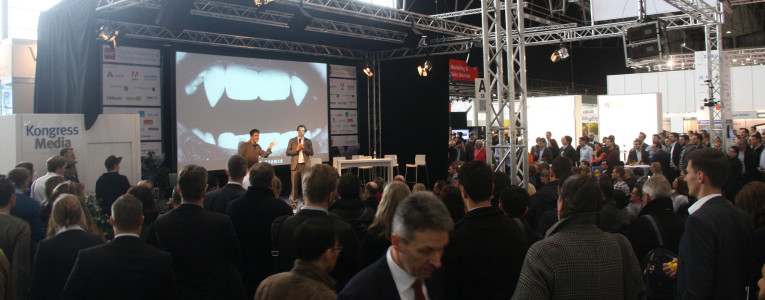
Kongress Media at CeBIT 2016-765x300

I have a problem with talking about the “Operating System” for the organization. I realise that in dealing with the new digital landscape and new business models, our organizations need to change. Dramatically (but we know change is really difficult). Traditional hierarchies and command and control just aren’t effective any more. Management isn’t working! White collar workers in the typical business seem to be busier and less productive than before. How can we fix that? What is the solution? If it’s upgrading the organization to a new Operating System then that feels like an industrial, command and control based solution to the problem. It’s thinking of the the new paradigm in terms of a kernel and drivers, connecting hardware and software, to be tested and debugged. It’s like thinking of the brain as just an electrical circuit. A collection of 90 billion neurons, each one connected to a thousand others, passing electrical signals. But that brain supports the mind which thinks and feels and imagines and has subjective thoughts. More than just electrical circuits.  We need to think organic rather than mechanic or engineering.

Now to Dave Gray. As well as his soon to be published Liminal Thinking book that I blogged about last week, Dave has work in progress following on from Alex Osterwalder’s Business Model Generation and Value Proposition Design books, with his Culture Mapping sessions – I recommend you take a look at his thinking on this. When Dave talks about this, or does a workshop, he often says that culture is like the Operating System of the company, but then he usually goes on to talk about changing and nurturing it in terms of gardening (explained here). In his talks he’ll often quote Louis Gerstner, from one of Agile Elephant’s favourite books (Who Says Elephants Can’t Dance? – from 2002 – it’s part of the reason behind for our name):

“Until I came to IBM, I probably would have told you that culture was just one among several important elements in any organization’s makeup and success — along with vision, strategy, marketing, financials, and the like… I came to see, in my time at IBM, that culture isn’t just one aspect of the game, it is the game. In the end, an organization is nothing more than the collective capacity of its people to create value.”

Although Dave uses operating system as shorthand, I prefer his more organic explanation and definitely agree with his focus on organzational culture.

There is plenty of talk about how the traditional hierarchy of most organizations is reaching its limits. There is talk of flattening the management structure and self organising and we reference companies like W. L. Gore, Valve Corporation (Steam) and Semco Partners. These are great examples, but I worry over the way some people talk about these and Holacracy without fully understanding the scale of the rules and methodologies that underpin it. I hear people discussing Frederick Laloux’s Reinventing Organizations book and the pursuit of the Teal Organization. My concern is over being too prescriptive with our solutions. At Agile Elephant we believe there are no “one size fits all solutions”. Every organization is different and at a different stage of evolution in the new digital landscape, and so we believe there needs to be more focus on the activities and behaviours and characteristics that work, rather than striving for a particular system that might.

That leads me to my Enterprise Irregular buddy Sigurd Rinde and discussions which will result in a series of posts including this one. In our catch up call this week we talked about where the classic organization is, and where the modern organization needs to be. He told me how positively people respond when he talks about white collar productivity and tells them (in words which I stole and used above):

“Management isn’t working!”

In our conversation he added more names to the list of companies that aren’t using a traditional hierarchy like Patagonia, Buurtzog, Handelsbanken and Zappos. Then we talked about Zappos and his discussions with them and their problems in changing to Holacracy. However, the most powerful thing we talked about is how organizations spend too much time thinking efficiency when they should be thinking effectiveness. Business is all about getting the work done and the work is a flow. Most of our organiations have vertical application silos – ERP, CRM, Email, HR, Document Management and more. Then we are adding enterprise social networks like Jive, or extra collaboration tools like Slack. The digital workplace is getting more complex.

Sig talks in language that we Elephants like. He talks about getting the work done as value creation. This core purpose generates a sequence of activities – a flow. Like water it requires a framework to be useful. Now there are three basic ways you can move water around:

  • In pipes – that’s the industrial approach, creating a complex system of flows with fixed connections, joints and valves, and more pipes to connect to the next system – like too much of the business application software we use.
  • In buckets passed hand to hand – how much of our day to day work feels like that, with work slopping over the edges on to the floor and not getting to where it needs to be?
  • Along a riverbed – water finds its path – there may be rocks, branches and obstructions that change the flow, but water finds its way around them, and we can work on the riverbed to remove the obstructions, or the river banks to shorten the course.

RiverBed

So when it comes to looking at company organizations at the Enterprise Digital Summit Paris, I’d prefer us to be thinking in organic rather than machine terms. I want us to be thinking about the things that work rather than the particular system deployed. Above all I want us to be thinking about frameworks and that riverbed and how we can make the value flow more effectively.

photos courtesy of Kongress Media and Sigurd Rinde
Share this:

  • Tweet
  • Email

Filed Under: #EntDigi conference, corporate culture, hierarchies, ideas, organisational culture Tagged With: Alex Osterwalder, brain, culture mapping, Dave Gray, Elephants, Louis Gerstner, mind, operating system, Sigurd Rinde

Enterprise Digital Summit London 2015 – #EntDigi impressions and key messages

October 27, 2015 By David Terrar

Enterprise Digital Summit London 2015 – #EntDigi impressions and key messages

Here’s a Storify summary of impressions, tweetable slides and key messages from the 22 Oct 2015, Enterprise Digital Summit London event, selected from the #EntDigi tweet stream and flickr photos.

We’ll be publishing more posts, impressions and write ups here soon.  Please contact us if you want to find out more.

Share this:

  • Tweet
  • Email

Filed Under: #EntDigi conference, collaboration, digital disruption, digital transformation strategy, Enterprise Social Network, future, organisational culture, social business, workplace

TEDx style Social Business Salon – evening 1 July in London

June 16, 2015 By David Terrar

TEDx style Social Business Salon – evening 1 July in London

Our friends at BroadVision asked us to collaborate with them on an event on the afternoon of 1 July when their founder and CEO, Dr Pehong Chen is over from the USA to speak and visit customers. We decided that was a great opportunity for him, as one of the social business pioneers, to also be the main speaker at our regular, evening “first Wednesday” Social Business Session London Meetup group. BroadVision would then sponsor the event so we can hold it at one of our favourite venues – the British Academy, 10-11 Carlton House Terrace – and because of that we would put on a special, more structured, TEDx style agenda. Things have come together to make, what we hope, will be a really great evening.

Start time for the event will be 18:15. For anyone that can arrive a little early, there will be a pre-event drinks reception sponsored by BroadVision at the ICA (which is actually physically underneath the British Academy, although the entrance is on The Mall) from 17:30 to which everyone is welcome, then we’ll move on “around the corner” to the British Academy at 18.15 for networking. Formal presentations will start soon after.

The theme for the evening will be future of social business and the digital enterprise. We have a great line up of speakers and topics as follows:

  • Dr Pehong Chen, CEO of BroadVision: Reclaiming control of your business communication
  • Jon Mell, Digital Leader IBM: Watson and the future of cognitive computing
  • Dr Kerstin Sailer, Lecturer in Compex Buildings at UCL: Designing spaces for people
  • Matt Partovi, Founding Member of responsive.org: Creating a fundamental shift in the way we work and organise in the 21st Century
  • Philip Sheldrake, Managing Partner Euler Partners: Organised Self
  • Anne McCrossan, Managing Partner, Visceral Business: Emergent Code Chronicles – making sense of what our future might be as digital humans
  • Bjoern Negelmann, Kongress Media: European perspectives of Social Business and Enterprise Digital Summit update
  • Benjamin Ellis, CEO Socialoptic: Organising chaos – techniques for leading this future enterprise

Rather than our usual panel of volunteers, all the speakers will join the Q&A session to discuss the future of the digital enterprise and what we should be focusing on to help organisations tackle the technology revolution. Our goal is to get everyone present involved, to merge ideas and minds and create a great evening of debate and discussions. Please come along, and tell your friends. Full details and to book a free space, register on the Meetup page as usual.

We would like to thank our sponsors BroadVision and Kongress Media for making this event possible, and we look forward to seeing you for some lively debate.

Share this:

  • Tweet
  • Email

Filed Under: enterprise 2.0, events, organisational culture, social business, workplace

The emerging risk of digital Taylorism

October 13, 2014 By Alan Patrick

The emerging risk of digital Taylorism

In our reading of the potential evolution of the work transformation, there are some rather compelling but very worrying views on the evolution of knowledge automation, from a variety of sources:

Instead of promoting a more participative and democratic society as hoped for by Castells and others, vertical disintegration and decentralisation allow for what is discussed under the broad term of marketisation. ‘By bringing the competition in product and labour markets to bear on their own internal processes, … [firms] are turning the market into an instrument of control’. [Sauer] therefore sees a ‘market-led decentralisation’. The individual unit although technically more independent is subjected to new and worse constraints through management by objectives including internal and external bidding as well as the application of benchmarks or the imposition of profit targets. Hierarchical control is replaced by sanctions by the ‘market’ and markets are increasingly internalised into business units

In services the ‘opening to the market’ can also take the form of elimination of managerial mediation between workers and customers and the increasingly direct exposure of workers to the changing wishes and requirements of customers. In management literature this is greatly welcomed as ‘advanced customer-orientation’. For workers, advanced customer-orientation can mean even more stress, especially if management at the same time cuts resources in order to save costs.

In essence, the demand for high rates of return on capital drives management to save costs by cutting resources which in turn can undermine the new autonomy workers enjoy in decentralised, digitised workplaces.  Rather then dreams of a post-Taylorist workplace emerging, there is increasing evidence that “new forms of bureaucratic control and repetitive tasks have been extended to the information sector”- or Digital Taylorism

Or there is this view – there is a high road and a low road that will be followed:

The high road variant can also be associated with the high-trust, high performance firm. Its main features are: decentralisation, creation of comprehensive tasks, establishment of work groups, promotion of competence development and sharing of knowledge as well as interdepartmental co-operation and integrated product development.

The low road type strive to achieve competitiveness through cost-cutting, which among other things expresses itself in staff reduction or outsourcing. For the internal organisation of work this mode means: organisation of work processes according to value creation aspects, acceleration of the processes through the grouping of individual work tasks and activities into business processes, intensification of work, and a tendency to divide staff into a highly qualified core and a low-qualified periphery that are employed to balance out capacity fluctuations.

In previous cycles, the Low road was usually the preferred option, the high road was the one less taken, and there is no compelling reason to believe anything will be different this time round.

The starkest portrait of Work to Come is this one – that the future of work, for many people, will be them strapped to an automated digital workflow, continuously prodded and monitored while doing the tasks that machines cannot yet do well or cheaply enough.

And there is nothing in the past that gives one comfort these scenarios above won’t play out, apart from maybe in very high value, high creative workspaces where Taylorism never really took hold – but even there, in law, medicine and other professional white collar areas, work is increasingly overwatched by digital monitoring devices. The only hopes from past experience is that where people have been well integrated with the process, and team work has been allowed to work, it has worked better than pure automation. (Cells, Quality Circles, etc) – but it does need careful design, appropriate use of automation, upskilling of the average worker, and flexible organisation structures above and around it.

These are non trivial requirements, needing non trivial design of new ways of working that are demonstrably more productive than those the neo-Taylorists are dreaming up, too often under the disguise of “smart” tools.

It is our view that if we (humans) do not do it this way,  especially in the high cost OECD countries, we shall most certainly get Digitised Taylorism in spades. One our prime items in our Manifesto is that work should be about people.  So – for anyone interested in the future workplace transformation,  our view is that for it to be sustainable for people, somewhere along the line it will be essential to work out how to take the high road

Incidentally, this is also why we have given our support to the hi: project. hi: stands for Human Interface, i.e. creating the tools and techniques that enable work to take the high road noted above (or is that the hi: road 😉 )


Share this:

  • Tweet
  • Email

Filed Under: high performance, organisational culture, workplace

Dealing with Digital Disruption

October 8, 2014 By David Terrar

Dealing with Digital Disruption

Riding the Digital Enterprise Wave

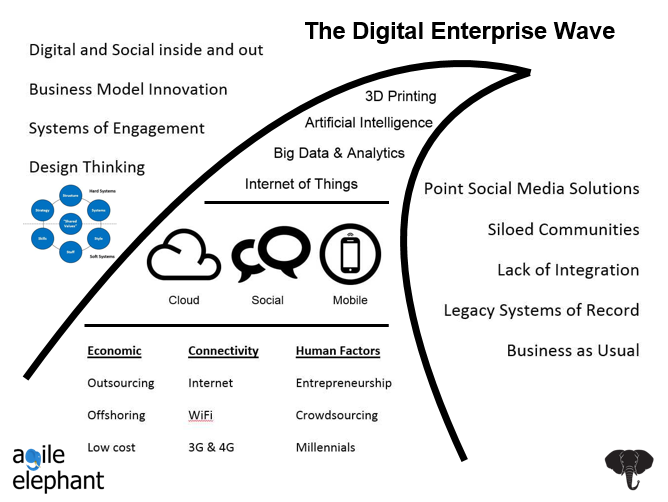
Your business model is under threat from what we call the Digital Enterprise Wave. Are you going to ride it or go under?

The digital enterprise wave from David Terrar

Take a look at these slides and let me explain how the business landscape is changing. It’s driven by significant changes in infrastructure and things that we already know about. There are Global economic pressures where access to low wage costs in Asia, Eastern Europe, or South America are facilitating outsourcing and offshoring, all supported by the connectivity provided by the Internet, extended by the huge rise in Wi-Fi access, 3G and 4G so that we now live in an “always on” World. Those things have dramatically lowered the costs and barrier to entry for any business start-up idea. It’s fostering an explosion in entrepreneurship. It’s enabling crowd-sourcing of expertise from Wikipedia to Waze. It’s giving us a new generation of Millennials who have grown up digital so that they think differently, communicate and multi-task in ways that are changing the expectations of the (digital) workplace forever. These are the factors that underpin the ideas in Thomas L. Friedman’s The World is Flat, or that facilitate the access to niche markets behind Chris Anderson’s The Long Tail, or give us Clay Shirky’s Here Comes Everybody. These factors form the foundation of the wave.

Next we have the Big Shift. For the last 50 years Moore’s Law has driven change and innovation in technology. Every 5-10 years we’ve had a major technology disruption that has changed the way we do business, created new companies, and seen the demise of others. We moved from the mainframe to the minicomputer, and then to the advent of the IBM PC back in 1981. We’ve networked computers and created the era of client/server applications and then seen the start of the Internet, web 1.0 and the Dot-com boom and bust. Then things started to get interactive with Web 2.0. However, we’ve never had more than one technology disruption happening at once, until now. Now we have three major technology disruptions happening simultaneously, and that’s never happened before. The shift to the Cloud and web apps is happening at the same time as the shift to social media where all markets are conversations, and that’s happening at the same time as the shift to mobile – smart-phones and tablets mean that most of us are carrying around the Internet in our hands. That Big Shift is the next layer of the wave.

Then on top of that there are emerging technologies like the Internet of Things, Big Data & Analytics, Artificial Intelligence and 3D Printing. Each one of these has the potential for an even more profound effect on the World economy, the global supply chain and the way business works. Today’s marketplace has more demanding customers, faster changing technology and more competition than ever before, and the rate of change is getting faster. These emerging technologies form the top of the wave. Whatever business you are in your business model is under threat by a smarter, nimbler competitor who will be using technology to skip past you in to a new field of play.

The problem is that most companies are too focused on the day to day. They think business as usual. They have legacy business systems, with tired old style user interfaces – systems of record that keep score for the business. There is often a lack of integration. Where social media initiatives or communities have been started, using the new web tools, they slide over the top of existing systems rather than connect properly. They’re alternatives to email for communication instead of changing the game. They are point solutions or provide siloed information, when you need to think in a holistic way about the business. Business as usual will get swamped by the wave.

To ride the wave we need think differently. We need to think “digitally”. We need design thinking and business model innovation. We need to create systems of engagement which connect and engage with our customers and partners. We need to think in terms of using digital and social tools outside, but more importantly inside our businesses to create the connected digital workplace and a new way of working. Digital thinking will help you ride the wave, but it has to be applied to the whole business. We use the McKinsey 7 “S” framework to look at every aspect of the business – it doesn’t matter so much which framework and approach you use, as long as you think beyond just “putting lipstick on a pig” with a dash of digital and social sitting on top of your “business as usual”.

We’re now moving to an “Everything as a Service” World where companies like AirBnB are changing the hotel industry, Uber is changing the taxi business and Apple is about to change the card payment industry. As I said before, I don’t care who you are and what business you are in, your business model is under threat and you need to be using tools like the Business Model Canvas and the Value Proposition Canvas to rethink and refocus what it is that you do.

We are talking Digital Transformation – what is that?

You will have noticed that companies that have been talking social media in business, or enterprise 2.0 or social business have just started to talk digital instead. Social collaboration tools and platforms are an important component that you might use in your evolution or transformation to doing better business. By using the term digital we are highlighting that you need to think further than just adding social and mobile technologies on top of your legacy systems. You have to harness your existing technology, those systems of record, and make them work better. You have to think of using technology to help you go to market faster with new offerings and to reach your customers in new ways. You have to re-evaluate your business and your value proposition and stop thinking business as usual. You have to start thinking “digitally” for your business and an entire new generation of technologies as well as looking at the culture of the way your company communicates and interacts. You don’t have to change your company structure, but you do have to recognise that we now live in a networked World where every person in your organisation can be involved and engaged in the same way that they connect with brands in their personal lives. Smart companies can evolve a digital strategy. Business as usual will get left behind. If you are behind the curve like a Kodak or Blockbuster or even a Phones 4U, you have to think in terms of a more significant digital transformation. But going digital to survive is a given.

Sounds quite interesting, but why bother?

If this still sounds nice to have as an add-on rather than vital, the most important thing is that it works! Take a look at these survey results from Capgemini Consulting and MIT Sloan Management from their report “How digital leaders outperform their peers in every industry“. They split the surveyed organisations in to 4 categories, with the most digitally savvy being called the “Digirati”. Companies in that most advanced category generate 9% more revenue, create 26% more profit and have 12% higher market valuation than the rest. Going Digital makes a direct contribution to the bottom line.

This post was first published on diginomica.com as Riding the Digital Enterprise Wave

Share this:

  • Tweet
  • Email

Filed Under: agile business, business innovation, digital disruption, enterprise 2.0, future, high performance, organisational culture, social business, strategy

Sign up for our regular Agile Elephant Newsletter - news, posts, ideas and more.

My Tweets

From the Agile Elephant Blog

  • The Metaverse doesn’t exist yet, but…
  • Impossible Things get Disruptive
  • Clarity, Cloud, and Culture Change at IBM

What Next?
Take a look around our site, check out our approach, see how we can help, join the conversation on our blog or contact us to find out more.

About Us

Agile Elephant is a new kind of consultancy designed to help companies embrace the new digital culture of social collaboration, sharing and openness that is changing business models and the world of work.

Contact us to find out more!

Our founder's blogs:

broadstuff

@DT on Medium

Technotropolis

Our blog:

The Agile Elephant Blog

Site Log In | Site Log Out

Subscribe to Site RSS

Subscribe to our Blog via Email

Enter your email address to subscribe

Join 30 other subscribers

Copyright © 2026 ·Streamline Pro Theme · Genesis Framework by StudioPress · WordPress · Log in