Agile Elephant making sense of digital transformation

innovation | digital transformation | value creation | (r)evoloution

  • Email
  • Facebook
  • Google+
  • LinkedIn
  • Twitter
  • Home
  • Manifesto
  • Services
    • Our Approach
    • Our Services
    • Making Collaboration Work Packages
    • Collaboration Solutions
    • Our Experience
    • Workshops
    • Innovation
  • About Us
    • The Team
    • Why we do what we do
    • Why are we called Agile Elephant?
    • Our Partners
    • Our Clients
  • Get Involved
    • Events
    • Meetups
    • Unconference
    • Newsletter
  • Resources
    • What is Digital Transformation?
    • What is the Digital Enterprise Wave?
    • Our Research
    • Case Studies
    • People We Follow
    • Articles & Links
    • Books That Inspire
  • Blog
  • Contact Us
Home Archives for employee engagement

November 5, 2014 By Janet Parkinson

Social Onslaught at Workplace Trends Conference – London

A few weeks ago I was invited to take part in Workstock’s first pop-up event which formed part of the Workplace Trends 2014 conference in London. The challenge was quite simple – create a Pecha Kucha of 20 slides with a preset 20 seconds to deliver each – and shake up the staid world of workplace. No problem…

Nervous was an understatement but the energy and creativity which Workstock and its participants created was worth every second. Thanks to Neil Usher for Workstock’s creation and also to Cara Long who wrote short introduction stories for everyone. Here’s my poem:

Over the past 7 years or so we have witnessed the explosion and ubiquitous use of social tools which have for most of us changed both the way we handle our social lives and increasingly our working lives too. The traditional natural and easy divide between work and home has now become blurred as we often find ourselves constantly switched on and accessible to all – permanently. Switching off isn’t easy.

Yet there is increasing evidence that switching off is critical to our health and multitasking which is a result of being constantly accessible damages both our brains and work. As a recent article in Forbes notes:

“Research conducted at Stanford University found that multitasking is less productive than doing a single thing at a time. The researchers also found that people who are regularly bombarded with several streams of electronic information cannot pay attention, recall information, or switch from one job to another as well as those who complete one task at a time…

…Researchers at the University of Sussex compared the amount of time people spend on multiple devices (such as texting while watching TV) to MRI scans of their brains. They found that high multitaskers had less brain density in the anterior cingulate cortex, a region responsible for empathy as well as cognitive and emotional control.”
Share this:

  • Tweet
  • Email

Filed Under: digital disruption, employee engagement, workplace

Social Business – Europe vs UK

September 29, 2014 By Alan Patrick

Social Business – Europe vs UK

We attended the IoM conference in Cologne last week, at the same time London Social Media Week was happening. (David gave a keynote talk, the slides are over here). It was interesting to juxtapose the core themes of these 2 events (incidentally, it was our  Patchwork Elephant Conference held during last year’s Social Media Week London that persuaded us to set up Agile Elephant).

In a nutshell, I noted the following large differences in themes on my twtstreams:

  • In Europe, a large amount of the case studies are based around improving operations, all over the business.
  • In the UK, most of the focus is on customer attraction – marketing, lead generation and sales.
  • Where the UK is looking at operation improvement, it tends to be around customer facing operations, typically serving existing customers.

Now to be fair, IoM is about “social business” whereas “Social Media Week” has a wider remit, but it’s interesting to note that even “Social Business” conferences in the UK are often focussed much more heavily on the sales/marketing arena. (Which is why we are running a more operations & customer related conference in November – see last paragraph of this post)

When we were kicking around the “why” this might be so, we came to the following hypotheses:

  • The UK has a more mercantile industry structure, but Europe has retained a lot more of its manufacturing industry – so by definition there are more European companies interested in operations improvement.
  • It is very likely that the CXO power base area is different – UK companies tend more often to be run by ex salesmen or accountants, European by ex operations people – the path to the CEO office usually tells you where the major power in the organisation lies, so its more likely that new projects in these areas are seen as priorities.
  • It may be cultural as well – in the UK my observation over many years’ consulting is the culture is more “sell it first, we’ll work out how to deliver it then” than European comapnies. As one delegate at IoM told us, to not have its operational side ticking along like a well made clock is painful for for a Germanic or Nordic company.

Whetever the reasoning, it leads to an interesting conclusion – best practice on customer attraction areas is in our observation coming from the UK and US, best practice in operational areas from Europe. Customer service examples seem to be coming from everywhere (it was after all a Swede who invented the concept of Moments of Truth in the customer value chain).

On implementation of social business projects, it seems that the same lessons are being laerned no matter where you are in the world, in that:

  • Projects should address an area of real business need
  • Pilot first
  • Use enthusiasts from the Pilot process to help spread the new system
  • Nothing will take off easily without CXO involvement
  • Nothing will scale easily without IT involvement
  • These projects put pressure on existing organisation structures, so education, and careful and sensitive change management is required.

There is a lot of discusion about what future organisation structures could or should be, in the UK and Europe, but after speaking to Jane McConnell, who has done quite a lot of research on this issue, I am increasingly coming to the conclusion that it’s more the culture than the structure or anything else that make the major difference in an organisation. As one person noted at IoM, “Culture eats Strategy for breakfast” (Peter Drucker).

The speaker roster at our Social Enterprise Summit in November tries to reflect this observation, in that we have invlited some real “best of” practitioners from Europe and the UK to speak. We are also giving a 1 day workshop the day before where we will present a wide array of “best practice” case studies from all over Europe as well as the UK.

Update – interesting article over here by Gloria Lombardi on the Northern European view od Social collaboration


Share this:

  • Tweet
  • Email

Filed Under: employee engagement, enterprise 2.0, social business, strategy, workplace

Employee Engagement :  The New Heart of Enterprise 2.0?

February 17, 2014 By Janet Parkinson

Employee Engagement : The New Heart of Enterprise 2.0?

‘7 out of 10 of your colleagues don’t give a sh*t about your company.  The biggest problem is employee engagement”  Luis Suarez at the Enterprise 2.0 Summit, Paris 2014

Luis was using figures from this Gallup survey which highlights how only 13% of employees worldwide are engaged at work. He’s right – but why is this?  You only have to look at the rise in volume of Google searches for the term over the last 5 years to see just what a buzzword ’employee engagement’ it is becoming, and it does lie at the heart of  the Social Business / Business Transformation / Enterprise 2.0 ethos – so why the poor figures?

There has been so much research produced over the years showing that employee engagement really does help the bottom line that no one can deny that benefits really do exist.  Take just one set of results by Gallup of meta-analysis of 1.4 million employees which shows that organizations with a high level of engagement do report 22% higher productivity, and Harvard Business Research which states:

‘strong employee engagement promotes a variety of outcomes that are good for employees and customers. For instance, highly engaged organizations have double the rate of success of lower engaged organizations. Comparing top-quartile companies to bottom-quartile companies, the engagement factor becomes very noticeable. For example, top-quartile firms have lower absenteeism and turnover. Specifically, high-turnover organizations report 25% lower turnover, and low-turnover organizations report 65% lower turnover.”

Social tools have been shown to be some of the most powerful enablers of employee engagement over the last few years as reports by McKinsey have shown.

Yet it seems that only now companies are catching up with the technology and beginning to take on board the true power of the social tools available to them. Having spent the last 5 years or so adapting their external marketing mix to absorb the power of social media, they are beginning to realise the full potential of internal social tools which are speeding up business processes and breaking down silos allowing employees to collaborate more effectively and at greater speeds.  Happier employees providing customer service support really does produce better customer service results. Companies now realise that with social tools which run in realtime they cannot remain hidden behind a wall.  They therefore no longer have the option to ignore it – employee engagement is about to hit big time.

As Luis notes in the interview below it is only in the last 2 years that we are beginning to hear more about behavior and how to influence mindsets rather than just hearing about the social tools.  “We are not there yet…  but now that we are talking about behavior we will begin to see a massive shift in the way that employees are engaged in the work that they do”.

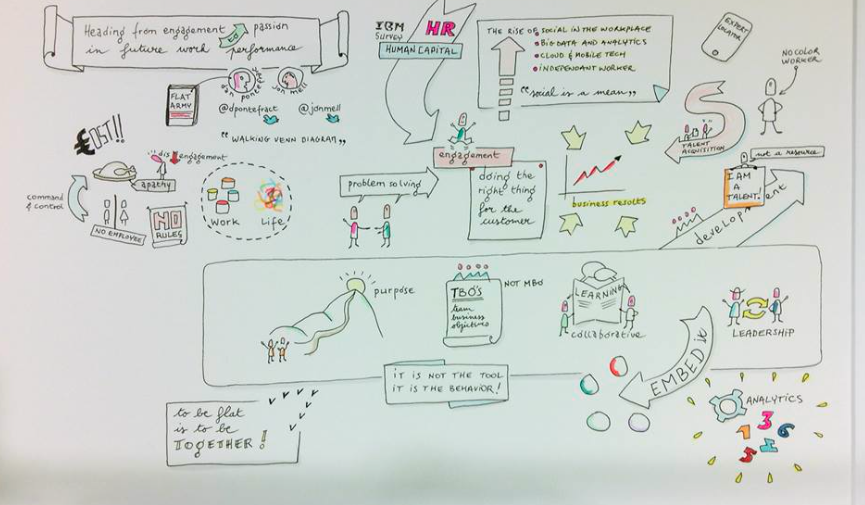
It was great to see though that employee engagement appeared as a key component of the Summit (which was after all traditionally a technology conference).  Yet it was right up front with both headliners. Dan Pontefract of Telus stated:

  • It’s not the tools it’s the behaviour
  • Engagement is a big driver of profitability which in turn is driving HR activity now
  • You can tie engagement to KPI drivers

and Jon Mell of IBM who noted:

  • Employee engagement drives customer satisfaction which drives profits
  • There are analytics now behind employee engagement which are key to the whole process, from interview questions to the proactive retention of the best employees
  • HR now has a seat at the table and has the power.

Many of the case studies touched upon engagement – though more often in terms of collaboration than specifically in terms of engagement.

Emanuele Quinterelli of Ernst & Young noted how in a survey of 300 Italian firms:

  • Currently the laggards tend to have no one in charge of collaboration as such
  • 56% of laggards have virtually no budget for collaboration while the top performers have at least 100k Euros of yearly budget and use business metrics 3 times more
  • 50% of laggards have no measurement, though only 9% of leaders have measurement in place
  • Leaders are engaging employees to engage customers

Martin Risgaard Rasmussen described how Grundfoss have deployed a program of culture change called Global Working Culture – run by HR.

HR – the company leaders of the future?

Following on from Jon Mell’s remark there are others who agree that HR really does have a seat at the table and Mar.  Oracle president Mark Hurd last October called for HR to transform itself and start to lead and drive businesses:

‘I want HR to help me run the company, to help with insight that will allow me to make the key business decisions, which will help the company grow…  Over the next decade HR as a function needs to lead and drive the business rather than react to it… It’s going to have to drive it in a way that’s more complicated than anyone has ever experienced before…  Turning from a support function to a leadership function will be core to what HR does in the next decade”

But in addition to HR let’s not forget the role of community managers.  At the Summit Rachel Happe discussed how to drive engagement and adoption on social platforms.  “A Community Manager has to inspire, establish and normalize a behavior change, this drives ROI” she said in a recent interview.  Community managers do act as lynchpins to networks which are increasingly crucial to the whole social business process.  Their role can encompass not just the monitoring and enhancement of engagement right across a company but also can provide and evaluate what can work better for the success of engagement across the whole community.

Employee Engagement – The Vision

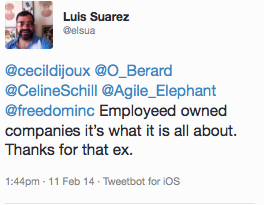
But perhaps the killer statement for me in terms of employee engagement came from a casual tweet by Luis on the second day of the Summit:

Screen Shot 2014-02-16 at 12.28.01

To truly engage employees to increase the performance and profitability of companies isn’t the ultimate deal to enable employees to own shares in the company?

Employee ownership is indeed on the rise:

“Employee ownership, where workers have a voice as well as a stake in the success of their business, is recognised as a sustainable business model which helps drive staff commitment, productivity, resilience and innovation.”  Real Business

And:

“Total return for shareholders in FTSE companies with employee share ownership rose by 53% in 2013, compared to 21% for companies in the FTSE All-share index, according to research by corporate finance firm Capital Strategies and the London Stock Exchange.” Employee Benefits

It’s becoming clearer that the way companies currently structure measurement and reward just isn’t working.  If you want employees to be truly engaged and really feel part of the big picture then treating them as cogs in the wheel and rewarding them for just being good cogs is never going to be enough.  Having a stake in the business will motivate them to take a business sized view.

Best of all it appears that Luis even has the UK government on his side…

 “Policy makers are increasingly embracing employee ownership as a key sustainable business model, and over the last 18 months we have seen a significant increase in support for this sector. In his budget in April this year (2013), George Osborne announced that, with effect from 2014, the Treasury would set aside £50m in tax reliefs for the employee ownership sector.  On top of this, in yesterday’s Autumn Statement George Osborne put the Government’s money where its mouth is, pledging a further £25m in support of this fast-growing sector of the UK…”  Real Business

Well, we’re not sure how many years we’ll have to wait for employee ownership to really take off and become the norm – but perhaps Luis should come over to London to give George a helping hand 😉

Image by Frederic Williquet: @fredericw : https://twitter.com/fredericw/media

Share this:

  • Tweet
  • Email

Filed Under: business innovation, collaboration, employee engagement, enterprise 2.0, HR, social business, social tools

Key factors for Strategic Enablement

February 15, 2014 By David Terrar

Key factors for Strategic Enablement

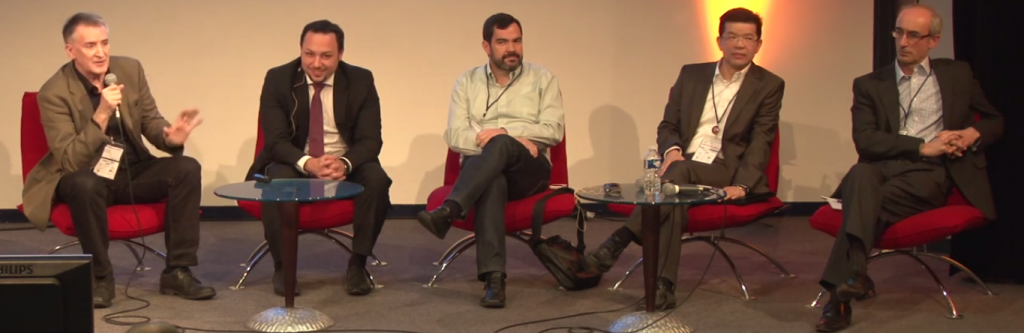
Here is the panel session that I took part in at the Enterprise 2.0 Summit in Paris this week, on 11th & 12th February 2014.  We were discussing the key factors for strategic enablement of enterprise 2.0, social business, and social collaboration in organisations. Emanuele Quintarelli set the scene presenting a survey of Italian firms. Then the discussion, moderated by Bjoern Negelmann, was between:

  • Emanuele Quintarelli – Digital Transformation Practice Leader, Ernst & Young
  • Luis Suarez – formerly Social Computing evangelist, IBM Software group
  • Dr. Chee Chin Liew – Enterprise Community Manager, BASF SE
  • David Terrar – Founder & CXO, Agile Elephant
  • Simon Levene – Senior Strategy Consultant, Jive Software

There was actually some tension between the speakers, resulting in a great discussion.  The tension is between the likes of Emanuele and myself who want to lift the argument to real, hard, business numbers and metrics that the executives in the C-Suite can understand in a business case, versus Luis and others at the conference who want to focus on the culture change required in the workplace, on improving employee engagement, the move to knowledge sharing, open business and collaboration, with use cases that are effective.  Both are important.  But to accelerate things, it’s my belief we need cold, hard business logic combined with the inspiration to change to open business.  Listen to the discussion and you decide.

Here are a few key quotes I’ve lifted out of the dialogue:

“7 out of your 10 colleagues don’t give s#%! about what you do today!”

“need more doing than talking”

“go back to the core nature of how work gets done”

“how can I help you today?”

“but first of all we need to make it clear to the business where is the benefit”

“does management agree or recognise social as an enabling tool for more engagement and to solve the problem of the fundamental (financial) crisis?”

“not happening yet because we are talking about collaboration, we are not talking about measurable business benefits”

“the majority of people in this room are believers in this thing”

“it’s up to us as a community to get out there and communicate it better to the average business person in the street

“it’s all about use cases, if you come up with a list of top 10, 15 use cases of how people work and socialise them”

“break a silo, and you go in to openness and transparency”

My post setting the scene and introducing the show is here, and my conference report will follow shortly.

Share this:

  • Tweet
  • Email

Filed Under: business innovation, change management, corporate culture, employee engagement, enterprise 2.0, events, strategy Tagged With: Agile Elephant, BASF, business metrics, culture change, depression, employee engagement, Ernst & Young, hard numbers, IBM, Jive, Kongress Media, optimism, ROI

Sign up for our regular Agile Elephant Newsletter - news, posts, ideas and more.

My Tweets

From the Agile Elephant Blog

  • The Metaverse doesn’t exist yet, but…
  • Impossible Things get Disruptive
  • Clarity, Cloud, and Culture Change at IBM

What Next?
Take a look around our site, check out our approach, see how we can help, join the conversation on our blog or contact us to find out more.

About Us

Agile Elephant is a new kind of consultancy designed to help companies embrace the new digital culture of social collaboration, sharing and openness that is changing business models and the world of work.

Contact us to find out more!

Our founder's blogs:

broadstuff

@DT on Medium

Technotropolis

Our blog:

The Agile Elephant Blog

Site Log In | Site Log Out

Subscribe to Site RSS

Subscribe to our Blog via Email

Enter your email address to subscribe

Join 30 other subscribers

Copyright © 2026 ·Streamline Pro Theme · Genesis Framework by StudioPress · WordPress · Log in