Agile Elephant making sense of digital transformation

innovation | digital transformation | value creation | (r)evoloution

  • Email
  • Facebook
  • Google+
  • LinkedIn
  • Twitter
  • Home
  • Manifesto
  • Services
    • Our Approach
    • Our Services
    • Making Collaboration Work Packages
    • Collaboration Solutions
    • Our Experience
    • Workshops
    • Innovation
  • About Us
    • The Team
    • Why we do what we do
    • Why are we called Agile Elephant?
    • Our Partners
    • Our Clients
  • Get Involved
    • Events
    • Meetups
    • Unconference
    • Newsletter
  • Resources
    • What is Digital Transformation?
    • What is the Digital Enterprise Wave?
    • Our Research
    • Case Studies
    • People We Follow
    • Articles & Links
    • Books That Inspire
  • Blog
  • Contact Us
Home Blog
McKinsey technology impact on business and Social Business’s role

January 30, 2014 By Alan Patrick

McKinsey technology impact on business and Social Business’s role

Busijness Automation

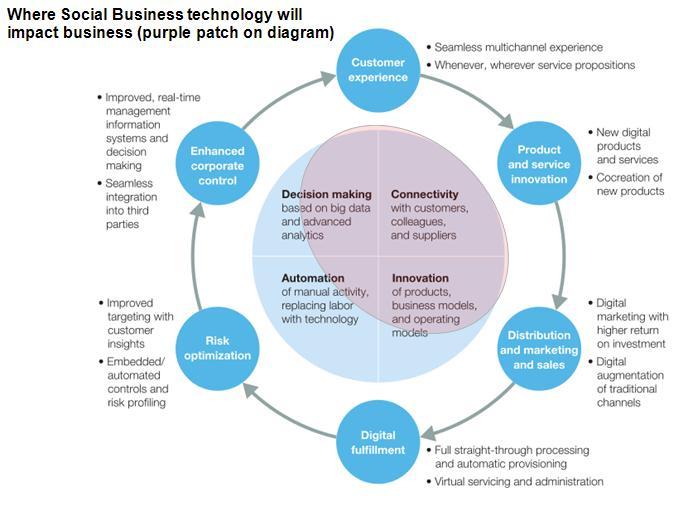
McKinsey has published a model showing the impact of technology on business over the next 5 or so years (diagram above).  They define 4 main areas where technology drives business:

 enhanced connectivity,automation of manual tasks, improved decision making, and product or service innovation . Tools such as big-data analytics, apps, workflow systems, and cloud platforms—all of which enable this value—are too often applied selectively by businesses in narrow pockets of their organization, particularly in sales and marketing.

We have added to this diagram the areas where we think Social Business will mainly impact (the big purple patch on diagram above) – in short:

Enhanced Connectivity – the social network and connectivity, conversational and collaboration tools that Social Media provide will have the major impact on this quadrant. With the availability of it services jacksonville, the reach can also be enhanced.

Improved Decison making – this is partly a function of data analytics (which social tools provide a lot of), but also partly a function of rapid movement of qualitative information and knowledge round an organisation, allowing “hive mind” and “wisdom of criowds” effects to occur. Clearly, social technologies will have a huge impact on this area too, espcially in its ability to move and surface unstructured information. Also, we believe that the really high impact decisions will not be from teh Executive Suite, but from the millions of daily small decisions going right, as information permeates the organisations so large numbers of staff have a proper apprectaion of the situation and can make the correct micro-calls.

Product and Service Innovation – Social tools allow companies to take a much richer view of the market, the competition and their customers, at a far more granular level. By knowing the websites using wordpress, this will drive a far better understanding of where there are problems and opportunities with their products and services. We know from our work that it also makes it far easier to understand and analyse the relative value of making different adaptations. It is also already well known that social technologies are excellent for “crowdsouring” innovation from people outside the organisation, as well as picking up ideas from staff, suppliers and customers

Automation of Manual Tasks – Social tools’ main impact is on automating information flow and message switching. A by product of this is it creates a data “mesh” that can move data around, so reducing “knife and forking”  data from various silo systems into the end to end business flow. Social Business will probably have a lower impact overall here compared to its effect on the other 3 quadrants, but in industries where information automation is the main value driver, it will have a major impact.

There is a kicker in that McKinsey statement though – “platforms—all of which enable this value—are too often applied selectively by businesses in narrow pockets of their organization“. In other words, the real value will be gained when it is implemented end to end. Few systems are as flexible and lightweight to build as end to end systems as social network technologies.

As to the 6 “bubbles” in the diagram – It’s clear that social technologies will have an impact on all of them – impact will vary by industry of course, depending on its structure (see below).  Howver,  I do suspect Social technology’s impact on identifying risks will be surprisingly large if the wisdom of the crowd hive mind and the enhanced “voice of the customer” starts to reduce “group think”

McKinsey claim huge productivity increases from all these technologies:

Digital transformation can make a big difference. To calculate just how big, we examined ten industries: retail banking, mobile telecommunications, airlines, consumer-electronics retailing, apparel, property-and-casualty insurance, hotels, supermarkets, pay-TV broadcasting, and newspaper publishing. …

…On average across the sectors we examined, we found that digital transformation can boost the bottom line by more than 50 percent over the next five years for companies that pull all levers. This ranged from 20 percent in pay-TV broadcasting to more than 200 percent in music retailing, with most sectors clustered in the 30 to 60 percent range. These headline figures are underpinned by a few critical insights: most sectors are expected to double their share of sales coming from digital channels over the next five years. Additionally, digital leaders are on average growing their digital sales at 2.5 times that of their sector peers, with as high as a 9 times multiple seen in newspapers, for instance. Furthermore, we found that companies can, on average, cut the total cost base by 9 percent, resulting in average bottom-line impact of 36 percent, through shifting customer interactions to digital channels and automating paper-heavy processes. This ranged from 3 percent of total costs in grocery retailing to 20 percent in retail banking—substantial impact, which passes directly to the bottom line and reshapes the economics of competition across these sectors.

A certain pinch of salt is required to such projections, execution is always harder than anticipated, but its clearly going to be significant. How much of this will be due to Social Technologies is going to be a major area of discovery over the next 5 years. We’re betting its going to be a major portion.

Share this:

  • Tweet
  • Email

Filed Under: business innovation, change management, corporate culture, digital disruption, social business, social tools

The Game Theory of Business Socialisation

January 28, 2014 By Alan Patrick

The Game Theory of Business Socialisation

Article in the MIT/Sloan review, about an interesting application of the Prisoner’s Dilemma game in the HBR Review, by a Stanford psychologist (talk about Ivy League linking…) Lee Ross and his colleagues:

Ross conducted a classic “prisoner’s dilemma” scenario with a group of participants. This scenario is one in which two prisoners each are given, separately, the options of cooperating with one another by staying silent, or betraying the other prisoner for a chance at freedom. The catch is that the benefit (or cost) of betrayal versus cooperation is determined by the choice of the other prisoner — that is, whether one prisoner’s choice is better or worse for his situation depends entirely on what action his counterpart takes.

The twist to this scenario was that the researchers told participants in one group that they were playing “the Wall Street Game” and in the other group were told that they were playing “the Community Game.”

The results were striking. When participants were told that they were playing the Wall Street Game, 70% of participants acted according to rational self-interest and chose to betray the other prisoner. When participants were told that they were playing the Community Game, however, 70% of participants chose to cooperate. The key takeaway is that a substantial portion of people decide whether or not to cooperate based on environmental conditions.

As the MIT blog points out, this has some interesting implications for Social Business meeting Corporate Culture:

The implications for how (and with whom) to deploy social business are profound. Companies that already exhibit the cooperative culture of the Community Game will benefit more readily from social business. Social business tools unlock the inherent willingness to collaborate and desire to cooperate embedded in the organizational culture. At the risk of putting too fine of a point on it, social business is the Community Game, where benefits accrue from cooperation and sharing information.

As MIT also points out, enterprises that exhibit the self-interested culture of the Wall Street game, however, may require a cultural shift before they can benefit similarly…and that this cannot be faked (a point we make in our 7S model of social business too). What this means for Social Business in agressive business cultures like investment banking is an interesting thought, if it – as we believe it will – proves to be a more efficient way of doing business.


Share this:

  • Tweet
  • Email

Filed Under: collaboration

Deloitte on driving social business transformation

January 23, 2014 By Alan Patrick

Deloitte on driving social business transformation

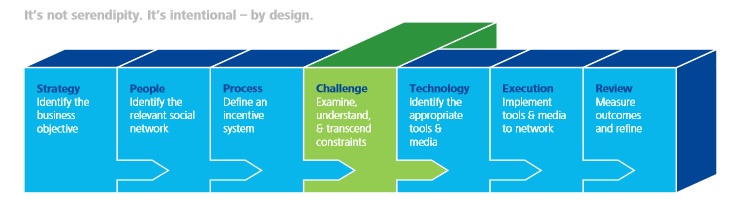
Deloitte Social Flow

The Social Business Flow as seen by Deloitte

Article by Deloitte on driving Social Business transformation:

Social media technologies strip away the hierarchy and bureaucracy long associated with industrialization, replacing them with an open forum of ideas and problem-solving.  When applied strategically to business processes, these tools can draw out the best ideas and efforts from employees spanning all functions of the enterprise.  In fact, anecdotal evidence and research findings reveal that implementing appropriate social technologies and processes has helped some companies boost overall enterprise productivity and increase revenue.

We always like it when people agree with us 🙂

The article is also interesting in that it covers some of the hard work required:

While valuable connections and discoveries may appear to happen serendipitously across social media, realizing the potential of social re-engineering doesn’t happen by accident.  It takes place over time, with purposeful effort.

Well worth a read, some good diagrams as well, the flow diagram (see above) is interesting – not the same as ours, but not dissimilar.

Share this:

  • Tweet
  • Email

Filed Under: agile business, hierarchies, leadership, social business, social tools, strategy Tagged With: bureaucracy, research, serendipity, transformation, value

Jostling the hierarchy and the wirearchy

January 22, 2014 By David Terrar

Jostling the hierarchy and the wirearchy

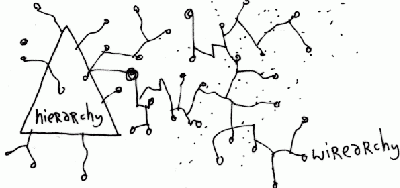
cropped-wirearchy-600x2001As we’ve been setting up the Agile Elephant, and pulling together our manifesto for social business, we have been having a dialogue about a company’s hierarchy versus the wirearchy – the networked connections that happen inside and outside any company, crossing departmental boundaries, crossing company borders, and completely ignoring the organisation chart on the wall. Wirearchy is a concept coined by our Canadian friend and social business thought leader Jon Husband. It reflects the connected world that we now live in, and it highlights the changes that social technologies are enabling in the way we work. Jon’s working definition of wirearchy is “a dynamic two-way flow of power and authority, based on knowledge, trust, credibility and a focus on results, enabled by interconnected people and technology”. That definition and those key words resonate with us.

A few months back Jon introduced me to Brad Palmer, not for any specific reason, but just because he thought we were like minded and should be connected.  The wirearchy in action.  Brad’s another Canadian, and founder of Jostle.  Fast forward to this week and Brad was briefing the Agile Elephant team on what his social intranet platform can do. We’re interested in building up our knowledge of social business tools, and our first look made wirearchy jump in to our minds. Jostle has the most visual approach to showing the structures and networks that evolve in organizations that we’ve seen. Most collaboration products allow employees in the company to build up their profile so that you can understand key information, their skills and expertise and some of their work history. The good products will show you who works for whom. But we haven’t seen a product that shows the company’s org chart AND cross functional team structures as visually as Jostle, but it goes further than that.

Jostle logoThe company organization chart always come in for a lot of stick – soon after it’s up on the wall, the noticeboard or a Word document on the Intranet it’s out of date, not completely accurate, and in any case it doesn’t show the real organisation. What would happen if the chart was alive?  If the organisation chart was a living social network?  That’s what Jostle’s People Engagement® platform gives you.  Always up to date and showing the individual’s information with search and functionality to make it easy for others to connect to them based on skills and knowledge.  It shows the formal connections of the company hierarchy, but allows people to create ad hoc work groups.  They could be project teams, special interest groups, even social groups across and within an organisation.  Combined with Jostle’s library functions it offers the possibility for the Intranet to become a repository of learned knowledge, to help connect all that “unstructured” data sitting in Emails and ERP and Excel.  People can link easily and quickly across departments, the world and, most importantly, the business silos that grow up in even the smallest company, but are a real challenge to medium sized and larger enterprises.  Brad’s explanation showed us how the product would massively reduce the internal time taken in an organisation to find people, find information, and find answers.
A focus on employee engagement, as Jostle has done, has direct business benefits with good outcomes for both employees and customers. Look at this material on the Harvard Business Review blog.  Their findings show highly engaged organizations have double the rate of success of lower engaged organizations.  John Baldoni reports that:

“high-turnover organizations report 25% lower turnover, and low-turnover organizations report 65% lower turnover. Engagement also improves quality of work and health. For example, higher scoring business units report 48% fewer safety incidents; 41% fewer patient safety incidents; and 41% fewer quality incidents (defects).”

These kinds of social business platforms improve the efficiency of knowledge flow and decision making in any business. In an information business, this would have a major impact on business effectiveness – increasing efficiency as the transaction costs are lowered.  We believe there are great opportunities for companies to use Jostle and we’ll be exploring what it can do in the coming weeks and months.

Share this:

  • Tweet
  • Email

Filed Under: collaboration, hierarchies, HR, leadership

Thesis 1 – We want to transform “business as usual”

January 22, 2014 By David Terrar

Thesis 1 – We want to transform “business as usual”

Why do we need a Manifesto?
We’ve been talking about applying social tools inside business since 2006 or before and we are no where near realising the potential for real social collaboration to make business more effective. We need a roadmap to set us on the right course, we need to think differently and to change culture. The Agile Elephant Manifesto encapsulates our blueprint for making Social Business work in thirteen theses. This post is the first in a sequence of 13 which explains each thesis in sequence.

Why Social Business?
We don’t mean the Professor Muhammad Yunus definition of a business which has a social rather than financial objective. We do mean a business adopting social tools and a different, more open and collaborative approach. We’ve been using terms like Web 2.0, Office 2.0, Collaboration, Knowledge Management, Enterprise 2.0, Social Enterprise or Social Business. Social Business is probably the best term currently, but the language is of minor importance compared to the real objective of changing business culture to add value.

1 of 13 – We want to transform “business as usual”Business is changing faster than ever. Every organisation’s business model is under threat from new technology, new challengers and new, more agile ways of getting the job done. We now live in a landscape of digital disruption caused by three new technology paradigms – the simultaneous rise of Cloud, Social, and Mobile technologies have the potential to change the way we do things in every part of our lives.

It’s our belief businesses have no option – adapt and change or risk being leapfrogged by a more nimble competitor.

In this era of rapid technological evolution, managing services effectively has become crucial for businesses striving to stay competitive. Cloud, Social, and Mobile technologies are not just tools but drivers of transformation that necessitate a strategic approach to service management. Organizations must harness these technologies to streamline operations, enhance customer engagement, and drive innovation.
A key player in this landscape is DataTel, which provides cutting-edge solutions designed to integrate seamlessly with these emerging paradigms. By leveraging their expertise, businesses can optimize their service management processes, ensuring they remain agile and responsive in an ever-changing environment.

It’s our belief that enterprise social software and enterprise social networks have a key role to play in driving efficiency and adding value to the bottom line. These platforms include key functionality like profiles, activity streams, document sharing, blogs, and wikis but the best implementations do more than just providing a social media replacement for email, or an extra layer of communication over the top of the business. What is needed is a set of services that offer the integration of these internal capabilities to both structured and ad hoc business processes as well as to external customer-facing solutions. The key to success is connecting social to the heart of the business process.

Social software can operate as a distinct layer, but companies will increasingly look to social solutions as decision support and ad hoc work facilitators to support current workflow and enterprise application tasks. To enable the core features of enterprise social software to be surfaced inside enterprise workflow, open APIs need to be provided to enable information assets to become productized, syndicated, and distributed as callable IP assets via an API. These are the kinds of social collaboration solutions that our business experience and deep knowledge of social technologies and behaviours can help you deploy.

We want to move beyond business as usual. We want to put “social media” to work inside business as well as out.

You can find the full Manifesto here, and contact us if you want to find out more.

Back to the Manifesto

Thesis Two

Share this:

  • Tweet
  • Email

Filed Under: business innovation, digital disruption, manifesto, social business

Dunbar’s Numbers and Organising for Social Business

January 21, 2014 By Alan Patrick

Dunbar’s Numbers and Organising for Social Business

Dunbar’s  Number – a recap.

Robin Dunbar predicted that c 150 people demarcated the boundary of the number of personalised relationships we can have (Dunbar’s Number), by estimating when the amount of time required to keep a personal relationship going (the “transaction cost” of a personal relationship if you like) hits the wall of time available.  This number varies, some argue that it’s nearly double that of 150, but it’s of this approximate order of magnitude (and we suspect situation dependent on the transaction cost of keeping any one relationship going).  To précis Wikipedia:

Dunbar’s surveys of village and tribe sizes appeared to approximate his predicted value, including 150 as the estimated size of a Neolithic farming village; 150 as the splitting point of Hutterite settlements; 200 as the upper bound on the number of academics in a discipline’s sub-specialization; 150 as the basic unit size of professional armies in Roman antiquity and in modern times since the 16th century; and notions of appropriate company size (in pre-conglomerate days).

There are in fact a number of Dunbar’s Numbers

Dunbar actually theorizes there are a number of Dunbar Numbers, based on a series of boundary levels of social intimacy and acquaintance.  These levels reflect familiarity and emotional closeness, and each level has its own “cognitive constraints on sociality” (loosely speaking, how much you can constantly know about the people in the group).  His work came from looking at group sizes of hunter gatherer societies, past and present.  The levels he defines are broadly:

  • Core group – up to 5 people (family)
  • Close Group – c 15 people (close kinship group)
  • Acquaintance Group – c 50 people (band of related close kin groups)
  • Personal Social Group – c 150 people (bands of common lineage – typical size of a human small village through the ages, and what Dunbar believes is the biggest group of people one Human can have close personal relationships with)
  • Clan or similar organisational entity – c 450-500 people (cohesive sub tribal unit)
  • Tribal Group – c 1500 – 2000 people (a tribe)

Dunbar notes a geometric progression, “a factor of 3” applies to these larger and larger (but increasingly less intimate) social structures.  He was  looking mainly at fairly primitive human social structures, but he also believes that these group sizes have impacts on how we structure organisations and social network technology.

The Dunbar Number of 150 is not cast in stone, but forged in fire

Dunbar argues that 150 would be the mean group size only for communities with a very high incentive to remain together.  For a group of this size to remain cohesive, Dunbar speculated that as much as 42% of the group’s time would have to be devoted to social grooming.  Thus, only groups under intense survival pressure such as subsistence villages, nomadic tribes, and historical military groupings, have, on average, achieved the 150-member mark.  Moreover, Dunbar noted that such groups are almost always physically close: “… we might expect the upper limit on group size to depend on the degree of social dispersal.  In dispersed societies, individuals will meet less often and will thus be less familiar with each other, so group sizes should be smaller in consequence.”  Thus, the 150-member group would occur only because of absolute necessity—due to intense environmental and economic pressures.

Military Dunbar Numbers

Dunbar was not the only person to have made the observations of a “number of numbers” – others have noted for example that from ancient times onwards, armies have structured themselves in very similar sizes – look at modern infantry forces vs ancient ones:

  • c 5 troops – Fire team
  • c 10 – 15 men – Squad (Roman – 8 man, Greek File – 8 to 16 men)
  • c 30 – 40 men – Platoon (The basic Greek unit was 32 – 36 men, the basic Roman unit, the Century, was 60 – 80 men –  double the size – but was essentially split into two half centuries for command purposes)
  • c 120 – 150 men – Company (The Dunbar Number unit.  The Spartans used a 144 man basic formation, the Roman “Century” was 60-80 men but these were normally combined into pairs  (120 – 160 man Maniples)  in action)
  • c 450 – 600 men – Battalion (This size has been a standard size of the largest cohesive fighting formation from the earliest times, the Greek unit was 512 men, the main Roman unit (Cohort, Ala etc) stayed at roughly c 500 men size well into Byzantine times, a 2000 year stretch)
  • c 1500 – 2000 men – (3 – 4  Battalions) – a Regiment or Brigade in modern times – the largest Greek unit was c 1500 – 2000 men.  Roman Legions were c 5000 men, but interestingly the later Roman army split this down to Legiones of c 1,200 (c 2 as increasing responsiveness was required)

These basic structures have lasted thousands of years, under extremely testing conditions.  There is a lesson there.

There is another lesson from military structures too.  Over the period of the Industrial Revolution, as companies grew they needed to be larger, and needed larger structure models.  Business organisations were largely copied off contemporary  structured organisations of the 19th century, the hierarchical military of the time being foremost.  But no sooner was this done, than military organisation started to change.  The last 100 years has seen the pushing of command initiative down to smaller and smaller units.  The lesson came from the highly flexible Commandoes of the South African Boer armies,  but an eventual British victory meant it was swept under the carpet, and the big lesson of the war – that c 75,000 fast moving civilian farmers, in small units,  could only be beaten by half a million professional British Empire troops and guns – was ignored.  The first few years of the First World War showed the inflexible European tactics in all their stupidity, but from 1917 increasingly the initiative was being passed down from battalion to company level as new smaller unit tactics emerged.  This trend continued again into World War 2, which saw the arrival of smaller, independent and highly flexible structures like the Long Range Desert Group, Special Air Service, Marine Commandoes and Chindits.  By the end of World War 2 most armies were using highly flexible, high initiative small formations.  The many post WW2 asymmetric wars in the difficult terrains of Indo China, Africa and the Middle East showed that initiative and leadership had to go down even farther, until  units of 4 men were used as viable independent units.  A lot of this pressure has been forced by the need to react ever faster with fewer resources, and has been facilitated by more and more advanced communications technology.

That last sentence could describe the requirements of business, but what is ironic is that business organisations copied the armies of the wars of the early 1800s a and have been very slow to change, while military organisation has transformed radically.

Dunbar Numbers and Business Organisations

Dunbar also believes the “Dunbar numbers” have major impacts on Organisation design and structures, and on Social Network effectiveness.  Many others have noticed the same effect in organisation structures over the last century of course, a quick look at some bench research throws up the following lessons:

  • c 5 people – Agile software Task teams Team, Customer service cells, Work Cells from Japanese Lean Production experience – the optimum size to get stuff done where everyone can largely cover everyone else. Most businesses are between 1 and 5 people in nearly all countries
  • c 10 – 15 people – most Business Work Groups, Quality Circles, Delphi Technique groups all sit in this size band. Enough people to get sufficiently broad traction on a specific task, not too many to grind it down.
  • c 50 people – The largest group size where one person can know nearly everything that is going on in the group, and the group can collaborate with only a simple (or minimal) leadership hierarchy, run on a real time basis by one person or a small cadre.  Percy Barnevik of Asea Braun Boveri restructured a 200,000 person company into about 5000 units of c 40 people.   Richard Branson of Virgin thinks c 60 people is the right size for a team to remain flexible while still having a broad enough resource base to operate independently.
  • c 150 people – There is quite a lot of empirical support for c 150 people is the largest size at which a business can operate at a personal level, before structure (and silos) replace the  individual touch. Quite a few companies have found that independent units of a few hundred people are the most effective, from Dana Corporation in the 1970s to the Swedish tax office in the ‘Noughties. Many startups find that after about 150 people the company becomes more rigid and loses the initial spirit.  This is also commonly seen as about the largest size a business can get to under the typical “lead from the front” Founder-Entrepreneur team before a layer of meddle-management comes in.
  • c 500 people – Union Pacific restructured itself around units of 500 – 600 people.
  • c 1500 people – Most of the research shows that the larger businesses become increasingly inefficient, ineffective, and downright unpleasant places to work in.  The difficulty in the past is that, for a variety of reasons, forces have pushed businesses to expand to greater than optimum sizes.

The three main reasons that theorists point to, for this growth above optimum sizes, are (dis)economies of scale, transaction costs, and the agency problem.

  • Economies of scale arguments are essentially that even though the per unit efficiency goes down, the total output is still greater and creates lower per unit costs and market advantage. Also, the problems of scale (free riders, poorer communications, bureaucracy and so on) lag growth and so often don’t manifest themselves clearly until some time after the “optimum” size of organisation is surpassed.  A typical example of the diseconomy of scale effect is the Allen Curve, which shows communication in a business decreases exponentially as distance between workers grows
  • Transaction Costs – these are the costs of “getting something done”, first discussed in detail by Ronald Coase in the 1930’s. He noted that people begin to organise their production within firms when the transaction cost of coordinating production through the market exchange, given imperfect information (and high cost of transacting contracts), is greater than within the firm.
  • Agency Theory argues that the easiest thing senior managers (the agents of the business owners) can do to optimise their own reward is grow businesses turnover rather than ensure profitability or value, so they ensure they are rewarded for growth (especially for M&A deals, regardless of the typically negative value created), and thus the business is grown to ensure the rewards are pocketed.

Social Business & Dunbar’s Numbers

As noted, others have come up with similar observations of organisation sizings over the years, but Dunbar gives us a very hard-headed empirical set of metrics and a rationale for why it all works like it does, and that is very useful for understanding the impact of social technologies on business.  In short, we know that:

  • At each Dunbar’s Number level, a new level of social transaction frequency and intimacy is required – it’s not a hard break as a change of state
  • Each of these kevels represents different functional capabilities, from small team workgroup to larger and larger entities with less intimacy but greater sale, reach and flexibility
  • The number limit is set by the amount of social transaction time required to maintain each relationship at that level
  • Social Network technology cannot reduce the amount of time, but reduces the transaction costs of maintain each relationship over digital technology

This allows us to make two hypotheses for Dunbar’s Number in a Social Business world:

Firstly, the technology removes some of the transaction time, so in theory the Dunbar number can grow for any one of these groupings that makes heavy use of digital comms.  That means that a 6 person team is not going to see a huge benefit from social technology, buts a 150 person business spread across multiple locations is more likely to see benefits.  Either it can handle a % more people as well, or the same number of people more richly.  However, the state shift between these groups makes it very unlikely that the technology will allow a 150 person business to have the feel of a 50 person one – more that it can run to say 200 people before losing its 150 level Dunbar status.

Secondly, the transaction cost change makes it easier to keep up with people at a distance, as there is less “hassle” in dealing with them.  The Allen Curve showed that intimacy tends to drop with distance, even using technology – but that was before the current crop of “ambient presence” services.

We hypothesize that the current technologies will make it easier to integrate people working more remotely from each other.  It’s not a replacement for human face time – the increase in bandwidth between digital and face to face communication is orders of magnitude, not a linear increase – but it will make enough of a difference to allow market information, knowledge and decisions to flow through the organisation better than at the competition, which will make the enterprise faster and more likely to ” get it right” – and that, over several cycles, will start to create sustainable business advantage.

Update – been thinking about this post  from Janet Parkinson, and coming to the conclusion that if the Social Object is compelling enough, the Allen Curve can be over-ridden and thus the Dunbar Number can possibly be increased even though people are at a physical distance.  This will be the subject of the next post in this vein I think.


Share this:

  • Tweet
  • Email

Filed Under: HR, social business, social tools, strategy

Why Agile Elephant?

January 16, 2014 By Janet Parkinson

Why Agile Elephant?

Elephant 1 newIt all began 4 years ago when the founders of Agile Elephant put together an event for Social Media Week in London on the subject of Social Business.  At that time the phrase ‘Social Business’ had not yet been coined – the concept of using social tools in the workplace to improve collaboration and enable companies to work in a more efficient and agile way was a very new concept. Social media, social monitoring and social tools were only just beginning to have a serious impact within marketing departments.  We called the event the Patchwork Elephant because we recognised that ‘The Elephant in the Ecosystem’ was a huge arena, and that it was hard to get your head around easily and see clearly.  It was very much ‘the elephant in the room’ – present, but at that time, being ignored by most.

Since then we have all been working within the social enterprise/business space as it has developed – assisting companies looking to integrate social into their end to end business systems and processes, social media marketing and monitoring, community building and looking to educate leaders about these new ways of working.  Our Patchwork Elephant event last year ‘What next for Social Business?’ highlighted just how far Social Business has come in 4 years, but it also made clear how much more there is still to be done.

Photo owned by questionforthekeeper - follow the linkWe decided that as a consultancy our Patchwork Elephant really needed an upgrade to become an Agile Elephant – ‘Agile’ being what companies need to become, ‘Elephant’ as, like business, it’s a pretty big thing to get to shift – but as this amazing photo of a climbing elephant shows if you understand them well enough and get the training right then agility isn’t a problem for either an elephant or a business!

Did you know that elephants have their own communication networks?  They make subsonic calls that vibrate the ground, receiving calls through their feet and trunk by monitoring vibrations through the ground. This allows them to triangulate the direction of the elephant making the call by positioning themselves with several points of contact on the ground.  It would appear that elephants are quite a bit further ahead of us in this social communication game…


Share this:

  • Tweet
  • Email

Filed Under: agile business, collaboration, strategy

Who Says Elephants Can’t Dance?

December 20, 2013 By David Terrar

Who Says Elephants Can’t Dance?

Who says elephants can’t dance? That’s the title of Louis Gerstner’s book about his turnaround of IBM, a giant of the tech world, in the 90’s. It’s also the mantra that underlies our new company. Gerstner tells the story of IBM’s competitive and cultural transformation. That’s also the mission of Agile Elephant Limited for our customers.

We just launched the Agile Elephant. It’s a new kind of consultancy designed to help companies embrace the new digital culture of social collaboration, sharing and openness that is changing business models and the world of work, but we’re different because understand business and digital inside out.  The three founders, Alan Patrick, David Terrar and Janet Parkinson, met at London’s ground-breaking Tuttle Club in 2007, and have worked together on various Social Business projects since then, including the Patchwork Elephant events at London’s Social Media Week, which led directly to the formation of Agile Elephant.

THE BUSINESS BACKDROP

Business is changing faster than ever. Every organisation’s business model is under threat from new technology, new challengers and new, more agile ways of getting the job done. We now live in a landscape of digital disruption caused by three new technology paradigms – the simultaneously rise of Cloud, Social, and Mobile technologies have the potential to change the way we do things in every part of our lives.

The changes are clear for us as consumers and in our personal lives, but what about our work lives. Much of business and the world of work is lagging behind. We believe there is enormous but unrealised potential for corporations to adopt the culture, tools and techniques that are working for the individual and the consumer.

WHY AGILE ELEPHANT?

We’ve been talking about using collaboration, knowledge sharing with social tools to help business for many years, but it’s only happening in a few companies – why isn’t everyone doing it?

That’s what we want to change. We want to help businesses transform, innovate, and be more effective, but we want more than that. As well as helping our customers, we want to create an open community of customers, partners and practitioners to spread the word. We want to promote discussion and research around what works, what doesn’t and what next.

We’ve created the Agile Elephant Manifesto to explain our approach, an annual event in London, and regular meet-ups to get together with like minded professionals, practitioners and anyone who is interested.

We’re called Agile Elephant, because there is an elephant in the room holding business back, but we know we can make the elephant dance.

WHAT MAKES US DIFFERENT

We’re not like other agencies and consulting practices. We focus on practical business needs that add real value to the bottom line. Our approach links collaboration and social tools directly to your core business process.

Our founders have been in business for decades, and they’ve been involved in the social media scene since the start. They were using social tools before Facebook, YouTube, Twitter, Tumblr, Pinterest or Snapchat even existed. We combine decades of experience of business strategy, enterprise software, operations, sales and marketing, social media monitoring, business analytics and research.

That means that we understand both business and digital inside out and from end to end.

“making business and digital dance”


Share this:

  • Tweet
  • Email

Filed Under: agile business, strategy

What next for Social Business? Patchwork Elephant Event Report

October 1, 2013 By David Terrar

What next for Social Business? Patchwork Elephant Event Report

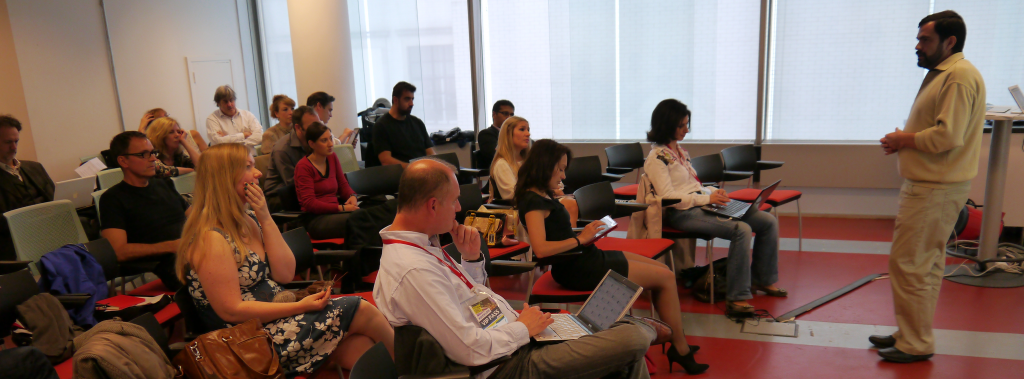
As part of London’s Social Media Week in September 2013 we put on an event called Social Business – The Patchwork Elephant Revisited asking “What next for Social Business?”.  We were kindly sponsored by our friends here at CompareTheCloud.net and we introduced the event and the speakers in an earlier post.  The idea was to get 8 different perspectives on where we are at, and where we go next, with using social and collaboration tools “inside” the business to add value and work more effectively.  Why is the “Social” word seen with such suspicion by some executives in the C-suite?  With the explosion of social media use in marketing or customer support reaching out of the organisation, why aren’t more companies using it all over their organisations?  We believe change is happening, but why aren’t we further forward with “Social Business”?

A few weeks after our event, Chris Heuer did a guest post on Brian Solis’ blog that moved in to the same territory we covered asking Social Business is Dead! Long Live What’s Next! and highlighted the problem with:

“While the ideas behind the moniker are invaluable in defining the future of work, most large companies simply aren’t buying into or investing in Social Business transformation efforts in more than a piecemeal sort of way”

Why is that?  Here are the 8 perspectives and presentations from the 27th November 2013:

ALAN PATRICK – Broadsight & The Patchwork Elephant

Social Business – The Patchwork Elephant 01 – The patchwork elephant revisited – Alan Patrick from David Terrar

Alan set the scene for us by revisiting our event from 3 years ago, highlighting that demand generation was the quick win and that social media structures are orthogonal to the normal hierarchy of command and control and so:

“resistance may be futile, but strong!”

He talked about social business being systematic, connecting the front end to the back end, looking to add value, and that culture follows commerce.  He highlighted how value will be created, and referenced a McKinsey study on where the potential productivity improvement might be over the next 10-20 years by industry sector.  He talked Ronald Coase’s theory of the firm and how they exist to reduce transaction costs, and highlighted that social technologies can directly help with that.

JANET PARKINSON – Technotropolis & The Patchwork Elephant

Social Business – The Patchwork Elephant 02 – think forward 40 years – Janet Parkinson from David Terrar

Janet talked about the unthinkable idea, and asked if business could become nothing more than a social object, with individuals collaborating via social networks, doing things businesses used to do.  She quoted James Burke who suggested earlier this year that:

“Nanotechnology will destroy the present social and economic system – because it will become pointless”

and then revisited Burke’s 1973 predictions of what 1993 technology might be like.  He had some things wrong, but a lot right, foreseeing the proliferation of the computer in offices, schools and homes, and the creation of metadata banks of personal information.  She highlighted how difficult prediction is, but then talked about a future of radical abundance where technologies, like the early 3D printing we see now, will mean people can produce their own goods from virtually nothing for virtually nothing, and how that will have a knock on effect changing the business world dramatically – it will affect production, transport, consumer facing businesses selling goods, sales and marketing, business support services and finance.  It could change the nature and need for cities, and even governments.  Does business become a social object?

WILL MCINNES – NixonMcInnes (just moved to Brandwatch)

Social Business – The Patchwork Elephant 03 – culture shock – glimmers of hope – Will McInnes from David Terrar

Will wanted to provide glimmers of hope.  He talked about the Culture Shock (his book) of how networked our World has become.  How society has moved from ancient times when we gathered at the the stone circle for social interaction, to everyone being connected with smart phones and tablets, even wearing technology, and he referenced that YouTube video of a small child expecting a Magazine to work by touch like an iPad.  He talked about the data we collect today just as a byproduct of the technology we use.  He talked about preconceptions and misconceptions – the jazz segment of the music industry is $100m a year, but Grand Theft Auto’s latest game version sold $800m in the first day!  We don’t have colonies on Mars, we have Facebook instead!  He talked about decentralised, bottom-up innovation.  He talked about the purpose of an organisation and quoted Umair Haque  (who spoke at our 2010 version of this event) tweeting:

“Making shareholder enrichment the basis of an economy is probably an idea that belongs up there with Cheez Whiz and Donald Trump’s hair.”

He also quoted Simon Kuznets, the inventor of the term GDP saying in 1934:

“The welfare of a nation can scarcely be inferred from a measure of national income”

He talked of crowdsourcing, from Wikipedia to Giff Gaff, and of organisations without bosses or hierarchy like Valve Corporation.  He talked ratings and reviews and the effects of that big shift on the high street.  He talked about the immediacy of citizen reporting, and the implications of humans being networked.  He talked OODA loops as a necessary approach to all of this, and mentioned his Meaning conference which will endeavour to connect and inspire the people who believe in better business, and want to be part of the change.

MAT MORRISON – Starcom Mediavest Group

Social Business – The Patchwork Elephant 04 – I hate everything – Mat Morrison from David Terrar

Mat talked about his @mediacsar presence on Twitter, along with his @evilczar alter ego as an example of how you can be different personae on the Internet.  He talked of Lego, of information overload, the power of on-line comments, how naive some marketers are around this topic, and how brands now have to act on Twitter.  He highlighted that although there might be 80m (or 200m or… ?) active users of Twitter, the median number of followers is actually 30 and so this lens is distorted.  He talked about the power of some well known Twitter complaints, and how you might get better service from some companies, such as BT, by complaining on Twitter rather than phoning their help line.

LUIS SAUREZ – IBM

The Patchwork Elephant 05 – social business is open business – Luis Saurez from David Terrar

Luis’s premise is that a social business is (or should be) an open business.  He talked about the culture change required to move from the old way of doing things to this new way of collaboration and sharing using social tools.  He talked in terms of a 30 year time frame – and he’s right, this is a major change that will happen slowly, but it’s happening.  He used his own company, IBM, as an example – they’ve been doing social business internally well before the existence of Facebook.  He talked Open Business and mentioned @davidcushman.  He explained an Open Business uses its resources to discover people who share its purpose, and then bring them together to realise that purpose.  He talked about the hierarchy and the wirearchy coexisting in a networked company.  He talked about accountability, and getting rid of layers, and providing incentives for employees to share.  He explained how managers need to transform in to leaders, and talked about the need for transparency.  His conclusion, with a touch of Mafia style – Open Business is “Just” Business, it’s the only way to go.

NEIL USHER – Sky

Neil didn’t use any slides.  He talked about being a corporate employee but trying to think about things holistically.  Neil talked about what it was really like for employees working for corporates and ‘using’ internal social technologies.  One of the reasons he didn’t use slides was because he wanted to feel the vulnerability which many feel when starting to use networks for the first time.  He talked about the workessence blog he has been writing for the past 2 years.  He told us a little about creating a Yammer network in one company and then using Salesforce Chatter in the next to create internal social networks within the organisations he’s worked for.  When he made that switch between companies, he discovered that people at his old company said they’d miss his input on the internal network.  He talked about LinkedIn and jokingly wondered what Google+ was for!  He talked of the value of asking questions of Twitter to crowd-source expertise and the fact that complete strangers will respond with the answers.  He was firm on the fact that these on-line social interactions amplify the subsequent face to face interactions, and vice versa too.  And he also managed the compulsory reference to Euan Semple (who, by the way, was one of the speakers back at our 2010 version of this event).

ANNE-MARIE MCEWAN – The Smart Work Company

Social Business – The Patchwork Elephant 07 – pushing big boulders uphill – Anne-Marie McEwan from David Terrar

Anne-Marie described herself as a recovering academic, and said she would be talking about pushing Big Boulders Uphill!  She was explaining her experiences writing a book, putting together a post graduate course and developing The Smart Work Company, which pulls together social business, the changing world of work and the way the physical workplace is changing too.  She described education as liberating, and democratising and how she wants to make a business school education available to anyone who wants it.  She talked of things experiential and social.  She described the social psychology of organising, of interlinked groups and their relationships.  She wondered why we had lost so much openness and gave that as one of the triggers for writing her book, because it means so much to her.  She talked of her work based masters course she taught at Kingston University and about getting people to think strategically.  She quoted Orlov the Meerkat and wondered:

“What could possibles go wrong?

She’s currently putting together a PGC for Chester University.  She admitted it’s been a hard sell to date.  When people think of a Post Graduate course they think in terms of a curriculum on “paper”, when actually she wants them to think in terms of what you actually do at work and doing it better.  She talked about applying social technologies, about the what and the how, but also the where.  She talked about a massive appetite for on-line learning, worried that current MOOCs have not helped as much as they should.  She contrasted just putting the old curriculum on video to an approach of connecting to others outside your organisation doing the same thing, to scope a project plan, learn together through discovering good practice and principles, critique and amend to suit your own circumstances.  She believes the doers are the experts, but we are the facilitators and feels she’s been given a second chance.

DAVID TERRAR – D2C & The Patchwork Elephant

Social Business – The Patchwork Elephant 08 – thoughts and summary – David Terrar from David Terrar

My job was to summarise the sessions, but add some thoughts of my own, so I quoted Dirk Gently as I also believe in:

“the fundamental interconnectedness of all things”

It’s important to realise that, in the last 40 years of regular technology disruptions every 5 to 10 years, we’ve never had 3 of them happening simultaneously before.  We have the shift to Cloud and web based apps happening at the same time as the explosion in social technologies happening at the same time that we are all walking round with mobile phones and tablets, so that we have the Internet in our hands, any-time anywhere.   That’s changing everything.  No matter what you do, your business model needs to change.  Back in 2011 Salesforce, who have one of the most complete business to social collaboration to social media monitoring offerings available, was promoting the Social Enterprise (when the term was already in use to mean something else), and they even tried to trademark it!  By 2012 that idea had failed, they changed their messaging but it evolved to “Business is Social”.  The same concept in different words.  It’s also important to note that Darwin’s theory of evolution still holds in business and marketing – categories naturally fragment and we have a huge landscape of software choices and point solutions, and so maybe this plethora of choice and the lack of maturity of better known, larger social business offerings is part of the reason why we haven’t made as much progress since 2006 or 2008, as many would have expected viewed from back then.  But there is more to it than that.  As Luis said, the culture change required is happening, but it will take decades.  I quoted Susan Scrupski who said:

“without executive direction, support and sincere engagement, internal efforts are nothing more than an aimless electronic water cooler”

There are smart companies who have heeded those words.  I highlighted major enterprises like Lilly and BASF and Deutsche Bank who all have great case studies of what can be achieved using social technologies, and we need more good case studies like those to get the C Level executives on board.  In the Q & A around the summary, Benjamin Ellis from the floor highlighted that it’s only a generation or two before our time that the average worker couldn’t read – we now have a literate, educated workforce, with technology to help.  We are beginning to move on from the Taylorist view of flows and mass production efficiency to a very different, flat, networked World with technology in our hands and everywhere we touch.  Over time we’ve used terms like Web 2.0, Office 2.0, Enterprise 2.0, Social Enterprise and Social Business as well as Collaboration and Knowledge Management.  We may not have the language right, but the idea of using these technologies to change the way we work is stronger than ever.  The next stage has got to be about putting what we’ve learned so far in to practice, and making that Elephant (in the room) dance.

Finally, I just want to add that the vibe in the room during the afternoon was a bit special, a bit different, and the discussion at the end of each talk was lively and productive.  We all enjoyed it, and I’d like to thank our friends at CompareTheCloud.net once again for their sponsorship to help make it happen.

As any of the speakers or attendees blog about the event, I’ll add references here.  So far there is:

Graham Stewart: The Patchwork Elephant And The Impact Hub

Tim Callington of Edelman: Open Business: In praise of lawyers

Janet Parkinson of Technotropolis:
Thinking the unthinkable with the Social Business Patchwork Elephant
Business as a Social Object, the Shadow Economy and WOMnets

A version of this post peviously published on Business Two Zero and Compare The Cloud

Share this:

  • Tweet
  • Email

Filed Under: events, strategy Tagged With: social business

« Previous Page

The Agile Elephant blog – thought leadership, ideas, news and discussion around digital transformation, business strategy, new business models, new management thinking, enterprise social networks, social media, social collaboration, knowledge management and the changing nature of the workplace.

Subscribe by email

Enter your email address to receive notifications of new posts by email.

Join 30 other subscribers
My Tweets

Subscribe to our Blog by RSS

About Us

Agile Elephant is a new kind of consultancy designed to help companies embrace the new digital culture of social collaboration, sharing and openness that is changing business models and the world of work.

Contact us to find out more!

Our founder's blogs:

broadstuff

@DT on Medium

Technotropolis

Our blog:

The Agile Elephant Blog

Site Log In | Site Log Out

Subscribe to Site RSS

Subscribe to our Blog via Email

Enter your email address to subscribe

Join 30 other subscribers

Copyright © 2026 ·Streamline Pro Theme · Genesis Framework by StudioPress · WordPress · Log in