Agile Elephant making sense of digital transformation

innovation | digital transformation | value creation | (r)evoloution

  • Email
  • Facebook
  • Google+
  • LinkedIn
  • Twitter
  • Home
  • Manifesto
  • Services
    • Our Approach
    • Our Services
    • Making Collaboration Work Packages
    • Collaboration Solutions
    • Our Experience
    • Workshops
    • Innovation
  • About Us
    • The Team
    • Why we do what we do
    • Why are we called Agile Elephant?
    • Our Partners
    • Our Clients
  • Get Involved
    • Events
    • Meetups
    • Unconference
    • Newsletter
  • Resources
    • What is Digital Transformation?
    • What is the Digital Enterprise Wave?
    • Our Research
    • Case Studies
    • People We Follow
    • Articles & Links
    • Books That Inspire
  • Blog
  • Contact Us
Home Blog
Perspectives on Enterprise 2.0 Summit London 2014

December 6, 2014 By David Terrar

Perspectives on Enterprise 2.0 Summit London 2014

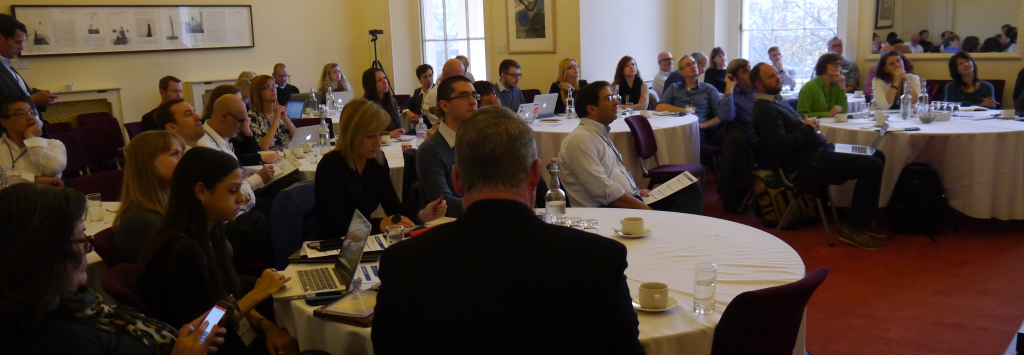
This is the first of a sequence of posts capturing some of the spirit, discussions, book suggestions, references and ideas that came out of the first incarnation of the Enterprise 2.0 Summit London (3 day event) on digital transformation, social collaboration and the future of work. The British Academy as a venue lived up to our expectations, and everybody seemed to love it as much as we do…. and so we have already booked for next year on October 21st & 22nd 2015!

Here are a few tweet impressions (messages and more to follow later) of the main conference day November 26:

Fantastic time at #e20s at London today! Learned loads, met awesome people and enjoyed presenting the @DeutscheBank story.

— Azfarul Islam (@azfarul) November 26, 2014

Thanks @DT @JanetParkinson @freecloud @enterprise20 for a fab day today: excellent speakers and some great insights! #e20s — Jemima Gibbons (@JemimaG) November 26, 2014

Disappointed to have to pay such a fleeting visit to #e20s today. Thanks to @dt and @JanetParkinson for organising. ’Til next year!

— ⌘ Stuart McIntyre ⌘ (@StuartMcIntyre) November 26, 2014

@janetparkinson Thank you for today. #e20s was thought provoking – good to hear from people facing real challenges, not snakeoil sellers! — Claire Thompson (@ClaireatWaves) November 26, 2014

@SusanScrupski shame you can’t be here today… it’s a beautiful venue #e20s

— Philip Sheldrake (@Sheldrake) November 26, 2014

Off Twitter for a while! “@ShortMarketeer: Lunch is served. #e20s pic.twitter.com/uyEqH5ccW3” — Celine Schillinger (@CelineSchill) November 26, 2014

Brains – and gender diversity. Thanks #e20s #changetheratio w @Annemcx @benjaminellis @leebryant @JanetParkinson pic.twitter.com/0Y9l9803ze

— Celine Schillinger (@CelineSchill) November 26, 2014

Entertaining too! RT @freecloud: Any panel with @benjaminellis, @leebryant & @annemcx on it is bound to generate a decent bunfight 🙂 #e20s — ⌘ Stuart McIntyre ⌘ (@StuartMcIntyre) November 26, 2014

.@azfarul takes the stage as the last speaker of this wonderful first #e20s in London. pic.twitter.com/biceAOJlJo

— Enterprise 2.0 (@enterprise20) November 26, 2014
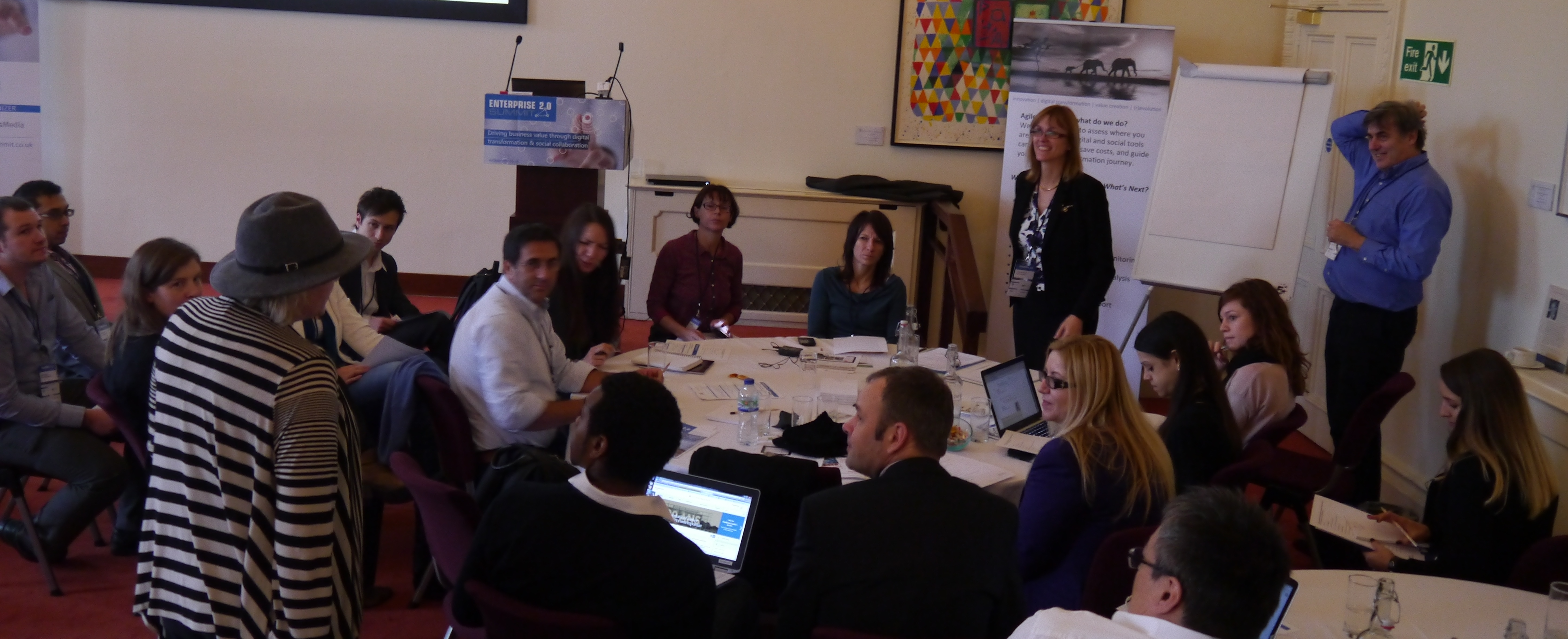
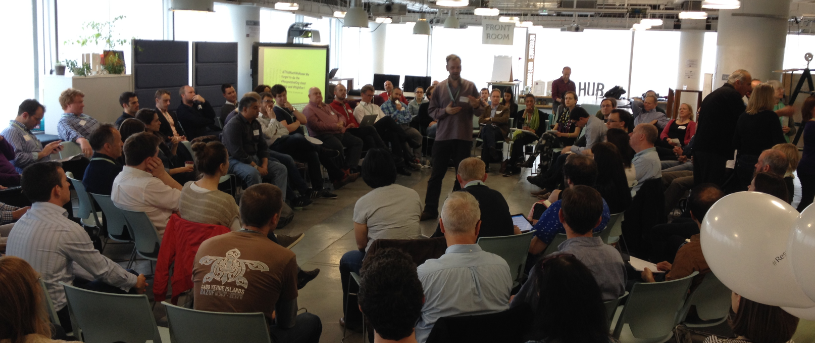
#e20s conference day workshop
(one of the three afternoon workshop streams)

More on #e20s London to follow. If you’ve got posts, photos, or feedback about the conference, please contact us.

Share this:

  • Tweet
  • Email

Filed Under: #EntDigi conference, digital disruption, enterprise 2.0, events

November 5, 2014 By Janet Parkinson

Social Onslaught at Workplace Trends Conference – London

A few weeks ago I was invited to take part in Workstock’s first pop-up event which formed part of the Workplace Trends 2014 conference in London. The challenge was quite simple – create a Pecha Kucha of 20 slides with a preset 20 seconds to deliver each – and shake up the staid world of workplace. No problem…

Nervous was an understatement but the energy and creativity which Workstock and its participants created was worth every second. Thanks to Neil Usher for Workstock’s creation and also to Cara Long who wrote short introduction stories for everyone. Here’s my poem:

Over the past 7 years or so we have witnessed the explosion and ubiquitous use of social tools which have for most of us changed both the way we handle our social lives and increasingly our working lives too. The traditional natural and easy divide between work and home has now become blurred as we often find ourselves constantly switched on and accessible to all – permanently. Switching off isn’t easy.

Yet there is increasing evidence that switching off is critical to our health and multitasking which is a result of being constantly accessible damages both our brains and work. As a recent article in Forbes notes:

“Research conducted at Stanford University found that multitasking is less productive than doing a single thing at a time. The researchers also found that people who are regularly bombarded with several streams of electronic information cannot pay attention, recall information, or switch from one job to another as well as those who complete one task at a time…

…Researchers at the University of Sussex compared the amount of time people spend on multiple devices (such as texting while watching TV) to MRI scans of their brains. They found that high multitaskers had less brain density in the anterior cingulate cortex, a region responsible for empathy as well as cognitive and emotional control.”

Share this:

  • Tweet
  • Email

Filed Under: digital disruption, employee engagement, workplace

A new strapline for Agile Elephant – innovation | digital transformation | value creation | (r)evolution

November 2, 2014 By David Terrar

A new strapline for Agile Elephant – innovation | digital transformation | value creation | (r)evolution

Businesses need to be constantly evolving. We believe in continuous improvement. We believe that it doesn’t matter what type of business you are, your business model is under threat. In today’s digital business environment change is a constant and you have to deal with it. It’s Darwin’s theory of evolution for business – only the fittest, or most fit for purpose survive. Recently people have taken one of our Agile Elephant business cards or come to the web site and said “yes, but what do you really do?” So we’ve had a rethink and we’ve just changed our company strapline – for the header of our website and for what’s on our business cards, so that it encapsulates what we do in 4 things:

innovation | digital transformation | value creation | (r)evolution

First we’re about innovation. Innovation is applying new ideas, new devices, new processes – finding better solutions. We believe commercial creativity is vital. We believe fostering new ideas should be part of part of a company’s daily DNA.

What we do as a business is digital transformation. Take a look at our explanation of the Digital Enterprise Wave. A smarter, nimbler competitor is angling to use new digital and social tools to take your market, your customers. We can help analyse where you are in the digital landscape, help you take stock, decide where to start, where digital tools can really help and then take you on a journey to become digitally competent. But that’s not enough – then we help you put the necessary leadership in place to master the digital topic and make it work for you effectively.

Going digital can only be effective if it leads to value creation. You need an approach which increases your revenue, improves profitability, helps you keep more of your customers, gets products to market quicker or reduces your operational costs – it has to be about doing what you do better and about adding to the bottom line. Take a look at these survey results from Capemini Consulting and MIT Sloan Management from their report “How digital leaders outperform their peers in every industry“. They split the surveyed organisations, all larger that $500m turnover, in to 4 categories, with the most digitally savvy being called the “Digirati” or digital masters. Companies in that most advanced category generate 9% more revenue, create 26% more profit and have 12% higher market valuation than the rest. Becoming a digital master works.

In taking you on this journey we believe in evolution not revolution. We believe many consultants and practitioners talking about “digital” and “social” focus too much on a grass roots revolution to change the culture in organisations. To dismantle hiearchical structures and recast the way of working for the new world. We don’t think that sort of revolution is productive. We believe any structure of organisation can become a digital master with the right core competence and the right leadership. Even huge companies like IBM can empower their employees and change, and using social tools helps them do it. We believe the Elephant can dance, but we don’t need to break it to make the changes.

innovation | digital transformation | value creation | (r)evolution

To find out more consider coming to our conference next month – The Enterprise 2.0 Summit London, or contact us to start talking sense about digital.
 
e20s_london_banner

Share this:

  • Tweet
  • Email

Filed Under: business innovation, change management, corporate culture, digital disruption, leadership, social business, strategy

The Agile Elephant Unconference – 27 November at Metro Bank HQ, Holborn

October 29, 2014 By David Terrar

The Agile Elephant Unconference – 27 November at Metro Bank HQ, Holborn

We are delighted to announce The Agile Elephant Unconference on digital transformation, social business, the future of work and the digital workplace – an all day event on 27 November 2014, hosted at Metro Bank’s London HQ, One Southampton Row, London WC1B 5HA – opposite Holborn Tube Station.

The Agile Elephant team, hosted at a Central London location, are facilitating a self-organised conference designed to bring together specialists, consultants, practitioners and change agents to discuss:

  • digital transformation
  • social business
  • next generation enterprise
  • the future of work
  • how to do more, and do it better

Responsive Org Unconference 1The Agile Elephant Unconference will be a full day from 9:00 to 17:30 at a Central London location close to the Underground and other transport links.  The Unconference follows, and is connected to, the Enterprise 2.0 Summit London on November 25 and 26 at The British Academy, 10-11 Carlton House Terrace.  The Summit is a practical, “how-to” style of event for a corporate audience.  The Unconference is aimed at specialists, consultants and change agents advising those companies who want to share ideas, best practice, and debate where the world of work, the digital landscape and emerging technologies are moving next.

The mantra for the day – what works, what doesn’t, what’s next?

Go here to sign up for the Unconference.  The ingredients are:

  • A curated unconference using Open Space Technology
  • As a group – the Morning and Afternoon will each start with 5 x 5 – five 5 minute lightning sessions to get your brain cells moving – the clock is ticking, when the time is up the speaker may have to finish mid-sentence – no exceptions!
  • We’ll split the room in to 3 unconference streams with timeslots across the day
  • 4 time slots per unconference stream – a choice of 12 topics discussed in depth during the day
  • Bringing it all together – as a group we’ll come back together at the end to discuss what we learned, how we capture the content and make some plans for what next?
  • Plenty of time for networking in and around the sessions in coffee and lunch breaks – the agenda framework for the day is here
  • Elephant volunteers will help facilitate the day and make things run smoothly

Responsive Org Unconference 2We’ll use social media to capture and share our energy and ideas from the day.

If you want to sign up to present one of the ten 5×5 sessions, go to this post and add your session title and explanation in the comments.  If we have more than 10 volunteers we’ll convene a panel of judges to pick the best 10.  For the 12 unconference sessions, we hope delegates bring along some great ideas and material to share and discuss.

We’d like to give a big thank you to our partner providing the venue, but that will have to wait a few days for a formal announcement. We’d also like to thank our sponsor Sei Mani for the lunch, coffee, tea and soft drinks – their support is helping us make the Unconference free for attendees.

About Metro Bank

Metro Bank are an ideal partner for our Unconference as they are, themselves, a case study in new business models, with an innovative and entrepreneurial approach – they are revolutionising banking by putting customers first. They are Britain’s first new high street bank in over 100 years. Metro Bank aims to provide personal and business customers with unparalleled levels of service and convenience. They’re a unique, customer-focused, retail business reinventing the rules of retail banking by killing all stupid bank rules. You can follow them on Twitter, download this to find out more about their approach, or go to: metrobankonline.co.uk

About Sei Mani

Sei Mani help organisations understand how investments in collaboration technologies can transform business performance. As well guiding companies on the journey from developing a business case and assessing impact on culture and leadership through to the creation of compelling value propositions, their services include: Visual design, information architecture, usability, accessability, application integration, agile software, web and mobile design and development. Find out more:  www.sei-mani.com

About Agile Elephant

The new digital and social approach to business can add real value to the bottom line. Agile Elephant is a new kind of consultancy designed to help companies embrace the new digital culture of social collaboration, sharing and openness that is changing business models and the world of work. Contact us to find out more.

About the Unconference

The conference will be free for attendees, but space is going to be limited to only 60 delegates. To find out more or sign up for a conference pass, go to these pages on the Agile Elephant website, go to the Eventbrite page, or contact us.

Share this:

  • Tweet
  • Email

Filed Under: digital disruption, enterprise 2.0, social business, social media, unconference, workplace

Unconference 5×5 Explained and Sign Up

October 29, 2014 By David Terrar

Unconference 5×5 Explained and Sign Up

About the Unconference on 27 November at a Central London venue

The Agile Elephant Unconference is designed to bring together digital transformation, social business, future of work and digital workplace specialists, consultants, practitioners and change agents to discuss:

  • digital transformation
  • social business
  • next generation enterprise
  • the future of work
  • how to do more, and do it better

The mantra for the day – what works, what doesn’t, what’s next?

To find out more, sign up or see the agenda – go here.

5×5 Explained and Register for a Speaking Slot

As a group – the Morning and Afternoon will each start with 5 x 5 – five 5 minute lightning sessions to get your brain cells moving – the clock is ticking, when the time is up the speaker may have to finish mid-sentence – there will be no exceptions!

First, you have to get one of the 60 Unconference tickets – book your place here.

Each 5 minute session can use slides, a flip chart, visual aids, or just you – it’s entirely in your hands.

They have to be on our topics (digital transformation, social business, enterprise 2.0, next generation enterprise, digital workplace or the future of work)

If you want to sign up to present one of the ten 5×5 sessions, simply add your session title and a brief explanation in the comments of this post below.

If we have more than 10 volunteers we’ll convene a panel of judges from the #e20s speakers to pick the best 10.

We are looking forward to it!

If you want to build a ship, don’t drum up people to collect wood and don’t assign them tasks and work, but rather teach them to long for the endless immensity of the sea.
– Antoine de Saint-Exupery

Unconference Sign Up

Unconference Agenda

Contact us

Share this:

  • Tweet
  • Email

Filed Under: digital disruption, enterprise 2.0, social business, unconference, workplace

Alan Patrick on the state of social business in the UK – #e20s interview series

October 20, 2014 By David Terrar

Alan Patrick on the state of social business in the UK – #e20s interview series

This is the next in a series of posts which present different views on the state of Social Business in the UK from a video interview series compiled by our friends at Kongress Media. Around our #e20s Meetup sessions Bjoern Negelmann asked well known consultants, practitioners and thought leaders in this space where we are with digital and social collaboration compared to the rest of Europe and elsewhere.

Here is our very own Alan Patrick, one of the 3 founders of Agile Elephant. We met in the early days of OpenCoffee and Tuttle Club meetups, and put together the Patchwork Elephant series of social business events which were the progenitor of our new company this year. Alan will be heavily involved in presenting the workshop sessions of the Enterprise 2.0 Summit London. He’s well known as a social collaboration speaker and influencer, as well as being an expert on data analytics.

Watch the video, but here are some highlights:

I think we have still got quite a lot of differences of opinion

the reason we called ourselves the Agile Elephant is everybody sees different bits of the Elephant and believes that is what it is

today there were arguments about what;s the state of social collaboration today – anything from complete revolution to actually things are just going to stay the way they are

still a lot of discussion and a lot of debate

from our analysis we’ve seen 3 different groups

best run British companies or top 50 companies who people want to work for who are definitely pushing very hard around engagement and collaboration of the workforce, what they’ve basically realised is that higher employee engagement drives better results

another group are doing it for economic reasons, all of them are start-ups or small companies where the traditional structures don’t work well enough

a third group are companies who often have a history of being jointly owned (like John Lewis) where they are starting to experiment with new ownership models to drive productivity in the business

nobody is doing this just for the sake of being social, they’re doing it to try and get business benefits

other people are trying to manage very global businesses and are using social technologies to keep in touch with very diverse populations

“the future is here, but unevenly distributed”

the early driver was definitely to increase sales

you’ve started to see people looking at it for cost reduction, things like increasing customer service or increasing internal business collaboration

and there are general business benefits to have more engaged people, so those three are the big value drivers at the moment


If you want to hear Alan and find out more and about what works, what doesn’t and what next then take a look at the Enterprise 2.0 Summit London on November 26. More information here.

e20s_london_banner


More #e20s state of UK social business interviews in the series here.

Share this:

  • Tweet
  • Email

Filed Under: #EntDigi interview series, digital disruption, enterprise 2.0, social business

Jon Ingham on the state of social business in the UK – #e20s interview series

October 15, 2014 By David Terrar

Jon Ingham on the state of social business in the UK – #e20s interview series

This is the next in a series of posts which present different views on the state of Social Business in the UK from a video interview series compiled by our friends at Kongress Media. Around our #e20s Meetup sessions Bjoern Negelmann asked well known consultants, practitioners and thought leaders in this space where we are with digital and social collaboration compared to the rest of Europe and elsewhere.

Here is Jon Ingham. Jon’s a well know human resources and human capital management expert who has been blogging around the topic since 2007, and before that authored Strategic Human Capital Management: Creating Value Through People. Our paths have been crossing regularly in the social media, social business and digital workplace space and so we were delighted to get his viewpoint.

Watch the video, but here are some highlights:

very positive, very dynamic

I feel, in one way, that we talk less about social business than we perhaps we were a few years ago

but there are more social businesses around – there are more organisations that know their sucesss depends on being social, doing collaboration, bringing their people together

HR is very much at the heart of creating that type of organisation

I still think the main driver tends to be technology, the move to digital, the move to mobile

I think that tends to be the wrong the idea – we were talking about 5 years ago that we could bring social technology in to the organisation and experiment, about using wikis and different things, and that would help me become more social – I think that’s largely been disapproved

the attempt to introduce social in to process, in the workflow – I don’t think that’s getting there either

I think what works is being a social business, introducing social in to the culture

but that’s not what it’s about, the driver is to improve the effectiveness of the organisation, the collaboration of the people, the connectedness of all of the people across departments, across functions – when the driver is that social business works more effectively

HR people who really do understand the power of the culture, how engagement can be shaped, how collaboration can be enhanced and doing terrific things in this area

but are also involved in organisation design, team design, organisation development, reward policies that ensure everybody is collaborating, in reshaping their performance management

a lot going on and I’m very proud of what we accomplish in HR

I would appoint HR as the head of that effort

I’m biased as I work mainly with HR… …a lot of HR people understand what social business is all about… … but (some of) their CEOs don’t get the plot

If you want to find out more and about what works, what doesn’t and what next then take a look at the Enterprise 2.0 Summit London on November 26.  More information here.

e20s_london_banner


More #e20s state of UK social business interviews in the series here.

Share this:

  • Tweet
  • Email

Filed Under: #EntDigi interview series, digital disruption, enterprise 2.0, social business

Jon Mell on the state of social business in the UK – #e20s interview series

October 14, 2014 By David Terrar

Jon Mell on the state of social business in the UK – #e20s interview series

This is the next in a series of posts which present different views on the state of Social Business in the UK from a video interview series compiled by our friends at Kongress Media.  Around our #e20s Meetup sessions Bjoern Negelmann asked well known consultants, practitioners and thought leaders in this space where we are with digital and social collaboration compared to the rest of Europe and elsewhere.

Here is Jon Mell.  Jon and I first met when we were both speaking at the International Forum on Enterprise 2.0 in Varese in Italy back in 2008.  He was in IBM, after that leading sales for Headshift, before going back to IBM to be their Social Business Leader UK and Ireland.  Back in February Jon was keynoting at the Paris edition of the Enterprise 2.0 Summit.  He’s a social collaboration expert who has been around in this space for a long time and brings a practical perspective to using social to drive business.

Watch the video, but here are some highlights:

I think it’s going pretty well

companies aren’t thinking of it necessarily in terms of social, they’re thinking in terms how do they improve their customer care process, how do they get products to market more quickly, how are they looking at recruiting and on-boarding new talent and they’re looking at social as a way to do that

they’re not looking at social as something in its own right

I don’t think they’re necessarily concious that they’re even thinking about social business

when an organisation looks at how do they attract the right talent, how do we break down silos and barriers in our organisation they’re thinking about solving those problems, they might use social to do it but they aren’t waking up in the morning and thinking “I want to collaborate using social business”

how can they get closer to their customers, how can the be more valuable in their marketplace and they’re looking at social as a way of doing that

we’re seeing a lot of interest from internal communications, we’re seeing a lot of interest from CHROs, but also lines of business, heads of sales, heads of R&D

how can I increase the innovation pipeline and get new products to market more quickly

seeing smaller companies get involved, using social as a way to punch above their weight


If you want to find out more and about what works, what doesn’t and what next then take a look at the Enterprise 2.0 Summit London on November 26.  More information here.

e20s_london_banner


More #e20s state of UK social business interviews in the series here.

Share this:

  • Tweet
  • Email

Filed Under: #EntDigi interview series, digital disruption, enterprise 2.0, social business

The emerging risk of digital Taylorism

October 13, 2014 By Alan Patrick

The emerging risk of digital Taylorism

In our reading of the potential evolution of the work transformation, there are some rather compelling but very worrying views on the evolution of knowledge automation, from a variety of sources:

Instead of promoting a more participative and democratic society as hoped for by Castells and others, vertical disintegration and decentralisation allow for what is discussed under the broad term of marketisation. ‘By bringing the competition in product and labour markets to bear on their own internal processes, … [firms] are turning the market into an instrument of control’. [Sauer] therefore sees a ‘market-led decentralisation’. The individual unit although technically more independent is subjected to new and worse constraints through management by objectives including internal and external bidding as well as the application of benchmarks or the imposition of profit targets. Hierarchical control is replaced by sanctions by the ‘market’ and markets are increasingly internalised into business units

In services the ‘opening to the market’ can also take the form of elimination of managerial mediation between workers and customers and the increasingly direct exposure of workers to the changing wishes and requirements of customers. In management literature this is greatly welcomed as ‘advanced customer-orientation’. For workers, advanced customer-orientation can mean even more stress, especially if management at the same time cuts resources in order to save costs.

In essence, the demand for high rates of return on capital drives management to save costs by cutting resources which in turn can undermine the new autonomy workers enjoy in decentralised, digitised workplaces.  Rather then dreams of a post-Taylorist workplace emerging, there is increasing evidence that “new forms of bureaucratic control and repetitive tasks have been extended to the information sector”- or Digital Taylorism

Or there is this view – there is a high road and a low road that will be followed:

The high road variant can also be associated with the high-trust, high performance firm. Its main features are: decentralisation, creation of comprehensive tasks, establishment of work groups, promotion of competence development and sharing of knowledge as well as interdepartmental co-operation and integrated product development.

The low road type strive to achieve competitiveness through cost-cutting, which among other things expresses itself in staff reduction or outsourcing. For the internal organisation of work this mode means: organisation of work processes according to value creation aspects, acceleration of the processes through the grouping of individual work tasks and activities into business processes, intensification of work, and a tendency to divide staff into a highly qualified core and a low-qualified periphery that are employed to balance out capacity fluctuations.

In previous cycles, the Low road was usually the preferred option, the high road was the one less taken, and there is no compelling reason to believe anything will be different this time round.

The starkest portrait of Work to Come is this one – that the future of work, for many people, will be them strapped to an automated digital workflow, continuously prodded and monitored while doing the tasks that machines cannot yet do well or cheaply enough.

And there is nothing in the past that gives one comfort these scenarios above won’t play out, apart from maybe in very high value, high creative workspaces where Taylorism never really took hold – but even there, in law, medicine and other professional white collar areas, work is increasingly overwatched by digital monitoring devices. The only hopes from past experience is that where people have been well integrated with the process, and team work has been allowed to work, it has worked better than pure automation. (Cells, Quality Circles, etc) – but it does need careful design, appropriate use of automation, upskilling of the average worker, and flexible organisation structures above and around it.

These are non trivial requirements, needing non trivial design of new ways of working that are demonstrably more productive than those the neo-Taylorists are dreaming up, too often under the disguise of “smart” tools.

It is our view that if we (humans) do not do it this way,  especially in the high cost OECD countries, we shall most certainly get Digitised Taylorism in spades. One our prime items in our Manifesto is that work should be about people.  So – for anyone interested in the future workplace transformation,  our view is that for it to be sustainable for people, somewhere along the line it will be essential to work out how to take the high road

Incidentally, this is also why we have given our support to the hi: project. hi: stands for Human Interface, i.e. creating the tools and techniques that enable work to take the high road noted above (or is that the hi: road 😉 )


Share this:

  • Tweet
  • Email

Filed Under: high performance, organisational culture, workplace

Lee Bryant on the state of social business in the UK – #e20s interview series

October 13, 2014 By David Terrar

Lee Bryant on the state of social business in the UK – #e20s interview series

This is the next in a series of posts which present different views on the state of Social Business in the UK from a video interview series compiled by our friends at Kongress Media.  Around our #e20s Meetup sessions Bjoern Negelmann asked well known consultants, practitioners and thought leaders in this space where we are with digital and social collaboration compared to the rest of Europe and elsewhere.

Here is Lee Bryant.  Lee was one of the pioneers of using social tools inside the enterprise in the UK, starting Headshift way back in 2002, well before people were talking social business consultancy or digital transformation.  Over the years we’ve supported each other’s events from London Wiki Wednesdays to SOMESSO (which used to be a conference) to the Dachis Business Summit. Headshift was acquired by Dachis Group in 2009, became Dachis Group London, but then Lee and Livio Hughes rebooted with Postshift, a foundry for new business structures, a consultancy and a place for learning in 2013.  Lee will be contributing and running a workshop session at the Enterprise 2.0 Summit London.

Watch the video, but here are some highlights:

in an interesting place

a lot of companies have gone through the phase of building a platform or putting a platform in place and beginning to see a little spike of collaboration and sharing

many of them have got to the point where they’re asking what that’s for and maybe in some cases lost a little bit of purpose and so they’re starting to ask questions about organizational transformation and what comes next, you know how do we make this more business relevant?

many of these projects began with CIOs or IT departments, but I think now they’re being owned more by the organisation so we are seeing more communications leads, more HR leads, more knowledge leads

and also executives, which is the really important thing, are starting to take over these projects and to try and define their purpose for the future

interesting times!

gone past the initial excitement, just beginning the next phase which is about what is the impact on the organisation, how does this really improve the business, and how does this change the way we’re organised and structure?

people are tempted to link them to business objectives

but we are zooming out now to look at the wider impact on the organisation and that’s what makes it really interesting… …in terms of business purpose

OD and HR are starting to understand they have some some skills and some experience that could really help push this forward, but I think it’s still in the realm of enlightened executives

where we are seeing real change, it’s enlightened leaders who are leading that

digital transformation is probably the overall goal

you need a base of a more socially connected organisation on the inside


If you want to find out more and about what works, what doesn’t and what next then take a look at the Enterprise 2.0 Summit London on November 26.  Lee will be on an expert panel and running a workshop session called “Building the next generation organizational chart”.   More information here.

e20s_london_banner


More #e20s state of UK social business interviews in the series here.

Share this:

  • Tweet
  • Email

Filed Under: #EntDigi interview series, digital disruption, enterprise 2.0, social business

« Previous Page
Next Page »

The Agile Elephant blog – thought leadership, ideas, news and discussion around digital transformation, business strategy, new business models, new management thinking, enterprise social networks, social media, social collaboration, knowledge management and the changing nature of the workplace.

Subscribe by email

Enter your email address to receive notifications of new posts by email.

Join 30 other subscribers
My Tweets

Subscribe to our Blog by RSS

About Us

Agile Elephant is a new kind of consultancy designed to help companies embrace the new digital culture of social collaboration, sharing and openness that is changing business models and the world of work.

Contact us to find out more!

Our founder's blogs:

broadstuff

@DT on Medium

Technotropolis

Our blog:

The Agile Elephant Blog

Site Log In | Site Log Out

Subscribe to Site RSS

Subscribe to our Blog via Email

Enter your email address to subscribe

Join 30 other subscribers

Copyright © 2026 ·Streamline Pro Theme · Genesis Framework by StudioPress · WordPress · Log in