Agile Elephant making sense of digital transformation

innovation | digital transformation | value creation | (r)evoloution

  • Email
  • Facebook
  • Google+
  • LinkedIn
  • Twitter
  • Home
  • Manifesto
  • Services
    • Our Approach
    • Our Services
    • Making Collaboration Work Packages
    • Collaboration Solutions
    • Our Experience
    • Workshops
    • Innovation
  • About Us
    • The Team
    • Why we do what we do
    • Why are we called Agile Elephant?
    • Our Partners
    • Our Clients
  • Get Involved
    • Events
    • Meetups
    • Unconference
    • Newsletter
  • Resources
    • What is Digital Transformation?
    • What is the Digital Enterprise Wave?
    • Our Research
    • Case Studies
    • People We Follow
    • Articles & Links
    • Books That Inspire
  • Blog
  • Contact Us
Home Archives for David Terrar
“Are you saying the map’s wrong?” – “Oh dear, yes!” – an example of Liminal Thinking

April 22, 2016 By David Terrar

“Are you saying the map’s wrong?” – “Oh dear, yes!” – an example of Liminal Thinking

Earlier this week I met with Dave Gray and he gave me an advance copy of his new book, and then I went to his talk at Postshift on Wednesday night. He talked Liminal Thinking, so what is that?

You might know that I am a huge fan of The West Wing (and Aaron Sorkin’s writing in general). There is a great sequence in the episode “Somebody’s Going to Emergency, Somebody’s Going to Jail” in season 2 when people and causes get the chance to pitch to White House staff for attention and funding on “Big Block of Cheese Day” (a day which recurs a number of times in the world of West Wing). One such team from the Organisation of Cartographers for Social Equality are pitching the idea of a government initiative across the school system that would change our maps and atlases from the Mercator projection of the World to the Peters projection. The argument is that stretching out the longitudinal lines so they are parallel at the north and south poles (back in 1569) to help navigators on ships, and so that the map fits on a page rather than a globe, actually skews the relative representation of the size of countries, and reinforces centuries old European Imperialist thinking. Those countries in the First World nearer the North Pole look unnaturally large – for example Greenland looks massive and similar in size to the whole continent of Africa when in reality its area is only one fourteenth of the size of that continent. We compound this incorrect filtering of land mass reality by putting, say, the UK on a page in the Atlas, and then Australia on the same size page, when actually that country is over 33 times the area of the UK. It’s why we Brits just don’t get how big the place is! The cartographers on West Wing argue that the maps influence our thinking in terms of World priorities and prejudices. The Peter projection (which should really be called the Gall-Peter projection) gives a much fairer representation. You have to see the look of incredulity on C. J. Cregg’s face as she looks at the new reality and says “what the hell is that!?”. Then when they suggest a North-South inversion of the new map (because there is absolutely no reason why North has to be at the top of the page), she just freaks out completely! This scene and the story behind it is a perfect example of Dave Gray’s Liminal Thinking approach, as described in the new book and at Wednesday’s event at Postshift’s offices in Shoreditch.

First sample the map presentation scene:

Liminal Thinking is the art of creating change by understanding, shaping, and reframing beliefs. The dictionary says liminal is an adjective relating to a transitional or initial stage of a process, or occupying a position at, or on both sides of, a boundary or threshold. As Dave knows, things happen at the edge, in the boundaries, in the spaces in between.

At Postshift in a sort of fireside chat, Dave related that he actually started out writing a book on agile software which morphed in to something different along the way. As he interviewed people for the book he realised there was a larger story than just talking about an agile mindset for developing software or technology more quickly and efficiently. If you are talking Agile, then Dave reckons Amazon ticks all the boxes, but their people don’t tend to talk or go on the record much about how they do what they do. He interviewed people who have to be agile in their thinking, like soldiers on the front line of the World’s trouble spots, or humanitarian aid workers in similar conflict zones. They have to maximise their ability to adapt yet still exert a level of control, and that’s agile. But in talking to them Dave realised that effecting change is connected with people’s beliefs. People in organisations who want to change things often don’t have the power, or the authority, or the budget to do what they want to do. Dave thought through how he could help that kind of change – and Liminal Thinking is what addresses that question.

Dave built a a sort pyramid of layers of thinking from reality, experience and attention, through to something that is “obvious” – what Dave calls you, me, everyone – see the diagram below.
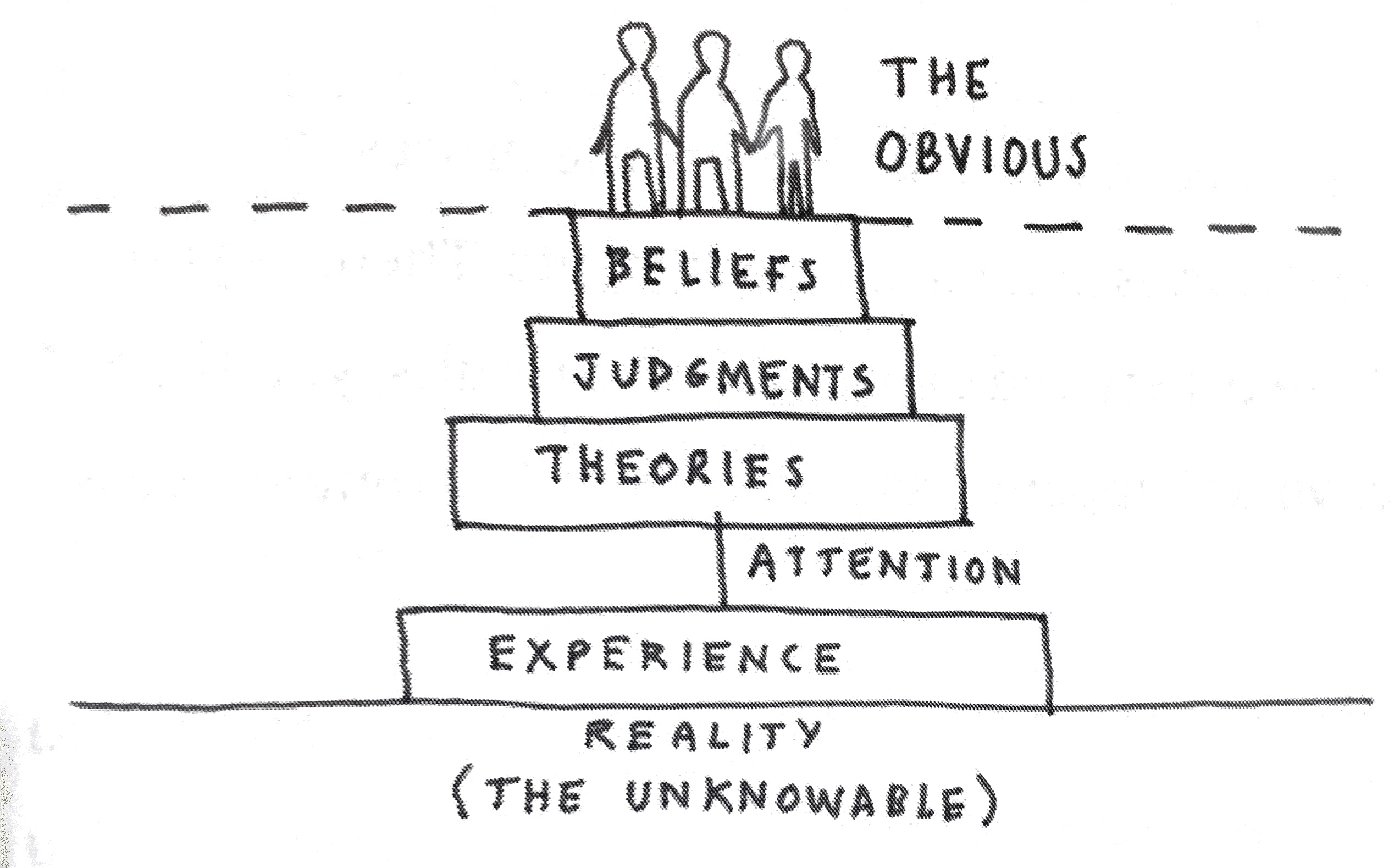
Dave_Gray_obvious_stack

He quoted a neuroscientist called Zimmerman who says that our brains experience 11 megabits of information per second, but actually we can only take in and understand 50 bits per second. How do we open our minds to process more or different? Dave related stories in the book from the Vietnam war where the USA viewed the conflict in terms of the domino theory and the rise of communist China, without looking at the history, the fact that this was a civil war and that most Vietnamese actually hated the Chinese anyway. The wrong beliefs and the wrong frame of reference, and so the USA could have avoided that war if only those in charge had stepped outside of their bubble, and reframed their beliefs.

We talked Weapons of Mass Destruction in the Iraq conflict. Dave talked about the stupidity of self validation, and the difficulty of anybody taking on board something that is truly new. If it’s really new, it will make no sense to you because it falls outside of your current frame of reference. Actually you have to test stuff that falls outside of your “bible” and expand your experience. Dave believes that moving the needle of experience is the most powerful thing! Of other needles, he said that so much of our thinking is like a stylus on a record (we’re going retro here, remember long playing records and singles?). We hang out in the same network friends, and at any given moment there is a way we act – that’s culture. But Dave believe’s the problem of culture is his autopilot and your autopilot, and a well worn groove – a routine of doing the same things the same way, which we need to break. He related another story about someone who changed their life completely simply by parking in a different place in the company car park – that small change triggered a new, different chain of events for him leading to a new job and more. Beliefs are true only because we make them true. The key message here is shut off your autopilot – do things differently.

Dave told more stories about soldiers and special forces in Iraq, about his biomedical engineer brother, or about groups on the two sides of the abortion debate coming together to try and verbalise the opposing argument properly to the other side’s satisfaction. They didn’t change their core beliefs, didn’t find compromise but they did find significant common ground in the welfare of children and family. We talked about organisations using the carrot and the stick and the problems that certain incentives embedded in a corporate culture can cause, making the employees feel like lab rats in a maze, looking for the cheese. We talked about the issues around making change, around the power of the negative often outweighing the possibilities of the positive.

Dave believes everything starts with experience. How we should focus on people’s emotional needs, and how we need to create an environment that makes it safe for people to express themselves, as so many people hide their real emotions in the work environment. He went on to suggest we get distracted too much by the stuff we disagree on. About how the biggest barrier to a leader changing is that even when they talk the talk, they aren’t aware that they’re not really changing their behaviour. The higher you are in an organisation the more insulated you can get from reality, and you should be constantly asking – what is my bubble?

Dave talked about the amygdala, the lizard brain responsible for our fight or flight response that still has so much influence on why we do what we do. When Dave works with a new group or new organisation, he asks them “how can we help you design this organisation so you are jazzed to come to work each day”. What can we do to help us make this company great? What works? Who is doings awesome things in spite of the environment and the circumstances?

Dave talks about belief being the stories in your head, and ended the session confirming how vital stories and story telling are to the process of change. A great session. Thanks to Lee and the Postshift team for facilitating the talk. I’m halfway through the book, enjoying it (and Dave’s drawings) and looking forward to writing a review here soon.

Top image captured from Dave’s website, and diagram from his Liminal Thinking book
Share this:

  • Tweet
  • Email

Filed Under: agile business, change management, corporate culture, ideas, leadership Tagged With: beliefs, change management, culture, culture change, Dave Gray, Liminal Thinking

The Gang of Four and why “there is nothing equitable about equity in a digital age”

February 5, 2016 By David Terrar

The Gang of Four and why “there is nothing equitable about equity in a digital age”

As a companion piece to my last post about the irresistible rise of mobile changing the face of the technology landscape, this piece looks at the big four companies that are succeeding there, but also the volatility and strange logic of the market, even for big social media brand names that are in the thick of and important in the change.  I’m writing against a backdrop of several weeks of speculation about where Twitter is heading, and then today’s dramatic share price drop for LinkedIn – 43 percent down today wiping out nearly $11 billion of market value so far, and the day’s not over yet.  What’s $11Bn?  Well, that’s 60% of the current value of HP…..

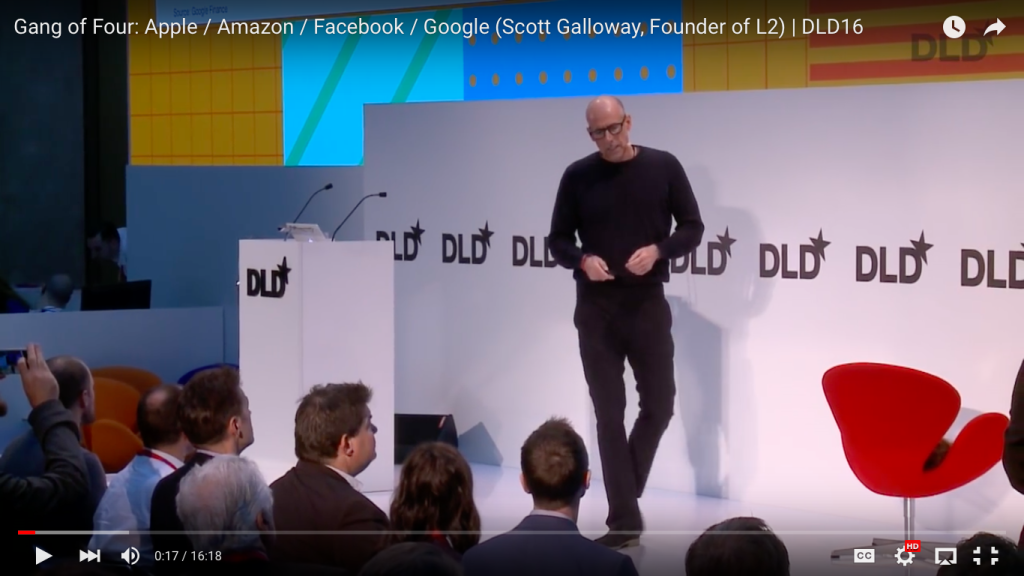
Like my earlier mobile post there is a must watch video at the core.  This one has NYU Professor Scott Galloway speaking at DLD16 in Munich a few weeks back on Monday 18th January talking about the Gang of Four – that’s Apple, Amazon, Facebook & Google.  The video went up on YouTube on the 25th January – at this second, 10 days later it has been viewed 520,618 times.  If you haven’t seen it, it’s definitely worth 16 minutes of your time to help you better understand today’s landscape and to learn some lessons from the steps the current titans are making.

Scott Galloway preceded his pitch with a brilliantly self deprecating health warning showing that some of his predictions will be wrong, but hoping that more will be right. Here are some of the things he said about the “four horseman of the apocalypse” Apple, Amazon, Facebook and Google:

  • In 2015 their combined market capitalisation rose from the GDP of Spain to the GDP of Canada
  • Each of the 4’s 2015 value is so large he compares each with a basket of well known brands in their sector to highlight their position
  • Amazon is the number 1 e-commerce player both sides of the atlantic, dwarfing the next 10 players in each market
  • Apple added $51Bn in revenues last year – that one year growth is more than the total 2014 revenues of luxury brands Louis Vuitton, Coach, Hermes, Michael Kors, Kering, Richmond and Prada combined
    Facebook and Google are growing at 40.3% and 12% compared to traditional media companies where they range from IAC’s 4.5% to Viacom’s -3.7%
  • “The advertising industrial complex is about to come to an end!” – last year 90% of CPG brands lost market share and 68% lost revenue “because advertising sucks!”
  • If you’re wealthy you can opt out of advertising with downloads, Netflix, iTunes, Tivo or Sky+
    He has quotes from fashion brand leaders highlighting how the fastest growing brands aren’t advertising in the traditional way
  • More venture capital going in to the ecosystem but fewer exits
  • The mobile ad market is a duopoly with Google and Facebook controlling 50% of the global market
  • Amazon has redefined the way we think about building businesses – it can be profitable any time it want but has made a conscious decision to run at break even because “profits are heroin to investors”, they get addicted to them and if you take them away, they respond negatively – he highlights Walmart’s recent capital investments to compete as the right thing to do, but the markets didn’t like the drop in profits and so the share price has gone down dramatically, where as Amazon is the master of consistency
  • Over 90% of the profit from the global smartphone market goes to Apple, then Samsun gets a bit, then the rest fight over the losses (the numbers on the slides don’t add up here, but the message is still clear)
    Apple’s revenue from PC’s is going up, everyone else’s is going down
  • If you believe the press, Apple’s Watch is a failure – Apple took away Samsung’s smart watch market share away as soon as they entered the market – ask Richemont and Swatch if they think Apple watch is a failure – he suggests Apple Watch will do $5-10Bn sales this year, but the entire Swiss Watch industry is $25Bn
  • He highlights the amazing rate of growth of Facebook, but then goes on to explain how they’ve only really monetised of its assets, and the potential they have with Instagram, WhatsApp and Messenger
  • Facebook are spending more per dollar on R&D than any other tech company in history – as well as being incredibly nimble with the number of products and releases they are doing, they’ve gone from 0% to 76% revenue in mobile in only 3 years – that’s a lesson in how to disrupt yourself and pivot
  • Scott explains how one of these four will become a Trillion Dollar company in the very near future
    He suggests Amazon should be acquiring bricks and mortar retail chains and become the true mini-channel retailer
  • Google needs a bigger business – he postulates they could go after the college education market
    Facebook, Google and Amazon are easy to understand, but what is Apple’s mission? He suggests they “pay an absence of vision tax”
  • Globalisation, free flow of capital, and the frictionless environment mean that i’s never been easier to be a billionaire, but never been harder to be a millionaire – it’s the middle classes that are getting squeezed
    With share options and stock being used as a regular motivator for senior people in companies, but look at the markets and the way companies are being valued – he says “there is nothing equitable about equity in a digital age”

Please watch the video to get all of this in his own words and the full story.  I’ll even forgive him the Adele segment:

He finishes excited by the technology opportunities, pleased by the meaningful things we are doing, but wondering whether we are doing anything profound. What all of this highlights for me is that there are key lessons to be learned from the way Facebook, Google, Amazon and Apple are innovating, expanding and addressing their markets that should be adopted by your business and my business, but that the equity markets don’t respond well to some of those moves required. I’m sure that’s why the likes of Dell have gone back in to private ownership, and why “going public” as an exit route is less important in the future plans of any of today’s startups.

Share this:

  • Tweet
  • Email

Filed Under: agile business, business innovation, digital disruption, innovation, Mobile, strategy Tagged With: Amazon, Apple, Conference Keynote, DLD16, Facebook, Four Horseman, Gang of Four, Google, markets, technology

The Irresistible Rise of Mobile

January 27, 2016 By David Terrar

The Irresistible Rise of Mobile

Last week part of a guest lecture I gave to students doing a Masters in digital marketing and social media at INSEEC’s London campus, I sampled Benedict Evans‘ great content around Mobile is Eating the World. Going through the material, and sending the students a link to a video version of one of his presentations on Vimeo reminded me of how crucial some of the data points are, and how so many people aren’t fully getting the significance of the shift happening right now!  You know, the wood for the trees and such.  Then a few other things conspired to connect in my synapses and reinforce the mobile story like this…

Firstly, in January it was 9 years since Steve Jobs announced the first iPhone which completely revamped, arguably created, what we now know as the smartphone market. There were clever phones and geeky devices from Nokia, Palm, Treo, HP, Sony Ericsson and others before iPhone that did email, web browsing, diaries, note taking and more, but Apple disrupted those with a completely new level of ease of use and “there’s an app for that!”.  Actually, it’s not even been 9 years.  We tend to forget how slow iPhone (and then Android) took hold. For example, in 2010 here in the UK the best selling smartphone in a crowded market was the Blackberry, both for business and consumers.  Teenagers loved it because of Blackberry Messenger using their data plan instead of the cost of sending text/SMS messages, and for the physical keyboard.  Blackberry had over a third of the UK smartphone market at that point, and if you separate out the pay as you go segment (those younger consumers), it was more than 50% at a point in time, and that’s only 6 years ago.  Things move fast in today’s disruptive business landscape. Android came along, then the iPad arrived in 2010 and Mobile started eating the World.

Just a few days ago Shel Israel and Robert Scoble announced they have started their 3rd book together called Beyond Mobile.  In their explanation they highlight that smartphones are unquestionably the most ubiquitous digital device on Earth and look to the future.  They suggest technology is going beyond the smartphone, getting closer to us people, and maybe even gaining holographic projection – very Star Wars and “help me Obi Wan Kenobi”.

Well, if you haven’t reviewed Benedict Evans material, I urge you to invest the time and watch the video version below to hear his own explanation of the slides, and grab the latest version from Slideshare.  He covers important data points such as:

  • By 2020 80% of the adults on Earth will have a smartphone
  • There will be more mobile users in Sub Saharan Africa than have electricity
  • The iPhone average price is higher than the average PC price, but that the $35 entry price for Android is driving the reach of that Third World market
  • That the smartphone industry dwarfs PCs with 4Bn people buying smartphones every 2 years rather than 1.6Bn buying PCs every 5 years
  • That mobile and smartphones dwarfs the electronics market for TVs, cameras and game consoles too
  • The shift in computing platform dominance from Microsoft towards Apple and Google

He talks of the profitability of Apple’s high end slice of the market set against the units sold for Android for the mid to low priced segments, about ecosystems and Facebook and plenty more, so go listen here:

https://vimeo.com/130722577

I regularly contrast the January 2014 acquisition of WhatsApp for $19Bn with Microsoft swallowing Nokia the same month for $7.2Bn.  Here’s another data point from last year that’s on Ben’s slides.  Globally there are 20Bn SMS messages sent by all phones, all carriers in a day.  WhatsApp sends 30Bn messages a day (supported by just 40 engineers).  What!  Well, that tells me if you haven’t put WhatsApp on your radar for business communication, you better start considering it in the near future.

And lastly, I’ve been listening to the news around Apple’s latest results, the negativity of the headlines and the way it is being reported.  Tim Cook forecast that revenue for the next quarter would be between $50bn and $53bn, below the $58bn it reported for the same period a year ago.  This will be the first time since that 2009 iPhone announcement that revenue might go down, but the actual results reported were Apple’s best quarter for revenue and profit ever!  If you look at their other products, the fact that their Mac sales are bucking the trend so they are the only PC manufacturer with sales going up, their further retail expansion in China, opening retail stores in India, looking at the way the strong dollar affects them overseas, and then their cash reserves – I find it difficult to understand the share price going down. The markets regularly confuse me.  The reporters and analysts ask what Apple’s next big thing or wonder device will be.  Their R&D must be looking at all sorts of things only they can imagine, but all of the above highlights that mobile is such a big piece of the technology pie, and they own the high ground.  I’m not expecting some new device category, but I am expecting good incremental improvements in existing products that will still excite the market.  Putting the car to one side, Apple have a huge opportunity for more revenue from their app ecosystem, and the whole area of social technology connected to their devices and ecosystem which they’ve never understood properly or had any success with. There must be some sensible acquisitions on the horizon to start making a dent in that.

But the bottom line is that Mobile really is Eating the world, and pulling a whole load more software opportunities, compute and storage infrastructure requirements, LCD displays, technology opportunities, and new business model possibilities with it.

Share this:

  • Tweet
  • Email

Filed Under: digital disruption, Mobile

Henley Business School’s free Digital Leadership course

January 1, 2016 By David Terrar

Henley Business School’s free Digital Leadership course

In 2015 Digital Transformation was the hot and hyped topic, with that “d” word used and misused more than in any other year since Negroponte and Tapscott helped us start talking around it in 1995.  Heading in to 2016, more than ever, we need a new kind of digital literacy at all levels in our organisation and a new kind of leadership, both personally and collectively.  I have a suggestion on how to make a start that is both specific and general.

I was honoured to be asked to do a guest lecture on the digital transformation topic at Henley Business School a couple of months back.  I’m delighted to report the session was enthusiastically received, and they subsequently asked me to contribute to their trailer for an upcoming online course.  The course is my specific suggestion.  Take a look at the introduction to their free online course Digital Leadership: Creating Value Through Technology.  In under 2 minutes you will hear a lot of the issues and thinking that we at Agile Elephant believe are important for organisations of any size to consider.

http://www.theagileelephant.com/wp-content/uploads/2016/01/DigitalLeadership.mp4


The course is aimed at middle managers and the C suite, delivered online with 3 hours of material each week for 4 weeks.  It includes videos, articles, case studies, discussions, quizzes and activities based on the participant’s own experiences.  The intention is to help you get the most out of technology for your business, understand emerging technologies and how relevant competencies and skills can help your sales and competitiveness.  It covers the strategic issues and aligning IT with your business.  It’s free, starts on the 8th of February and is well worth a look.

As well as this specific course, you should check out the Future Learn platform in general. business, management, creative arts, media, online, digital, and psychology but also history, politics, teaching, health and more.  All of them are free.

Future Learn is a private company wholly owned by The Open University.  They partner with 76 institutions including UK and international universities, as well as accessing the archive of cultural and educational material from the British Council, the British Library, the British Museum, the National Film and Television School and more.  The platform itself is an example of digital transformation in action and highlights the way the world of education is changing.  The education sector is thinking differently with many institutions realising they have to risk traditional revenue streams as they explore different business models.  Many universities are providing free, online courses and resources and opening up their archives, as part of the digital shift.

The core message of the intro to Henley’s course is that everyone needs to keep learning.  We recommend you check it out, review the Future Learn course schedules and include this kind of personal development in your resolutions for 2016!

Share this:

  • Tweet
  • Email

Filed Under: digital literacy, ideas, leadership

Google CEO Sundar Pichai on how our education systems should prepare for the next generation of problems

December 17, 2015 By David Terrar

Google CEO Sundar Pichai on how our education systems should prepare for the next generation of problems

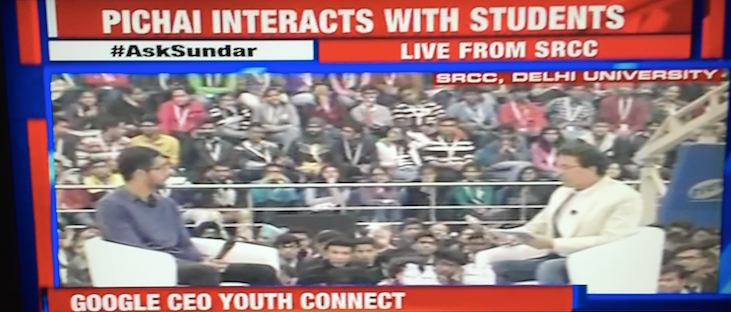
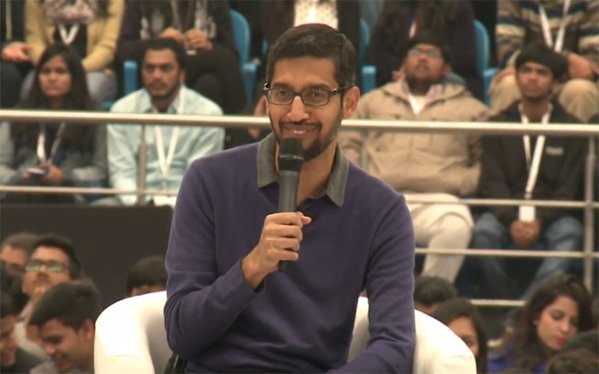
Sundar PichaiCourtesy of my satellite TV service I’ve just been watching Google CEO-Youth Connect live on Indian news channel Times Now.  Google CEO Sundar Pichai was addressing students at the Shri Ram College of Commerce, Delhi University.  In front of a large audience including teachers and students from local schools, Harsha Bhogle was moderating a stream of questions from the audience, on video and online.  You can follow some of the interaction on Twitter hashtag #AskSundar.

One of the best questions came from the Principal of Ami Public School in Burari, Delhi – I couldn’t quite catch her name but it might have been Malini Narayanan.  She was worried about what we should be teaching our kids so they can compete in today’s environment – how do we adapt ourselves to become future ready, what skills and techniques do our children need to learn?  She asked:

“How do we get the edge?”

I loved and totally agree with Sundar’s three part answer for how we prepare to solve the next generation of problems. His first ingredient was worrying that there was too much emphasis in the education system on the rigorous academic process and values versus creativity.  He said:

“Creativity is an important attribute, encouraging more creativity through the education system.”

Next he referred to what the best schools in the US do which is:

“Experiential, very hands on, people learn how to do things by doing them, not just by learning about them”

Lastly, he raised the massive point around the fear of failure. He said we should:

“Teach students to take risks, make sure the system doesn’t penalise for you to take risks.”

  • Creativity
  • Learning by doing
  • Encourage taking risks

All of our education systems need to dedicate more time and emphasis to these three great maxims if we are to prepare the next generation to handle the current rate of change, emerging technologies, and the disruptive business and political landscape they are creating.

Photo on Twitter from India Today

Share this:

  • Tweet
  • Email

Filed Under: creativity, digital literacy, ideas

Future of Work – a Blockchain primer

December 9, 2015 By David Terrar

Future of Work – a Blockchain primer

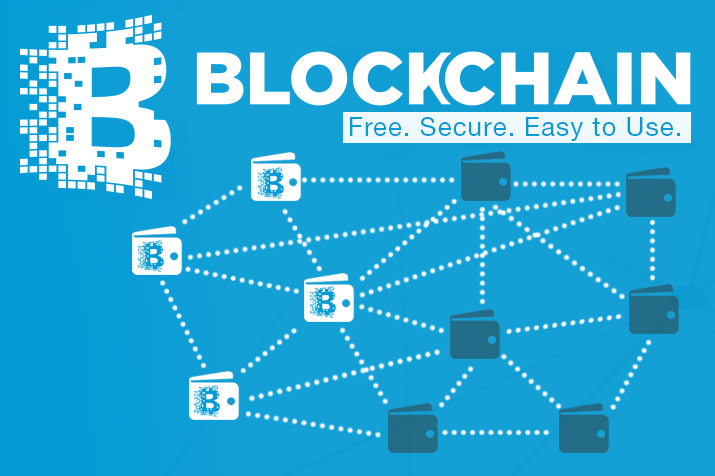
A few weeks back on 19 November I attended a Blockchain event – one of the Future of Work sequence of sessions sponsored and hosted by Truphone, organised by Lloyd Davis of the Tuttle Club and Helen Keegan of Heroes of Mobile.  These sessions explore different technologies and their potential impact on the business landscape, and the workplace. It was an interesting event, with singer Imogen Heap talking new approaches and business models oriented towards the working musician within the music industry, but it wasn’t quite the topic primer on Blockchain I was looking for.  A good event nevertheless, and the second part of this post covers my notes on Imogen’s session.  But first I want to relate the subsequent homework I did to figure out how to explain why Blockchain is so important.

Part of the problem with talking Blockchain is that commentary on it is often strongly tied to the digital currency that it supports – Bitcoin. That single implementation overwhelms most explanations of the underlying technology. I’ve looked at a lot of explanations generated over the last year and come away puzzled, but the best I’ve found is from Mike Gault on re/code on July 5. He starts by saying:

“Imagine that you’re walking down a crowded city street, and a piano falls from the sky. As dozens of people turn to watch, the piano crashes down right in the middle of the street.

Then, without a second to lose, every person who witnessed the event is strapped to a lie detector and recounts exactly what they saw. They all tell precisely the same story, down to the letter.

Is there any doubt that the piano fell from the sky?”

This is the innovative and disruptive concept behind blockchain technology – a distributed consensus model for recording digital events of any kind.  A way of simply and easily creating a digital ledger of events that is automatically duplicated across many nodes and could be recording anything from an exchange of currency, to a contract, to any step in a process that needs to be certified and verified.  Wikipedia tells me that blockchain is a permissionless distributed database, derived from the bitcoin protocol, that maintains a continuously growing list of transactional data records hardened against tampering and revision, even by operators of the data store’s nodes.  Each blockchain record is enforced cryptographically and hosted on machines working as data store nodes.  The cryptography combines with the fact that the records are duplicated across many nodes in the network so that tampering with a record would be so astronomically “expensive” as to be impossible in practical terms.

Think of what that could change in business.  At the moment so many processes rely on some trusted intermediary and a multi-stage process of exchange. Whether that’s a bank, or an accountant in practice, or a law firm, or some legislative body with a compliance procedure to follow or a combination of several of these things.  Suddenly, one or more layers of process complexity could be taken away and replaced by a single ultra secure transaction in a ledger.  If we are talking money, then we are used to a system of promisary notes, bank notes, bank cards, online banking systems and phone apps that access our money, controlled by the institutions which print the notes, record the amounts, exchange them with our customer and supplier bank accounts, trade them in to other currencies for exchange, or hold them in secure vaults.  These can be replaced by a digital ledger and much simpler processes without the need for all of that administration and physical infrastructure.  The same digital concept can be applied to simplify the processes around agreeing and verifying a contract, a person, ownership of a thing, or any sort of event, in the broadest sense, that needs to be trusted.  Take a look around the audience at the next Blockchain event you are at, and you will see that banks, law firms and accounting practices are taking note and getting educated.  New markets and new ways of working are going to be created alongside legacy infrastructure, similar to the way basic mobile phone message technology has been so disruptive in Third World markets in recent times (but on steroids).  A lot of what we now consider as normal business practice will change over the next 10 years because of the Blockchain.

Imogen HeapSo let’s head back to Imogen Heap the Grammy Award winning composer, performer, recording engineer, technologist, and inventor talking about the music business.  She explained her Mycelia project, taking it’s name from fungal colonies of mycelium forming the largest organism in the World, relating that idea to the music business.  The music content are the nutrients underground and above ground you access them with Spotify or iTunes or YouTube but using Blockchain technology.  The model would change from the current centralised model where the record companies are the intermediary gateway controlling everything, to a distributed network where the creator of the content, the musician, would have the power.  Imogen would know every time one of her pieces was downloaded or played, and she would control the cost and decide if and when it might be free.  Mycelia would have open and shared data so that fans could find out about the bands they were interested in.  There would be tools to help, curation provided, and choices available so you wouldn’t just have access to a small compressed music file, you could choose the high resolution version to get the full sound experience that was created in the studio.  The approach would make the revenue splits between the musician and other parties involved transparent.  There would be Blockchain based smart contracts as an integral part of this new solution.  Imogen has been interviewed by Forbes magazine around this topic.  She worries that the music industry has boxed itself in to a corner where their model is based on producing a few big hits a year and so the industry is too top heavy.  Actually, like any market, we need healthy competition but coming back to her mushroom analogy, we need to nourish the base layer of the industry.  Her belief is that the key to that is to make the whole process easy, in the way Napster was when it first started to subvert the industry.

At least part of the problem is the cost of production, and how the music companies manage the capital involved and act like banks towards new acts, funding an album with advances that then need to be paid back with interest. Some musicians are getting around that problem with technology like Kickstarter.  For example, I’m a fan of the American-Irish band Solas.  I’m one of 726 backers who have pledged $46,199 to fund the studio recording of their next album, celebrating their 20th anniversary, called All These Years.  That’s a good work-around, but Heap would like that concept to become part of the new structure and approach.

So Blockchain could definitely change the music business, but there are plenty of applications where it will be changing industry and the world of work before 2020 and 2025.

Share this:

  • Tweet
  • Email

Filed Under: digital disruption, events, future, ideas, workplace Tagged With: bitcoin, blockchain, future of work, music

Learn, Unlearn and Relearn – the new digital literacy imperative

November 19, 2015 By David Terrar

Learn, Unlearn and Relearn – the new digital literacy imperative

I’ve started a number of keynote sessions this year, including the one I did at the i2 Summit (that’s the Internet & Intranet Summit) in Switzerland last week, with one of my favourite quotes from Alvin Toffler, the author of Future Shock:

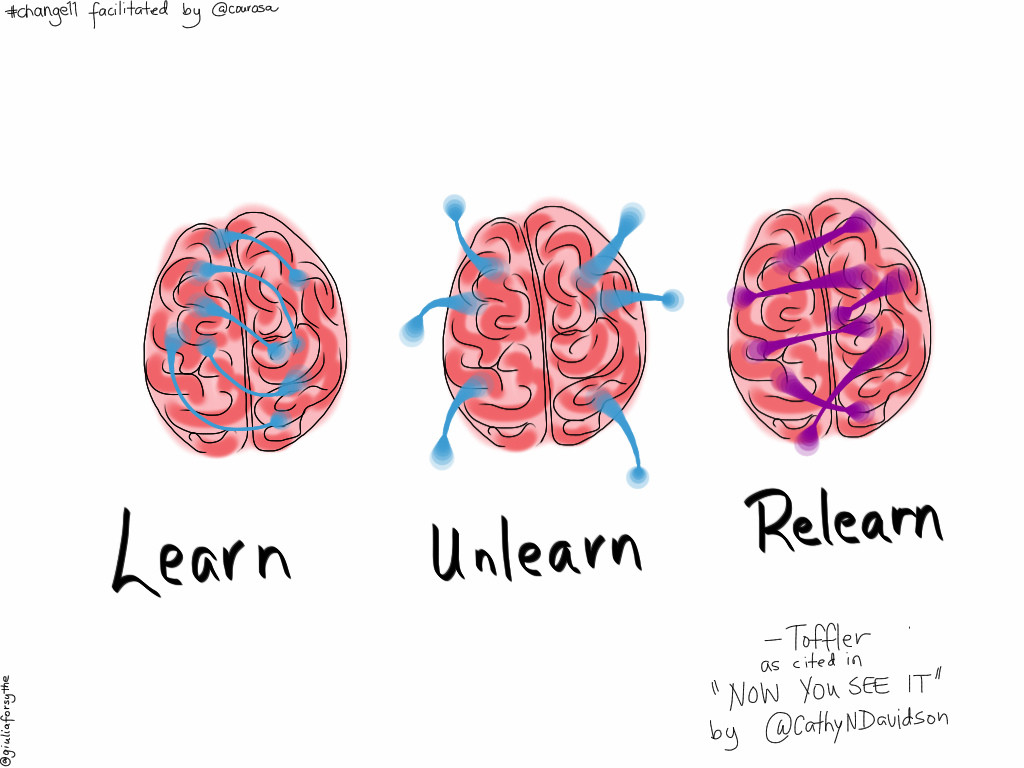
“The illiterate of the 21st century will not be those who cannot read and write, but those who cannot learn, unlearn, and relearn. ”

As we advance well in to the second decade of the century this literacy lesson is painfully clear and important on several levels.  I asked the conference audience in Switzerland of around 90 practitioners, technologists, marketers and internal communications professionals whether they had heard of the Cluetrain Manifesto, and only 3 hands went up. Depressing, but understandable.  I need to be constantly reminded that we pioneers of the social media (and social tools) landscape who have been living and breathing and learning the lessons for maybe 10 years or more are merely the advanced guard.  The overwhelming majority of very smart and technology literate people in business are usually just starting the digital and social journey.  Their technology literacy extends to driving desktop, laptops, email, documents, spreadsheets and corporate, legacy IT systems. Even the ones who live in the apps on their smart phones, or have started using twitter, messaging apps and hashtags, or maybe they are sharing content, contributing to the enterprise social network – they still have many lessons to learn, as well as legacy behaviours that are tied to legacy technology that need to be unlearned.

There is cultural divide.  Those that get it versus those that don’t. It doesn’t have to be an age thing, although Millennials who are “growing up digital” start closer to where they need to be in the new digital workplace.  Back in the day we learned that markets are conversations. We learned about blogging and building community. We learned about the 90-9-1 rule (although people often call it 1-9-90). We heard Andrew McAfee talking SLATES – search, links, authorship, tags, extensions and signalling.  Those basics haven’t gone away and need to be relearned.

This next level of literacy is framed around that “digital” word and the behaviours we need to learn to embrace its potential.  I’ve talked and blogged under the banner of “everyone’s talking digital and it’s dangerous!”  We’ve been talking about moving atoms to bits since 1995 with Nicholas Negroponte’s Being Digital book setting the tone, and we know that “software is eating the World” and now “mobile is eating the World” too.  Every company and organisation has become, in part, a software company as technology becomes an ever growing component in the products and services we provide. Everyone’s business model is under threat by some smarter, nimbler competitor with a new way of doing the work (or part of the work).  In your market it might be as significant as a Netflix or an Uber, but the disruptions you have to guard against can come in all shapes and sizes and at many points along the value chain.  As organisations and businesses we have to think continuous reinvention, think about competing with ourselves – if we don’t somebody else will.  These new business models, new ways of working, and digitisation of deliverables and processes or even parts of the process, all get wrapped up in the “d” word so that it’s about much more than just bits.

In 1985 or 1990 or 1995 or even 2000 you could have gone in to the new year with a reasonably clear answer to the question “what is the next big frontier in technology?”.  In 2015 how do we answer that question?  We’ve been used to big disruptions happening every 5 to 10 years, but the period we are in now is different.  We now live in exponential times.  At Agile Elephant we happen to call this new landscape the Digital Enterprise Wave, but there are many names for it.  Globalisation, our interconnected World, Cloud, Social and Mobile technologies are at the heart of it, but we have Big Data & Analytics, 3D Printing, Artificial Intelligence, Machine Learning, the Internet of Things and more.  It’s a wave of new and emergent technology – how do we ride that wave?  Well for a start we need to adapt our existing organisations to the new norm. As organisations we have to evolve (or face extinction).  Adding a Chief Digital Officer is a temporary fix – a bolt on solution where actually the “d” word and all that it means needs to be embraced by the CIO, the CMO, the CHRO, the CEO – well, across the whole organisation really.  Every company is different and at different stages in that learning curve, but every company needs to be thinking in terms of new structures to adapt to and deal with the wave.  The smart companies need to accelerate that learning, get literate and then fluent in the new language – look to the human side of the equation, the human interface dealing with the change is much more important than any individual technology change being brought in to the chain.  Oh, and by the way, we are complicating the landscape by adding layers and silos and of new, often disconnected, communication tools and channels that make the digital workplace and the omni-channel connection to the customer even more of a challenge (or should I say mess!).

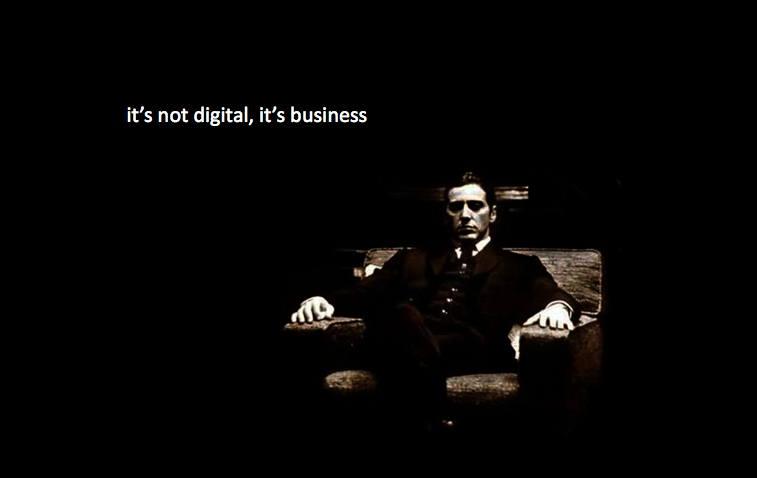
Its not digital its business

If you move the timeframe forward by a few years, we’ll be using different language.  At the moment, the “d’ word is dangerously over-hyped, often misunderstood, but definitely useful.  In those keynotes I’ve referenced Michael Corleone from The Godfather, when he tells Sonny, talking of how he is going to kill Solazzo and McCluskey, that “it’s not personal, it’s business”. I’ve paraphrased that to say “it’s not digital, it’s business”. This is just the way we do business now, but at some point we’ll drop the word or change it for something else.  At the moment, the “d” word highlights that we need a new kind of thinking and a new literacy for our leaders, our middle managers, and for our people on the front line with customers, in their cubicles, or at their desks in their home offices.  Now more than ever in this digital era, as organisations and people we need to learn, unlearn and relearn.

(top image from Giulia Forsythe on Flickr)

Share this:

  • Tweet
  • Email

Filed Under: digital literacy

Artificial Intelligence and the Future of Work

November 13, 2015 By David Terrar

Artificial Intelligence and the Future of Work

How will Artificial Intelligence affect the future of work? That was the theme of a combined Tuttle Club and Heroes of Mobile event that I attended on Tuesday in one of the towers of Canary Wharf. It was the second in a series hosted and sponsored by Truphone, a mobile phone service provider that produces a SIM card that operates in many countries – a goodbye to roaming charges they say! I met their founder and now CTO James Tagg at the start of the event and we started talking Physics – my own Applied Physics degree is a distant memory, but we shifted on to the Artificial Intelligence topic and James said something really useful and a little profound. He said that Artificial Intelligence is to Human Intelligence like an artificial (actually he said plastic) flower is to a real flower. Viewed in a certain way it can be as beautiful and look very similar, but it’s actually different. It might perform the same core purpose, an acceptable alternative to the real thing, but it’s still different. But that difference might be very useful – it lasts for years not days and doesn’t need water for example. That put the whole Artificial Intelligence and Machine Learning topic in to a new light for me… I was there at the event to learn more about an emergent technology which has the potential to be massively disruptive. Will it take away jobs? Will the robots take over the World? Is there a HAL 9000 or a Cyberyne in our real future?

Benjamin Ellis at #FOWAIThe session was introduced by James, and Lloyd Davies of Tuttle was master of ceremonies and moderator. The main speaker was our good friend Benjamin Ellis. He admitted he is an engineer at heart, but soon got on to a key date in history. 25th January 1970 and the name Robert Williams. What is the significance? It was the date and name of the first person killed by a robot at Ford. It meant that from that point on industrial robots were deployed in cages. He talked about how we relate to artificial intelligence and robotics, and how it changes our behaviour. He mentioned how Google has open sourced their AI engine this week. That’s interesting but he believes the smart stuff is how you apply and contextualise the technology (not the AI engine itself, which will just end up as commodity technology). He went on to highlight a basic paradox. More people are being employed with AI solutions rather than less. Going further, we have less leisure time as a generation, even though we are using more technology at work to help get the job done – all surveys around this topic have found productivity hasn’t gone up with newly deployed IT.

Benjamin used a great 1950s picture of an IBM 305 5Mb (first ever) hard drive being loaded on to a plane with a crane, highlighting how far we’ve come. Kryder’s law suggests we might see a 2.5 inch 40 TB drive by the end of the decade – that plus Moore’s Law is driving a hell of an increase in the potential processing power and storage available – will that help make AI more of a reality?

Then Benjamin shifted gears to talk about emulation and simulation and the distinction between the two. We know the brain is made up of neurones. We can emulate what the brain does with things like visual recognition, face recognition and the like. However, there is more to it than that. Benjamin got us to stand and strike a Superman pose. Then he got us to sit timidly, and we discussed how our physiology changes our decision making, and our thinking based on that body language – we are very complex systems. He talked about how 1.73 billion nerve cells connected by 10.4 trillion synapses actually equates to less than 1% of the brain. He quoted this particular set of figures from this piece of research where Japan’s K Computer — a massive array consisting of over 80,000 nodes and capable of 10 petaflops (about 1016 billion operations per second) was put to work to simulate that portion of the brain’s capacity. It took 40 minutes to complete the simulation of 1 second of brain operation. Neurones are phenomenally complicated and not just switches. Neural networks are more complicated than we think, so emulating those may be just too hard. Let’s do simulation instead. Well that works really well for systems that we can describe precisely, where they are well documented. Businesses are more complex than that, barely repeatable processes as my friend Sig calls them – informal processes that are a little different every time through. So much of business works that way day in day out. Then he quoted Gregory House from the TV program – everybody lies. Lots of our behaviour is built around responding in a socially desirable way, to do with social cohesion, instincts that come from the reptilian part of the brain that controls fight or flight – the part that helps us avoid getting killed. We can put together a model of how we think the other person works, but social interactions are phenomenally complicated and how do we factor those in? Try running a simulation of what’s happening in the other person. What do we think that they think when they are saying that. Actually there is a negotiation of meaning here – how long will it take until we can compute that kind of thing as well as the human brain? Well if you start to cost out computers versus people, you soon get to numbers where the annual cost of ownership of even a single well specified laptop is more than the salary of a third of the planet’s population. Compute power is surprisingly expensive, and we humans can be very cheap. Where does it make economic sense?

Benjamin talked about the Hedonometer for measuring happiness, and how we can track the sentiment of tweets. Maybe computers can do the raw pre processing, be used for predictive analytics, or they can run algorithms to analyse data in the medical space. Yes, there are certain things that the compute power available today can do really well, but is AI really going to take all our jobs?

Well we discussed the productivity paradox – some types of jobs are ripe for automation with AI, but there are others where we’re nowhere near, and humans are still very necessary. But Benjamin was asking how do we work with this AI. How do we get inside the cage with it (bringing it back to the robot, Robert Williams and 1970)? Being alongside robots and AI will change our behaviour in business and he cited the Cobra paradox. In the time of Empire in India, there was a cobra problem. The government’s solution was to put a price on their heads to eradicate the cobra. But the entrepreneurs arrived and started cobra farms to make money out of the bounty! If you set an objective, people will find a way of gaming it. Where do you delineate? Who makes the decisions? At what level do you maintain control? How does the use of AI and robotics change our behaviour?

All great food for thought. We then adopted an Open Space Technology approach – people suggested a collection of issues to be discussed, and we split in to groups for some very thought provoking discussion. The whole evening was summarised by each of the 30 or 40 or so attendees by speaking a sentence or two of the key things they’d learned or a highlight of the evening in to a digital recorder that got passed around.

The hashtag for the event had been #FOWAI but we’d all spent so much time listening and talking, that nobody in the group had tweeted. There was just one tweet in that stream that I shared with the group at the end to their amusement. A “bot” of some kind had generated a tweet that said:

Attending Future of Work: Arti #FoWAI event? Here’s the best hotel to book: https://t.co/dDkcdcbvWn

— Magic Manila (@MagicEventDeals) November 9, 2015

You have to laugh at the irony of it!

Some very interesting thinking that has set me on the road to explore this topic some more in follow on posts.

Share this:

  • Tweet
  • Email

Filed Under: artificial intelligence & robotics, future, innovation

Enterprise Digital Summit London 2015 – #EntDigi impressions and key messages

October 27, 2015 By David Terrar

Enterprise Digital Summit London 2015 – #EntDigi impressions and key messages

Here’s a Storify summary of impressions, tweetable slides and key messages from the 22 Oct 2015, Enterprise Digital Summit London event, selected from the #EntDigi tweet stream and flickr photos.

We’ll be publishing more posts, impressions and write ups here soon.  Please contact us if you want to find out more.

Share this:

  • Tweet
  • Email

Filed Under: #EntDigi conference, collaboration, digital disruption, digital transformation strategy, Enterprise Social Network, future, organisational culture, social business, workplace

Essential TED Talks – Simon Sinek – Start With Why, how great leaders inspire action

October 1, 2015 By David Terrar

Essential TED Talks – Simon Sinek – Start With Why, how great leaders inspire action

Following on from Sir Ken Robinson on education and creativity, this next TED talk recommendation is about inspiration.  It explains something that is so simple, and yet so powerful.  A vital ingredient that is missing from many of the companies we work with, or work for, or buy products and services from.  An idea that can galvanise action, or if it’s missing can make the message fall flat so that we say – meh!

This talk comes from the independently run TEDx talks rather than the main conference.  It is from TEDxPugetSound which happened on 16 September 2009.  The video was loaded to YouTube a few days later and to date it has 1,382,600 views.  Simon Sinek explains that we should “Start With Why” because that is the way great leaders inspire action.  It applies to marketing, business, politics – anywhere that you need to inspire action.

Simon’s talk doesn’t use fancy graphics.  It’s low tech, using a flip chart and some coloured pens to draw diagrams, but he amplifies the message with some great stories and examples that we already know from history or our daily lives, but he shows us something different, something that should be obvious – like so many great ideas.

His examples include wondering why Apple is so innovative and loved, when they are just a computer company.  He wonders why Martin Luther King led the civil rights movement in the United States in the 60s – many people were involved, but we focus on Dr. King – why is that?  And he tells us the story of the Wright Brothers taking flight.

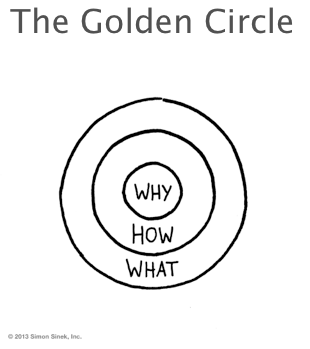
The Golden CircleThe core of his idea is what he calls The Golden Circle.  Every single organisation in existence knows what they do.  Most of those organisations know how they do it.  Very few know or express why they do what they do, and that’s Simon’s key point – so many companies have forgotten their why.  It’s not about profit, and it shouldn’t be about shareholder value.  Even the great Jack Welch, CEO of GE, said “on the face of it, shareholder value is the dumbest idea in the world”.  Actually when people start companies it is based around a cause or a belief or an idea about doing things better.  Simon’s first example is Apple, and he highlights the difference between those technology companies that just make products against Apple’s “why” which they had at the start and then lost, and then found again when Steve Jobs returned to the company.  For everything they do they believe in challenging the status quo, and that drives them to make beautifully designed products that are easy to use and desirable.  If you ever heard Steve Jobs speak, it was always about why, with much less emphasis on the what and the how.  Simon suggests it’s too easy to start from the outside of the circle and work in.  If you want to inspire people you start from the inside and work out.

He goes on to suggest that the golden circle mirrors the structure of the brain, with logic and language controlled by the neo cortex, but the limbic brain controls feelings of trust and loyalty – that’s where we make our gut decisions (which we then rationalise with the neo cortex part of the brain).

Martin Luther King - I have a dreamHe uses TiVo as an example of a great product which failed because the marketing and positioning never properly explained its “why”, and then moves on to the story explaining why the Wright Brothers were the first to take flight.  His final example goes back to the Civil Rights movement in the US and Martin Luther King’s speech at the Lincoln Memorial in Washington DC.  It was delivered to 250,000 supporters – there were no formal invites, no websites to tell people where to go and when – it was word of mouth and the power of Dr. King’s message that brought the huge audience.  Importantly, Simon Sinek quips:

“by the way, he gave the I Have a Dream speech, not the I Have a Plan speech!”

Simon tells us there are leaders and there are those who lead.  Leadership is not about power and authority – those who lead inspire us.  Simon’s message can help you do the same.  Watch the TED talk and then go to his website for useful (free) resources.  You could also read the book.

If you want to understand more of our Agile Elpehant thinking, check the rest of our blog material and take a look at the Enterprise Digital Summit London in October. We’d love to hear your comments or suggestions or to see you in London next month.

Share this:

  • Tweet
  • Email

Filed Under: #EntDigi conference, ideas, leadership, resources, strategy

« Previous Page
Next Page »

Sign up for our regular Agile Elephant Newsletter - news, posts, ideas and more.

My Tweets

From the Agile Elephant Blog

  • The Metaverse doesn’t exist yet, but…
  • Impossible Things get Disruptive
  • Clarity, Cloud, and Culture Change at IBM

What Next?
Take a look around our site, check out our approach, see how we can help, join the conversation on our blog or contact us to find out more.

About Us

Agile Elephant is a new kind of consultancy designed to help companies embrace the new digital culture of social collaboration, sharing and openness that is changing business models and the world of work.

Contact us to find out more!

Our founder's blogs:

broadstuff

@DT on Medium

Technotropolis

Our blog:

The Agile Elephant Blog

Site Log In | Site Log Out

Subscribe to Site RSS

Subscribe to our Blog via Email

Enter your email address to subscribe

Join 30 other subscribers

Copyright © 2026 ·Streamline Pro Theme · Genesis Framework by StudioPress · WordPress · Log in