Agile Elephant making sense of digital transformation

innovation | digital transformation | value creation | (r)evoloution

  • Email
  • Facebook
  • Google+
  • LinkedIn
  • Twitter
  • Home
  • Manifesto
  • Services
    • Our Approach
    • Our Services
    • Making Collaboration Work Packages
    • Collaboration Solutions
    • Our Experience
    • Workshops
    • Innovation
  • About Us
    • The Team
    • Why we do what we do
    • Why are we called Agile Elephant?
    • Our Partners
    • Our Clients
  • Get Involved
    • Events
    • Meetups
    • Unconference
    • Newsletter
  • Resources
    • What is Digital Transformation?
    • What is the Digital Enterprise Wave?
    • Our Research
    • Case Studies
    • People We Follow
    • Articles & Links
    • Books That Inspire
  • Blog
  • Contact Us
Home Archives for sustainability
Taking Sustainability a step further – Marginal Gains

April 5, 2019 By David Terrar

Taking Sustainability a step further – Marginal Gains

I wrote about my sit down and interview with Chris Wellise, HPE’s Chief Sustainability Officer yesterday.  He was joined by his colleage Matthias Röse, HPE’s Chief Technologist for Mfg, Auto and IoT, for a round table session with me and the other influencers that were invited by HPE to #HM19 at the Hannover Messe.  
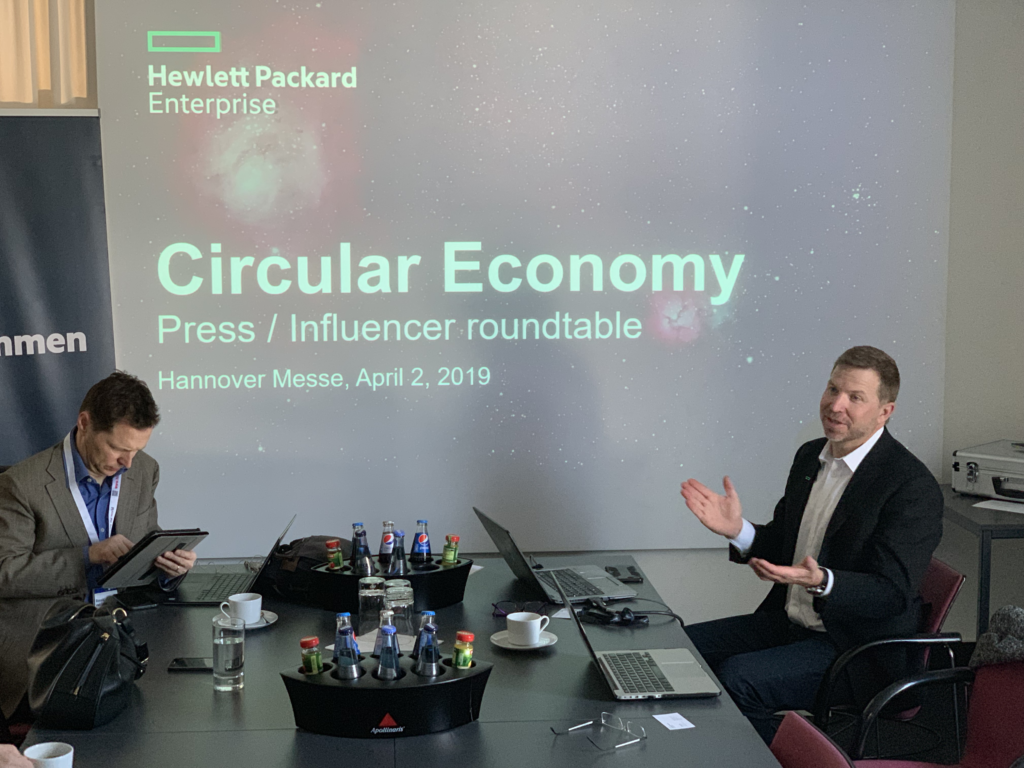
Chris Wellise explaining Circular Economy to the HPE Influencer Group

Between Chris and Matthias they expanded on HPE’s alternative to the typical “take, make and dispose” economy to think circular and closed loop.  They talked about the amount of greenhouse gasses used in the extraction, manufacturing and production processes and how they think in terms of material resourcing designed to minimise its impact on the environment.  As explained in the last post, HPE design their products for recyclability and end of use management, with an impressive 89% remanufactured and marketed to new customers. To put some numbers against that, it equates to their renewal centres processing £58m worth of product a year consisting of 1.7m data centre products and 2.3m workplace products.  That’s a huge saving in energy and resources that don’t have to be extracted and consumed.  Apart from saving the planet, the business case for doing this balances the potential for higher commodity prices as resource scarcity and volatility hits, with the resultant supply disruptions that would cause, along with the potential for ever tightening regulation, balanced against the opportunity for reduced costs, generating new revenues, improved competitiveness and a more resilient supply chain.  
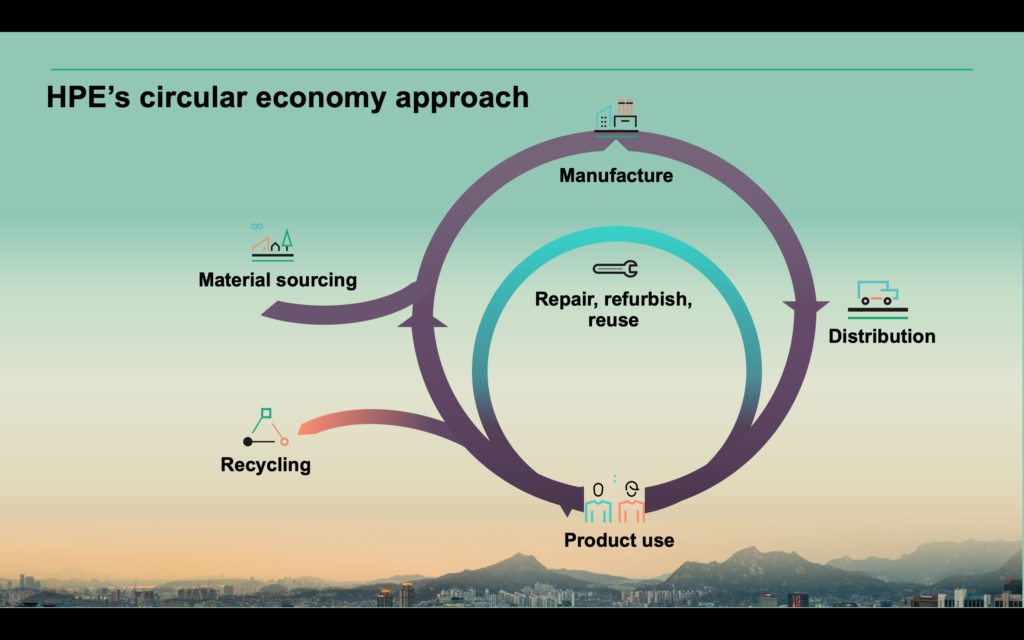
HPE’s circular economy approach to sustainability
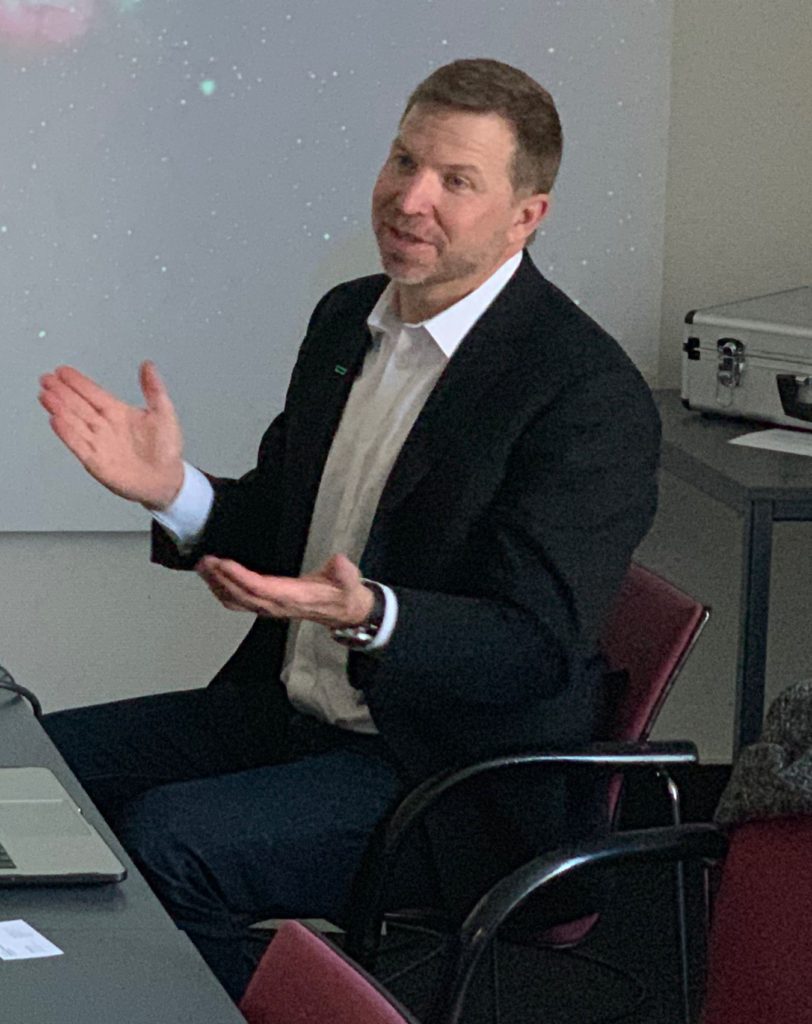
Matthias Röse, HPE’s Chief Technologist Mfg, Auto, IoT

However, 60% of the environmental impact of technology products comes in the use phase.  HPE believes it’s critical to be designing for efficiency to have the biggest impact.  That means thinking in terms of materials innovation.  It means products like HPE’s Synergy providing software defined storage, network and compute in one block instead of a standard rack mounted server, and that means less impact and a better utilisation rate.  Sadly most data centres are often over provisioned with server set ups 80% under-utilised – Matthias talked about zombie servers idling away, and I rather like that  term.  HPE are on a mission to share applications on a block, and provide a better utilisation rate.  Virtualisation and containerisation is the first step, but they talked in terms of using the whole chain of IT as a process with software defined architecture.  You should be paying only for what you use, what you need.  Interestingly, with their Greenlake product, that extends the OpEx pay-as-you-go consumption-based approach to on-premise hardware.  That, in turn, extends HPE’s hybrid-cloud credentials and means  better cashflow for their customers, and the ability to manage the peaks more easily.  Capacity on demand in your data centre, as well as the public cloud.  

This approach to infrastructure goes hand in hand with the shift in focus of data and processing moving to the edge, where we need solutions that provide compute power at or near the source of where the data is generated by a mobile device, a machine on the shop floor or a sensor.  This is vital for supporting IoT, for the requirements of autonomous vehicles in the field, or the needs of the smart city.  Gartner predicts that 75% of data will computed at the edge rather than in the data centre by 2025, and maybe it’s coming even sooner than that!  

Matthias was talking in terms of extending the sustainability arguments to closed loop manufacturing, taking the data from manufacturing shop floor systems, apply data analytics and AI to identify resource leakage.  Using predictive maintenance for identifying and preventing failures means the firm doesn’t need to build new, replacement product.  He told us about an undisclosed car manufacturer that he is currently working with.  For a luxury model with an automatic close function for the boot they are tracking usage, how often is that close button actually pressed.  How robust do the mechanisms and the motors driving the boot door actually need to be?  That may sound trivial, but I liken it to Sir Dave Brailsford’s sports science of marginal gains.  He transformed UK cycling by focusing on every element of the process from the cyclist, to her clothing, to the bike, to the track and looking for 1% gains in each piece of equipment used, each process step, and particularly looking for undiscovered areas to make a small difference.  All those tiny gains eventually add up to significant change, and the increase in effectiveness gave the team a large haul of Olympic and World Championship Gold medals.  That’s exactly the way those marginal gains for the automotive manufacturer will add up to significant efficiencies and sustainability, and a more successful HPE customer. 

They talked about how the repair shops generally not owned by manufacturers, but can be connected better.  They mentioned Daimler and their leadership 2020 programme helping them become agile.  They mentioned blockchain implementations in the context of making data more secure, and the idea of sharing more data from the car.  That could mean monetisation opportunities, but more likely it will be providing inputs to applications like Google Maps or Waze for traffic patterns, or route planning or emergencies.
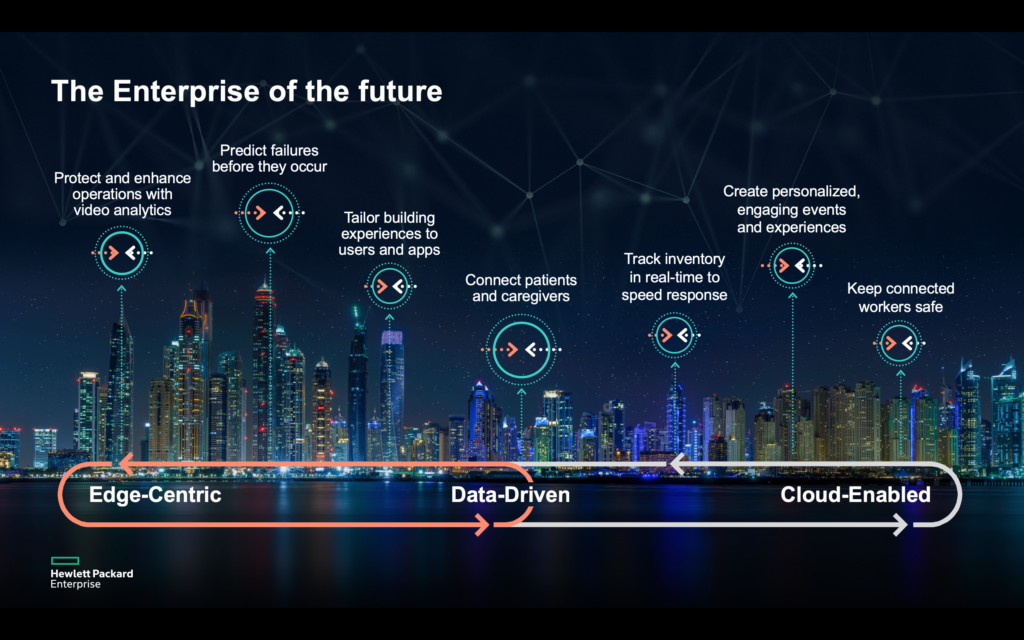
The Enterprise of the future – edge to cloud, IT with OT, AI and IoT

There is a change in approach in the company from 3 years ago where within IoT they were trying to do everything.  Today their strategy is an open ecosystem approach with more choice, and a range of the right partners for specific parts of the processes.  They are bringing IT and OT (Operational Technology) together.  Matthias has a background in Siemens before HPE, and they could argue that they had IoT 25 years ago.  Except it just wasn’t as open to the outside as Industrial IoT is today.  They are building in safety and security, gathering more data, more knowledge, applying AI to detect issues, deviate the data flows, eliminate challenges, increase the uptime – they bring a lot to the table. It’s a totally different mindset that combines lean manufacturing, and what I suggested as “marginal gains” in to OEE or Overall Equipment Effectiveness.  It’s taking sustainability a step further.  

Check back here for more content like this, and contact us if you want to find out more about digital manufacturing.

Disclosure: HPE paid my expenses for the trip to HMI 2019 as part of their influencer programme.
Share this:

  • Tweet
  • Email

Filed Under: agile business, digital transformation strategy, IoT, operations Tagged With: Chris Wallise, edge, edge computing, enterprise of the future, HPE, hybrid cloud, Matthias Röse, sustainability

Sustainability might not be sexy, but life depends on it

April 2, 2019 By David Terrar

Sustainability might not be sexy, but life depends on it

I’m at Hannover Messe 2019 for the first time, courtesy of Hewlett Packard Enterprise.  It’s not as big as CeBIT was, but it is still a huge conference with over 20 halls of exhibitors, covering everything from Industry 4.0, integrated automation, the digital factory, industrial supply, research & technology to the digital workplace.  HPE are in hall 6, the home of digital manufacturing.  I’ll be telling more stories from here around AI, automation, IoT, edge computing and a whole lot more, but on the first day I met with Chris Wellise HPE’s Chief Sustainability Officer.  

Chris Wellise, HPE’s Chief Sustainability Officer

When I’m speaking at events I’ll often ask the audience who amongst them was born on or before 1974, because those of us that were have been alive while the population of the planet has doubled, and as humans have been around for 200,000 years, that rate of change is staggering.  We live in exponential times, and Chris is full of eye-watering quotes and statistics on a topic that ins’t particularly sexy, but our lives and the future depends on it.  Chris says that as a large scale manufacturer:

“HPE produces 7 servers, 13 networking devices and 80 TB of storage every 60 seconds!”  

That’s 5 million units a year, all which generate data, and all of which need energy and resources in their creation.  Chris suggests that by 2030 most people will have 15 devices, all generating data because “everything computes at the edge and everywhere”.   He’s seen research that suggests we will run out of gold by 2030.  Yikes!  

You don’t have to have watched The Blue Planet to recognise the effect of what we are creating and then throwing away is doing for all of our futures.  Chris believes that sustainability is key.  We have to power the digital economy in a new way, and recognise the energy and resource constraints we need to work around.  Chris believes we have to move towards the circular economy.  To be able to do more with less.  We have to think in terms of applying our technology to disrupt the status quo.  We need smart manufacturing approaches to remove resource leakages.  

HPE have been rethinking design for environment since late 80s and they are one of only a few tech companies who regularly talk about what they are doing and why, rather than it just being a topic in the corporate social responsibility section of the website.  This thinking is necessary as the numbers are so big.  There will be 8.5 billion of us by 2030.  We’ll have 21 billion devices connected and sharing data by 2020.  By 2060 we will be need to be extracting twice the raw material that we do today, unless we can think differently.  We are running out of our planet at the same time that some people don’t even accept that global warming is real.

The HPE approach is to think through every product and design for its end of use.  They can “upcycle” and reconfigure equipment for a new customer within 48 hours at their renewable technology centres in Erskine, Scotland, and Andover, Massachusetts.  The products are, on average, 89% remanufactured to be sent on to a new customer with the remaining 11% responsibly recycled.  HPE have a vast shared supply chain servicing more than 150,000 customers, helped by over 170 suppliers, and then delivering products to 140 countries.  Chris says that they think about how they can have a sustainable influence on that massive supply chain in terms of greenhouse gas targets connected to the science of what they are doing, all in line with the Paris Accord on climate change.  It’s a call to action for our industry.  The current trajectory we are on is not sustainable.  

The other concept Chris talks about is “data landfill”.  He suggest that only 6% of data we generate is actually being used, and so the other 94% is wasted data that we have used energy, raw materials and production capacity to generate (for no added value).  How do we close that gap?  

Here’s Chris at the show following our sit down, talking with me some more around the sustainability topic:

Chris Wellise talking HPE’s approach sustainability with David Terrar for IT2

I’ll carry on the discussion in a follow on post, taking the sustainability thinking through to HPE’s customers using IoT, AI and data analytics technology to change the dynamic and reduce the waste.  Like I said at the start, sustainability might not be a sexy topic, but our future depends on it! 

Check back here for more content like this, and contact us if you want to find out more.

Disclosure: HPE paid my expenses for the trip to HMI 2019 as part of their influencer programme.

Share this:

  • Tweet
  • Email

Filed Under: corporate culture, future, HM19, innovation, strategy Tagged With: cloud, edge computing, HPE, hybrid cloud, supply chain, sustainability

Sign up for our regular Agile Elephant Newsletter - news, posts, ideas and more.

My Tweets

From the Agile Elephant Blog

  • The Metaverse doesn’t exist yet, but…
  • Impossible Things get Disruptive
  • Clarity, Cloud, and Culture Change at IBM

What Next?
Take a look around our site, check out our approach, see how we can help, join the conversation on our blog or contact us to find out more.

About Us

Agile Elephant is a new kind of consultancy designed to help companies embrace the new digital culture of social collaboration, sharing and openness that is changing business models and the world of work.

Contact us to find out more!

Our founder's blogs:

broadstuff

@DT on Medium

Technotropolis

Our blog:

The Agile Elephant Blog

Site Log In | Site Log Out

Subscribe to Site RSS

Subscribe to our Blog via Email

Enter your email address to subscribe

Join 30 other subscribers

Copyright © 2026 ·Streamline Pro Theme · Genesis Framework by StudioPress · WordPress · Log in