
Agile Elephant making sense of digital transformation

innovation | digital transformation | value creation | (r)evoloution

  • Email
  • Facebook
  • Google+
  • LinkedIn
  • Twitter
  • Home
  • Manifesto
  • Services
    • Our Approach
    • Our Services
    • Making Collaboration Work Packages
    • Collaboration Solutions
    • Our Experience
    • Workshops
    • Innovation
  • About Us
    • The Team
    • Why we do what we do
    • Why are we called Agile Elephant?
    • Our Partners
    • Our Clients
  • Get Involved
    • Events
    • Meetups
    • Unconference
    • Newsletter
  • Resources
    • What is Digital Transformation?
    • What is the Digital Enterprise Wave?
    • Our Research
    • Case Studies
    • People We Follow
    • Articles & Links
    • Books That Inspire
  • Blog
  • Contact Us
Home Archives for storytelling
My head’s SPINning with storytelling acronyms

July 5, 2019 By David Terrar

My head’s SPINning with storytelling acronyms

Sam Sethi’s podcast

A few days ago I was the latest victim on Sam Sethi’s Marlow FM 97.5 radio show and podcast – Sam Talks Technology (and there’s a Facebook group here).  Sam and I go way back to the start of the London social media scene in the mid 2000s and it was a delight to be a guest on his show.  His format is to mix technology and personal history, with a smidgen of “Desert Island Disks” thrown in.  He splits an hour and a half of chat in to what’s happening now, some history and then the future.  The time flew by.  He only had a chance to play one of my chosen tunes (the Mary Black with Emmylou Harris, Transatlantic Sessions version of my favourite Sandy Denny song “By The Time it Gets Dark“), and we didn’t get to half the topics we had planned, but it was great.  For some reason Sam asked me about SPIN and that got me thinking about useful acronyms and formulae I’ve picked up over the years to help with talking business, presenting and storytelling.

SPIN

What’s SPIN?  Well, way back when I came in to the technology industry, straight from University, I was being trained to be a Systems Engineer by IBM.  I was lucky enough to be on the first course on SPIN® Selling that they had commissioned from the Huthwaite Research Group.  My course was actually taught by Neil Rackham, the founder of Huthwaite and the researcher who had devised the technique.  Actually he had analysed the questioning techniques in thousands of sales calls and distilled the ingredients that were most successful in to a model process.  It’s an acronym for:

  • Situation Questions – to understand the customer’s current situation
  • Problem Questions – to identify current problems, issues and difficulties
  • Implication Questions – where you tease out the consequences of what those problems cause
  • Need-Payoff Questions – where you set up the value and importance of a potential solution
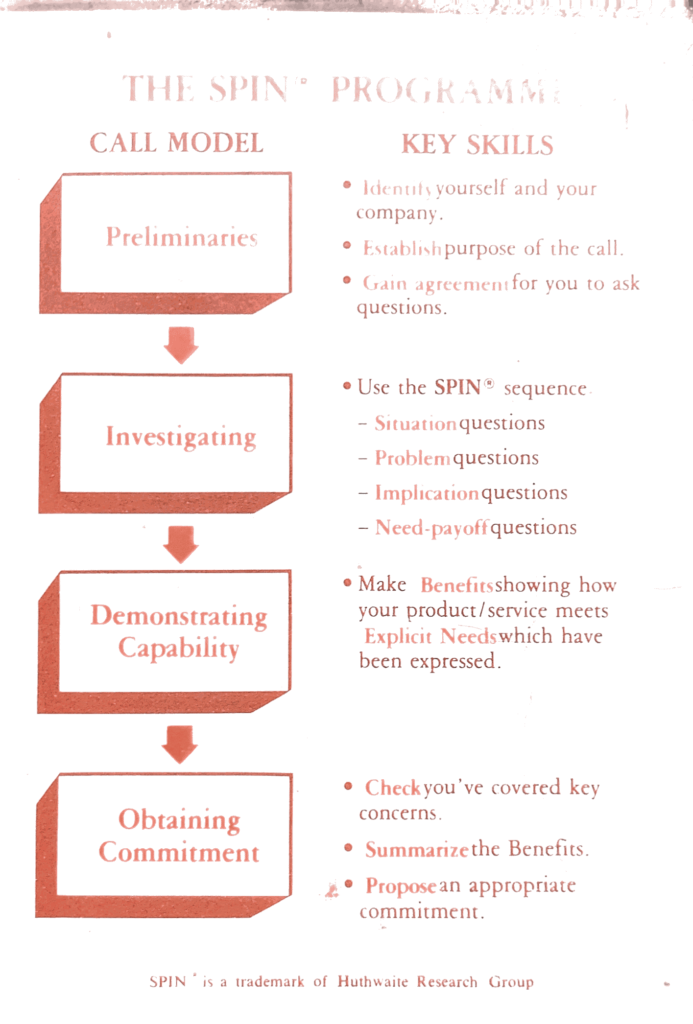
You might iterate around these questions to properly quantify the need and build up the value before you come in with the potential benefits of your solution.  As a model it works in all sorts of circumstances.  I’ve been using it ever since and I still carry the laminated card (see above and left) that I was given on the course in my wallet to this day (40 years on, but don’t tell anyone)! 

So what about those other acronyms and formulae?  Whether it’s a long form article, a presentation, an email marketing piece, your next 250 word post on LinkedIn, or 280 characters on Twitter, these will help you be more effective.


The 4 Cs

  • Clear
  • Concise
  • Compelling
  • Credible

In your writing, presenting or explaining keep things clear and concise, and make sure your arguments are compelling, with evidence or examples to ensure it’s credible.

The 4 Us

  • Useful – Make sure it’s useful to the reader or audience
  • Urgent – Provide them with a sense of urgency
  • Unique – Focus on your main benefit and convey the idea that it is somehow unique
  • Ultra-specific – Do all of the above in an ultra-specific way for this audience or reader

The Us are universal, but if you’ve got to get your message across quickly, like on social media, maybe this is where you start.

AIDA (Attention – Interest – Desire – Action)

  • Attention – Grab their attention
  • Interest – Make sure what you are saying is interesting, fresh and appealing
  • Desire – Make them want the idea or service with proof that it does what you say
  • Action – You must have a call to action – make sure they know what you want them to do next 

This has been a staple approach of copywriting, advertising and marketing for a long time, in fact since it was developed by the American businessman, E. St. Elmo Lewis, in 1898!

FAB (Features – Advantages – Benefits)

  • Features – Explain what your product or idea can do
  • Advantages – Explain how it helps them
  • Benefits – Translate what that really means for the audience or reader

This is deceptively simple, should be obvious.  However, it amazes me how many people in our technology space spend so much time explaining the features and ingredients of their products, and not enough time on the benefits and business outcomes that their solution, concept, or idea could achieve.  

BAB (Before – After – Bridge)

  • Before – Show them the world before your idea or solution
  • After– Help them imagine what the world would be like after your solution
  • Bridge – Present your solution as a bridge between the two worlds

Describe a problem, describe a world where that problem doesn’t exist, and then take them on the journey to get them to the new place.  People are motivated to take action to avoid pain, or look for pleasure.  Psychologists like Sigmund Freud have explained how we tick, and you can use that.  The added benefit of this approach is the shift in focus to benefits and outcomes, not products and features.

PAS (Problem – Agitate – Solve)

  • Identify a problem
  • Agitate the problem
  • Solve the problem

Here’s a formula that I’ve seen on Copyblogger, which is another great resource for writing ideas. Identify the reader or the audiences’s pain point.   Go round the loop a few times to increase the discomfort. Deliver a solution.

Storytelling

The core issue here is storytelling.  Whether it’s 280 characters on Twitter, 1,200 words in a blog post, 50,000 words for that book you are going to write, or the outline of your next podcast, we have to get better at it.  All of these formula will help you get your message across more effectively, whatever job you do.  It will also help you to think in terms of the basics of any story.  Christopher Booker wrote The Seven Basic Plots: Why We Tell Stories in 2004.  It contains a Jungian-influenced analysis of stories and their psychological meaning and the key thesis of the book is that all literature, scripts and stories are structured in terms of 7 archetypal plots:

  • Overcoming the Monster
  • Rags to Riches
  • The Quest
  • Voyage and Return
  • Comedy
  • Tragedy
  • Rebirth

I’d recommend you learn more about the art of storytelling, and of how to be a better writer and communicator.  My own writing mentor is my friend David Tebbutt.  He’s the best writer and editor that I know.  I won’t steal his thunder here.  You can download his writing tips from his website, and you should definitely watch this playlist of 9 videos he did with Alison O’Leary called Develop your Business Writing Skills.  Like so many things these days, you can learn it free on YouTube!  

I’ll leave you with David’s own 3 Bs maxim on writing: 

  • Be clear. Be credible. Be read.  

If you want help with telling your technology story, or finding your way through current business landscape, please contact us, or join the conversation below.  

Share this:

  • Tweet
  • Email

Filed Under: ideas, marketing, resources, sales Tagged With: communicating, selling, SPIN selling, storytelling, writing

Reframing the Digital Transformation conversation in 5 steps

March 14, 2019 By David Terrar

Reframing the Digital Transformation conversation in 5 steps

I’ve spent the last 2 days at Cloud Expo Europe, the premier London based event covering cloud platforms, hybrid and multicloud approaches, cybersecurity, AI, blockchain and more, as well as well as all of the ingredients of the data centres that support those technologies.  A wide set of tech topics, but within them everyone’s talking digital transformation and it’s dangerous.  Dangerous because, like talking cloud 10 years ago, it means different things to different people, becoming a catch all with too much emphasis on the technology itself, rather than the business outcomes it supports.  It’s the classic mistake we technology marketers have been making with our “widgets” for decades.  We need to reframe the digital transformation conversation!

First, how do we define it?  On the first day I was chairing the Techerati Keynote theatre.  During the stand out session of the morning an audience member asked the speaker that very question.  The speaker was Ian Johns, Chief Architect at Kings College London, who was talking about how you should ride the wave of digital disruption, rather than being swamped by it.  A message close to the heart of us Agile Elephants!  His session properly explained the disruption we are all experiencing, and he did a great job of defining digital transformation too.  I’m delighted that various blogs have referenced, and the latest Cloud Industry Forum research has adopted, our own definition which is:

“Digital transformation is the process of shifting your organisation from a legacy approach to new ways of working and thinking using digital, social, mobile and emerging technologies.  It involves a change in leadership, different thinking, the encouragement of innovation and new business models, incorporating digitisation of assets and an increased use of technology to improve the experience of your organisation’s employees, customers, suppliers, partners and stakeholders.”


The crucial point is that emerging technologies and innovation are driving it, but the true transformation is all about business, mindset and leadership change.  

Allan and Will interviewing me on the
Disruptive.Live studio/stand

I spent a lot of my time at the Expo with my good friends at Disruptive.Live co-hosting some of their live #Techerati interview shows, but then switching sides and coming on as a guest to be interviewed by Will Spalding and Allan Behrens (see later).  “Where are we at with digital transformation?” was the first question they asked me.  So if we put the technology aside for a moment, how do you go about integrating these new approaches while running your existing business?  How do you reduce risk and increase your chances of success?  I believe we need to reframe the conversation.  Here are my five suggestions on how to do that:

1. Encourage good behavior

Digitally savvy companies have leaders who encourage teamwork, explain their purpose with clarity, and promote an environment of openness and sharing. The particular organizational structure you have in place is less important than getting employees and leaders to embrace these behaviors. In her book The Management Shift, Vlatka Hlupic shows that many successful companies share a management style characterized by an open mindset, an unbounded culture, strong team cohesion, inspirational leaders, a strong sense of purpose, and passion for the work the company does.  Check out the absolutely excellent Team of Teams by General Stanley McChrystal, Chris Fussell et al translating their experiences in Iraq War 2 to today’s complex supply chains where teamwork across organisational boundaries is crucial.  These are the characteristics that 21st century leaders and managers need to be able to handle today’s rapidly changing business landscapes.

2. Think holistically

Adding mobile apps and new digital business components on top of existing systems can provide some help, and even give short-term benefits in key areas. To really transform your business, however, you need a holistic approach.  According to recent Forrester research, most digitally mature businesses recognize that they must break down business silos in order to realize their digital visions. One helpful tool is the McKinsey 7-S framework, which has been tried and tested over decades.  The 7-S framework emphasizes the role of coordination, rather than structure, in organizational effectiveness.  First you assess the business in terms of strategy, structure, and systems. Then you examine your staff, skills, and style, as well as the shared values of the company.  This approach helps to integrate all the factors needed to add value, find efficiencies, and make a real difference in your organization. You don’t have to use this particular framework, of course—there are many other useful tools out there.  The point is that digital transformation becomes much easier when you think about it holistically.

3. Be agile

You need a plan to integrate your digital transformation project so that it works with your legacy systems. Your plan should draw on agile thinking while still satisfying the financial demands of the C-suite. Think in terms of short time scales and multiple iterations. Don’t fear experimentation or failure.  The Forrester research already mentioned highlights agility as one of the top five metrics to measure the success of digital programmes.  True agility requires you to think like a startup. First, identify the problem that needs to be solved with a new digital approach. Next, develop a minimum viable product that you can implement. Use the resulting feedback to improve and iterate your product.  Pursue multiple, parallel streams of change with a six-to-eight-week cycle or shorter. Focus on achievable outcomes rather than individual tasks and steps, and be sure to foster regular communication at all levels across the process (back to Team of Teams).

4. Build a social network

True digital transformation touches all of a company’s teams and processes. You need sound cross-functional governance to get everyone on board with the disruption that’s to come. Our research shows that organizations that have implemented some form of enterprise social network or social collaboration platform, such as Workplace by Facebook, Jive, Microsoft Teams, Kahootz, GitHub or Slack, are more successful with their transformation than those that don’t. This kind of communication harnesses the collective intelligence of teams in ways that aren’t possible with old communications technologies such as e-mail.

5. Create your transformation story

Unless you are a digital native startup, your digital transformation will most likely be a complex series of incremental and strategic initiatives that fundamentally change the company over time. To get employees, customers, and investors on board, leadership needs to communicate the big idea—the “why” of what you are trying to achieve by reinventing your business.  Start thinking about the principles of story telling.  Start thinking in terms of the visual tools and communication processes you are going to use get the whole company as well as your partner and supplier ecosystem on board.  

Here is the interview, with the answer that triggered this post. Allan and Will also ask me about Blockchain technology, and what I think of the show too:


Please check out the hashtags #techerati and #disruptivelive for more CEE19 content from this year’s show.  

In summing up how to go about integrating digital transformation:

  • Digital transformation requires an open mindset, an unbounded culture, strong team cohesion, inspirational leaders, a strong sense of purpose, and passion for the work the company does.  
  • You need agile thinking, a mix of incremental and strategic initiatives, and short development cycles.
  • Leaders must communicate why they are reinventing the company so that everyone is on board with the overall goal.
  • If you need help defining, adapting or communicating your particular digital transformation story, please contact us – we’d love to help. 

Note – this post is an evolution of an article I wrote for enterprise.nxt the HPE Insights blog.  

Share this:

  • Tweet
  • Email

Filed Under: #Techerati, digital transformation strategy, events, leadership Tagged With: digital disruption, digital transformation, digital transformation strategy, leadership, storytelling

Sign up for our regular Agile Elephant Newsletter - news, posts, ideas and more.

My Tweets

From the Agile Elephant Blog

  • The Metaverse doesn’t exist yet, but…
  • Impossible Things get Disruptive
  • Clarity, Cloud, and Culture Change at IBM

What Next?
Take a look around our site, check out our approach, see how we can help, join the conversation on our blog or contact us to find out more.

About Us

Agile Elephant is a new kind of consultancy designed to help companies embrace the new digital culture of social collaboration, sharing and openness that is changing business models and the world of work.

Contact us to find out more!

Our founder's blogs:

broadstuff

@DT on Medium

Technotropolis

Our blog:

The Agile Elephant Blog

Site Log In | Site Log Out

Subscribe to Site RSS

Subscribe to our Blog via Email

Enter your email address to subscribe

Join 30 other subscribers

Copyright © 2026 ·Streamline Pro Theme · Genesis Framework by StudioPress · WordPress · Log in