Agile Elephant making sense of digital transformation

innovation | digital transformation | value creation | (r)evoloution

  • Email
  • Facebook
  • Google+
  • LinkedIn
  • Twitter
  • Home
  • Manifesto
  • Services
    • Our Approach
    • Our Services
    • Making Collaboration Work Packages
    • Collaboration Solutions
    • Our Experience
    • Workshops
    • Innovation
  • About Us
    • The Team
    • Why we do what we do
    • Why are we called Agile Elephant?
    • Our Partners
    • Our Clients
  • Get Involved
    • Events
    • Meetups
    • Unconference
    • Newsletter
  • Resources
    • What is Digital Transformation?
    • What is the Digital Enterprise Wave?
    • Our Research
    • Case Studies
    • People We Follow
    • Articles & Links
    • Books That Inspire
  • Blog
  • Contact Us
Home Archives for social business
CeBIT SBA keynote – Strategic Building Blocks for your  Digital Transformation Strategy

March 19, 2015 By David Terrar

CeBIT SBA keynote – Strategic Building Blocks for your Digital Transformation Strategy

As my last post explained, I was privileged to do the opening keynote, substituting for Dion Hinchcliffe, at this week’s Social Business Arena at CeBIT 2015. The theme of the show was social as the enabler for digital transformation. I expanded on a session I did at the Enterprise 2.0 Paris Summit with some additional material on our 20 year journey in to a “world gone digital” since the publication of Nicholas Negroponte’s Being Digital in 1995. I added some Dion slides (but avoided doing a Dion impression) to explain the challenge that the typical CIO has dealing with legacy IT, edge IT and the shadow IT that is happening because their department isn’t being responsive enough.

We are living through a time of immense disruption. We explain it in the presentation as the Digital Enterprise Wave. IDC calls it the Third Platform. Gartner calls it the Nexus of Forces. It doesn’t matter what we call it, but it does mean that everyone’s business model is under threat. You need to transform, but how do you do it? First you have to get educated, and I suggest 3 books you might read covering the global forces at work, the management shift required, and the kind of leadership that organisations need to adopt to start real, digital thinking. Then I’ve added in our definition of Digital Transformation.  There are several you can find (that I link to in my definition blog post) but we believe there are key ingredients missing from some of the explanations you can find.  After that I work through 8 strategic building blocks you need to address to form the basis of the change that your organisations needs to go through. One important factor I bring in that is usually missed by so many is creativity. When we live in a world where content can appear to be free, or we can use low cost resource, or Amazon’s mechanical turk, competing with commodity ideas on price just won’t cut it. More than ever we need to be teaching our kids, our employees, our managers and leaders thinking skills, and we need to make our organisations live and breathe creativity. When your business is under threat and needs a reset, new ideas are the weapons that you need to make progress.

Here is the audio and slides from Monday’s keynote. They did video me, but I guess I was probably jumping around on stage in too animated or distracting a fashion. It was a blast – hope you enjoy it.

So my core message is that the most important of the 8 blocks is that you need to change your and your organisation’s mindset to a permanent state of re-invention.
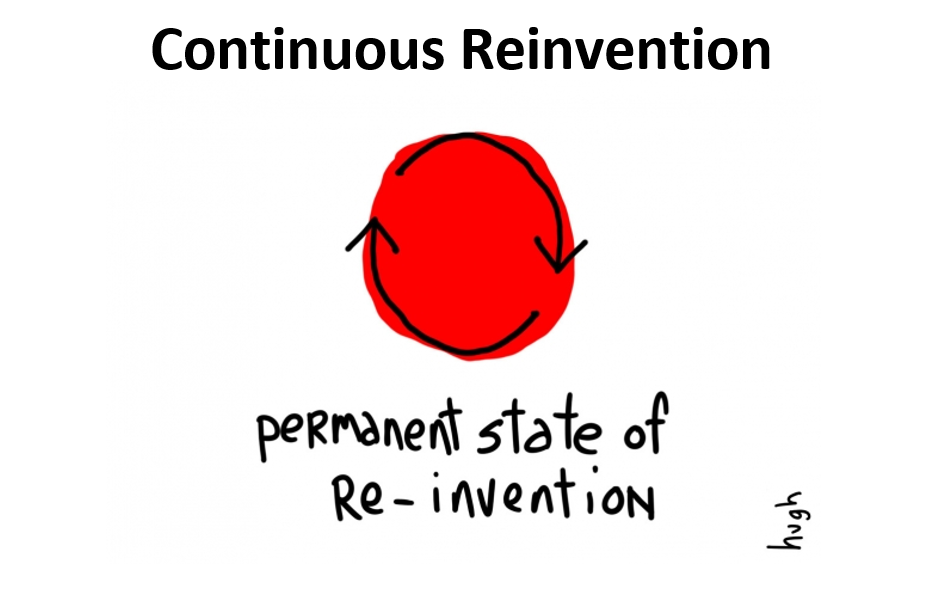
 

Continuous Reinvention

Share this:

  • Tweet
  • Email

Filed Under: digital disruption, enterprise 2.0, social business Tagged With: creativity, culture, design thinking, digital disruption, digital transformation, end to end, leadership, social business

Social as Enabler for Digital Transformation (or is it the new Black?)

March 19, 2015 By David Terrar

Social as Enabler for Digital Transformation (or is it the new Black?)

It’s been a while since I’ve been to CeBIT in Hanover. At its height during the late 90s and early 2000s, the time of the dot-com boom, it had over 800,000 visitors and covered everything form of technology from consumer electronics to enterprise IT. The consumer electronics part happens elsewhere now but it has a dozen halls of enterprise technology, 180,000 visitors and over 2000 exhibitors – it is still a huge event by any standards. Within one of the main halls, alongside very large stands for Deutsche Telekom, Salesforce, SAP, Microsoft, Software AG and others, the Social Business Arena was a 3 day “show within a show” focussing on Digital Transformation. I was delighted to be invited across, at late notice, to do the opening keynote when the organizers and my good friend Dion Hinchcliffe called me Saturday evening to say Dion was needed back home urgently.

I’ll post my keynote later on, but here is Bjoern Negelmann interviewing me just after the keynote on Monday talking social as an enabler for Digital Transformation. I talk about social as the glue that can, if deployed correctly, connect the organisation’s people and processes to do things more effectively. We go on to talk about Digital Transformation as a term becoming a bit of a catch all for many social and digital components. “Is Digital the new Black?” asks Bjoern. But no, it’s not just fashion, it’s vital!  I explain that a successful business must use these social and digital components, many of which have only come in to our personal and business lives over the last 10 years or so, to create value and drive the business forward. The C-Suite needs to get educated, but I also talk about how there are no one size fits all solutions – the approach will vary depending on the “digital state” of your company, and “digital experience” of the leaders.

Most of the presentations were in German – I think only Sameer Patel and I spoke English on that first day, but there were some great conversations going on.  You can follow them at #cebitsba.

Share this:

  • Tweet
  • Email

Filed Under: digital disruption, enterprise 2.0, Social Business Arena Tagged With: CeBIT, digital transformation, enterprise 2.0, Germany, Hanover, social business

A new Combined Social Business Meetup for London (with free beer and pizza)

April 2, 2014 By David Terrar

A new Combined Social Business Meetup for London (with free beer and pizza)

When we formed Agile Elephant, we had always wanted to start a regular series of monthly meetups around “what works?, what doesn’t?, what next?” in the social business space.

There are plenty of meetups that cover use of social media for marketing and promotion. We wanted something different. Something that covers the use of social tools inside the organisation, between teams and partners and customers to get work done more effectively, as well as for communication and outreach. We want to discuss topics like community building, barriers to adoption, employee engagement, new management structures and the future of the workplace. We’ll discuss social business platforms of course, but we plan to spend more time on behaviour and the culture required to make collaboration really make a difference to the bottom line for an organisation

Will McInnes started a like minded Meetup group in 2012 called Social Business Sessions London where we both have a lot of themes in common. Will has since moved to New York, and we have just taken over running that group on Meetup.com. We plan to run the meetup on the first Wednesday of each month (except for the summer holiday season) and there is a specific reason for that. We also hope to attract the champions of wikis and social software who used to attend London Wiki Wednesdays a few years ago – a group that we used to run. Their core theme is also the same as ours, and so we plan on incorporating that group too. However, we want to combine the best ingredients from each community, and continue the open spirit of all of the groups.

We are also delighted with our new partnership with Kongress Media.  They run the well-known, annual Enterprise 2.0 Summit in Paris as well as other Social Business events in Europe. They have offered to sponsor the beer, wine and pizza at each event. They will include our group in the promotion of their similar #e20s meetups in Paris, Brussels, Berlin and Zurich which connects us directly to an active Europe wide social business network.

Our working title is the Combined Social Business Meetup, but participants at the first session will have the job (fun?) of agreeing a better name.

Here is our initial, proposed format (which will no doubt be modified by group consensus):

  • Usually the first Wednesday of each month
  • Start time 18:00
  • Venue – Yammer’s EMEA HQ at 80 Gt Eastern Street, London (if you’d like to host a meetup please contact us)
  • One themed presentation of around 20 minutes – the first one will have Jon Mell of IBM as main speaker
  • Any attendee can speak on any social business related project or topic of their choice for up to 5 minutes, followed by 5 minutes of questioning from the floor – you book your place on the agenda by adding a post to the Meetup.com page – agenda sequence first come first served after the main speaker
  • Sales pitches are allowed, but we’ll make sure there aren’t more than 1 or 2 each week
  • An unconference panel of up to 5 volunteers will take questions for 30 mins
  • Kongress Media will sponsor the beer, wine and pizza and encourage everyone to promote the event using #e20s

The first event will be on 7th May. You can book your place on Meetup.com.  The main speaker at this first event is Jon Mell, Social Leader of IBM UK, and the venue will be Yammer’s EMEA HQ, 80 Gt Eastern Street, London (opposite Hoxton Hotel).  Contact us if you have suggestions or you want to find out more.

UPDATE:
The Meetup.com page for the event is now live. Go to the event page and RSVP.

Share this:

  • Tweet
  • Email

Filed Under: events Tagged With: collaboration, enterprise 2.0, London, londonwikiwed, meetup, open business, social business

What next for Social Business? Patchwork Elephant Event Report

October 1, 2013 By David Terrar

What next for Social Business? Patchwork Elephant Event Report

As part of London’s Social Media Week in September 2013 we put on an event called Social Business – The Patchwork Elephant Revisited asking “What next for Social Business?”.  We were kindly sponsored by our friends here at CompareTheCloud.net and we introduced the event and the speakers in an earlier post.  The idea was to get 8 different perspectives on where we are at, and where we go next, with using social and collaboration tools “inside” the business to add value and work more effectively.  Why is the “Social” word seen with such suspicion by some executives in the C-suite?  With the explosion of social media use in marketing or customer support reaching out of the organisation, why aren’t more companies using it all over their organisations?  We believe change is happening, but why aren’t we further forward with “Social Business”?

A few weeks after our event, Chris Heuer did a guest post on Brian Solis’ blog that moved in to the same territory we covered asking Social Business is Dead! Long Live What’s Next! and highlighted the problem with:

“While the ideas behind the moniker are invaluable in defining the future of work, most large companies simply aren’t buying into or investing in Social Business transformation efforts in more than a piecemeal sort of way”

Why is that?  Here are the 8 perspectives and presentations from the 27th November 2013:

ALAN PATRICK – Broadsight & The Patchwork Elephant

Social Business – The Patchwork Elephant 01 – The patchwork elephant revisited – Alan Patrick from David Terrar

Alan set the scene for us by revisiting our event from 3 years ago, highlighting that demand generation was the quick win and that social media structures are orthogonal to the normal hierarchy of command and control and so:

“resistance may be futile, but strong!”

He talked about social business being systematic, connecting the front end to the back end, looking to add value, and that culture follows commerce.  He highlighted how value will be created, and referenced a McKinsey study on where the potential productivity improvement might be over the next 10-20 years by industry sector.  He talked Ronald Coase’s theory of the firm and how they exist to reduce transaction costs, and highlighted that social technologies can directly help with that.

JANET PARKINSON – Technotropolis & The Patchwork Elephant

Social Business – The Patchwork Elephant 02 – think forward 40 years – Janet Parkinson from David Terrar

Janet talked about the unthinkable idea, and asked if business could become nothing more than a social object, with individuals collaborating via social networks, doing things businesses used to do.  She quoted James Burke who suggested earlier this year that:

“Nanotechnology will destroy the present social and economic system – because it will become pointless”

and then revisited Burke’s 1973 predictions of what 1993 technology might be like.  He had some things wrong, but a lot right, foreseeing the proliferation of the computer in offices, schools and homes, and the creation of metadata banks of personal information.  She highlighted how difficult prediction is, but then talked about a future of radical abundance where technologies, like the early 3D printing we see now, will mean people can produce their own goods from virtually nothing for virtually nothing, and how that will have a knock on effect changing the business world dramatically – it will affect production, transport, consumer facing businesses selling goods, sales and marketing, business support services and finance.  It could change the nature and need for cities, and even governments.  Does business become a social object?

WILL MCINNES – NixonMcInnes (just moved to Brandwatch)

Social Business – The Patchwork Elephant 03 – culture shock – glimmers of hope – Will McInnes from David Terrar

Will wanted to provide glimmers of hope.  He talked about the Culture Shock (his book) of how networked our World has become.  How society has moved from ancient times when we gathered at the the stone circle for social interaction, to everyone being connected with smart phones and tablets, even wearing technology, and he referenced that YouTube video of a small child expecting a Magazine to work by touch like an iPad.  He talked about the data we collect today just as a byproduct of the technology we use.  He talked about preconceptions and misconceptions – the jazz segment of the music industry is $100m a year, but Grand Theft Auto’s latest game version sold $800m in the first day!  We don’t have colonies on Mars, we have Facebook instead!  He talked about decentralised, bottom-up innovation.  He talked about the purpose of an organisation and quoted Umair Haque  (who spoke at our 2010 version of this event) tweeting:

“Making shareholder enrichment the basis of an economy is probably an idea that belongs up there with Cheez Whiz and Donald Trump’s hair.”

He also quoted Simon Kuznets, the inventor of the term GDP saying in 1934:

“The welfare of a nation can scarcely be inferred from a measure of national income”

He talked of crowdsourcing, from Wikipedia to Giff Gaff, and of organisations without bosses or hierarchy like Valve Corporation.  He talked ratings and reviews and the effects of that big shift on the high street.  He talked about the immediacy of citizen reporting, and the implications of humans being networked.  He talked OODA loops as a necessary approach to all of this, and mentioned his Meaning conference which will endeavour to connect and inspire the people who believe in better business, and want to be part of the change.

MAT MORRISON – Starcom Mediavest Group

Social Business – The Patchwork Elephant 04 – I hate everything – Mat Morrison from David Terrar

Mat talked about his @mediacsar presence on Twitter, along with his @evilczar alter ego as an example of how you can be different personae on the Internet.  He talked of Lego, of information overload, the power of on-line comments, how naive some marketers are around this topic, and how brands now have to act on Twitter.  He highlighted that although there might be 80m (or 200m or… ?) active users of Twitter, the median number of followers is actually 30 and so this lens is distorted.  He talked about the power of some well known Twitter complaints, and how you might get better service from some companies, such as BT, by complaining on Twitter rather than phoning their help line.

LUIS SAUREZ – IBM

The Patchwork Elephant 05 – social business is open business – Luis Saurez from David Terrar

Luis’s premise is that a social business is (or should be) an open business.  He talked about the culture change required to move from the old way of doing things to this new way of collaboration and sharing using social tools.  He talked in terms of a 30 year time frame – and he’s right, this is a major change that will happen slowly, but it’s happening.  He used his own company, IBM, as an example – they’ve been doing social business internally well before the existence of Facebook.  He talked Open Business and mentioned @davidcushman.  He explained an Open Business uses its resources to discover people who share its purpose, and then bring them together to realise that purpose.  He talked about the hierarchy and the wirearchy coexisting in a networked company.  He talked about accountability, and getting rid of layers, and providing incentives for employees to share.  He explained how managers need to transform in to leaders, and talked about the need for transparency.  His conclusion, with a touch of Mafia style – Open Business is “Just” Business, it’s the only way to go.

NEIL USHER – Sky

Neil didn’t use any slides.  He talked about being a corporate employee but trying to think about things holistically.  Neil talked about what it was really like for employees working for corporates and ‘using’ internal social technologies.  One of the reasons he didn’t use slides was because he wanted to feel the vulnerability which many feel when starting to use networks for the first time.  He talked about the workessence blog he has been writing for the past 2 years.  He told us a little about creating a Yammer network in one company and then using Salesforce Chatter in the next to create internal social networks within the organisations he’s worked for.  When he made that switch between companies, he discovered that people at his old company said they’d miss his input on the internal network.  He talked about LinkedIn and jokingly wondered what Google+ was for!  He talked of the value of asking questions of Twitter to crowd-source expertise and the fact that complete strangers will respond with the answers.  He was firm on the fact that these on-line social interactions amplify the subsequent face to face interactions, and vice versa too.  And he also managed the compulsory reference to Euan Semple (who, by the way, was one of the speakers back at our 2010 version of this event).

ANNE-MARIE MCEWAN – The Smart Work Company

Social Business – The Patchwork Elephant 07 – pushing big boulders uphill – Anne-Marie McEwan from David Terrar

Anne-Marie described herself as a recovering academic, and said she would be talking about pushing Big Boulders Uphill!  She was explaining her experiences writing a book, putting together a post graduate course and developing The Smart Work Company, which pulls together social business, the changing world of work and the way the physical workplace is changing too.  She described education as liberating, and democratising and how she wants to make a business school education available to anyone who wants it.  She talked of things experiential and social.  She described the social psychology of organising, of interlinked groups and their relationships.  She wondered why we had lost so much openness and gave that as one of the triggers for writing her book, because it means so much to her.  She talked of her work based masters course she taught at Kingston University and about getting people to think strategically.  She quoted Orlov the Meerkat and wondered:

“What could possibles go wrong?

She’s currently putting together a PGC for Chester University.  She admitted it’s been a hard sell to date.  When people think of a Post Graduate course they think in terms of a curriculum on “paper”, when actually she wants them to think in terms of what you actually do at work and doing it better.  She talked about applying social technologies, about the what and the how, but also the where.  She talked about a massive appetite for on-line learning, worried that current MOOCs have not helped as much as they should.  She contrasted just putting the old curriculum on video to an approach of connecting to others outside your organisation doing the same thing, to scope a project plan, learn together through discovering good practice and principles, critique and amend to suit your own circumstances.  She believes the doers are the experts, but we are the facilitators and feels she’s been given a second chance.

DAVID TERRAR – D2C & The Patchwork Elephant

Social Business – The Patchwork Elephant 08 – thoughts and summary – David Terrar from David Terrar

My job was to summarise the sessions, but add some thoughts of my own, so I quoted Dirk Gently as I also believe in:

“the fundamental interconnectedness of all things”

It’s important to realise that, in the last 40 years of regular technology disruptions every 5 to 10 years, we’ve never had 3 of them happening simultaneously before.  We have the shift to Cloud and web based apps happening at the same time as the explosion in social technologies happening at the same time that we are all walking round with mobile phones and tablets, so that we have the Internet in our hands, any-time anywhere.   That’s changing everything.  No matter what you do, your business model needs to change.  Back in 2011 Salesforce, who have one of the most complete business to social collaboration to social media monitoring offerings available, was promoting the Social Enterprise (when the term was already in use to mean something else), and they even tried to trademark it!  By 2012 that idea had failed, they changed their messaging but it evolved to “Business is Social”.  The same concept in different words.  It’s also important to note that Darwin’s theory of evolution still holds in business and marketing – categories naturally fragment and we have a huge landscape of software choices and point solutions, and so maybe this plethora of choice and the lack of maturity of better known, larger social business offerings is part of the reason why we haven’t made as much progress since 2006 or 2008, as many would have expected viewed from back then.  But there is more to it than that.  As Luis said, the culture change required is happening, but it will take decades.  I quoted Susan Scrupski who said:

“without executive direction, support and sincere engagement, internal efforts are nothing more than an aimless electronic water cooler”

There are smart companies who have heeded those words.  I highlighted major enterprises like Lilly and BASF and Deutsche Bank who all have great case studies of what can be achieved using social technologies, and we need more good case studies like those to get the C Level executives on board.  In the Q & A around the summary, Benjamin Ellis from the floor highlighted that it’s only a generation or two before our time that the average worker couldn’t read – we now have a literate, educated workforce, with technology to help.  We are beginning to move on from the Taylorist view of flows and mass production efficiency to a very different, flat, networked World with technology in our hands and everywhere we touch.  Over time we’ve used terms like Web 2.0, Office 2.0, Enterprise 2.0, Social Enterprise and Social Business as well as Collaboration and Knowledge Management.  We may not have the language right, but the idea of using these technologies to change the way we work is stronger than ever.  The next stage has got to be about putting what we’ve learned so far in to practice, and making that Elephant (in the room) dance.

Finally, I just want to add that the vibe in the room during the afternoon was a bit special, a bit different, and the discussion at the end of each talk was lively and productive.  We all enjoyed it, and I’d like to thank our friends at CompareTheCloud.net once again for their sponsorship to help make it happen.

As any of the speakers or attendees blog about the event, I’ll add references here.  So far there is:

Graham Stewart: The Patchwork Elephant And The Impact Hub

Tim Callington of Edelman: Open Business: In praise of lawyers

Janet Parkinson of Technotropolis:
Thinking the unthinkable with the Social Business Patchwork Elephant
Business as a Social Object, the Shadow Economy and WOMnets

A version of this post peviously published on Business Two Zero and Compare The Cloud

Share this:

  • Tweet
  • Email

Filed Under: events, strategy Tagged With: social business

Sign up for our regular Agile Elephant Newsletter - news, posts, ideas and more.

My Tweets

From the Agile Elephant Blog

  • The Metaverse doesn’t exist yet, but…
  • Impossible Things get Disruptive
  • Clarity, Cloud, and Culture Change at IBM

What Next?
Take a look around our site, check out our approach, see how we can help, join the conversation on our blog or contact us to find out more.

About Us

Agile Elephant is a new kind of consultancy designed to help companies embrace the new digital culture of social collaboration, sharing and openness that is changing business models and the world of work.

Contact us to find out more!

Our founder's blogs:

broadstuff

@DT on Medium

Technotropolis

Our blog:

The Agile Elephant Blog

Site Log In | Site Log Out

Subscribe to Site RSS

Subscribe to our Blog via Email

Enter your email address to subscribe

Join 30 other subscribers

Copyright © 2026 ·Streamline Pro Theme · Genesis Framework by StudioPress · WordPress · Log in