Agile Elephant making sense of digital transformation

innovation | digital transformation | value creation | (r)evoloution

  • Email
  • Facebook
  • Google+
  • LinkedIn
  • Twitter
  • Home
  • Manifesto
  • Services
    • Our Approach
    • Our Services
    • Making Collaboration Work Packages
    • Collaboration Solutions
    • Our Experience
    • Workshops
    • Innovation
  • About Us
    • The Team
    • Why we do what we do
    • Why are we called Agile Elephant?
    • Our Partners
    • Our Clients
  • Get Involved
    • Events
    • Meetups
    • Unconference
    • Newsletter
  • Resources
    • What is Digital Transformation?
    • What is the Digital Enterprise Wave?
    • Our Research
    • Case Studies
    • People We Follow
    • Articles & Links
    • Books That Inspire
  • Blog
  • Contact Us
Home Archives for Sigurd Rinde
Sig taught me about Barely Repeatable Processes and how work flows

May 22, 2019 By David Terrar

Sig taught me about Barely Repeatable Processes and how work flows

Earlier this month we lost a friend and the world lost a super-smart, clear thinker and business innovator.  Our friend Sigurd Rinde, business partner, fellow Enterprise Irregular and founder of Thingamy, died peacefully at home with his family on 9th May 2019.  This post isn’t intended to be a eulogy or an obituary, but a reminder of some of the important ideas that Sig taught us, and which will continue to influence our thinking on how business is done and the future of work.  
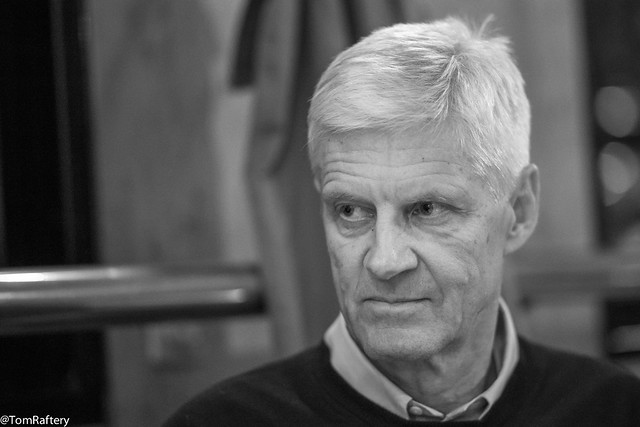
Sigurd Rinde – photo by Tom Raftery at SAP TechEd


One of the phrases you would often hear Sig say was:

“Management isn’t working!”

He was scathing about the “business as usual” attitude of all levels of management in our enterprises, the rigidity of the business systems that most organisations use, and the amount of time the average knowledge worker spends in meetings, dealing with their inbox and looking for answers.  Sig was, like me, a big fan of Gapingvoid cartoonist Hugh Macleod:
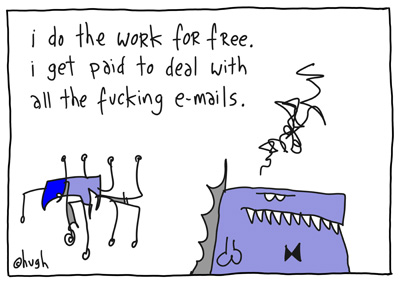
Cartoon by Hugh Macleod of Gapingvoid

Sig was always critical of the concept of ERP (Enterprise Resource Planning).  In fact, he redefined the term as Easily Repeatable Processes describing them on his blog as:

“Processes that handles resources, from human (hiring, firing, payroll and more) to parts and products through supply chains, distribution and production. The IT systems go under catchy names like ERP, SCM, PLM, SRM, CRM and the biggest players are as we know SAP and Oracle plus a long roster of smaller firms.”


So most organisations large, medium or small may have a company wide IT system which is either an integrated package, or assembled from best of breed components covering the very structured processes and data models required by their particular industry sector for order processing, finance, corporate planning, manufacturing or project management, procurement, sales and various forms of relationship management. The problem is that these systems almost certainly don’t cover all of the processes needed and they certainly don’t cover the way things actually happen day to day.  For that reality, Sig coined the term Barely Repeatable Processes (BRP).


Barely Repeatable Processes (BRP)

There are plenty of ad-hoc processes in any company. They might cover the unplanned issues that happen every day, or they are the company specific things that aren’t covered by the standard package. They might have no system to help at all, or are often supported by data in an Excel spreadsheet being e-mailed around a group of people. These are what Sig calls Barely Repeatable Processes (BRP). They have some rules, but they often need to adapt and change as new circumstances arise. They need information, but it’s often unstructured notes and facts captured on paper or buried in e-mails sitting in someone’s inbox on their PC, tablet or smartphone.

Sig founded his company and product, Thingamy, to address that business challenge.  His business philosophy was rooted in value creation, and a desire to shift the balance of work to effectiveness (doing the right things) over efficiency (doing things right).  He recognised that the big opportunity to do better was with our knowledge workers:

“This is the big but forgotten area of opportunity. Knowledge work happens mostly in non-linear, unpredictable processes/flows, a kind of process where about 63% of the world’s value creation happens. At the same time these kind of processes have only manual support – organisational hierarchies and management – that costs approximately 2/3rd of a knowledge worker’s time.”

All work is a flow

Business is  all about getting the work done and the work is a flow.  We discussed ERP and email and the imperfect systems we have to deal with.  To help get things done we’ve tried to bridge across our data and application silos by adding enterprise social networks like Jive, or by using Office365 with Yammer and Teams, or by adding external collaboration tools like Slack.  All this means the digital workplace is getting more complex, and there has to be a better way to approach the problem.  

Getting work done is where the value gets created.  This core purpose of any organisation generates a sequence of activities – a flow.  Like water it requires a framework to be useful.  Now there are three basic ways you can move water around:

  • In pipes – that’s the industrial approach, creating a complex system of flows with fixed connections, joints and valves, and more pipes to connect to the next system – like too much of the business application software and ERP systems we talked about above.
  • In buckets passed hand to hand – how much of our day to day work feels like that, with work slopping over the edges on to the floor and not getting to where it needs to be?
  • Along a riverbed – water finds its path – there may be rocks, branches and obstructions that change the flow, but water finds it way around them, and we can work on the riverbed to remove the obstructions, or the river banks to shorten the course.

Ignore the pipes and buckets, we need work to flow.  If you start to think about work in this way, you recognise that you need to shift the balance of your thinking to more organic terms like river management or gardening, over systems thinking like an engineer.  We should be thinking about flexible and adaptable frameworks that follow the riverbed model to help work find its path and so make the value flow more effectively.  This thinking dovetails perfectly with our contention that all businesses need to be thinking of themselves as being in a permanent state of reinvention to fight off their competitors.  Adaptability is the key survival trait in today’s business environment, and that adaptability characteristic, handling the exceptions over the rules, needs to be designed in to the apps and business systems that support the way we work. Thanks Sig.


If you want to talk about Sig, find out more about these ideas, or how this kind of framework can help your transformation project, then please contact us.  

Share this:

  • Tweet
  • Email

Filed Under: ideas Tagged With: Barely Repeatable Processes, business processes, flows, future of work, Sigurd Rinde, Thingamy

Of organizational Operating Systems, Frameworks and Flows

May 6, 2016 By David Terrar

Of organizational Operating Systems, Frameworks and Flows

The Paris edition of the Enterprise Digital Summit is coming together for next month. Bjoern posted recently on the conference’s key themes with some great links to ideas around platforms, the elastic enterprise and machine learning, but he also talks about the company’s operating model and operating system, and that triggered some thoughts around terminology that connected with conversations I had with Dave Gray two weeks back (and last year!), and that connected with conversations I had with Sigurd Rinde this week (and over the years). Connections in context over time.

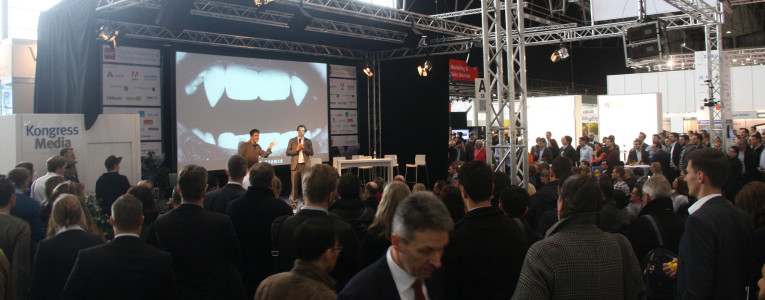
Kongress Media at CeBIT 2016-765x300

I have a problem with talking about the “Operating System” for the organization. I realise that in dealing with the new digital landscape and new business models, our organizations need to change. Dramatically (but we know change is really difficult). Traditional hierarchies and command and control just aren’t effective any more. Management isn’t working! White collar workers in the typical business seem to be busier and less productive than before. How can we fix that? What is the solution? If it’s upgrading the organization to a new Operating System then that feels like an industrial, command and control based solution to the problem. It’s thinking of the the new paradigm in terms of a kernel and drivers, connecting hardware and software, to be tested and debugged. It’s like thinking of the brain as just an electrical circuit. A collection of 90 billion neurons, each one connected to a thousand others, passing electrical signals. But that brain supports the mind which thinks and feels and imagines and has subjective thoughts. More than just electrical circuits.  We need to think organic rather than mechanic or engineering.

Now to Dave Gray. As well as his soon to be published Liminal Thinking book that I blogged about last week, Dave has work in progress following on from Alex Osterwalder’s Business Model Generation and Value Proposition Design books, with his Culture Mapping sessions – I recommend you take a look at his thinking on this. When Dave talks about this, or does a workshop, he often says that culture is like the Operating System of the company, but then he usually goes on to talk about changing and nurturing it in terms of gardening (explained here). In his talks he’ll often quote Louis Gerstner, from one of Agile Elephant’s favourite books (Who Says Elephants Can’t Dance? – from 2002 – it’s part of the reason behind for our name):

“Until I came to IBM, I probably would have told you that culture was just one among several important elements in any organization’s makeup and success — along with vision, strategy, marketing, financials, and the like… I came to see, in my time at IBM, that culture isn’t just one aspect of the game, it is the game. In the end, an organization is nothing more than the collective capacity of its people to create value.”

Although Dave uses operating system as shorthand, I prefer his more organic explanation and definitely agree with his focus on organzational culture.

There is plenty of talk about how the traditional hierarchy of most organizations is reaching its limits. There is talk of flattening the management structure and self organising and we reference companies like W. L. Gore, Valve Corporation (Steam) and Semco Partners. These are great examples, but I worry over the way some people talk about these and Holacracy without fully understanding the scale of the rules and methodologies that underpin it. I hear people discussing Frederick Laloux’s Reinventing Organizations book and the pursuit of the Teal Organization. My concern is over being too prescriptive with our solutions. At Agile Elephant we believe there are no “one size fits all solutions”. Every organization is different and at a different stage of evolution in the new digital landscape, and so we believe there needs to be more focus on the activities and behaviours and characteristics that work, rather than striving for a particular system that might.

That leads me to my Enterprise Irregular buddy Sigurd Rinde and discussions which will result in a series of posts including this one. In our catch up call this week we talked about where the classic organization is, and where the modern organization needs to be. He told me how positively people respond when he talks about white collar productivity and tells them (in words which I stole and used above):

“Management isn’t working!”

In our conversation he added more names to the list of companies that aren’t using a traditional hierarchy like Patagonia, Buurtzog, Handelsbanken and Zappos. Then we talked about Zappos and his discussions with them and their problems in changing to Holacracy. However, the most powerful thing we talked about is how organizations spend too much time thinking efficiency when they should be thinking effectiveness. Business is all about getting the work done and the work is a flow. Most of our organiations have vertical application silos – ERP, CRM, Email, HR, Document Management and more. Then we are adding enterprise social networks like Jive, or extra collaboration tools like Slack. The digital workplace is getting more complex.

Sig talks in language that we Elephants like. He talks about getting the work done as value creation. This core purpose generates a sequence of activities – a flow. Like water it requires a framework to be useful. Now there are three basic ways you can move water around:

  • In pipes – that’s the industrial approach, creating a complex system of flows with fixed connections, joints and valves, and more pipes to connect to the next system – like too much of the business application software we use.
  • In buckets passed hand to hand – how much of our day to day work feels like that, with work slopping over the edges on to the floor and not getting to where it needs to be?
  • Along a riverbed – water finds its path – there may be rocks, branches and obstructions that change the flow, but water finds its way around them, and we can work on the riverbed to remove the obstructions, or the river banks to shorten the course.

RiverBed

So when it comes to looking at company organizations at the Enterprise Digital Summit Paris, I’d prefer us to be thinking in organic rather than machine terms. I want us to be thinking about the things that work rather than the particular system deployed. Above all I want us to be thinking about frameworks and that riverbed and how we can make the value flow more effectively.

photos courtesy of Kongress Media and Sigurd Rinde

Share this:

  • Tweet
  • Email

Filed Under: #EntDigi conference, corporate culture, hierarchies, ideas, organisational culture Tagged With: Alex Osterwalder, brain, culture mapping, Dave Gray, Elephants, Louis Gerstner, mind, operating system, Sigurd Rinde

Sign up for our regular Agile Elephant Newsletter - news, posts, ideas and more.

My Tweets

From the Agile Elephant Blog

  • The Metaverse doesn’t exist yet, but…
  • Impossible Things get Disruptive
  • Clarity, Cloud, and Culture Change at IBM

What Next?
Take a look around our site, check out our approach, see how we can help, join the conversation on our blog or contact us to find out more.

About Us

Agile Elephant is a new kind of consultancy designed to help companies embrace the new digital culture of social collaboration, sharing and openness that is changing business models and the world of work.

Contact us to find out more!

Our founder's blogs:

broadstuff

@DT on Medium

Technotropolis

Our blog:

The Agile Elephant Blog

Site Log In | Site Log Out

Subscribe to Site RSS

Subscribe to our Blog via Email

Enter your email address to subscribe

Join 30 other subscribers

Copyright © 2026 ·Streamline Pro Theme · Genesis Framework by StudioPress · WordPress · Log in