Agile Elephant making sense of digital transformation

innovation | digital transformation | value creation | (r)evoloution

  • Email
  • Facebook
  • Google+
  • LinkedIn
  • Twitter
  • Home
  • Manifesto
  • Services
    • Our Approach
    • Our Services
    • Making Collaboration Work Packages
    • Collaboration Solutions
    • Our Experience
    • Workshops
    • Innovation
  • About Us
    • The Team
    • Why we do what we do
    • Why are we called Agile Elephant?
    • Our Partners
    • Our Clients
  • Get Involved
    • Events
    • Meetups
    • Unconference
    • Newsletter
  • Resources
    • What is Digital Transformation?
    • What is the Digital Enterprise Wave?
    • Our Research
    • Case Studies
    • People We Follow
    • Articles & Links
    • Books That Inspire
  • Blog
  • Contact Us
Home Archives for future of work
Sig taught me about Barely Repeatable Processes and how work flows

May 22, 2019 By David Terrar

Sig taught me about Barely Repeatable Processes and how work flows

Earlier this month we lost a friend and the world lost a super-smart, clear thinker and business innovator.  Our friend Sigurd Rinde, business partner, fellow Enterprise Irregular and founder of Thingamy, died peacefully at home with his family on 9th May 2019.  This post isn’t intended to be a eulogy or an obituary, but a reminder of some of the important ideas that Sig taught us, and which will continue to influence our thinking on how business is done and the future of work.  

Sigurd Rinde – photo by Tom Raftery at SAP TechEd


One of the phrases you would often hear Sig say was:

“Management isn’t working!”

He was scathing about the “business as usual” attitude of all levels of management in our enterprises, the rigidity of the business systems that most organisations use, and the amount of time the average knowledge worker spends in meetings, dealing with their inbox and looking for answers.  Sig was, like me, a big fan of Gapingvoid cartoonist Hugh Macleod:
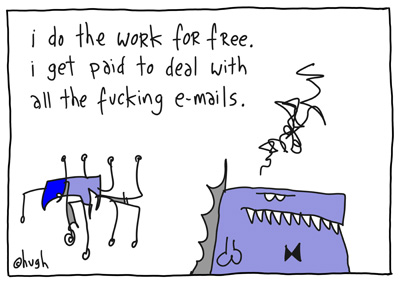
Cartoon by Hugh Macleod of Gapingvoid

Sig was always critical of the concept of ERP (Enterprise Resource Planning).  In fact, he redefined the term as Easily Repeatable Processes describing them on his blog as:

“Processes that handles resources, from human (hiring, firing, payroll and more) to parts and products through supply chains, distribution and production. The IT systems go under catchy names like ERP, SCM, PLM, SRM, CRM and the biggest players are as we know SAP and Oracle plus a long roster of smaller firms.”


So most organisations large, medium or small may have a company wide IT system which is either an integrated package, or assembled from best of breed components covering the very structured processes and data models required by their particular industry sector for order processing, finance, corporate planning, manufacturing or project management, procurement, sales and various forms of relationship management. The problem is that these systems almost certainly don’t cover all of the processes needed and they certainly don’t cover the way things actually happen day to day.  For that reality, Sig coined the term Barely Repeatable Processes (BRP).


Barely Repeatable Processes (BRP)

There are plenty of ad-hoc processes in any company. They might cover the unplanned issues that happen every day, or they are the company specific things that aren’t covered by the standard package. They might have no system to help at all, or are often supported by data in an Excel spreadsheet being e-mailed around a group of people. These are what Sig calls Barely Repeatable Processes (BRP). They have some rules, but they often need to adapt and change as new circumstances arise. They need information, but it’s often unstructured notes and facts captured on paper or buried in e-mails sitting in someone’s inbox on their PC, tablet or smartphone.

Sig founded his company and product, Thingamy, to address that business challenge.  His business philosophy was rooted in value creation, and a desire to shift the balance of work to effectiveness (doing the right things) over efficiency (doing things right).  He recognised that the big opportunity to do better was with our knowledge workers:

“This is the big but forgotten area of opportunity. Knowledge work happens mostly in non-linear, unpredictable processes/flows, a kind of process where about 63% of the world’s value creation happens. At the same time these kind of processes have only manual support – organisational hierarchies and management – that costs approximately 2/3rd of a knowledge worker’s time.”

All work is a flow

Business is  all about getting the work done and the work is a flow.  We discussed ERP and email and the imperfect systems we have to deal with.  To help get things done we’ve tried to bridge across our data and application silos by adding enterprise social networks like Jive, or by using Office365 with Yammer and Teams, or by adding external collaboration tools like Slack.  All this means the digital workplace is getting more complex, and there has to be a better way to approach the problem.  

Getting work done is where the value gets created.  This core purpose of any organisation generates a sequence of activities – a flow.  Like water it requires a framework to be useful.  Now there are three basic ways you can move water around:

  • In pipes – that’s the industrial approach, creating a complex system of flows with fixed connections, joints and valves, and more pipes to connect to the next system – like too much of the business application software and ERP systems we talked about above.
  • In buckets passed hand to hand – how much of our day to day work feels like that, with work slopping over the edges on to the floor and not getting to where it needs to be?
  • Along a riverbed – water finds its path – there may be rocks, branches and obstructions that change the flow, but water finds it way around them, and we can work on the riverbed to remove the obstructions, or the river banks to shorten the course.

Ignore the pipes and buckets, we need work to flow.  If you start to think about work in this way, you recognise that you need to shift the balance of your thinking to more organic terms like river management or gardening, over systems thinking like an engineer.  We should be thinking about flexible and adaptable frameworks that follow the riverbed model to help work find its path and so make the value flow more effectively.  This thinking dovetails perfectly with our contention that all businesses need to be thinking of themselves as being in a permanent state of reinvention to fight off their competitors.  Adaptability is the key survival trait in today’s business environment, and that adaptability characteristic, handling the exceptions over the rules, needs to be designed in to the apps and business systems that support the way we work. Thanks Sig.


If you want to talk about Sig, find out more about these ideas, or how this kind of framework can help your transformation project, then please contact us.  
Share this:

  • Tweet
  • Email

Filed Under: ideas Tagged With: Barely Repeatable Processes, business processes, flows, future of work, Sigurd Rinde, Thingamy

Future of Work – a Blockchain primer

December 9, 2015 By David Terrar

Future of Work – a Blockchain primer

A few weeks back on 19 November I attended a Blockchain event – one of the Future of Work sequence of sessions sponsored and hosted by Truphone, organised by Lloyd Davis of the Tuttle Club and Helen Keegan of Heroes of Mobile.  These sessions explore different technologies and their potential impact on the business landscape, and the workplace. It was an interesting event, with singer Imogen Heap talking new approaches and business models oriented towards the working musician within the music industry, but it wasn’t quite the topic primer on Blockchain I was looking for.  A good event nevertheless, and the second part of this post covers my notes on Imogen’s session.  But first I want to relate the subsequent homework I did to figure out how to explain why Blockchain is so important.

Part of the problem with talking Blockchain is that commentary on it is often strongly tied to the digital currency that it supports – Bitcoin. That single implementation overwhelms most explanations of the underlying technology. I’ve looked at a lot of explanations generated over the last year and come away puzzled, but the best I’ve found is from Mike Gault on re/code on July 5. He starts by saying:

“Imagine that you’re walking down a crowded city street, and a piano falls from the sky. As dozens of people turn to watch, the piano crashes down right in the middle of the street.

Then, without a second to lose, every person who witnessed the event is strapped to a lie detector and recounts exactly what they saw. They all tell precisely the same story, down to the letter.

Is there any doubt that the piano fell from the sky?”

This is the innovative and disruptive concept behind blockchain technology – a distributed consensus model for recording digital events of any kind.  A way of simply and easily creating a digital ledger of events that is automatically duplicated across many nodes and could be recording anything from an exchange of currency, to a contract, to any step in a process that needs to be certified and verified.  Wikipedia tells me that blockchain is a permissionless distributed database, derived from the bitcoin protocol, that maintains a continuously growing list of transactional data records hardened against tampering and revision, even by operators of the data store’s nodes.  Each blockchain record is enforced cryptographically and hosted on machines working as data store nodes.  The cryptography combines with the fact that the records are duplicated across many nodes in the network so that tampering with a record would be so astronomically “expensive” as to be impossible in practical terms.

Think of what that could change in business.  At the moment so many processes rely on some trusted intermediary and a multi-stage process of exchange. Whether that’s a bank, or an accountant in practice, or a law firm, or some legislative body with a compliance procedure to follow or a combination of several of these things.  Suddenly, one or more layers of process complexity could be taken away and replaced by a single ultra secure transaction in a ledger.  If we are talking money, then we are used to a system of promisary notes, bank notes, bank cards, online banking systems and phone apps that access our money, controlled by the institutions which print the notes, record the amounts, exchange them with our customer and supplier bank accounts, trade them in to other currencies for exchange, or hold them in secure vaults.  These can be replaced by a digital ledger and much simpler processes without the need for all of that administration and physical infrastructure.  The same digital concept can be applied to simplify the processes around agreeing and verifying a contract, a person, ownership of a thing, or any sort of event, in the broadest sense, that needs to be trusted.  Take a look around the audience at the next Blockchain event you are at, and you will see that banks, law firms and accounting practices are taking note and getting educated.  New markets and new ways of working are going to be created alongside legacy infrastructure, similar to the way basic mobile phone message technology has been so disruptive in Third World markets in recent times (but on steroids).  A lot of what we now consider as normal business practice will change over the next 10 years because of the Blockchain.

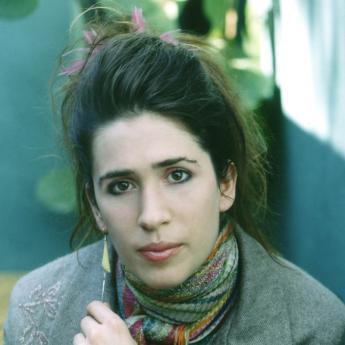
Imogen HeapSo let’s head back to Imogen Heap the Grammy Award winning composer, performer, recording engineer, technologist, and inventor talking about the music business.  She explained her Mycelia project, taking it’s name from fungal colonies of mycelium forming the largest organism in the World, relating that idea to the music business.  The music content are the nutrients underground and above ground you access them with Spotify or iTunes or YouTube but using Blockchain technology.  The model would change from the current centralised model where the record companies are the intermediary gateway controlling everything, to a distributed network where the creator of the content, the musician, would have the power.  Imogen would know every time one of her pieces was downloaded or played, and she would control the cost and decide if and when it might be free.  Mycelia would have open and shared data so that fans could find out about the bands they were interested in.  There would be tools to help, curation provided, and choices available so you wouldn’t just have access to a small compressed music file, you could choose the high resolution version to get the full sound experience that was created in the studio.  The approach would make the revenue splits between the musician and other parties involved transparent.  There would be Blockchain based smart contracts as an integral part of this new solution.  Imogen has been interviewed by Forbes magazine around this topic.  She worries that the music industry has boxed itself in to a corner where their model is based on producing a few big hits a year and so the industry is too top heavy.  Actually, like any market, we need healthy competition but coming back to her mushroom analogy, we need to nourish the base layer of the industry.  Her belief is that the key to that is to make the whole process easy, in the way Napster was when it first started to subvert the industry.

At least part of the problem is the cost of production, and how the music companies manage the capital involved and act like banks towards new acts, funding an album with advances that then need to be paid back with interest. Some musicians are getting around that problem with technology like Kickstarter.  For example, I’m a fan of the American-Irish band Solas.  I’m one of 726 backers who have pledged $46,199 to fund the studio recording of their next album, celebrating their 20th anniversary, called All These Years.  That’s a good work-around, but Heap would like that concept to become part of the new structure and approach.

So Blockchain could definitely change the music business, but there are plenty of applications where it will be changing industry and the world of work before 2020 and 2025.

Share this:

  • Tweet
  • Email

Filed Under: digital disruption, events, future, ideas, workplace Tagged With: bitcoin, blockchain, future of work, music

Sign up for our regular Agile Elephant Newsletter - news, posts, ideas and more.

My Tweets

From the Agile Elephant Blog

  • The Metaverse doesn’t exist yet, but…
  • Impossible Things get Disruptive
  • Clarity, Cloud, and Culture Change at IBM

What Next?
Take a look around our site, check out our approach, see how we can help, join the conversation on our blog or contact us to find out more.

About Us

Agile Elephant is a new kind of consultancy designed to help companies embrace the new digital culture of social collaboration, sharing and openness that is changing business models and the world of work.

Contact us to find out more!

Our founder's blogs:

broadstuff

@DT on Medium

Technotropolis

Our blog:

The Agile Elephant Blog

Site Log In | Site Log Out

Subscribe to Site RSS

Subscribe to our Blog via Email

Enter your email address to subscribe

Join 30 other subscribers

Copyright © 2026 ·Streamline Pro Theme · Genesis Framework by StudioPress · WordPress · Log in