Earlier this week I met with Dave Gray and he gave me an advance copy of his new book, and then I went to his talk at Postshift on Wednesday night. He talked Liminal Thinking, so what is that?
You might know that I am a huge fan of The West Wing (and Aaron Sorkin’s writing in general). There is a great sequence in the episode “Somebody’s Going to Emergency, Somebody’s Going to Jail” in season 2 when people and causes get the chance to pitch to White House staff for attention and funding on “Big Block of Cheese Day” (a day which recurs a number of times in the world of West Wing). One such team from the Organisation of Cartographers for Social Equality are pitching the idea of a government initiative across the school system that would change our maps and atlases from the Mercator projection of the World to the Peters projection. The argument is that stretching out the longitudinal lines so they are parallel at the north and south poles (back in 1569) to help navigators on ships, and so that the map fits on a page rather than a globe, actually skews the relative representation of the size of countries, and reinforces centuries old European Imperialist thinking. Those countries in the First World nearer the North Pole look unnaturally large – for example Greenland looks massive and similar in size to the whole continent of Africa when in reality its area is only one fourteenth of the size of that continent. We compound this incorrect filtering of land mass reality by putting, say, the UK on a page in the Atlas, and then Australia on the same size page, when actually that country is over 33 times the area of the UK. It’s why we Brits just don’t get how big the place is! The cartographers on West Wing argue that the maps influence our thinking in terms of World priorities and prejudices. The Peter projection (which should really be called the Gall-Peter projection) gives a much fairer representation. You have to see the look of incredulity on C. J. Cregg’s face as she looks at the new reality and says “what the hell is that!?”. Then when they suggest a North-South inversion of the new map (because there is absolutely no reason why North has to be at the top of the page), she just freaks out completely! This scene and the story behind it is a perfect example of Dave Gray’s Liminal Thinking approach, as described in the new book and at Wednesday’s event at Postshift’s offices in Shoreditch.
First sample the map presentation scene:
Liminal Thinking is the art of creating change by understanding, shaping, and reframing beliefs. The dictionary says liminal is an adjective relating to a transitional or initial stage of a process, or occupying a position at, or on both sides of, a boundary or threshold. As Dave knows, things happen at the edge, in the boundaries, in the spaces in between.
At Postshift in a sort of fireside chat, Dave related that he actually started out writing a book on agile software which morphed in to something different along the way. As he interviewed people for the book he realised there was a larger story than just talking about an agile mindset for developing software or technology more quickly and efficiently. If you are talking Agile, then Dave reckons Amazon ticks all the boxes, but their people don’t tend to talk or go on the record much about how they do what they do. He interviewed people who have to be agile in their thinking, like soldiers on the front line of the World’s trouble spots, or humanitarian aid workers in similar conflict zones. They have to maximise their ability to adapt yet still exert a level of control, and that’s agile. But in talking to them Dave realised that effecting change is connected with people’s beliefs. People in organisations who want to change things often don’t have the power, or the authority, or the budget to do what they want to do. Dave thought through how he could help that kind of change – and Liminal Thinking is what addresses that question.
Dave built a a sort pyramid of layers of thinking from reality, experience and attention, through to something that is “obvious” – what Dave calls you, me, everyone – see the diagram below.
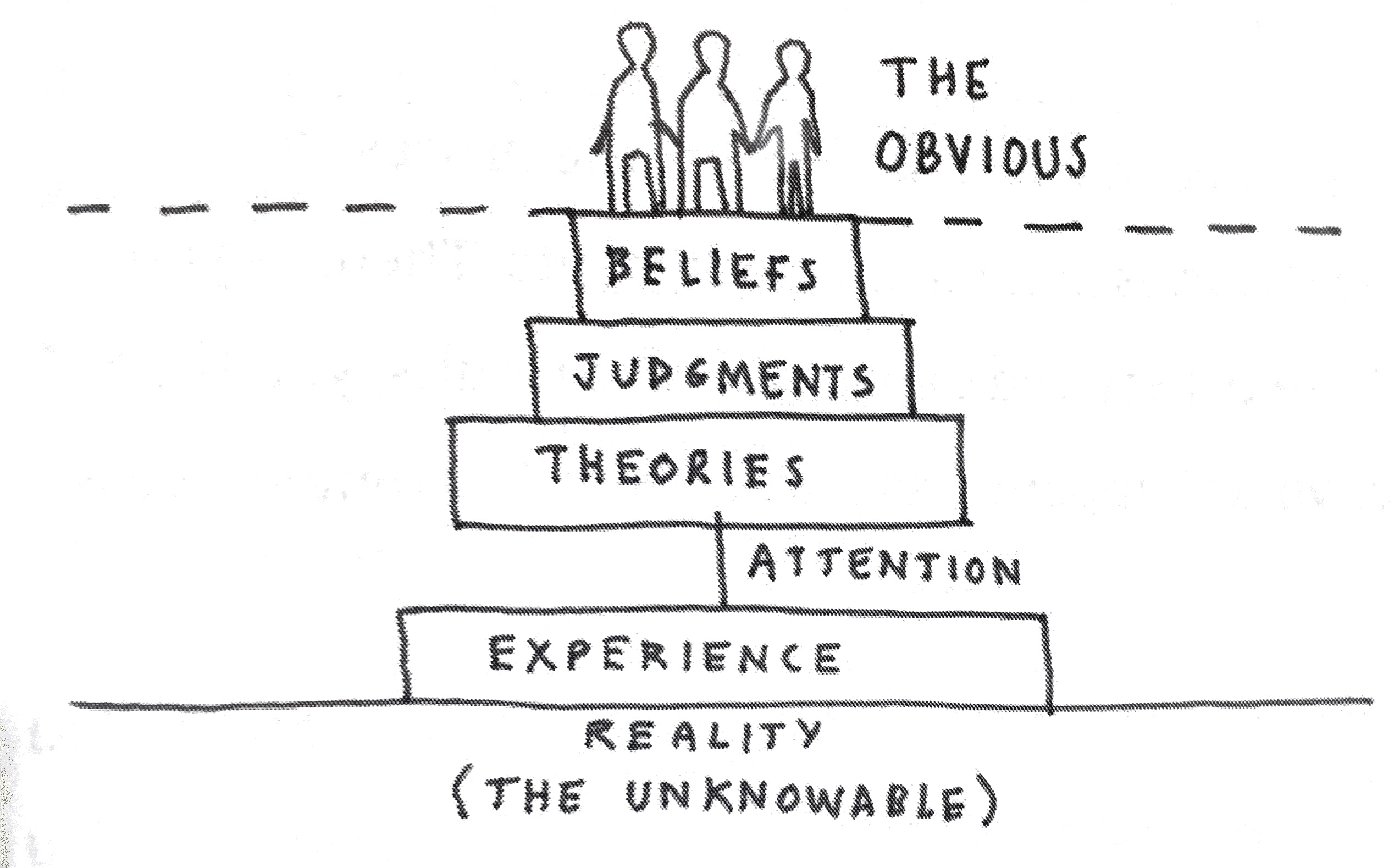
He quoted a neuroscientist called Zimmerman who says that our brains experience 11 megabits of information per second, but actually we can only take in and understand 50 bits per second. How do we open our minds to process more or different? Dave related stories in the book from the Vietnam war where the USA viewed the conflict in terms of the domino theory and the rise of communist China, without looking at the history, the fact that this was a civil war and that most Vietnamese actually hated the Chinese anyway. The wrong beliefs and the wrong frame of reference, and so the USA could have avoided that war if only those in charge had stepped outside of their bubble, and reframed their beliefs.
We talked Weapons of Mass Destruction in the Iraq conflict. Dave talked about the stupidity of self validation, and the difficulty of anybody taking on board something that is truly new. If it’s really new, it will make no sense to you because it falls outside of your current frame of reference. Actually you have to test stuff that falls outside of your “bible” and expand your experience. Dave believes that moving the needle of experience is the most powerful thing! Of other needles, he said that so much of our thinking is like a stylus on a record (we’re going retro here, remember long playing records and singles?). We hang out in the same network friends, and at any given moment there is a way we act – that’s culture. But Dave believe’s the problem of culture is his autopilot and your autopilot, and a well worn groove – a routine of doing the same things the same way, which we need to break. He related another story about someone who changed their life completely simply by parking in a different place in the company car park – that small change triggered a new, different chain of events for him leading to a new job and more. Beliefs are true only because we make them true. The key message here is shut off your autopilot – do things differently.
Dave told more stories about soldiers and special forces in Iraq, about his biomedical engineer brother, or about groups on the two sides of the abortion debate coming together to try and verbalise the opposing argument properly to the other side’s satisfaction. They didn’t change their core beliefs, didn’t find compromise but they did find significant common ground in the welfare of children and family. We talked about organisations using the carrot and the stick and the problems that certain incentives embedded in a corporate culture can cause, making the employees feel like lab rats in a maze, looking for the cheese. We talked about the issues around making change, around the power of the negative often outweighing the possibilities of the positive.
Dave believes everything starts with experience. How we should focus on people’s emotional needs, and how we need to create an environment that makes it safe for people to express themselves, as so many people hide their real emotions in the work environment. He went on to suggest we get distracted too much by the stuff we disagree on. About how the biggest barrier to a leader changing is that even when they talk the talk, they aren’t aware that they’re not really changing their behaviour. The higher you are in an organisation the more insulated you can get from reality, and you should be constantly asking – what is my bubble?
Dave talked about the amygdala, the lizard brain responsible for our fight or flight response that still has so much influence on why we do what we do. When Dave works with a new group or new organisation, he asks them “how can we help you design this organisation so you are jazzed to come to work each day”. What can we do to help us make this company great? What works? Who is doings awesome things in spite of the environment and the circumstances?
Dave talks about belief being the stories in your head, and ended the session confirming how vital stories and story telling are to the process of change. A great session. Thanks to Lee and the Postshift team for facilitating the talk. I’m halfway through the book, enjoying it (and Dave’s drawings) and looking forward to writing a review here soon.
Top image captured from Dave’s website, and diagram from his Liminal Thinking book