Some interesting points in the latest McKinsey report on the State of Social Business. If no one has been following this series, in essence they differentiate between highly connected companies and less connected ones, their hypothesis is that most of the benefits of social technology comes from the connections.
Firstly, some interesting points over last year’s report:
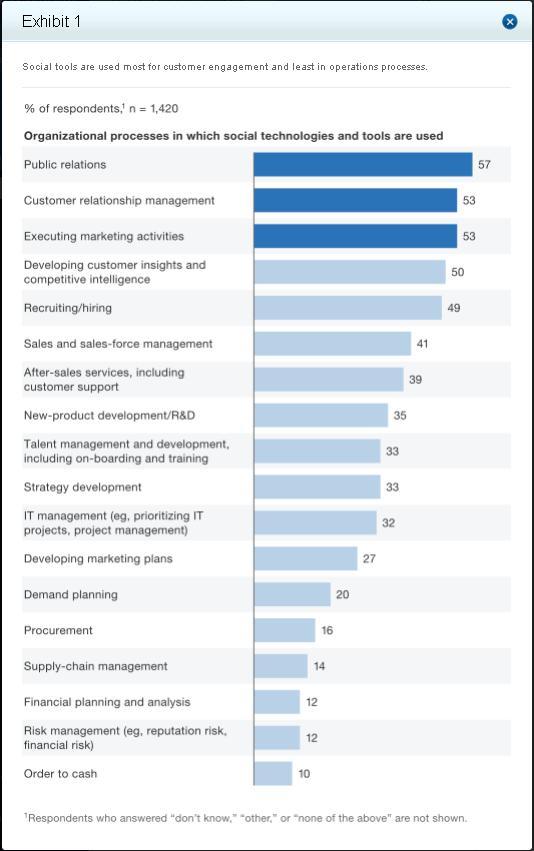
- Social tools are used most for customer engagement and least in operations processes – in other words the historic pattern of organisations using Social tools initially for Comms, PR & Marketinmg and then it radiating further through the organisation is still standard (see chart 1 at top of post)
- Increasing push to use mobile devices, with…you guessed it – Sales & Marketing being the major areas of introduction (i.e. used for customer outreach more than employee comms).
- At the more fully networked organizations, social technologies are integrated more deeply into day-to-day work & these organisations see more impact (network effects).
- (A small number of) respondents cite a growing number of benefits from social interactions with external business partners.
More broadly, say McKinsey, this year’s results confirm that company adoption of social technologies is maturing. Executives continue to say their companies use highly interactive technologies, such as online videoconferencing and social networking, more often than less engaging tools, such as wikis and podcasts. The use of social tools with customers or among employees is still more common than using tools with external business partners, although executives report only incremental changes in the internal or customer-related benefits their companies gain.
A growing share of executives expect their companies’ investments in social will increase in scale and scope, they say. In effect, Social technology is “mainstreaming” – or, to use Bjoern Negelman’s analysis, it has fallen down the Hype Curve into the Slough of Despond, and from here on it replaces sex appeal with increasing value add.
The most interesting bit of the report is “what’s next” bit. McKinsey see 3 trends:
- Begin with a targeted approach, then broaden impact. While the overall adoption of social tools remains widespread, the results indicate that most companies use them intensely in only a few functional processes. Yet the successful use of social in sales-and-marketing processes suggests how much more potential value is at stake in other parts of the business. To get the most value out of social technologies, companies should focus on specific cases where these tools could be implemented in a targeted way. A company already using social tools could broaden the technologies’ impact by adopting them in areas such as operations, where they are used less often now.
- Focus on metrics. As companies adopt (and adapt) these relatively new technologies in their business, they also face the challenge of measuring data they’ve never seen or worked with before. To use social tools more effectively and understand where and how they can add future value, companies must mind how to measure the impact from tools already in use. One approach is comparing existing metrics from areas of the business where social is used against control-group areas without social tools. But the best methodology depends on the process and what benefits companies ultimately want to see.
- Change the way people work. Executives are optimistic about the potential business value from social tools—a common attitude toward new technologies. There’s an initial growth phase that drives adoption and excitement around the technology, but then companies need time to figure out how to use it to drive real productivity improvements. To reach the next S-curve of value from social tools, companies must think more holistically about the organizational and cultural changes to make.6 Social tools have the potential to change organizations, but only if those tools are implemented in a way that changes how individual employees work day to day.
Now, if that doesn’t sound a lot like an implementation plan for any major system over the last 3o years…..
We take this (along with the emerging strong case studies) as fairly concrete evidence that Social Business has now jumped “The Chasm” into the early mass market and will become a key part of the business infsrastructure over the next decade or so.