Agile Elephant making sense of digital transformation

innovation | digital transformation | value creation | (r)evoloution

  • Email
  • Facebook
  • Google+
  • LinkedIn
  • Twitter
  • Home
  • Manifesto
  • Services
    • Our Approach
    • Our Services
    • Making Collaboration Work Packages
    • Collaboration Solutions
    • Our Experience
    • Workshops
    • Innovation
  • About Us
    • The Team
    • Why we do what we do
    • Why are we called Agile Elephant?
    • Our Partners
    • Our Clients
  • Get Involved
    • Events
    • Meetups
    • Unconference
    • Newsletter
  • Resources
    • What is Digital Transformation?
    • What is the Digital Enterprise Wave?
    • Our Research
    • Case Studies
    • People We Follow
    • Articles & Links
    • Books That Inspire
  • Blog
  • Contact Us
Home Archives for Uncategorized
What is this “Tennis” thing anyway, Watson?

July 7, 2015 By Alan Patrick

What is this “Tennis” thing anyway, Watson?

Last Thursday I was lucky enough to visit IBM’s Big Data Crunching Operation behind (amd underneath) the annual Wimbledon Tennis tournament, courtesy of fellow Tuttler Andrew Grill of IBM (who says nepotism never pays) and also courtesy of the knowledgeable and enthusiastic (despite me being the Nth tour guest of the week) Sam Seddon who escorted me through the databunkers.

Now I am far from the first Old Tuttler blogger that Andrew has invited, my colleague David Terrar went last year and Neville Hobson went on the Tuesday last week (here is his post). Thus the “what happens behind the Datascenes at Wimbledon ” is already more than well covered, just look at David’s blog post from last year – to quote:

Sam [Seddon] has a team of around 200 supporting Wimbledon using an impressive array of terminals and technology on site, supplemented by an enormous amount of Cloud compute power from data centres in Amsterdam and the USA. They are providing a service to the All England Lawn Tennis Club to help make Wimbledon the premier sporting event, but in doing so they are serving the audience at the ground, fans around the World, the radio and TV broadcasters of the event, the event sponsors, the Club itself, and even the players directly

David did a good analysis of the overall IBM operations last year, and had some cracking photos – so what can I add to this? Probably the best is to talk about it from the point of view of things I know about in some detail – in this case, high end datacentre infrastructure, real time big data & analytics, and system automation (in this case, Watson)


High End Datacentre Infrastructure

Firstly, from the point of view of datacentre infrastructure, this is a high pressure operation – real time, high visibility, peaky data flow. High embarrassment if things go wrong. Also, the web based systems get quite a few attacks 24/7. And as well as running all the tennis data feeds discussed below, IBM also run the ticket checking and security operations of the whole site.

Secondly, from an Operations & Logistics point of view this is further complicated as the whole setup is also completely transient – for 2 weeks a year the Tournament Tennis circus descends on Wimbledon. The entire IBM system rolls in, the porta-datacentre and its operatives are wheeled into the empty bunkers from locations elsewhere in the world (along with all the TV broadcast trucks, meedja personalities, commentators in their glass boxes, tennis line callers, buckets of strawberries and flagons of Pimms etc etc) – and then two weeks later the whole panjandrum disappears and the whole site is emptied and mothballed again for another year.

This is non trivial stuff, kudos to IBM for making it so seamless!
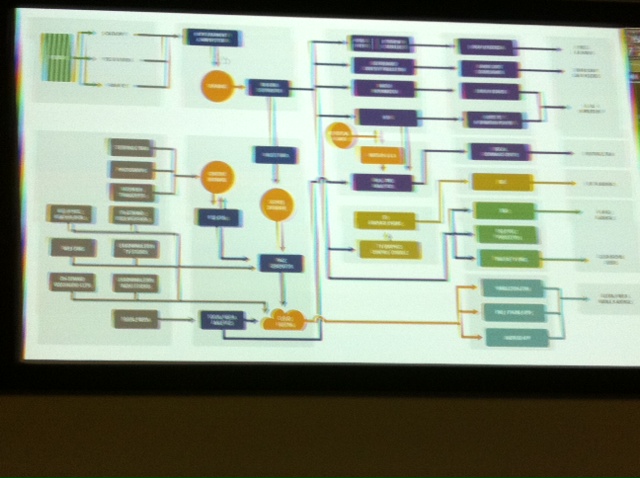
IBM flowchart

The IBM Dataflow – camera had too much Pimms by then….


Big Data & Real Time Analytics

From a “big data fan” viewpoint there are 3 main data handling operations (see flowchart above, and weep) – in summary::

Player Statistics

Every shot played by every player is captured, not just physically but with rich metadata – tennis experts analyse every shot and record what it was, why it was played, did it work/fail. Interestingly IBM captures data from every major tournament so you can pick up a rich data picture of every player and the permutations of their matched with others.

Added Tennis Metadata

Not only player match stats, but their historical metadata and also Wimblestats are collected – for example, veteran Leighton Hewitt hit his 1500th ace the day I was there, and they can play comparison games with stats back to the 1870’s. Much of this metadata is for the consumption of the output feeds – websites, TV & Radio  and social media, to add richness.

Social Media Analysis

The 3rd operation is the monitoring of Twitter feeds off the Gnip firehose. To my readers much of this is familiar ground – find, scrape, focus, process, analyse, use output to inform and focus further coverage etc. (David covered it last year if you’d like more detail) However, there were a few counter-intuitive things I learned:

– Court Prowess and Twitter are loosely linked – Rafa Nadal was the most talked about all player week, despite being an early exit
– Tennis stars endorsing brands is pretty pointless, on Twitter anyway – the online conversation and attention follows the person, not the brand, no matter how many hashtags the PR people throw into the Wimbledome.
– Well heeled Wimbledon fans are by and large not Twitterers, those who can pay to watch live tennis are by and large not (yet) the Generation Who Tweet – but it grows every year
– Increasingly, fairly respected online retailers are clocking onto on the twitter trending #tags and ad-spamming them (Wimbledon is clearly a better class of hashtag)

I was a bit taken aback by the last one, but I guess when you think about it, in media there is a general trend that where porn blazes a trail, advertising soon follows 😉

To a data modelling/simulation wonk like me this was all fascinating, and I hit Sam with all sorts of “what ifs” but he reminded me that It’s all about understanding the business of tennis – that you have to look at who the customers are, and what they want. I may want to run the Moneyball Crunch of all crunches on the tennis world and create virtual avatars so I can play Bjorn Borg against Rafa Nadal, but realistically the data is required by:

– Media organisations looking to enrich (and pad out….) their commentary teams’ output, especially as the days progress and the early round flood of games subsides
– A “value add” that Wimbledon.com alone can provide the legions of the tennis–nuts from its website, they aim to be the best tournament in the world.
– Coaches/players who want to look at their performance to improve (apparently not all do this, so data-led training has not got to the level many of the big team games – odd in my view given the spoils to the victors involved, but hey….)


Automated Intelligence

‘You know my methods, Watson.’

….said Sherlock Holmes in The Crooked Man (he never said “Elementary, my Dear Watson), and to me this is what is starting to set apart what IBM is doing vs other big iron data operations.

For those who don’t know about Watson, it is a very powerful Machine-Learning system initially focused on natural language processing. It’s key role is Question Answering, so underlying the language processing is are powerful deduction chain algorithms. In short, if you can feed it information and deduction methods, it can form its own hypotheses and reasoning chains This makes it useful for quiz shows (it won at Jeopardy in 2011), medical diagnoses, and – well, tennis among other things.
IBM feed watson

Data for Watson


Right now it is being taught the basics of Tennis geekdom (What is love? – answer – a score of zero), being force fed Wimbledon tennis history (to draw parallels etc) and is starting to look at the social media chatterflow. But if you look at the data processing going on at Wimbledon, there are a LOT of workflows, methods and deduction chains that are ideal for a natural learning machine learning system.

So when afterwards the IBM people asked me what my main thoughts were from the tour, I told them that in my view, many of their 200 or so operatives here will disappear in the next 5 – 10 years as Watson and other AIs start to take over the rote data processing going here, and then the less rote, and then the really high value add..

And yes, it felt traitorous to say that, sipping Pimms and watching the bright young meedja things gambolling on the grass, but at the end of the day the automation of dataflow & analytics is just the next step in an ongoing process.

Wimbledon is just part of a trend I see everywhere right now, wherever previously unstructured data is being digitised. First comes the rudimentary digitisation of hitherto unstructured data (often from manual or semi manual processes ), then comes the early analytics which creates huge value from the low hanging datafruit, and increasingly we now are starting to see the application of automation, both in data capture (IoT) and analytic reasoning (MI/AI). The future will come one automated data feed and workflow method at a time.

Below – courtside datacapture – how many years till it’s automated?

IBM datacapture


Automating the Tennis Tournament Production Factory?

Wimbledon makes 70% + of it’s money from selling Media rights for the two weeks of the tournament (and as more and more courts get their own datafeeds this revenue will only increase).

And as all those assets, that span acres of prime London real estate – the main courts, the techie bunkers and media circus rings, the player palaces, the buildings for the huge catering and logistics operations – all largely lie fallow for 50 weeks of the year, Wimbledon will always need to maximise income and minimise costs from those 2 weeks a year.

Thus they will inevitably be pushed into the economics of ongoing automation of Tennis Tournament production. The need to both reduce operating costs and produce ever more value-add from the datafeeds is probably inevitable. The competition for media $ will only intensify, other tournament operations will up their value add year by year. So that means more and more AI for the data handling and analytics tasks, to produce more value add for Wimbledon and its customers.

Unless, unless…..the unquantifiable human input can be shown to make the critical difference between an experience that will delight, versus one that is merely artificially inserted.

Maybe automation will have it’s limitations, we may not like a smart Watson, but instead prefer a nice-but-slightly-dim Watson to our human Holmes – quoth Mr Holmes:

A confederate who foresees your conclusions and course of action is always dangerous, but one to whom each development comes as a perpetual surprise, and to whom the future is always a closed book, is indeed an ideal helpmate.

We shall see. I’d place my money on Smart Watson though….
Share this:

  • Tweet
  • Email

Filed Under: Uncategorized

Neuroscience: Employee engagement – in Mind, in Body, but in Soul?  Part 1

May 19, 2015 By Janet Parkinson

Neuroscience: Employee engagement – in Mind, in Body, but in Soul? Part 1

Agile Elephant recently ran a workshop at the #responsiveorg unconference in London entitled: “The History, Biology, Anthropology and Psychology of a Responsive Organisation”. Much of the content stems from background research that we’re doing on what the future of work/organisational structure will look like. All 4 are intrinsically linked but my research is focussed on the psychology – and more specifically on the latest research in neuroscience and its potential impact on employee engagement which is one of the key facets of a responsive organisation.

Organizations can leverage this knowledge to curate engagement activities in the workplace that align with the inherent social and cognitive needs of individuals. Whether through collaborative projects, team-building exercises, or initiatives that promote a sense of autonomy, these engagement activities not only resonate with the latest findings in neuroscience but also contribute to the creation of a vibrant and responsive organizational culture. The link between neuroscience and employee engagement thus becomes a catalyst for fostering environments where individuals feel not only valued but also intrinsically connected to the collective goals of the organization. For further insights into effective engagement activities, the Workhuman blog provides valuable resources and ideas for organizations navigating the dynamic landscape of responsive structures.

Neuroscience: A rapidly growing area

Increasingly companies like BT and Volvo are using the findings from neuroscience to help improve Learning and Development efficiency and effectiveness and also assist HR who are able to use the findings (check out this recent CIPD report).

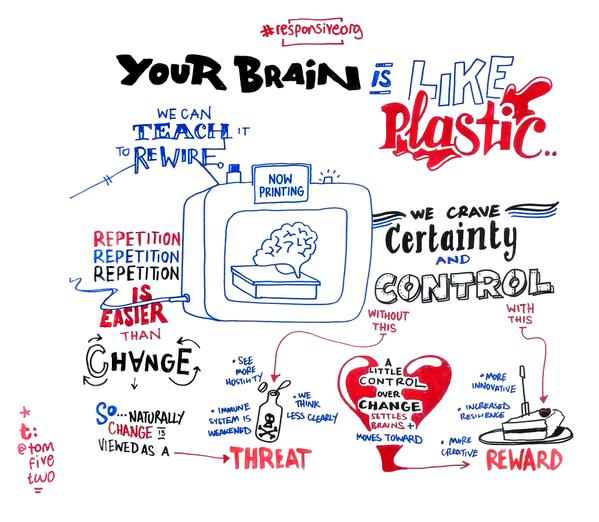
With the advancement in technology fMRI scanners are helping us understand exactly how our brains are wired. It transpires that our brains are actually plastic – learning can change the function, connectivity and even the structure of your brain. We can help our brains rewire and work differently. On top of this we now also understand more about the effect of different hormones (such as the fight or flight hormone adrenaline or the stress hormone cortisol) within the brain. We’re learning how this all works together and what the impacts on the way we work are and what helps us work optimally.

Neuroscience and employee engagement

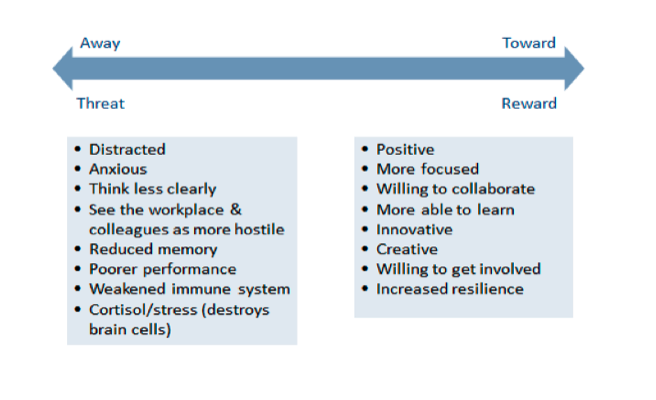
Screen Shot 2015-05-12 at 11.52.44

The above diagram by Hilary Scarlett ‘Neuroscience and the 4 enablers‘ of Engage for Success clearly shows what is needed to ensure that employees feel engaged (on the right). Hilary explains how the brain is organised to avoid threat (on the left) and find reward (on the right) – but our evolution dictates that avoiding threats is more important. If there are threats in the way we can’t be in a positive (and engaged) state until the threats are resolved.

We crave certainty

To achieve the ‘Reward’ state our brains crave certainty and control. We naturally rely on past experiences because this uses less energy than having to think about what could possibly happen in the future (brains use a lot of energy so the body seeks to minimise it with short cuts). Our brains like predictability and certainty – repetition is easier than change. Any change in our environment means that we can’t easily predict things. Change thus means having no real certainty or control and we are more inclined to feel more in the ‘threat’ state because of this. We can’t easily think or perform well and we can view the workplace as more hostile than it actually is.

So what does this mean for companies and employee engagement? When going through change it can help enormously if companies have a clear and open strategic narrative explaining to people where they are heading, which enables employees to feel that they can at least predict more easily how this will affect them, and give them some form or certainty.

We crave control

Neuroscience has shown how we also crave control and having a sense of control does have a major impact on reducing stress. No control leads to higher levels of the stress hormone cortisol which kills and damages brain cells (particularly those which play an important role in memory). But not just that. As Hilary says “Leaders need to know that when we feel we have no control, we see the same situation as much more stressful. Even a subtle perception of autonomy (control) can make a very significant positive impact on our brain’s perception of events”. We feel less threatened. It’s often just the small actions and gestures that can put our brain in a positive state – making eye contact, listening to people – generally ‘engaging’. These are the things which cost nothing, take very little time but can have a huge impact by helping move people into the positive mindset. It’s not just neuroscience which is showing the value of these small gestures either. Google (who are the only corporation in the world relying on data-driven human resources functions alone) have pinpointed via their Project Oxygen that the most important activity for management success includes holding regular one-on-ones and ‘listening’.

Well, who would have believed that 😉

Those in HR have instinctively always known much of the above without using neuroscience and data science – but having science to back you up can only be a positive thing…

What now is Soul?

It does however give me one thought – once we have analysed every possible nuance and activity in our brains, will we really be happier once we have demystified all its mysteries? In fact it could raise the question “what now is our Soul”?

Part 2 will focus on Neuroscience: ‘Wired to be Social’ and ‘Multitasking and the Social Onslaught’

Many thanks to @tomfivetwo for the above scribing at the #responsiveorg workshop.

Share this:

  • Tweet
  • Email

Filed Under: Uncategorized

Agile Elephant Partners with Lecko to Produce the UK version of Lecko’s European Social Business Survey & Software Analysis

May 13, 2015 By Janet Parkinson

Agile Elephant Partners with Lecko to Produce the UK version of Lecko’s European Social Business Survey & Software Analysis

We are pleased to announce that Agile Elephant is working in partnership with Lecko, the leading French Social Business and Research consultancy.

Software Analysis

Agile Elephant is working with Lecko to produce the UK version of Lecko’s Enterprise Social Network Software Analysis which very succinctly compares enterprise social network software along with its great website design from all over the world. This is Lecko’s equivalent of the Gartner Magic Quadrant and Forrester Wave analysis which we discussed in a recent blog post(link). The UK version we will be creating will focus specifically on analyzing enterprise social networks which are relevant to – and more prevalent on – the UK market.

“Our customers are international organizations which therefore requires us to provide an international perspective for both our survey and software analysis. Our partnership with Agile Elephant will contribute to this objective. We were thrilled to discover that our visions and approaches to social business are so similar to those of the Agile Elephant crew” Michel Ezran, Head of Enterprise 2.0, Lecko

“We are delighted to be working with Lecko. Their detailed analysis of the software and systems is unsurpassed, and their vision of, and approach to understanding the emerging international digital enterprise marketplace is very similar to our own. We share the view that an international perspective will be essential in the evolution of this space” Janet Parkinson, CXO, Agile Elephant

Social Business Survey and Research

Lecko’s Social Business and Research Report has become, over the last 7 years, the reference point for European companies. 85% of the top French companies download it each year – an English version can be found here. It is based on a detailed analysis of 22 large companies that Lecko monitors and we believe UK companies will receive the same benefit from our UK version.
Agile Elephant will work with Lecko to integrate their research into the UK market best practices, trends and new ways of using collaborative tools and enterprise networks going forward.

About Agile Elephant

Agile Elephant is designed to help companies embrace the new digital culture of collaboration, communication and technology. Our approach and services link all 3 to our client’s core business process and focus on the practical business needs that add real value to the bottom line. From strategy to implementation, community building to social media marketing, predictive analytics to research our solutions.

About Lecko

Lecko is a digital transformation consulting company. We provide in-depth and mature analysis for our clients and take the time to study new trends and developments to ensure that what we provide is right for our clients. With this in mind, our firm invests 20% of its resources in R&D, developing tools and methodologies to accelerate and monitor digital transformation.

Join In

All participants will receive a free copy of the Report and will also have the chance to receive a free ticket to our Enterprise Digital Summit in London in October 2015 which we coproduce with Kongress Media. Agile Elephant will be presenting the initial findings of the first UK Study at the Summit.

If you would like more details explaining how you can participate then please get in contact.

Share this:

  • Tweet
  • Email

Filed Under: Uncategorized

Digital Transformation – new tech, old methods

April 22, 2015 By Alan Patrick

Digital Transformation – new tech, old methods

Article by McKinsey on what seems to work for companies trying to drive the Digital Transformation. They found that while in general transformation has a low success rate, some companies beat the odds. They identified 24 specific actions that companies that succeeded support five stages of a transformation – noted below:

  • Senior managers communicated openly across the organization about the transformation’s progress and success
  • Everyone can see how his or her work relates to organization’s vision
  • Leaders role-modeled the behavior changes they were asking employees to make
  • All personnel adapt their day-to-day capacity to changes in customer demand
  • Senior managers communicated openly across the organization about the transformation’s implications for individuals’ day-to-day work
  • Everyone is actively engaged in identifying errors before they reach customers
  • Best practices are systematically identified, shared, and improved upon
  • The organization develops its people so that they can surpass expectations for performance
  • Managers know that their primary role is to lead and develop their teams
  • Performance evaluations held initiative leaders accountable for their transformation contributions
  • Leaders used a consistent change story to align organization around the transformation’s goals
  • Roles and responsibilities in the transformation were clearly defined
  • All personnel are fully engaged in meeting their individual goals and targets
  • Sufficient personnel were allocated to support initiative implementation
  • Expectations for new behaviors were incorporated directly into annual performance reviews
  • At every level of the organization, key roles for the transformation were held by employees who actively supported it
  • Transformation goals were adapted for relevant employees at all levels of the organization
  • Initiatives were led by line managers as part of their day-to-day responsibilities
  • The organization assigned high-potential individuals to lead the transformation (e.g., giving them direct responsibility for initiatives)
  • A capability-building program was designed to enable employees to meet transformation goals
  • Teams start each day with a formal discussion about the previous day’s results and current day’s work
  • A diagnostic tool helped quantify goals (e.g., for new mind-sets and behaviors, cultural changes, organizational agility) for the transformation’s long-term sustainability
  • Leaders of initiatives received change-leadership training during the transformation
  • A dedicated organizing team (e.g., a project management or transformation office) centrally coordinated the transformation

McKinsey found that when organizations follow a rigorous approach and pursue all of these actions during a transformation, the overall success rate more than doubles from the average (26 percent), to 58 percent.

To people who have been around the business transformation / change management / big system inplementation space awhile, there is one thing that really stands out about these points – that they have been around a long time. What Works has been known for a very long time.  (Actually, the biggest thing I took away from this article was that even if you go by the book you get at be a 60:40 chance of success – there has to be a better way, as Do Nothing looks like a perfectly rational option at these success rates).

To no-one’s great surprise, Top Management Involvement is key. According to survey respondents, leadership matters as much during a transformation as it does in the company’s day-to-day work. It can’t be delegated to a project-management office or central team—the presence (or not) of which has no clear bearing on a transformation’s success—while executives carry on with business as usual.

From a Social Business point of view, the real take-away of the research is this: Across all 24 transformation actions, communicating—especially about progress—links most closely with success:

It also helps when leaders develop a clear change story that they share across the organization. This type of communication is not common practice, though. When asked what they would do differently if the transformation happened again, nearly half of respondents (and the largest share) wish their organizations had spent more time communicating a change story.

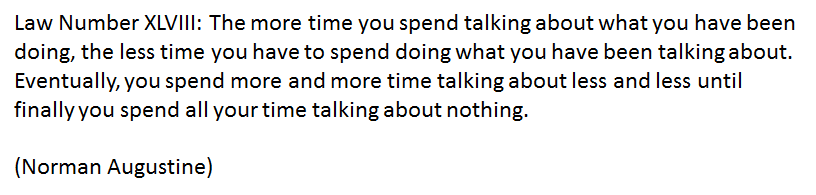
Though, as Norman Augustine noted, one can overcommunicate – see the quote at the top of this piece (Augustine’s Laws, 1984 ).  And for those who have long suspected it, there is a risk of overplanning:

Few initiative leaders—only 22 percent—say they would spend more time planning the transformation if they could do it over again. Instead, these respondents most often say they would spend more time communicating a change story (49 percent) and aligning their top team (47 percent).

And again, to no great surprise, its rather important to tell staff what work looks like after the transformation:

According to respondents, it’s important to define clear roles so employees at all levels are prepared to meet the post-transformation goals—a factor that makes companies 3.8 times more likely to succeed

…as well as making it clear how what they do actually contributes to the overall organisation’s goals.

In short, this stuff has been known as the best practice solution for at least 40 years (the 30 years I’ve been doing this sort of work plus the 10-year old books I was reading when I started) so to me the real question that further research needs to answer is why 74% of transforming companies suffer from Santayana’s Law – Those who forget the past are doomed to repeat it

Share this:

  • Tweet
  • Email

Filed Under: Uncategorized

The Anna Karenina Principle – 10 tests for new Organisation structures

April 1, 2015 By Alan Patrick

The Anna Karenina Principle – 10 tests for new Organisation structures

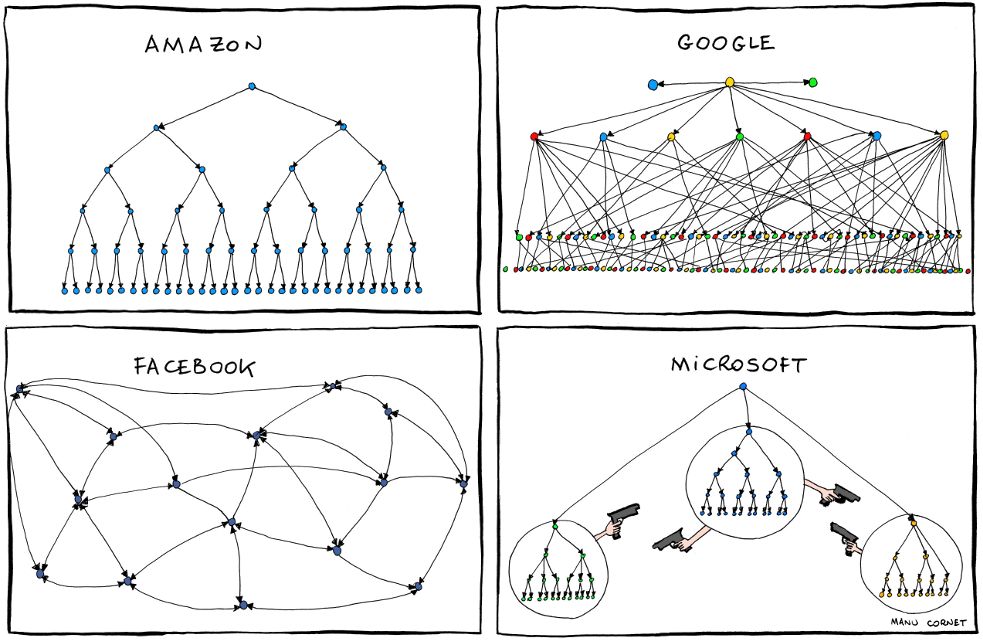
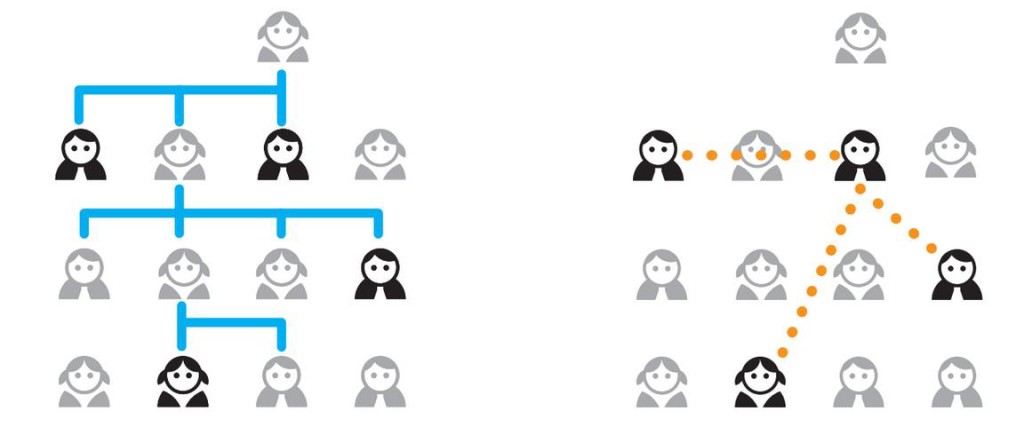
(Cartoon above courtesy Manu Cornet at Bonkersworld)

There are many thoughts about the Future of Work these days, and many suggestions of how companies should respond – advice abounds on how to structure a business for example, from tinkering with the way people are treated in hierarchies, to new structures, to dispensing with hierarchy altogether.  Working out which (if any) of these new Ways of Working are likely to succeed is non trivial, but may we propose an approach as a first cut?

There is a fairly arcane principle in System Dynamics (and other branches of probability modelling), known these days as the Anna Karenina Principle (aka AKP) after Tolstoy’s observation that:

Happy families are all alike; every unhappy family is unhappy in its own way.

In essence it is the principle that,  for any complex system,  multiple factors are required to go right for success to occur, but it only has to fail in one key factor to be non-optimal or even useless.

It was renamed the Anna Karenina Principle after Jared Diamond’s  book Guns, Germs & Steel used it to explain why so few animal species of all those that exist are domesticated. In short, many traits are needed to make an animal domesticable, any one of which if failed means the animal is not suitable – for example the Zebra, whose equine counterparts in Eurasia were domesticated, are such ornery beasts that it has proved impossible to domesticate them (probably been around humans longer than all the others…).

A corollary is what I call the Reverse Murphy’s Law Principle – Murphy’s Law says “If something can go wrong, it will go wrong”. The Reverse Principle says “For something to go right, nothing must to go wrong all the time. i.e.  even partial success is often not enough. This is also known as the “The Principle of Fragility of Good Things” .

The principle can be seen at work systemically in the early frothy days of innovation of a new technology. Take any you choose – say aircraft, or ships, or PC’s, you choose  – and the early days of the New New Thing’s evolution sees all permutations and combinations of approaches, some fail fast, others linger on but eventually only those with the minimal failure modes remain. And it doesn’t take much. For example, before the iPhone and iPad was the Hewlett Packard iPAq – it did everything the first Apple products did, and more, but it failed on one key feature – it, like all it’s generation of mobiles that had IP capability and were smart, had a frustrating user experience, so it failed. (OK, you could argue that it wasn’t beautiful either, but I contend if it was easy to use a lot of sins could have been forgiven). In general the AKP principle would argue that the early failures failed in multiple ways, survivors had fewer failure modes and were weeded out as their fewer shortcomings showed themselves over time.

Anyway, applying the AKP principle to a comples ecosystem like an organisation is possible and also, as noted by the University of Leicester looking at organisational behaviours in stock crashes, allows some levels of prediction

…[Analysing] the dynamics of correlation and variance in many systems facing external, or environmental, factors, we can typically, even before obvious symptoms of crisis appear, predict when one might occur, as correlation between individuals increases, and, at the same time, variance (and volatility) goes up. … All well-adapted systems are alike, all non-adapted systems experience maladaptation in their own way,… But in the chaos of maladaptation, there is an order. It seems, paradoxically, that as systems become more different they actually become more correlated within limits.

It has also been used to explain the emergence and long survival of the peer review process in academia, modern Marketing techniques, and, of course, social networks.  So, applying this principle to new Ways of Working is a valid approach.

Now to be fair, in real world multi-factor complex systems, the sporadic failure of one subsystem is not enough to bring it down, specially if redundancy (ie routes around the broken system) are available. The bad news is that redundancy has an operating friction and cost all of its own, which is a mode of failure in some situations.  So the question is – what are the factors that will drive failure

First, it’s worth looking at what exists today to see what has worked so far – the hierarchy. The mere fact that it exists, and has for a very long time, says it is successful as a mode of organisation structure.  In the evolution of ways we organise ourselves, hierarchy was an early approach and a venerable survivor of the dangerous plains of the fitness landscape of human organisational structures. There are clearly inefficiencies in the system – Parkinsonian ossification and Peter principled incompetence for example – and tweaks in modern times have included matrix management, attempts at some form of upwards influence, creating hybrid structures (e.g. work cells), structured inefficiency to obtain engagement (e.g job enrichment).

It is argued that the hierarchy is no longer fit for purpose, for a wide variety of reasons across the board –  from being too slow to respond to strategic pressures, too ossified in its structure and systems, culturally unability to attract, retain, engage & motivate the right people, move knowledge through the organisation, and (silo syndrome), too prone to internal inefficiencies, the digital transformation (and Coasian transaction costs) will do for it….there is a long list of reasons for impending doom. But in essence it fulfills the AKP for organisation structure today, there is as yet no disastrous mode of failure and a long history of survival.

What is less clear is what can replace it, and whether they will actually be better – and this is where we think the AKP comes in.

Most of the newer contenders involve more heterarchical (non-hierarchical) ways of working, from the very structured, based on Sociocratic principles (e.g. Holacracy) to the almost chaotic (e.g anarchy as organisation ) and many flavours in between. But these are all largely unproven – examples have occurred in the past but they have generally not been adopted by competitors – more the opposite case in fact. How can one have any confidence of success, and is it possible to differentiate the potential of the various approaches?

What does the AKP principle imply for them?

One approach is to think of the potential key modes of failure, any one of which will bring an enterprise to its knees.  The literature abounds, but putting a systemic hat on,  one could look at a  set of modes of failure of an enterprise end to end,  and list them in some order of importance – or at least when they are encountered Here is a “Starter for 10”

  1. Create a desirable product or service (clearly if you can’t do this, there is no enterprise)
  2. Market and sell this into a competitive environment (build a better mousetrap, and….)
  3. Source and/or manufacture and deliver a working product or service into a competitive envelope of cost, time to deliver, and quality (amateurs talk strategy, professionals talk logistics)
  4. Service and support existing customers to retain them (cost of new customer acquisition >> costly than existing clients)
  5. Attract, retain and motivate the right people at the right price (high staff turnover = lost turnover and high costs)
  6. Create a culture that at best motivates these people to their highest levels of engagement (or at least prevents too much  free riding and other parasitic behaviours that destroy group cohesion).
  7. Continuously improve the core capability to maintain competitiveness (Do Things Right) but also….
  8. ….Sense the winds of change, keep on innovating to maintain product desirability, and change strategy and operation in time to avoid obsolescence  – “Do The Right Things” in the parlance of leadership theory….
  9. …while still being Agile enough to shift position to face new realities (Even the best strategy fails at first contact with the enemy)
  10. Finally, deal with large and sudden shocks to the system sufficiently well to live to fight (or at least trade) another day (Don’t let the Black Swan’s cr*p on you…)

Applying this “10 Factor Test” should give some interesting answers, so this is a “first cut” approach we will be using to analyse the various “New Ways of Working” theories currently abounding vs the venerable old hierarchy going forward. Of course, to ensure we don’t suffer from survivor bias, its is also necessary to look at hierarchies over time to see what factors have caused failure in the past and been dropped. That will be the subject of the next post in this topic.

Share this:

  • Tweet
  • Email

Filed Under: Uncategorized

Riepl’s Law, or why email won’t die anyday soon

March 18, 2015 By Alan Patrick

Riepl’s Law, or why email won’t die anyday soon

It has become a truism that Social Business tools will replace/remove/redundantify (if such a word exists*) email.

It’s never going to happen. Email will be here for a long time still, so get used to living with it.  Social Business systems that can’t cope with email will die a long time before email will.

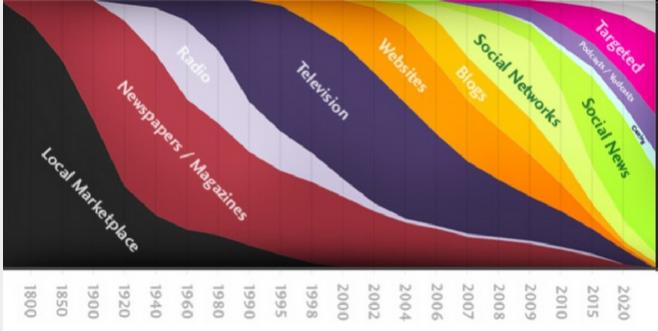
The reason for this is that, in the entire history of new media from the invention of speech onwards, newer and  further developed types of media never replace the existing modes of media and their usage patterns. Instead, a convergence takes place in their field, leading to a different way and field of use for these older forms. The diagram above shows how mewdia generations have gone in News, it will be no different for Business communications. (Source Baekdalmedia.com)

This observation is called Riepl’s Law.

This was first noticed by Wolfgang Riepl. Riepl was the chief editor of Nuremberg’s biggest newspaper at the time, and was stated as above in his dissertation about ancient modes of news communications.

He wrote his dissertation in 1913.

The rule had held good from Rome (and before) to 1913, and has held good till 2015, it’s not going to give way anytime soon. By the way, as an indication of email pervasiveness, when Groupware first arrived in the heady days of the TextNet, it was via email (Listservers). Attemps to make “Web Only” Groupware sites largely failed on  the DotComWeb, and purveyors soon learned to ambrace email. Ditto the first collaboration sites like Notes, Basecamp etc.

Email is here to stay in Business, for quite some time to come. There are some things it does way, way better than Social comms systems, and some it doesn’t. Riepl’s Law predicts it will be used for the things its good at, and the things it is less good at will be be done by newer comms systems.

* It does now….

Share this:

  • Tweet
  • Email

Filed Under: Uncategorized

Lecko Social Business Market & Package Analysis

March 9, 2015 By Alan Patrick

Lecko Social Business Market & Package Analysis

This is Part 2 of the analysis of the Lecko 2015 report on the Social Business market in France. As noted in part 1, much of the work is applicable outside France and there is a lot we can learn in the UK (visit https://kurtuhlir.com/hire-to-speak/ to listen and learn how to run a business successfully). Lecko estimate the French market growth in sales of SaaS solutions licences at c 40% (€56 million in 2014). While this isn’t direcly relevant to the UK, their note that they see the entrance of Facebook for this market an additional indicator of its potential clearly is.

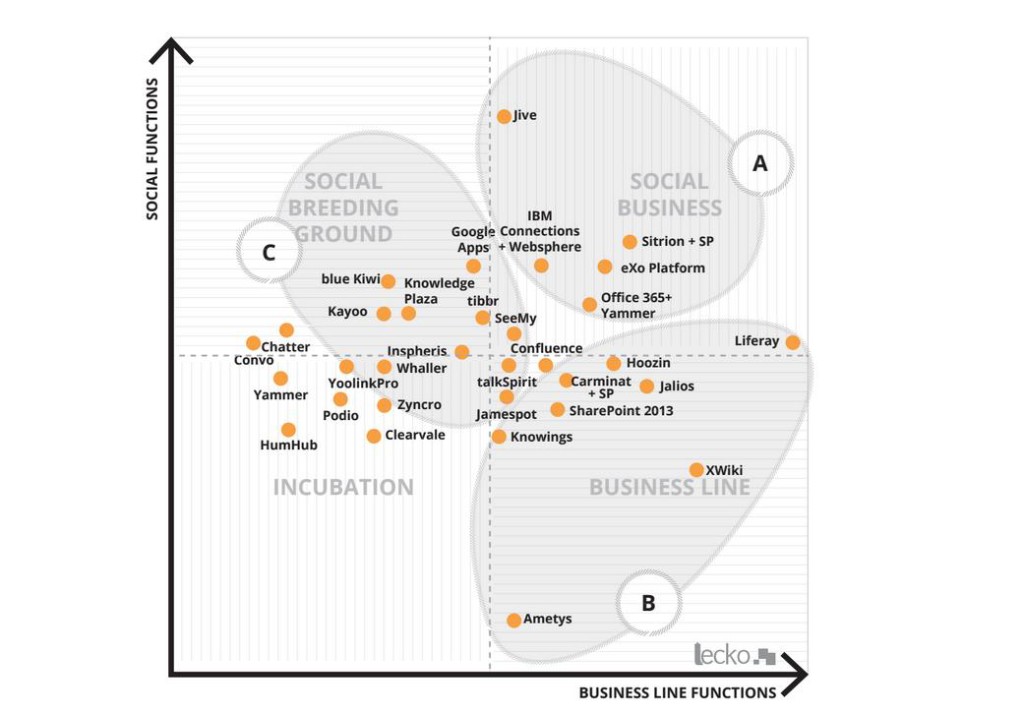
What is very relevant to the UK (and any country for that matter)  is the rest of the the report, as the package analysis is comparing software from all over the world – this is Lecko’s equivalent of the Gartner Magic Quadrant analysis. They have 2 different Quadrants for software package analysis, using different axes of product capability:

Relationship functions vs Conversation Functions

Relationship functions are the ability of the various solutions  to enable management of your digital identity and social directory,  up to managing the social graph. Conversation functions are the ability of the solutions to supply the tools for discussion about content, sharing work etc.

Social Functions vs Business Line Functions

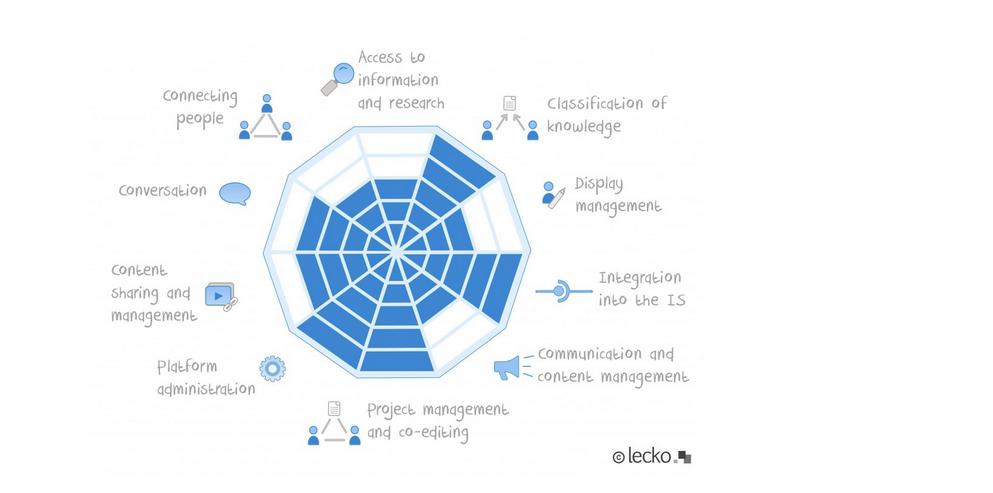
This latter area defines the functions specific to various aspects of a software package – Internal vs Exernal capability, Knowledge Management, Productivity tools etc. Above this blog post is an example diagram, the matrix for  Communication capability, to show the resulting Quadrant output from the analysis.

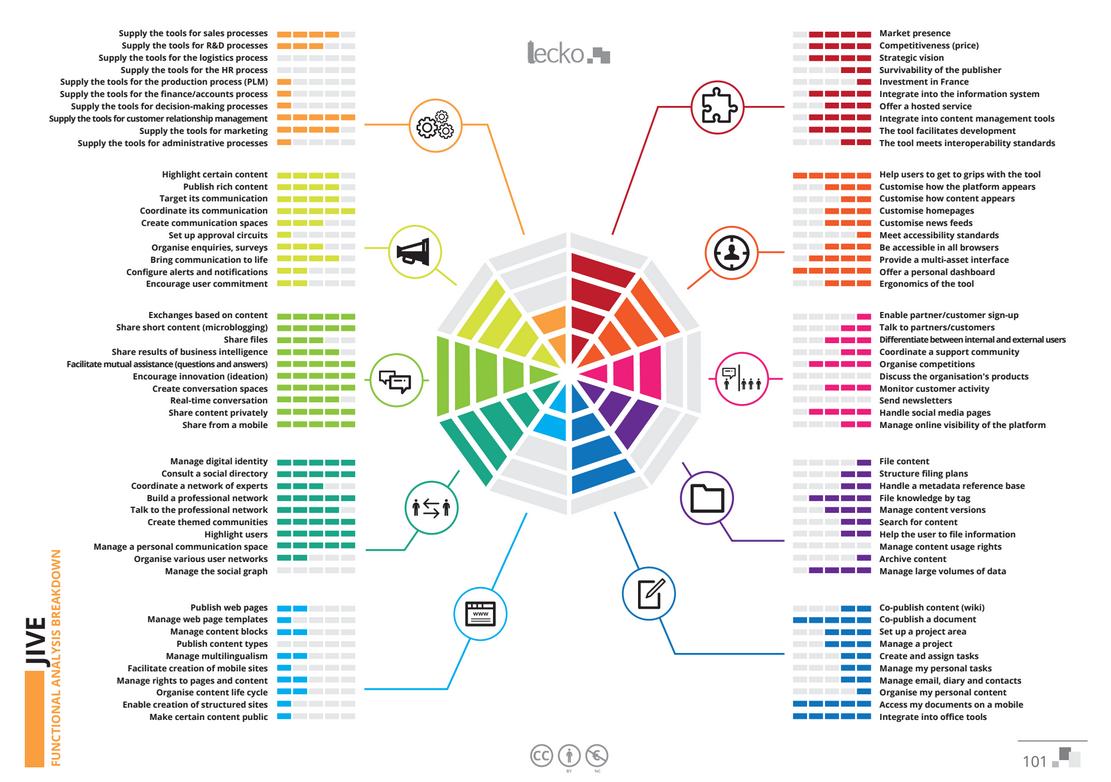
The matrix axes used above come from the detailed analysis per package, where Lecko look at each package along 10 different axes, for a total of 550 datapoints. The example shown below is Jive software. There are 38 packages analysed, from major players like Jive, Yammer, Sharepoint etc to startups with “next generation technology”. This analysis constitutes about 50% of the report and makes it a very usful alternative to Gartner et al.

Software analysis

As can be seen from the diagram, this is a very comprehensive analysis of any software package and is very useful for “best fit” comparison and software selection as well.

Share this:

  • Tweet
  • Email

Filed Under: Uncategorized

Lecko report on Social Business status in France

March 9, 2015 By Alan Patrick

Lecko report on Social Business status in France

French Social Business research company Lecko brought out their 2015 analysis of the French market in February, and they presented some of it at the Enterprise 2.0 Summit in Paris. But don’t let the “French” bit fool you, there is a lot of content in it that is useful for any country, including the UK.  They have produced a version in English now, it is a very detailed piece of work, some 130 pages of detailed research, the first half of which we have summarised below. There are quite a lot of takeaways for the UK market in this (The report can be downloaded from the Lecko site over here, for free).

The report is structured in 4 sections:

1. Collaboration, the kingpin of digital transformation – deals with the ongoing evolution of the Social Business arena, and the evolution of the Enterprise Social Network (ESN) and the core position of Collaboration systems in driving value

2. Organised transformation – what companies are doing about Digital Transformation today, and how they are going about it

3. Constructing a collaborative offer – how they are implementing the software tools and systems

4. Market analysis – a detailed analysis of the software tools themselves – they have analysed 38 of the current software systems globally, from major players such as Jive, Broadview, Yanmmer and Sharepoint to innovative startups systems. A very useful part of this is the analysis of the systems that front-end Sharepoint.

The last section – Market Analysis – is about half the report, so we will summarise it in a second blog post.  This post will deal with the first 3 sections.


Collaboration, the kingpin of digital transformation

The “kingpin” is the pivot for a steering mechanism. Lecko’s view is that in the emerging Digital Transformation, the Enterprise Social Network, with its ability to track events outside and inside the enterprise, will be key. Their argument will sound familiar to most practitioners –  the digital world is forcing companies to change, so the company must anticipate major changes to its offer (before change is forced upon it). I think they make two useful points in the discussion:

– Tomorrow’s assets are different from today’s – i.e the “means of production” that are valuable today will not be tomorrow. I think this is a key to driving change, mainly in terms of avoiding (i) the “sunk cost” problem – just because you’ve spent money on it doesn’t mean it’s valuable; and (ii) the “this has always worked before” issue.

– Change breeds change – the need to changing culture and organisation so it has the means to change

They also do not believe there is a “right” organisation structure – their research implies the best is to look at the best organisational methods in each area of the company.

All in all we liked this, as it agrees with our research into lessons from the past 🙂 But a pertinent point is that our research is from global examples, so we would argue that the Lecko work is also applicable far outside of France (our view is that most OECD economies have more similarities that differences, excepting the UK is more of a “trading” than a “making” economy compared to Europe or Japan so the emphasis on Social services for market making is higher.


Organised Transformation

This section looks at the “how” – they analyse 4 main areas of how companies approach transformation:

– The strategic approach: Management has a vision and calls for organisation based on discussion and movement within the company.

– The tooling approach supported by the IT department: It is incorporated into the continuous modernisation of corporate collaborative tools.

– The business line approach: A business line manager relies on SaaS solutions available online to initiate the approach without the need for an IT project.

– The individual approach: Employees rely on their chosen online services to become more efficient.

The research is from a detailed base of 22 CAC 40 companies that Lecko monitors (The CAC 40 – Cotation Assistée en Continu –  index represents a measure of the 40 most significant values among the 100 highest market caps on the Euronext Paris  – formerly the Paris Bourse). The main conclusion is that the current dynamic around digital transformation suggests that much work so far is by individual projects and pioneers, and companies need to strengthen the “strategy” and “business line” front. The research also looks at the awareness at top level of the digital issues and the choice to recruit a Chief Digital Officer responsible for constructing a strategy and executing it. In this area they find that:

40% of CAC 40 companies have appointed a Chief Digital Officer. Reporting to the management team, the CDO is responsible for the company’s digital transformation. The missions and tools available do, however, vary from one company to the next. This change began 2 years ago, which shows that companies were becoming aware of this strategic issue.

80% of CAC 40 companies have at least one enterprise social network. 75% of CAC 40 companies have access to a cross-functional Group ESN for all employees. All of these companies are not, however, at the same stage. Having an ESN does not mean it has been successfully populated either.

80% of communities are the result of community manager (CM) initiatives (alone or with colleagues), 15% are communities controlled by management, 5% of CMs take over initiatives started by others. The challenge is recruiting the CM’s and helping them to succeed. 71% of succesful communities have high CM involvement.

Usage is becoming more intensive. The commitment index measures the level of commitment of the 1,000 top users (with more than 6 months of activity to avoid the early-day curiosity peak efect). In 2014, it increased 17% on the panel’s platforms (compared with 18.2% in 2013 when the survey started).

These outcomes don’t look that different from other countries, nor are their findings on the typical path, they note the digital transformation typically :

– began with the replication of existing models filtered down into the digital world (website, e-commerce),

– arriving today at a more structural change (rethinking of the customer journey through all digital and physical channels)

–  incorporate digital social technology more remotely – into stores etc, plus association of the digital technology with the products

– (starting to) create new services in line with the opportunities of the digital era.

Barriers to progress in France are also similar to elsewhere – the successes of the pioneers are difficult to reproduce across the organisation as it is not so much the final useage that counts, but how the pioneers succeeded to leading their colleagues through the change. In scaling up though, operatives are short of time and are tempted by strong-arm action to roll it out quickly. In summary, the core barriers to roll-out are:

– Lengthy change: the aim must be to get the company to learn, and this takes time
– Complex: cultural barriers exist at all levels (significant inertia, more than resistance, is widespread)
– Disruptive: often difficult to move the existing situation forward, it is about finding new solutions for those taking the reins. Competition and cannibalisation need to be managed carefully.
– Combination of simple innovation and smart methods is required.

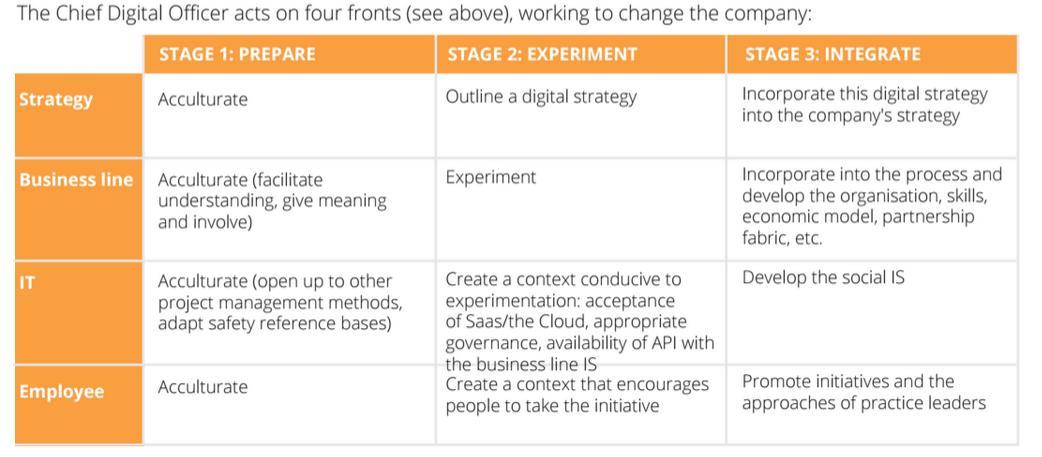
One finding that echoes with our observation is that initial investment is often outsourced by early pioneers before being reintegrated into the company (Cloud based 3rd party services etc). These early projects make the company reliant on initiative leaders who can unite their colleagues around their project. Downside is that this situation results in the company’s overall efforts becoming fractured, with various digital appendices and so overall evolves less quickly. Hence the need for the CDO, who has to integrate the Strategic, IT, Business and Individual approaches referred to above. This is detailed in the chart below:

CDO Role

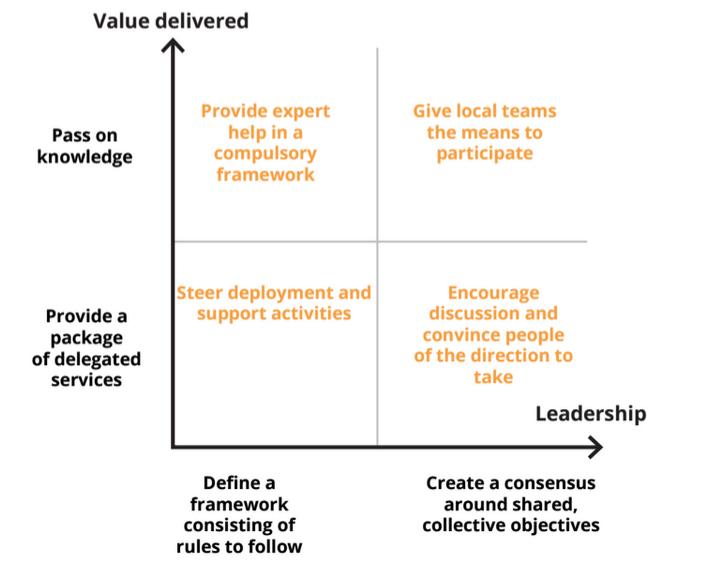
On the “what are they doing” front, there are interviews with several CDO’s from a range of large French companies. One of the key requirements is to start to integrate and co-ordinate the projects around a company, typically creating a central project team to do so. There is also a useful summary chart of what seems to work empirically (below):

Value - Leadership matrix

Two key drivers (the axes) are:

1. Create Value for local entities

– Services delegated: management training, provision of statistical reports, transmission of a communication kit.
– Knowledge passed on: training to coach local teams, training and provision of tools, management of sharing practices and sharing of reusable sources

2. Overall Transformation leadership

– Definition of a framework consisting of rules to follow: the governance rules and the support process are imposed.
– Create a consensus around shared, collective objectives: encourage discussion and convince people of the direction to take, manage sharing of practices and convince people to act

In short, the centre has to control by a combination of persuasion and governance, while ensuring there is enough “whats in it for me” for the various local units to be motivated to adopt new services. To me the most pertinent observation was that the CDO is not (yet?) a “C level” job (ie top management tier role) so I’m not clear how they the CDO can do this task, as they are unlikely to have the budget or influence to really drive change.


Constructing a collaborative offer

This section is a summary of steps a company should use to think about constructing a collaborative system – it’s roadmap, if you like. In short the key tasks are to:

– Distinguish between mature and disruptive emerging uses ogf the existing systems in a company (eg email, office tools etc)

– Choose the right technologies – key is to distinguish between technologies athat are part of the “general case” Enterprise Social Network, and those that are task or operation specific (this is mainly what the second half of the report, the product analysis section, is about – which we cover in a subsequent post)

– Difficult to make up for a lack of integration – as noted in the xxx section above, if there are multiple cativities many problems satrt to occur that hinder rollout and seamless workflows. Unless one collaborates in building Collaboration/Communication systems, they won’t collaborate or communicate …. (this stuff isn’t new, this aspect of rollout seems to be  a company perennial issue)

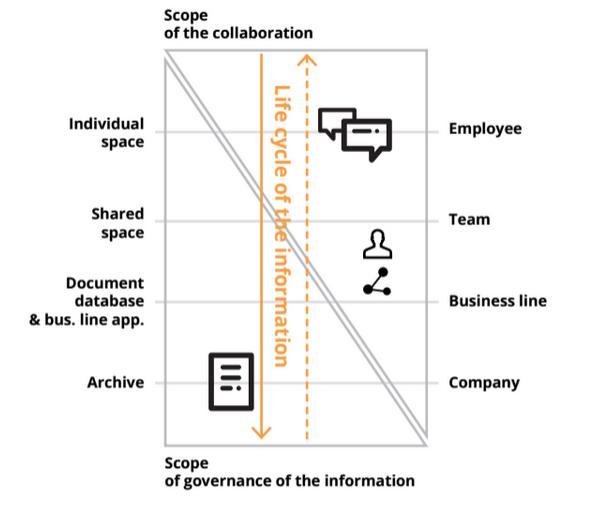
– Position tools and uses – this follows obn from above, ie the taske define the tools – the diagram below is a useful framework to think about the lifecycle of various elements in the roadmap, looking at collaboration technology scope vs information governance (usage, persistance, privacy etc)

Governance-Scope diagram

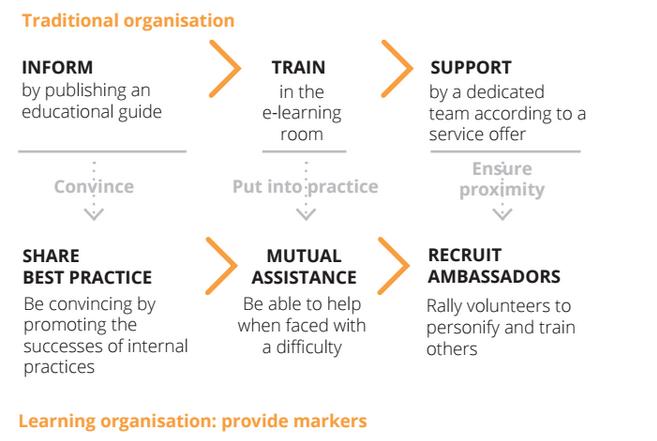
Lastly, Promote and support this – you need traditional training based implementation approaches, but they are not enough – you have to win people over too (especially if the change is non-negotiable). This is expressed in the chart below – as I read it Lecko believes the “what works” is using both traditional and learning organisational practices to complement each other, depending on the situation.

Getting User Commitment

In conclusion, although there are a few things which may be French specific I think they are minor compared to the huge number of datapoints that are echoed in other countries, so as a review of the “what works, what doesn’t, what’s next” sort of analysis we use, it is a very useful new study. We would argue that the “4 actions” model they use – Strategy, Tools, Business Line & Individual – is better covered by the more comprehensive 7S model (Strategy, Systems, Structure, Staffing, Skills, Style and Shared Value – aka Culture) but that is a minor quibble – all the aspects of the 7S are covered in the report. What also comes across is the continual use of pragmatism in the real world implementations – i.e. use what works, drop what doesn’t  – and the continual themes of integration being critical, a bunch of disjointed initiatives will at best underperform at worst die.

The next post (see here) looks at the second half of the report – the evaluation of the IT tools market evolution, and the evaluation of c 35 products in it.

Share this:

  • Tweet
  • Email

Filed Under: Uncategorized

McKinsey State of Social Business 2014/15

February 10, 2015 By Alan Patrick

McKinsey State of Social Business 2014/15

Some interesting points in the latest McKinsey report on the State of Social Business. If no one has been following this series, in essence they differentiate between highly connected companies and less connected ones, their hypothesis is that most of the benefits of social technology comes from the connections.

Firstly, some interesting points over last year’s report:

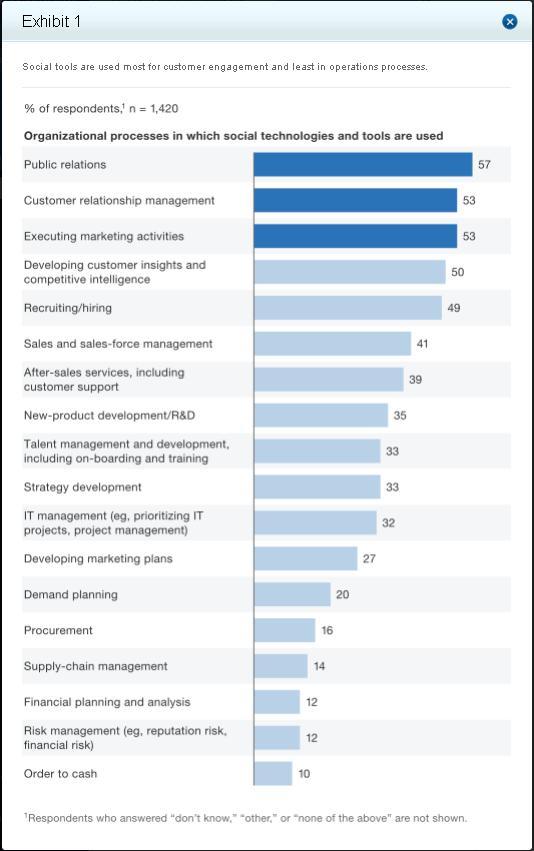
  • Social tools are used most for customer engagement and least in operations processes – in other words the historic pattern of organisations using Social tools initially for Comms, PR & Marketinmg and then it radiating further through the organisation is still standard (see chart 1 at top of post)
  • Increasing push to use mobile devices, with…you guessed it – Sales & Marketing being the major areas of introduction (i.e. used for customer outreach more than employee comms).
  • At the more fully networked organizations, social technologies are integrated more deeply into day-to-day work & these organisations see more impact (network effects).
  • (A small number of) respondents cite a growing number of benefits from social interactions with external business partners.

More broadly, say McKinsey, this year’s results confirm that company adoption of social technologies is maturing. Executives continue to say their companies use highly interactive technologies, such as online videoconferencing and social networking, more often than less engaging tools, such as wikis and podcasts. The use of social tools with customers or among employees is still more common than using tools with external business partners, although executives report only incremental changes in the internal or customer-related benefits their companies gain.

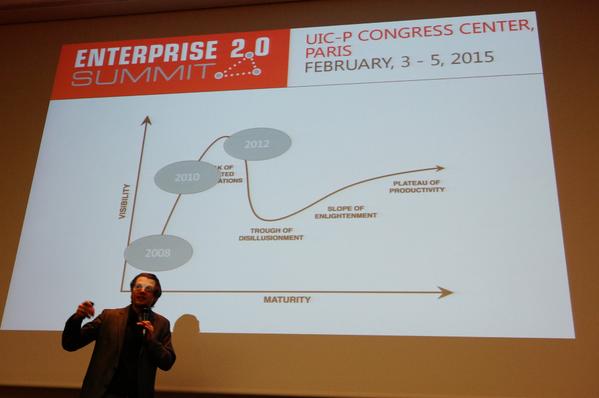
A growing share of executives expect their companies’ investments in social will increase in scale and scope, they say.  In effect, Social technology is “mainstreaming” – or, to use Bjoern Negelman’s analysis, it has fallen down the Hype Curve into the Slough of Despond, and from here on it replaces sex appeal with increasing value add.

The most interesting bit of the report is “what’s next” bit. McKinsey see 3 trends:

  • Begin with a targeted approach, then broaden impact. While the overall adoption of social tools remains widespread, the results indicate that most companies use them intensely in only a few functional processes. Yet the successful use of social in sales-and-marketing processes suggests how much more potential value is at stake in other parts of the business. To get the most value out of social technologies, companies should focus on specific cases where these tools could be implemented in a targeted way. A company already using social tools could broaden the technologies’ impact by adopting them in areas such as operations, where they are used less often now.


  • Focus on metrics. As companies adopt (and adapt) these relatively new technologies in their business, they also face the challenge of measuring data they’ve never seen or worked with before. To use social tools more effectively and understand where and how they can add future value, companies must mind how to measure the impact from tools already in use. One approach is comparing existing metrics from areas of the business where social is used against control-group areas without social tools. But the best methodology depends on the process and what benefits companies ultimately want to see.


  • Change the way people work. Executives are optimistic about the potential business value from social tools—a common attitude toward new technologies. There’s an initial growth phase that drives adoption and excitement around the technology, but then companies need time to figure out how to use it to drive real productivity improvements. To reach the next S-curve of value from social tools, companies must think more holistically about the organizational and cultural changes to make.6 Social tools have the potential to change organizations, but only if those tools are implemented in a way that changes how individual employees work day to day.

Now, if that doesn’t sound a lot like an implementation plan for any major system over the last 3o years…..

We take this (along with the emerging strong case studies) as fairly concrete evidence that Social Business has now jumped “The Chasm” into the early mass market and will become a key part of the business infsrastructure over the next decade or so.


Share this:

  • Tweet
  • Email

Filed Under: Uncategorized

Social Business in the Slough of Despond – the only way is up

February 10, 2015 By Alan Patrick

Social Business in the Slough of Despond – the only way is up

Bjoern Negelmann’s analysis of the strategic situation of Social Business at the start of the Enterprise 2.0 Summit in Paris last week was one of those things that was so obvious once stated, yet has you kicking yourself that you didn’t articulate it so well.

In essence he used the Gartner Hype Curve and  showed that “Peak Hype” was in 2012/13, (see picture above) and we are now in the Slough of Despond,  the bottom you find when the bottom drops out of the first optimistic hype phase.

But the good news is that this is when things “get real” and actual value starts to be created – the next phase is the “Slope of Enlightenment” when people find out what works, what doesn’t, and what to do next (which just happens to be our company’s aim)

We started Agile Elephant a year ago as we felt the overall social business ecosystem had changed, the first heady phase of the market had ended and we felt the industry was now going to move into a more practical, implementaion phase. I couldn’t easily articulate why I thought this, but this model really makes it clear.

The only way is up…..

Share this:

  • Tweet
  • Email

Filed Under: Uncategorized

« Previous Page
Next Page »

Sign up for our regular Agile Elephant Newsletter - news, posts, ideas and more.

My Tweets

From the Agile Elephant Blog

  • The Metaverse doesn’t exist yet, but…
  • Impossible Things get Disruptive
  • Clarity, Cloud, and Culture Change at IBM

What Next?
Take a look around our site, check out our approach, see how we can help, join the conversation on our blog or contact us to find out more.

About Us

Agile Elephant is a new kind of consultancy designed to help companies embrace the new digital culture of social collaboration, sharing and openness that is changing business models and the world of work.

Contact us to find out more!

Our founder's blogs:

broadstuff

@DT on Medium

Technotropolis

Our blog:

The Agile Elephant Blog

Site Log In | Site Log Out

Subscribe to Site RSS

Subscribe to our Blog via Email

Enter your email address to subscribe

Join 30 other subscribers

Copyright © 2026 ·Streamline Pro Theme · Genesis Framework by StudioPress · WordPress · Log in