Agile Elephant making sense of digital transformation

innovation | digital transformation | value creation | (r)evoloution

  • Email
  • Facebook
  • Google+
  • LinkedIn
  • Twitter
  • Home
  • Manifesto
  • Services
    • Our Approach
    • Our Services
    • Making Collaboration Work Packages
    • Collaboration Solutions
    • Our Experience
    • Workshops
    • Innovation
  • About Us
    • The Team
    • Why we do what we do
    • Why are we called Agile Elephant?
    • Our Partners
    • Our Clients
  • Get Involved
    • Events
    • Meetups
    • Unconference
    • Newsletter
  • Resources
    • What is Digital Transformation?
    • What is the Digital Enterprise Wave?
    • Our Research
    • Case Studies
    • People We Follow
    • Articles & Links
    • Books That Inspire
  • Blog
  • Contact Us
Home Archives for Uncategorized
Artificial Intelligence in Professional Services

February 22, 2018 By Alan Patrick

Artificial Intelligence in Professional Services

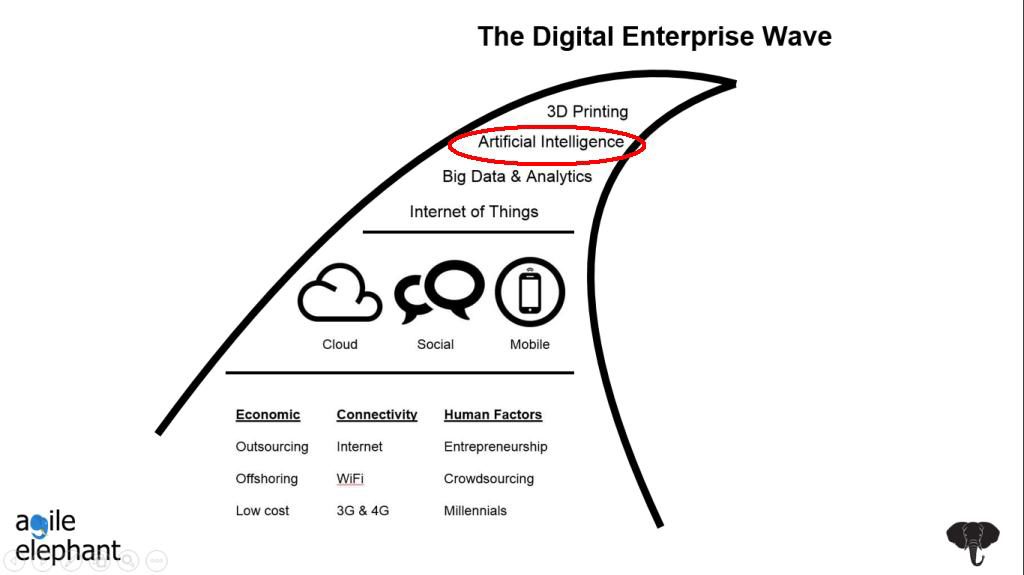
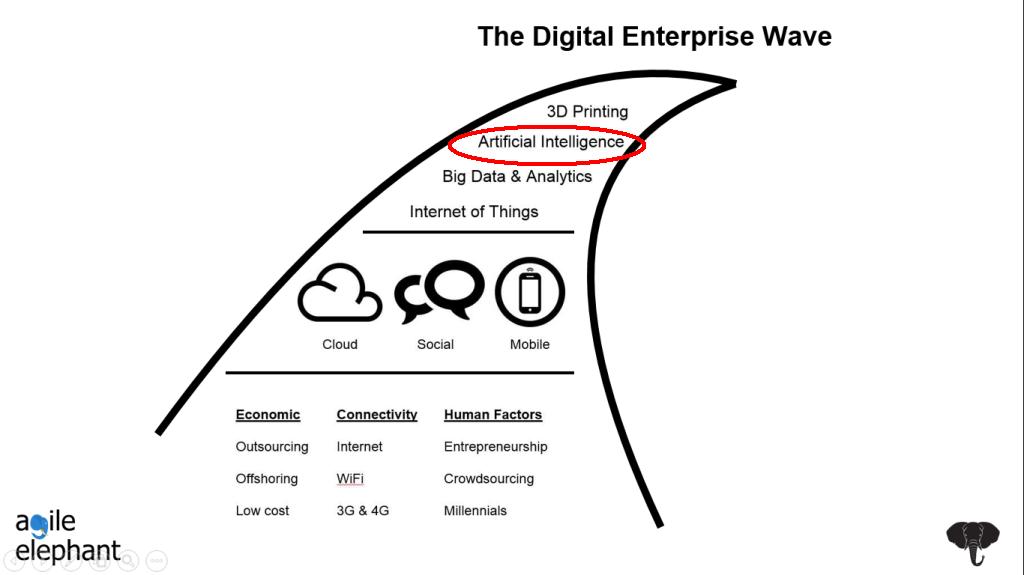
People may recall in 2014 we set up our Digital Wave model (see picture above). At the time we identified Mobile, Social and Cloud  as trends that would shape the next few years of Digital Transformation. That is playing out now much as predicted, so one of the things we have started to bring more sharply into focus for enterprioses looking at Digital Transformation is how to think about using the next “wave” using our “What Works, What Doesnt, What’s Next” approach.

Our current focus is Professional Service businesses and our support of the Global Legal Hackathon so this post is focussed on that arena – interestingly enough, McKinsey recently put this sector (and themselves, by extension?) as laggards in AI adoption (See chart below and this report) – this despite news of AI taking over low level legal roles, introduction into marketing and customer service roles etc.

This post is an initial analysis of opportunities and managing reviews in Artificial Intelligence (AI) as early systems start to come into range of being useful to enterprises other than the big data analytics based businesses like Google and Facebook. To say the sector is overhyped is putting it mildly, but there  are some babies among the frothy bathwater, but hopefully we can sort the wheat from the crap.

What Works

Maybe a better term for AI is “Automated Intelligence” – essentially it is just another wave of (digital) automation, chipping away at “white collar” knowledge work, just at the next level up compared to the previous waves. And as with all automation, it is initially being used to automate work that is simple and has:

  • Bounded Solutions – Most useable AI is today is what is better termed “machine learning” or “deep learning”. To be honest, when I was at Uni  few decades ago these weren’t considered “AI” at all – there has been hype creep. But in essence “Machine Learning” systems are very bounded closed loop systems – machines – that have a limited ability to adjust their processes and outputs to react to new inputs. “Deep Learning” is reall better termed “Pattern Recognition” – it’s the ability of IT systems to just crunch far more data and find relationships in the data that humans don’t have the time to do. “General purpose” AI – AI that can learn on it’s own – is still a long way from being usable in most situations.
  • Easy to Automate – rote tasks, with simple workflows and minimal variation, that are easy to write rules for and replicate in software. AI is the took that hadles that bit more variation and workflow complexity
  • Worth Automating – this is important – the economics of replication have to be considered, If it can be done for less by people it will be as a human still has a higher functioning AI computer than anything yet built,  Where AI comes into it’s own is that it can work 24x7x365, and makes fewer errors with repetitive tasks.

In a way, AI is more useful compared to past “AI revolutions” that failed since today, because there is more digital real estate in most enterprises, it is easier to find work for AIs to work on – so we expect a lot of the first “AI” systems to be used to automate existing digital workflows in enterprises.

What Doesn’t Work

Many of the pronouncements about AI capabilities today won’t be around for years, if not decades. There are a number of major barriers today:

  • Vertical Variability – Modern AI is still very simple, they can only really work in very tightly defined verticals where variability in conditions is low or else the environment becomes too complex (This is what has killed all previous AI “hot tech” cycles, not computer power). This why all the “gee whiz” comes from AI in games like Go and Chess, which have very constrained variability and a bounded solution space. The question for large scale deployment is always “is this vertical big enough/valuable enough per workpiece to make it worth throwing expensive automation at it.”
  • GIGO (Garbage In, Garbage Out) – the same problem that besets Analytics besets AI – today’s systems have no judgement of context outside the narrow area they are aimed at, so data has to be very carefully scrubbed, structured and tagged for them to use it without making gross errors. Also, the data has to be more than just clean, it has to be correct to train an AI.
  • Volumes – most AI systems need a lot of data to do tjeir thing, many enterprises bven in teh days of Big Data don’t have enough in all the necessary areas in a workflow for AT to be useful.
  • Developing and training AI’s is hard and expensive – very time consuming and needs high levels of expertise. Parenting a living infant is hard and a near  full time job, for a long time. Ditto an AI system. As with live infants, the simpler the organism the less the time and work needed – but the less it is capable of. Some types of AIs can self learn very well against datasets (genetic algorithms, neural networks for example) but having used these in the past I know one quickly hits the Vertical Variability and GIGO problems

What’s Next

No doubt the technology will continue to improve, but when we look at what will be adopted in teh near future, a few clear rules emerge:

  • It will have to be in high value verticals – we expect a lot of early uses will be to automate existing digital systems and workflows in high value industries.
  • But these verticals will also have to be very predictable with small solution spaces – so think mass production, rote tasks rather than replacing creative roles.
  • Many work roles will need to be re-engineered to use AI effectively – many work roles today have a mix of the rote and complex, the predictable and the variable, and it typically is only the “rote and predictable” that can be AI’d away. It’s not worth automating tiny bits of a person’s role, so all previous automation from Winslow Taylor (and before) seeks to split up and redefine the worflow to aggregate the automatable parts.
  • It has to be a good deal better than “good enoughs” – this includes human part time effort (Mechanical Turks, Gig Workers, Offfshoring etc) or simply that the AI-able tasks in a role being easily done in the workflow by the existing workers don’t add enough value.
  • In addition, we are picking up real concerns about “blind” and biassed” algorithms –  so algorithm testing and transparency are going to big issues for deployment, especially into consumer areas. We’d expect to see a lot of AI technologies deployed inter-enterprise first.

It’s no accident therefore that the McKinsey analysis of the industries most  advanced in AI (see McKinsey chart below) are IT & Comms (automating existing systems) and Finance (highly valuable benefits of automation). and the next ones are high value Manufacturing, Logistics and Energy which have been the main recipients of previous automation waves.- these are all very rules based industries, with fairly bounded processes and relatively well defined workflows. Note for example Aerospace isn’t in there in the vanguard – it’s a lot harder to automate, we can tell you!
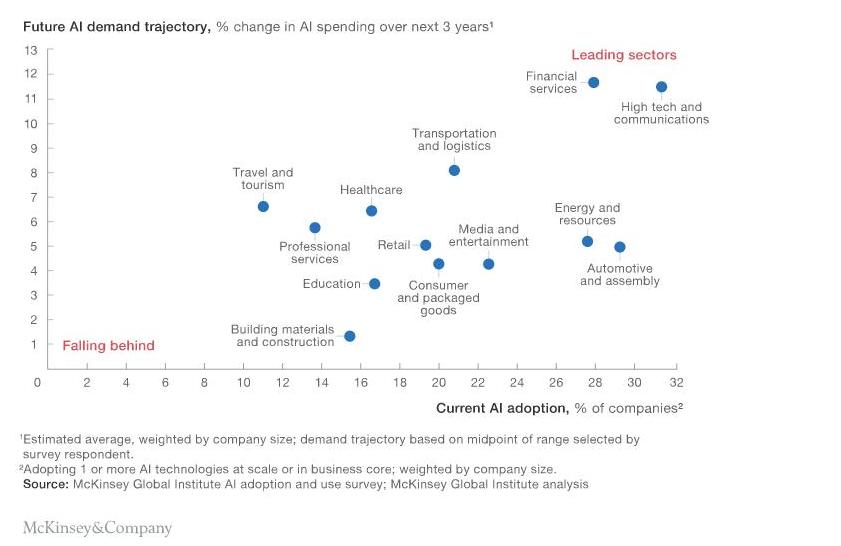
So what of professional services and AI? Note that they are a laggard in the chart above. That’s no real surprise to us, professional services have proven very difficult to automate in the past as the work – although often very valuable – is highly variable, and the solution space is highly unbounded. If previous lessons from automation in these industries are anything to go by it’s largely the support services and rote work that are automated, so we would expact AI to come into areas that have already seen IT inroads such as:

  • Knowledge management – everything from document capture, document checking, tagging/labelling, storage, sampling etc.
  • Data assembly – searching for data, reports etc and assembling it against requests
  • Aids in building presentations, contracts etc – and checking them intelligently for errors
  • Load balancing – scheduling people, resources, work packages etc. You can check out McLeod Brock to maintain the perfect schedule to handle things.
  • Workflow processes with simple rules – e.g, changing a report or contract for one client to another,  one day maybe even expenses (one can dream)
  • Recruitment and retention, HR policies, IT support systems, possibly financial support
  • Risk analysis (of major risks) – probably financial, contractual and regulatory initially
  • Decision support – this is where we predict AI will enter the more creative, “one off” project type work areas, design support – supporting the human experts in the space. Look for very high value tasks to make it worthwhile

But that is more than enough to be getting on with for now…….

Share this:

  • Tweet
  • Email

Filed Under: Uncategorized

Microsoft Teams and Slack point to the future of collaboration

November 3, 2016 By David Terrar

Microsoft Teams and Slack point to the future of collaboration

Yesterday Microsoft responded to the incredible rise of Slack, the cool “new kid on the block” inter office chat app, with Teams. I watched the live stream of the announcement and was surprised. I expected a Slack alternative, a “Slack killer” even, but what they’ve announced is much more significant. Teams and Slack together signpost the future of collaboration and the evolution of the digital workplace. The collaboration and enterprise social network software providers need to take notice.

Over on Hewlett Packard Enterprise Insights, their enterprise.nxt guide to digital transformation, they published my post “5 things Slack and Microsoft Teams tell us about workplace collaboration”. This is a companion piece, amplifying those conclusions having had a chance to think through the implications of what I saw streamed from yesterday’s Microsoft NYC Office event.

screenshot-2016-11-03-17-39-57Earlier in the year it had been rumoured that Microsoft might buy Slack for $8Bn, but they’ve done their own thing instead. Yesterday’s announcement was an open secret for a while, and Slack took the rather interesting step of publishing a full page advert in the New York Times, simultaneously publishing the text on Medium. They say they are excited at the competition, but that’s more in the context of the purported Chinese curse “May you live in interesting times”.

First let’s run through what Slack have achieved, which is pretty incredible really! They’ve only been around since August 2013. You probably didn’t know that the name is an acronym, “Searchable Log of All Conversation and Knowledge”. Slack has $540m in funding and a valuation of around $3.8 billion at their last funding round in March, and then we had those Microsoft rumours. Back in May this year Slack passed 3m daily active users, but that was 3.5 times growth in both free and paid for users over the previous year, and the rate isn’t slowing down (so even with Microsoft’s announcement, Slack won’t be going away). As I explained in the HPE article, Slack is used by 77 of the Fortune100. There are teams inside eBay, Ogilvy, Salesforce, Samsung, and Urban Outfitters. IBM themselves have 30,000 users, and have even announced a partnership with Slack so Watson’s AI can quickly provide insights from the huge data sets collected by the messaging system. Slack is being used by large enterprises, small enterprises, by groups of developers sharing code snippets, and it’s even gaining traction in the gaming community.

Like so many web based products of recent years that we know and love, such as Twitter or Flickr, it is the result of a company doing a pivot from their original intention. Stewart Butterfield and his team were working on an online game called Glitch. They had developed their own internal messaging system, and when the online game didn’t succeed, they launched their internal collaboration solution instead, to become the cool product platform that it is now. They have the classic freemium business which has made it easy for groups of users, frustrated with whatever collaboration options they have within their enterprise, to set a Slack group, invite people in and provide their own tactical solution to help a particular community, issue or project. There are plenty of other options around like HipChat in the business world, or Discord in the gaming community, but in a very crowded market of overalapping communication tools, Slack have made a big impact inside 3 years.

Let’s look at what Slack actually provides a group of users. The functionality covers three areas:

  • A message threading alternative to email that is device independent. I can use it on Mac, Windows PC, through a web interface, or with mobile apps for smartphones and tablets. Conversations are synced across all devices so I can join the conversation in one place, and continue on a different device when I’m on the move or back at the office.
  • It has a more open communication approach – the conversations get organised within channels that are like the hashtags I’m used to on public social media platforms, and everything is searchable so that I can easily loop in the skills and people I need.
  • The third key area is Slack’s focus on helping me with menial tasks. They have a growing directory with over 750 apps, chatbots and algorithms that I can deploy to help make my collaboration life that little bit easier. Slack are riding the growing wave of Bots, Machine Learning, Artificial Intelligence and Robotic Process Automation – a mega trend that is changing office work just as much as automation has on the shop floor.

But wait, there’s more. I mentioned sharing code snippets, but those 750 apps include easy integration with developer and agency friendly tools like Trello, IFTTT, Zapier and GitHub. They are also investing in people to help them scale with senior hires from Salesforce and Foursquare this year.

Slack’s success highlights a key problem for our existing collaboration software options. They are more difficult to use than they should be. On top of that, the digital workplace is a mess. Alongside whatever we use for team collaboration, we access a whole host of disparate corporate systems with differing interfaces to get the job done. Slack has the ease of use and frictionless set up of the consumer apps we all used to on our smartphones and tablets. On top of the user experience there are two more factors. First, team chat functionality which allows me to find, connect and communicate with the right experts helps me get the job done. It’s a core component of all the administration and knowledge work we do. Second, and the masterstroke, is the open platform which provides the store of bots and integrations to third party apps. It means Slack (or Teams) provides me with a place where work happens. Where I can connect to these disparate app silos that my company uses, but in one place where the useful conversations are already happening. This is the starting point for a proper digital workplace, or what Dion Hinchcliffe called a digital workplace hub in his post on ZDNet a few days ago.

More than anything with this team chat based digital workplace approach, I’m looking forward to the demise of email, and products like Slack and Teams bring that a little closer. Having discussed the incredible rise of Slack, the functionality it provides, and some of the reasons why it’s been successful, what did Microsoft give us in response?

screenshot-2016-11-03-17-43-53

Yesterday, CEO Satya Nadella and Office Corporate VP Kirk Koenigsbauer, with a little help from their friends, laid out the new strategy and provided an impressive demo of Microsoft Teams. From my initial take it has many of the good characteristics of Slack, certainly has a similar look and feel, but offers the potential of more through tight integration with the Office365 family of products that it sits in, and becomes the front end to. Satya opened the announcement talking about how the new product needs to accomodate how different teams work differently, using the example of jazz ensembles, crew races, and even cricket teams, and that sets up the fact that the product allows you to customise the experience on a team by team basis.

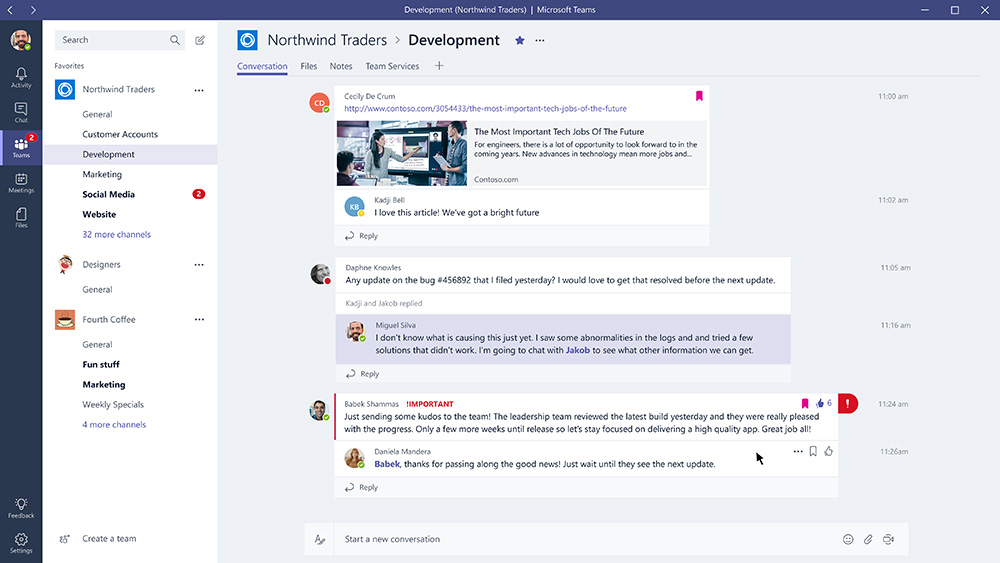
Getting in to the demo helps explain what Teams does. Over on the left of the screen there are tabs for activity, chat, teams, meetings and files. This bar moves to the bottom in the mobile experience. When you set up a private team, a Sharepoint is automatically provisioned “behind” it to support it, and so any files are put there or created there. The team space showed normal multithreaded conversations, and I rather liked the way messages to you were highlighted with a red tab/tag over on the right of the message. You can open files or notes within the stream, and have conversations around them. Of course (the rather excellent) OneNote has all the characteristics of a wiki for co-creation. When you go in to a team space, you can pin things on to the tabs across the top of the space. Things like the budget for this project (an Excel spreadsheet), a planner for this project team, or even third party tools like Zendesk, accessed right there. This access to, and seamless integration with, the whole of the Office365 suite, or things like Microsoft Power BI, and on top of that a set of third party apps too, is crucial. Teams acts like your inbox, or maybe it’s a workbox, or maybe it’s your digital workplace hub.

When it comes to typing your messages you can add emojis, stickers, or attach files. A ‘Fun Picker’ lets you find and add Giphy GIFs, or memes. The next thing to say is that you can interact with bots just like in Slack. T-Bot sits on top of  Teams’ help system, so you can ask questions like “how do I create a channel?”. WhoBot links in to the directories, and more importantly the conversations and meta data associated with that person, so you can ask “who knows about ticket sales?”. You can jump in to video chat with the team right there, using Skype.

threaded-conversations-in-microsoft-teams-web

Microsoft Teams is available now as a customer preview in 181 countries and 18 languages. General Availability is planned for Q1 2017, when it will have 85 Bots, 70 connectors, and integrations with 150 partners including Zendesk and HootSuite. In terms of licensing it is available to any user on an O365 Enterprise or Small Business plan. One key point that Satya emphasised is that Microsoft already have 85million active users of O365, and this is the market they are addressing.

Microsoft Teams looks like a very good team chat option, but it has important advantages if you are already following an Office 365 strategy. Both Slack and Teams bring you to a place where you can connect and collaborate with overlapping teams to get things done. They both plug in to the rising trend of bots and AI to automate tasks, find answers quickly and easily, and save time. They both offer an array of integrations with other business apps and so begin to provide a practical answer to Dion’s digital workplace hub. They definitely point the way for the next stage of collaboration solutions, and the major social software players need to take note.

Find out more about this year’s Enterprise Digital Summit London:

eds_blogteaser16

Share this:

  • Tweet
  • Email

Filed Under: collaboration, Enterprise Social Network, social tools, software tools, Uncategorized, workplace Tagged With: IBM, Microsoft Teams, Satya Nadella, Slack, Stewart Butterfield

Post Capitalist ways of working

October 14, 2016 By Alan Patrick

Post Capitalist ways of working

Readers of the blog will know that we have long proposed that the “Future of Work” appears to have 4 emerging trends:

  • Human Centric – Better organisation of human potential via collaboraion/co-operation/communication
  • Offshoring – moving to lower and lower cost labour pools, in low wage countries
  • Uberisation – using technology to organise low cost “gig economy” labour in-country
  • Automation – replacing labour with electro-mechanical and increasingly digital equipment

We have written about this in more detail on this blog over here, and will also be talking about this in or conference on the 24th November in London. We have argued that the economics of the various options means the Human Cenric approach is most likely to occur in complex, non mass-produced work with high added value – too variable to automate or offshore, to valuable to leave to gig economy mechanical Turks.

As input to this discussion, today Paul Mason published an interesting article on what he called Postcapitalist ways of working. In essence he argues that IT is having 3 main impacts on work:

  • Firstly, it dissolves the price mechanism. Information goods — if they can be copied and pasted infinitely, and used simultaneously without wear and tear — must fall in price under market conditions to a value close to zero. This is essentially the Automation issue at ts most broad case.
  • Secondly, IT automates work faster than new work can be invented. Around 47% of all jobs are susceptible to automation, say Frey and Osborne (2013). And information also makes it work modular, loosening the link between hours worked and wages; and it makes work possible to do outside the worplace — blurring the division between work and life.

Mason argues that the capitalist system copes with these twin shocks in two unfortunate ways:

a) to maximise capacity utilisation of low-skilled labour and of assets. So we get Uber, Deliveroo and AirBnB are effectively capacity utilisation businesses. [aka Uberisation and Offshoring]

b) to artificially inflate the price and profitability of labour inputs: so housing becomes the major thing wages are spent on — and healthcare and university education. [ie if labout cost is not a key input, make it pay its way in the broader capitalist system].  Things that in all previous eras of capitalism the elite desired to be as cheap as possible — to ease wage pressures — are now made as expensive as possible, and capital migrates away from production and from private-sector services towards public sector services.

He believes this, if taken to its logical endpoint, results in  a form of Gig-Economy based neo-feudalism.

He believes what we call Human Centric way of working is the way out of this, his a third impact of info-tech. It has begun to create organisational and business models where collaboration is more important than price or value. As he notes:

Networked busieness models create massive positive externalities — network effects –where the data, or the wellbeing, or the utility created by network interactions is capturable and exploitable. But as soon as technology allowed it, we started to create organisations where the postitive effects of networked collaboration were not captured by the market.

Wikipedia is the obvious example; or Linux; or increasingly the platform co-operatives where peopel are using networks and apps to fight back against the rent-seeking business models of firms like Uber and Airbnb.

He believes that the examples set by enterprises such as Wikepedia, Linux etc create a model for the Future of Work, and this is the way out of the inevitable Automation/Uberisation trap and calls for the transition to a non-capitalist form of economy which unleashes all the suppressed potential of information technology, for productivity, wellbeing and culture, by:

  • Moving as much as possible of human activity out of the market and state sectors into the collaborative sector; to produce more stuff for free.
  • Networked living (even physical) he believes cities are the ideal environment as they are “the closest the analog world comes to a network”.
  • Reduce the input costs to labour, so that we can survive on less wages and less work (this would need regulatory or other activity usch as mass house building to reduce prices)
  • Pushing forward rapidly the de-linking of work and wages

In essence moving production out of the paid economy, and replacing wages with some form of wage for living. (His last point by the way is the same argument as that Minimum Wage exponents use, arguing it is necessary to handle the displacement period from the old ways of working  to new ones without major strife).


Share this:

  • Tweet
  • Email

Filed Under: Uncategorized

Gartner on the Future Digital Workplace

September 2, 2016 By Alan Patrick

Gartner on the Future Digital Workplace

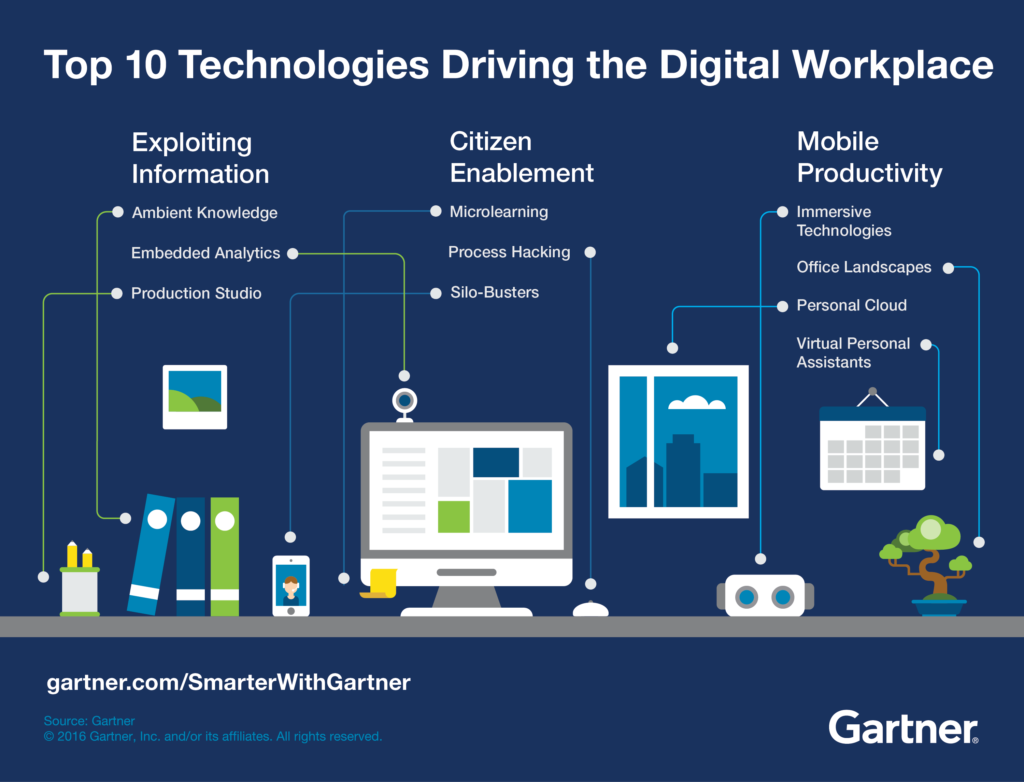
Gartner has put forward its Top 10 trends driving the Future Digital Worlplace – the areas are nicely summarised in the graphic above.

To be honest. the “digital transformation” predictions are somewhat aggressive, even possibly hyped (surely not!) – a trend others have noticed with some of Gartner’s recent output in the space.

In the Agile Elephant view, based on the limited successes of Office Automation 1.0,  the Digital Workplace is more likely to resemble the graphics above rather than their tech automation predictions for quite some time.

But, all fuel to the debate.


Share this:

  • Tweet
  • Email

Filed Under: Uncategorized

February 2, 2016 By Alan Patrick

The Limits to Collaboration


HBR on Collaborative Overload – High Collaboration people get burned out

Collaborative Overload

Evidence is emerging that too much Collaboration can be a bad thing – Economist:

…the current Harvard Business Review(HBR) has a cover story on “collaborative overload”; and Cal Newport of Georgetown University has just brought out a book called “Deep Work: Rules for Focused Success in a Distracted World”.

A growing body of academic evidence demonstrates just how serious the problem is. Gloria Mark of the University of California, Irvine, discovered that interruptions, even short ones, increase the total time required to complete a task by a significant amount. A succession of studies have shown that multitasking reduces the quality of work as well as dragging it out. Sophie Leroy, formerly of the University of Minnesota (now at the University of Washington Bothell) has added an interesting twist to this argument: jumping rapidly from one task to another also reduces efficiency because of something she calls “attention residue”. The mind continues to think about the old task even as it jumps to a new one.

On the “Information Residue” issue, there were studies done many years ago on the impact of telephone interruption. They showed that it took several minutes to mentally “set down” what you had been doing, and several minutes to “set up” the tasks the telephone call is about, (or re-set what you were doing) before effective work could again begin. The more complex the task, the more the set up / set down time. Too many phone calls and the worker was effectively spinning in air and could do only the most menial tasks, any real “knowledge work” was out the question.

Another issue The Economist notes is the poor understanding of the costs of Collaboration, which also plays to the above point:

A second objection is that, whereas managers may notice the benefits of collaboration, they fail to measure its costs. Rob Cross and Peter Gray of the University of Virginia’s business school estimate that knowledge workers spend 70-85% of their time attending meetings (virtual or face-to-face), dealing with e-mail, talking on the phone or otherwise dealing with an avalanche of requests for input or advice. Many employees are spending so much time interacting that they have to do much of their work when they get home at night.

Problems

The HBR article referred to above notes X main problems emerging from modern Collaboration systems – I have split the issues into teh 3 main issues:

  • Volume
  • Victims of Virtue
  • Vampires

Volume

How much time do people spend in meetings, on the phone, and responding to e-mails? At many companies the proportion hovers around 80%, leaving employees little time for all the critical work they must complete on their own. Performance suffers as they are buried under an avalanche of requests for input or advice, access to resources, or attendance at a meeting. They take assignments home, and soon, according to a large body of evidence on stress, burnout and turnover become real risks.

As one commenantor in The Economist points out, Collaboration kills itself by the Network Laws

“There is a simple reason why performance declines with collaboration. It is caused by an arithmetic progression: one person = 100% work (theoretically, and rounding the numbers for this example); two people = 90% work and 10% collaboration overhead; three people = 80% work and 20% overhead; four people 60% work and 40% overhead, and so on.
Why the sudden drop in work? Because when you have four people, you suddenly have six interactions to service (to prove it, draw a box with a person at each corner and draw all the lines between them). Above four, the number of interactions increase again.
By about 15 people, work has dropped to almost zero and collaboration overhead risen to almost 100% (all those meetings ‘the alternative to work”).

Victims of Virtue

What’s more, research done across more than 300 organizations shows that the distribution of collaborative work is often extremely lopsided. In most cases, 20% to 35% of value-added collaborations come from only 3% to 5% of employees. As people become known for being both capable and willing to help, they are drawn into projects and roles of growing importance. Their giving mindset and desire to help others quickly enhances their performance and reputation. As a recent study led by Ning Li, of the University of Iowa, shows, a single “extra miler”—an employee who frequently contributes beyond the scope of his or her role—can drive team performance more than all the other members combined.

But this “escalating citizenship,” as the University of Oklahoma professor Mark Bolino calls it, only further fuels the demands placed on top collaborators. We find that what starts as a virtuous cycle soon turns vicious. Soon helpful employees become institutional bottlenecks: Work doesn’t progress until they’ve weighed in. Worse, they are so overtaxed that they’re no longer personally effective. And more often than not, the volume and diversity of work they do to benefit others goes unnoticed, because the requests are coming from other units, varied offices, or even multiple companies. In fact, when we use network analysis to identify the strongest collaborators in organizations, leaders are typically surprised by at least half the names on their lists. Also see the Chart at the top of the post, these people start to burn out.

Vampires

Other people start to (ab)use highly collaborative people.

Instead of asking for specific informational or social resources—or better yet, searching in existing repositories such as reports or knowledge libraries—people ask for hands-on assistance they may not even need. An exchange that might have taken five minutes or less turns into a 30-minute calendar invite that strains personal resources on both sides of the request.

Consider a case study from a blue-chip professional services firm. When we helped the organization map the demands facing a group of its key employees, we found that the top collaborator—let’s call him Vernell—had 95 connections based on incoming requests. But only 18% of the requesters said they needed more personal access to him to achieve their business goals; the rest were content with the informational and social resources he was providing. The second most connected person was Sharon, with 89 people in her network, but her situation was markedly different, and more dangerous, because 40% of them wanted more time with her—a significantly greater draw on her personal resources.

Solutions?

From the HBR article, we can see 3 practical approaches (there are some impractical ones that we discuss later):

Redistribute the work

Any effort to increase your organization’s collaborative efficiency should start with an understanding of the existing supply and demand. Employee surveys, electronic communications tracking, and internal systems such as 360-degree feedback and CRM programs can provide valuable data on the volume, type, origin, and destination of requests, as can more in-depth network analyses and tools.

Also, can one shift decision rights to more-appropriate people in the network? It may seem obvious that support staff or lower-level managers should be authorized to approve small capital expenditures, travel, and some HR activities, but in many organizations they aren’t. (Risk here though is too often responsibility is pushed down, but authority is not)

Structure for Collaboration Boundaries

Show the most active and overburdened helpers how to filter and prioritize requests; give them permission to say no (or to allocate only half the time requested); and encourage them to make an introduction to someone else when the request doesn’t draw on their own unique contributions. The latest version of the team-collaboration software Basecamp now offers a notification “snooze button” that encourages employees to set stronger boundaries around their incoming information flow. It’s also worth suggesting that when they do invest personal resources, it be in value-added activities that they find energizing rather than exhausting.

Also consider whether you can create a buffer against demands for collaboration. Many hospitals now assign each unit or floor a nurse preceptor, who has no patient care responsibilities and is therefore available to respond to requests as they emerge. The result, according to research that one of us (Adam Grant) conducted with David Hofmann and Zhike Lei, is fewer bottlenecks and quicker connections between nurses and the right experts. Other types of organizations might also benefit from designating “utility players”—which could lessen demand for the busiest employees

Measure and Reward the right things

We typically see an overlap of only about 50% between the top collaborative contributors in an organization and those employees deemed to be the top performers. As we’ve explained, many helpers underperform because they’re overwhelmed; that’s why managers should aim to redistribute work. But we also find that roughly 20% of organizational “stars” don’t help; they hit their numbers (and earn kudos for it) but don’t amplify the success of their colleagues. In these cases, as the former Goldman Sachs and GE chief learning officer Steve Kerr once wrote, leaders are hoping for A (collaboration) while rewarding B (individual achievement)

The Economist article is a bit more sceptical about how easy this is, however:

…collaboration is much easier to measure than “deep work”: any fool can record how many people post messages on Slack or speak up in meetings, whereas it can take years to discover whether somebody who is sitting alone in an office is producing a breakthrough or twiddling his thumbs.

Also, Managers “feel obliged to be seen to manage: left to their own devices they automatically fill everybody’s days with meetings and memos rather than letting them get on with their work”

The HBR article also mention two things which (to our minds at least) will not help a lot unless one is very careful:

(Don’t) Use more Collaboration Technology

HBR recommends using technology such as Slack and Salesforce.com’s Chatter, with their open discussion threads on various work topics; and Syndio and VoloMetrix , which help individuals assess networks and make informed decisions about collaborative activities. This seems like a retrograde step if the core problems noted above are not solved. Technologys is largely the reason for the problems to begin with.

(Don’t) Try new fangled Office Productivity schemes

As The Economist points out, the cult of collaboration has reached its apogee in the very arena where the value of uninterrupted concentration is at its height: knowledge work. Open-plan offices have become near-ubiquitous in knowledge-intensive companies. The HBR (and many organisational theorists) likes all this open plan, water cooler stuff. The Economist comments section punctures this however:

In my experience, open plan offices work well where there is a small team working on the same issue. Other than that they are a Dilbert zoo of oppression.

And….

[This] may explain another phenomena of the knowledge-intensive business: the rise of telecommuting. If you don’t go in to the open-plan office, you can actually concentrate on getting the job done.

And…

Well, the newest hype is flexible seating within open plan offices, assigning one working place to about 1.2 employees – strictly to foster collaboration, not as a cost cutting exercise. But indeed, this reduces the “collaboration curse” – because you do not know the people around you and thus have nothing to collaborate upon. So we are already further: we now combine the disadvantages of open plan offices without getting any of the promised benefits of collaboration…

And, cynically

“Collaborative” workspaces typically have a much higher density of employees per square meter. It’s cheaper to house employees and the company saves money. Collaboration is the cutesy label used to justify it to the employee base but the bottom line is that it’s cost driven.


What Works, What Doesn’t, What’s Next?

What works

  • Collaboration – in moderation
  • Careful curation of collaboration systems to optimise performance.
  • Performance measure that encourage effective collaboration. This does not mean pushing people to be “more collaborative” as so many metrics today do
  • Boundaries to protect the most collaborative people t keep their time sink to effective levels

What Doesn’t

  • Collaboration unbound (just reproduces the email inbox problem, without email’s search and file tools)
  • Use of new techniques and technologies without a lot of due care and thought about scale, scope and structure.
  • Design and Office/Company organisation “fads” to foster Collaboration (especially if the real reason is cost reduction etc)
  • Mathematically – too many people in the collaborative net, ensuring that so much tme is spent communicating rather than creating or working

What’s Next

  • Increasing focus on monitoring internal collaboration systems
  • Increased attempts at measuring and rewarding effective collaboration
  • Reducing size/scope of collaboration networks as better metrics winnow down ineffective collaboration approaches- silos are dead, all hail the new silos
  • Many collaboration system failures as the above optimisation requires restructuring to give people authority as well as responsibility, managers to cede control, and collaboration to be curated for impact (hard), not as a good in itself (easier)


Share this:

  • Tweet
  • Email

Filed Under: Uncategorized

New Ways of Working and New Economies

November 20, 2015 By Alan Patrick

New Ways of Working and New Economies

A summary of a piece I did on Broadstuff on the emerging New Economy, this is germane to New Ways of Working:

I was prompted to write the post after reading Gideon Lichfield’s useful article on all the different types of systems jumbled up in the term “Digital Economy” and the muddy thinking about it that results. To summarise Gideon first, these are the different types of systems operating up in this new economy, and the reality behind the hype – the expurgation is mine:

Sharing economy – The name is apt for any service that allows a thing previously available only to its owner to be used by other people, thus making more efficient use of resources.

Peer (or peer-to-peer) economy – It’s meant to get at the more direct connection between the people on either side of a transaction, unmediated by a big faceless company, but “peers” economy” is very misleading as to the relationship between borrowers, lenders and intermediary

Gig economy – not a steady job but a series of gigs. But the gig economy could be short-lived: Legal disputes about gig workers’ rights, liability, and so forth could force the creation of a new category of worker that is neither freelancer nor employee.

On-demand economy – this is where the venture capital money is: services that offer cars, food, home-cleaning, and other services at the touch of an app button. [My note – and it relies on “Gig-economy” labour]

Platform economy – a digital platform that, whether through algorithms, a rating system, or some combination of the two, serves to connect customers with providers of goods or services.

Networked economy – See “Platform economy.”

Bottom-up economy – the newfound ability of small businesses and freelance workers to find customers or band together with other workers from all around the world.

Access (or Rental) economy – services that let you pay to use things like cars (Zipcar), movies (Netflix), or music (Pandora, Spotify) without owning them. Been going on since long before the Ubers of this world came into being,

Uber economy – “Uber for X” has become an easy shorthand, but it’s simplistic—the Uber model is only one of many.

The first takeaway is that these different “New Economies” will drive many different ways of working.

But what this summary also really made clear to me is that all these “Next Economies” (possibly with the exception of a Bottom Up collaborative system) is that they like to use the impressive (and more upmarket ) term “Economy” whereas in reality they are just good old Markets – either simple ones flogging something, or two sided markets matching a buyer and a seller via a mediator.

So it’s a lot more like the Old Economy than one is led to believe at first reading.

And this is hardly a new feature of the digital age (I am reminded that many “vertical markets” and “e-market” dotcoms were proto-Unicorns until the dotcom crash, and its hardly as if the last 15 years haven’t seen a lot of new digital markets emerge).

Some Implications..

The implications are that there is little “this time it will be different” New Economy in the next iteration – it’s the Old Economy, but mainly with added automation and more part time, low wage workers. New Ways of Working will have to obey Old Rules of Economics more than on would ideally like, so any new structures will be judges on old metrics, like:

  • Efficiency
  • Effectiveness
  • Dependability (predictability of output)
  • Reliability (uptime)
  • Mean times between failure/ faiure per unit output

As  Texas oilfield accidents lawyers has stated that it is the right of employee to claim compensation for the injury caused during the course of employment.There are some following implications – regardless of the ways of working or organisatio chosen, human centred work will need to be structured at all times to be better a than a low cost “gig” worker or automation.This implies the sort of thought into work structure that Toyota put into its systems, a point made by Professor of Operations Management Zeynep Ton at the O’Reilly #NextEconomy conference last week.

If the structure can’t do that, it won’t be part oaf any New Economy.

Share this:

  • Tweet
  • Email

Filed Under: Uncategorized

Towards Future Organisation Structures

November 4, 2015 By Alan Patrick

Towards Future Organisation Structures

At the Enterprise Digital Summit I did a sort of Pecha-Kucha style talk on future organisation structures but I thought it may be worth going through the talk in more detail as a blog post as well. In essence, the formal part was to show the research behind 3 hypotheses we were going to discuss:

  • There are many options for effective organisations, from quite structured hierarchies to very open structures, there is no one “best” option. Some are more appropriate than others in certain situations
  • Forget Dunbar’s numbers in any organisation structure at your peril
  • Pure Hierarchies are inflexible, flexible Network & Heterarchical organisations have problems scaling and delivering, so the likely “future organisation” solutions are going to be around hybrid structures

Also, we have done a bit of research on long lasting alternative organisation structures, so in the spirit of our “what works, what doesn’t, what’s next” approach, we can make a few observations about modus operandii.

There have been many effective organisational structure options – the ecosystem decides which is “best” (aka “fittest”)

We have gone back into biology and anthropology as well as history to look at organisation structures that work. By this we mean structures that are resilient,  effective and flexible – the term we like to use (inspired from here)  is Responsive organisations – capable of adapting to new situations. One of the most interesting cases from nature is the difference in societal structure between Chimpanzees and Bonobos – genetically very similar apes to each other (and to humans…), yet one has a hierarchical, patriarchal society and the other is a flatter, matriarchal society. Both are resilient, both are effective (for example both species can use tools), and flexible. The reason for the difference is believed to be the different ecosystems they live in. Another interesting case study is  a troop of Baboons that changed from patriarchal to matriarchal society when the alpha males were killed off, and have remained stable in the new state for 3 generations so far.

Also, Jared Diamond’s* and others work on early human societies show that there has always been a wide variety of human ways of organising society. And again, the explanation for differences is usually the environment they are in. Human evolved a more flexible social structure than Chimpanzees or Bonobos, which ultimately has led to 9 billion of us.

As far as organisational structures go, we noted the extremely long lives of various hierarchies – the Catholic Church, Byzantine government, various flexible military organisations, to give a few examples. We also noted that modern corporate hierarchies were modelled on old 18/19th century military structures, but the modern military has in many ways moved farther away from that model than most organisations have, due to the pressures of combating asymmetric armies.

Forget Dunbar’s Numbers at your peril – scale drives hard choices

As we have explained before, there is more than one Dunbar’s number. Dunbar’s work shows that we can only hold a limited number of people at various levels of social closeness. Very close is about 5, close is about 15, general friendship group about 50, and casual friends/acquantances about 150. The amount of social transactions required to keep a person at a particular level rises as they become closer, and we have a limited capacity. To keep 150 people at the level of intimacy you keep 15 would take take all the spare time in a day. Larger groups become ever more distant.

In a social business context, this has a real impact. The level of extreme collaboration that a close team like a work cell requires tops out at the Dunbar number of c 5, it’s very difficult to run teams where everyone knows what is going on at sizes greater than c 15 people, and at c 50 people there is a transition from one person being able to run an organisation, and it has to be split between subordinate managers (this is a well known problem in startups, this is the point where the entrepreneur has to “let go” direct control and put processes in place. In many cases either entrepreneur or organisation don’t survive the transition).   At c 150 people up a company moves from being a place you vaguely know everyone to being an “organisation”, where formal structure replaces informal connections.

The reason for this is the amount of interactions required to keep a high level of trust and collaboration.  For 5 people, fully connected (networked) to each other, there are 10 links between the individuals in total (20 if you count each part of a link as a 2 x 1 way interactions). At 15 people it is 105 links, at 50 people 1225, at 150 people 11,175. This is a power law, every time the group size increases by 3x, the number of links increases by the square (The law is (N(N-1)/2 to be precise).  You can model this to show that fully linked groups rapidly become unsustainable as they scale.

To scale therefore, there are two options

(i) reduce the quality of the links, and as Dunbar explains, this already occurs as social groups scale – but so does their functionality, and therein lies the rub, for more co-ordinated activities (like business activities) to happen the links have to operate at a certain minimum level of functionality; or

(ii) reduce the number of links required. The way to do this is to introduce a structure where not everyone has to link to everyone else. The simplest way of doing this is to introduce a hierarchical structure, where everyone knows their place in it and who they link to. Arguably hierarchies also reduce the number of links which are fully bi-directional, further reducing the load.

This is why human enterprise in any form, when it scales, throughout history has moved to forms of hierarchical structures, almost irrespective of surrounding environment. That they are imperfect is not in doubt, but throughout history hierarchies have been, to paraphrase Winston Churchill, the worst form of organisation, except for all the others.  In fact, the only really notable thing about any alternative structures so far has been their relative rarity and short lifespans. (There are also a few interesting features of the ownership structure of such stable alternatives which we go into further down the page)

The argument today is that modern working conditions – a sped up business cycle, ability to work anywhere, anytime, increasing need to inovate to compete, plus new technology will force a shift from the hierarchy, and that technology will facilitate this shift to other structures, usually postulated to being more networked and heterarchical.

Hierarchies, Heterarchies….. and Hybrids

There are a number of proposed alternative structures around at the moment, mostly based around networked and/or heterarchical principles. Although these terms are often used interchageably, they are not quite the same.

Networks are the structures that connect people together, strictly speaking any connection structure is a network, including a hierarchy. But by “network” most proponents of new organisations mean a non ranked, non hierarchical structure that connects all to all, and argue that new technologies allow a more flexible way of linking people digitally.

Heterarchies are “a system of organization where the elements of the organization are unranked (non-hierarchical) or where they possess the potential to be ranked a number of different ways” – they differ from the above network definition in that “ranked in different ways” term. The idea is that any individual is differently connected to a variety of networks.

But given the limits of Dunbar numbers and link scaling power laws, how will this work? All the above comments about Dunbar numbers and scalability still apply to these networked structures – it’s not really a technology issue, its a human cognition issue. The flooded inbox problem is a symptom of being over-networked in a business sense, and newer technology doesn’t solve this – companies are finding that as email use declines, the social messaging overload grows – increasingly companies are asking how to filter business social messaging for relevance. In other words, how to impose a link-reducing structure on information flow.

Arguably a heterarchy is more scalable than a pure network, as it allows one to drop a lot of unnecessary links so in effect not everyone is connected to everyone else – in effect forming a scalable small world network structure. However, that starts to look suspiciously like a hierarchy if all links are equal, but some (those that link between the various sub networks – small worlds – for example) are more equal than others – which they tend to become.

Both these new models also require more energy to maintain than a hierarchy, the transaction costs required in maintaining these informal structures require higher time investment and personal skill levels, so at the minimum there usually needs to be a lot of education of people to work in them. There is some concern that not all people or jobs can work in this way, so they limit the labour they can use.

But Hierarchies have also adapted, implementing some features of network and heterarchical practice, and in watching this adaptation we believe the eventual endgame is taking shape – a hybrid structure. For quite a few decades Hierarchies have been trying a number of approaches to reduce their flaws:

  • Breaking up into smaller units within a large structure, wher each unit gets closer to a viable Dunbar number so can opearte withoit overwhelming process.
  • Increasing reporting lines across the organisations – “matrix” organisations.
  • Implementing hetearchies within the hierarchy – Quality Circles, Manufacturing Cells, Ad Hoc Project teams, “Agile” processes are all examples of this.
  • Giving authority to people further down the organisation.


What Works – Alternative Organisations that have scaled, succesfully and sustainably

There are a number of interesting case studies of larger companies that do use alternative approaches and have proven they are both scalable and systainable over time:

John Lewis Partnership

The UK department store retailer has been going for over 100 years, and is consistently seen as great for customers and great for staff. In structure its is at first glance hierachical, but with the major difference that every employee is in fact a aprtner, a shareholder in the company at a meaningful level, and this impacts it’s culture and approach. There are however 3 other features worth noting about John Lewis that are important:

  • It is privately held, i.e. can focus on long term company goals rather than short term pressures from rent seeking investors
  • Stores are “natural Dunbar structures” – they are essentially a large collection of c “150 person” elements, the ecosystem has been sympathetic to reproducing viable sized structures
  • It operates at the upmarket (aka higher margin end) of its business ecosystem, where a focus on service generates more benefit than possible higher costs of its approach

W L Gore

Gore has been going for c 60 years and pioneered an Open Allocation organisation (choose what you work on, within bounds) structure based on it’s founder’s experience with ad-hoc task teams in hierarchical structures. Gore has c 10,000 associates (employees) in operations spread across the world. It looks to be poles apart from John Lewis, but Gore has some interesting features that are similar:

  • Family, then privately owned
  • Gore Plants also have limits to size – In each factory they limit the number of employees to c 150 people (recegnise thet number?) so that “everyone knows everyone”.
  • At the high end of it’s business ecosytem, again a focus on customer service yields a larger benefit than on cost

Toyota

Toyota was founded just before WW2, but like most Japanese companies had to re-invent itself afterwards, and developed a system to optimise the conistions of austerity in post war Japan. It  became well known for this “Toyota Production System” as the exemplar of “just-in-time” production. The system focussed on minimising slack resources, and emphasized efficiency on the part of employees, and gave a lot of power to the employees on the front lines. They pioneered work cells, quality circles and modular structures. It was the go-to case study in the 1970’s & 80’s. During the 1990s, Toyota began to experience rapid growth and expansion, largely due to the culture.  Expansion strained resources across the organization and slowed response time, and the organization culture became more defensive and protective of information. Toyota’s CEO, Akio Toyoda, the grandson of its founder, noted that  “I fear the pace at which we have grown may have been too quick.” Note that it maps to Gore and John Lewis in that i:

  • Is Family owned
  • Although a mass market player, it strove to be at the “high value” end – quality and customer choive were built in from the design process
  • There is no direct linking to the 150 “Dunbar Number” but they certainly understood small team dynamics very well, and the “respect for people” philosophy echoes a lot of the thinking of the other two
  • Although it does not have the common ownership model of the other two, it does benefit from teh Japanese company corporate loyalty model, arguably an equivalent approach in terms of aligning interests

A number of new companies are often posited as being examplars of these new ways of working (Valve,  Medium etc) but as most are new we can’t tell whether they are sustainable. Also, most of these organisations are still relatively small, few are over 50 employees in size, never mind 150, so in Dunbar terms these organisations can work mainly because of human cognition capacity rather than any new structure per se. Also most are almost pure “knowledge busineses”, which have already shown over the last few decades that they are fairly easy to run in less hierarchical fashion . The interesting thing will be to see what happens when they scale, and if there are any ecosystem factors underlying the successes (or failures).

Of the current crop of new organisation experimemts, the one that interests us most is Zappos, as unlike many of the others held up as exemplars today, who are mainly too small and new for any conclusions to be drawn, Zappos is already a larger enterprise that is trying to re-engineer its culture, and it deals with physical materials and operational issues.

Zappos

Two years ago Zappos stated to implement holacracy, an approach originally based on Sociocracy, ostensibly a heterarchical system but one which has a very structured approach to the ranking of people in different ways (to the extent that sceptics observe that it looks very much like a hierarchy in all but name…).

Zappos differs from our sustainable case studies in a few ways:

  • It is not family/privately run, being acquired by Amazon
  • It is not clear if it has the common ownership model (at a level that makes alignment of interest top of mind), so it is up to the holacracy culture to deliver this.
  • It is not “upper end” of its market, however it is obsessive about service and was an early adopter of the online channel, and can offer a huge range of niche sizes and products that are hard to find in conventional stores

So far the results are unclear, reports lauding and lamenting it both appearing in the media to date, but it’s early days and major change is never quick – definitely a cse study in the making.

What Doesn’t?

We have written already of why many earlier structures failed (see here) and have noted that all succesful organisations tend to have in them the seeds of their own destruction, but the following amusing – and educational – concepts are also worth following up on, as they will kill any organisation, no matter how structured:

  • Peter Principle – every employee rises to their level of incompetence
  • Parkinson’s Law – make-work expands to fill the time available for its completion. There will be the maximum number of chiefs at the point the system collapses
  • Pournelle’s Iron Law – in essence that in any organisation, the people who will eventually rule it will optimise for its own survival, regardless of whether it is functional or not

What’s Next?

This was to be the rest of the workshop – publish a comment and damn the torpedoes!


*Some in the Anthropological establishment dislike Diamond’s work, its hard to tell whether its valid objection or noses out of joint, but what is unarguable is that he shows that various succesful early human societies can be organised very differently

Share this:

  • Tweet
  • Email

Filed Under: Uncategorized

What is the (real) Future of Work?

October 7, 2015 By Alan Patrick

What is the (real) Future of Work?

Returned from the IOM Conference in Cologne last week, which is mainly concerned with the “Human” side of the Future of Work that the Digital Transformation will bring. The focus is really on how white collar, mainly fairly knowledge oriented workers, will do their work in future. It’s all about improving human potential – expanding knowledge, increasing collaboration & co-ordination, engaging & enthusing, a move from hierarchy to flat organisations. It’s an optimistic vision, a Human-centric model. What’s not to like?

But here’s the rub – The Humanist, People-Centric approach is just a subset of the whole “Future of Work” trope – you don’t have to go far before you find three other very different futures being created:

While I was at the conference, there was news of other “Futures of Work” splashing over my Twitterfeed – Transport for London has put up a consultation document aimed at limiting Uber’s use of non-regulated approaches to run taxi services in London at prices the regulated cabs can’t match. Uber of course has retaliated with its normal tactic of a well funded PR campaign & petition, which quickly got c 100,000 of its faithful signing up after the call to arms. As readers of this blog knows we have also been tracking the rise of companies using fractional assets & people’s time. allied with market making technology, of which Uber is just one example.

Also, when I returned to London I saw a link to an article by Andrew McAfee in the Financial Times wondering why Humanists don’t like Technology (essentially if you are suspicious of Tech, and want to put people first, you are for Ludditism 2.0). And you don’t have to go far on the ‘Net to see worries about all sorts of white collar jobs being offshored to lower wage countries. Last night’s Social Business & Digital Transformation Meetup that we run in London also explored a lot of these themes after Rawn Shah’s presentation, and made me realise that as well as the Human centric view of the Future of Work, there are a number of other “Future of Works” that are occurring today:

  • Automation, ie using ICT to replace human work (See McAfee & Brynolffson’s “The Second Machine Age” for a starter)
  • Digital Offshoring – moving skilled work to lower cost, less regulated environments (this isn’t necessarily to low cost country – a lot of “Mechanical Turk” work is done by underemployed people in rich countries it’s not called the Digital Sweatshop for no good reason.)
  • “Uberisation” (for want a better word) is partly automating the process (the App) and partly commoditising the process provider – the use of self employed (often unregulated below-minimum wage workers) for just the fractions of their time required, with no payment of their costs of working, nor any form of employment benefits. Read the “Work – The Future” set of essays to get a good idea of the thinking in this arena. Ditto the increasing use of “fractional assets” – rented private rooms on Airbnb, pop-up shops etc.

The people impacted by these worlds are going to have a very different experience from the happy human-centric vision painted at the start of this article.

But here is the second rub – a lot of those impacted will be those that thought they were slated for the happy, hierarchy-free humanist world of work. How so? Well, if your job can be:

  • Automated (even partly), you can be replaced by an AI and an apparatchik, or
  • Sent to a cheaper person elsewhere (And this will happen to everyone – Legal work once down by qualified professionals in the OECD is being sent to India), or your time can be
  • Bought in small slices when required. The IT Contracting market is already like this – right now it can be a good living as there are still relatively few doing it. When there are far more people doing it as their full time jobs disappear, per diem payments will plummet for most).

Work will be impacted differently depending on where in the value chain one is, and where one is geographically. To understand this there are 2 useful models – the Value Chain model, and the Product/Process model:

The Value Chain Model 

Future of Work 4 Box

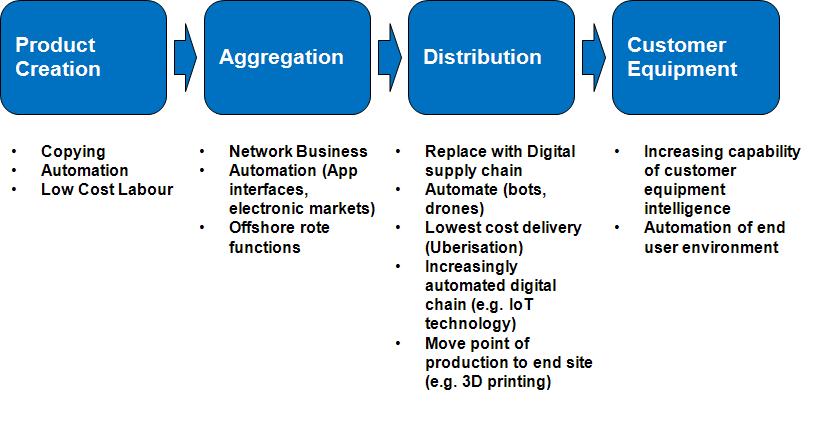
A useful simple model is the “4-box” model of a simple value chain, and see how it changes in a Digital shift:

Creation – Automation of creativity is still hard, but mass copying, algorithmic approximation and other ICT techniques are rapidly making inroads and the truth is that a lot of “creative” work is just re-mashing existing stuff. True creatives cannot be replicated, but their value is largely marginal, rewards are distributed according to power laws – a very small number of creatives make most of the money. They have thus always lived in the lowest rent areas (Artists in Parisian garrets) unless they are of the tiny fraction that make it, but what does today’s Parisian artist do in a global world where the lowest rent garrets are in Paraguay or the Philippines?

Aggregation – The part of the business that organises & co-ordinates supply with customers – once it had to be “close to the customer”, can be increasingly easily automated and/or offshored. “Uberisation” reduces this to an automated function (eg an App).  Winners in the Aggregation stage are in a strong position in the digital world, as they specialise in aggregation of supply or demand and network effects tend to give the spoils to the frontrunners and damn the also-rans. The ideal is a market maker that not only aggregates both sides, but makes a market, hence the sudden rise of “Unicorn” businesses where this occurs.

Distribution – getting product from producing area to consumption area. Anything that can be digitised can be transmitted around the world at the press of a button which has already crashed many media businesses, and increasingly manufacturing will be possible at point of consumption. What is harder to automate is physical delivery, especially of the last mile, but “Uberisation” is essentially the fractionalisation and commoditisation of the labour of the people who man the physical delivery assets (cars, spare rooms etc). They too will apparently (we shall see…) be automated out by delivery drones and robot cars etc.

Customer Facing Environment – the main impact of automation is customer self service, allowing people to bypass local sales and delivery organisations, and companies to use less sales staff but this is till a relatively safe area as many of these tasks are extremely varied – too complex to automate, impossible to offshore, no easily scalable “Ubermarket”, often quite “high touch”. A lot of this is done in cash, with one to one organisation that cannot be aggregated easily in market making apps as existing social nets & comms platforms carry the load. Our view is that this “Dark Market” will grow as people seek to protect themselves from the Automation and Uberisation of much of the rest of the value chain.

The Product/Process Model

Product Process Humanist Model

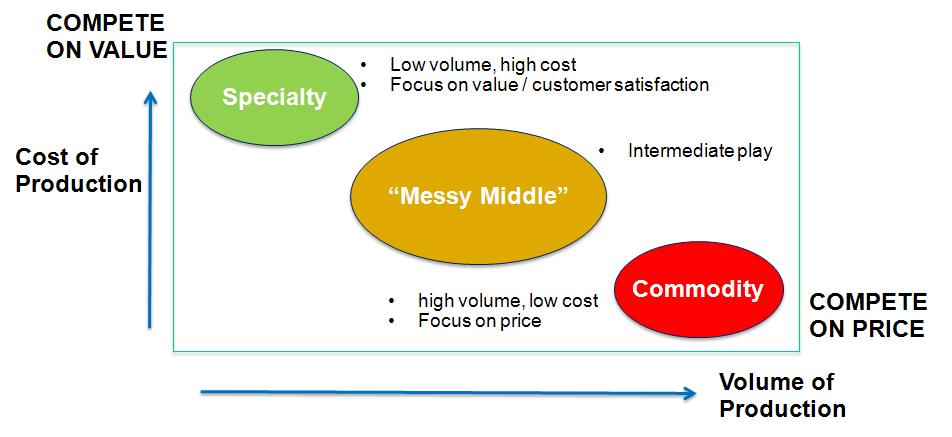
This model notes the essential truism that high value products tend to be made in small volumes by highly flexible workers and processes, whereas high volume products tend to be mass produced in large, highly structured workplaces where automation and/or highly repetitive work is the norm. In the middle is a mix of processes and practices, in a continual tradeoff between cost of process vs value achieved –  a continual battle between automation or labour costs, cost of supply chain vs cost of assets, access to skills vs regulation vs enforcement etc.

In essence we can say that:

  • High value work will still be “safe” for humans (Green blob) – automation will still be very hard, the volumes are too low for “Uberisation” to skim a percent or two off each transaction, and (in general) the value of the goods means labour costs are relatively inconsequential, plus location close to customer is often essential to sell and service the product.
  • High volume commodity work will go to automation and/or cheap labour, whether the work is white or blue collar, if it is repetitive, standardisable and programmable it will disappear from human work options (Red blob)

Which leaves the middle ground (Orange blob) to be fought over between all these models – history suggests a hybrid will occur in most cases (just as manufacturing best practice today incorporates offshoring. lean production & worker cells, automation and elements of business process re-engineering).

The discussion about how the next shift will play out politically, economically & socially in detail is for a later discussion, but – for now – a quick look at the Industrial Revolution is instructive to think about the next 20 years. During the Revolution, while it is true that the changes created new jobs, better lifestyles and a better world for those countries that went through industrialisation, it was not an easy transition:

  • It is also true to say that it took 1-2 generations, and the transition was not pretty to live through- mass migration, impoverishment, starvation, riots & massacres, smashing of factories, appalling pollution, alcoholism, what we would today call “mental health” issues. Many thinkers do not believe a modern democracy would survive the riots, starvation, massacres and huge movements of people that happened the last time round, so for example some leading economists propose a basic citizen wage to buffer people from the worst of the shift to this Future of Work.
  • Things only really got better when this new Working Class organised itself as a movement to prevent the excesses of exploitation and gained political power. Marxism, Unions and other Labour movements, Labour Days worldwide seem a bit arcane today, but that was the way most of your great-grandparents ensured they captured some of the benefits of that New Way of Work transition. We can expect some fairly radical resistance from workers again, but this time with social tools to back them up. We live in Interesting times

If you are interested in exploring these issues and the overall Digital Transformation in more depth, why not come to our Enterprise Digital Summit workshop & conference in London on October 21st/22nd where these issues and others will be discussed

Share this:

  • Tweet
  • Email

Filed Under: Uncategorized

Virtue Signalling – Social Business impact

September 11, 2015 By Alan Patrick

Virtue Signalling – Social Business impact

Last Wednesday night we had our September Social Business Meetup, with Euan Semple being our speaker for the evening (he spoke on Pigs, Lipstick & Dinosaurs – see our summary here, and his relevant blog posts his relevant blog posts here, here and here)

Anyway, in the Q&A&D afterwards, we started to talk about “clicktivism”, and people noted the way Twitter seems to be increasingly being used by people to try and drive “mob opinion”, and even signal they are “more X than thou”. I have seen the effect, and it does seem to be an increasing “thing” on Social Media – but I can’t prove it as it’s very hard to write algorithms to sort genuine opinions from these, so I started looking for a reason as to the “why”.

So, I was scrabbling round the Web to see if there was any information on this, and one term I came across was “Virtue Signalling” and that made me realise that this was covered already in a classic piece of game theory in signalling “weak tells”.

In Game Theory, you can signal an intent – a “tell” in the parlance – that may or may not be genuine. The way you tell if the “tell” is genuine or not is to measure its strength, and this is measured as the cost to the signaller. A “strong tell” is typically by someone who will “put their money (or other assets, reputation, time etc) where their mouth is”. A weak tell is a signal with little cost to the user.

In general, weak tells are easy ways of generating a lot of traffic – they are, for example, the method of choice for “clicktivism” – a low cost of supporting something with little comeback. Facebook “Likes” are a simiar example of a Weak Tell.  I did an analysis on my Broadstuff blog of how this plays out in Social Media, especially about making it harder to measure true intentions and sentiment.

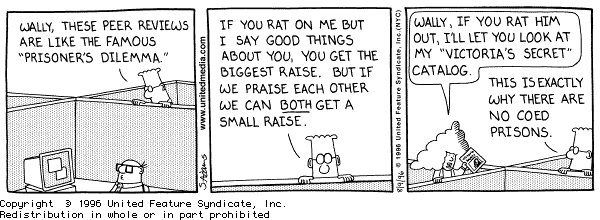
From an Enterprise point of view, as well as making it harder to discern meaning on social media that one may be monitoring, this has an impact on internal social business systems as well, given that similar conditions apply. (And then there is the impact of payoff distortion by non-business goals, as the Dilbert cartoon above notes). But in general, “Virtue Signalling” has 3 main effects:

  • Exaggerates a particular (popular, or advantageous) view
  • Puts off potential for disagreement
  • (Possibly) allocates social capital to the wrong people

The net-net is that certain arguments are overplayed, certain arguments are not made as hard as they should be, and possible the wrong people get allocated resources or authority. This can have a negative impact on performance – studies have shown that suppressing dissent can drive hidden costs such as wasted and lost time, reduced decision quality and decreased engagement/motivation.

To be fair, this is hardly a Digital “thing”, this has happened in organisations from the start. The risk with electronic media though is that the effect is amplified, so the question is how to prevent it. In face to face environments, it is usually the role of a moderator, facilitator or chair to ensure that all voices are heard, but how does one replicate that on a business’s social communication systems? Some thoughts:

  • Good news – the “mob storm” effect is likely to be far less intense, so less social pressure to say nothing
  • More Good News – unilike public social systems, it is possible to “set a tone” on a private network that just cannot be achieved easily on more public ones
  • There are a number of approaches that have worked in allowing a wider set of views to emerge, from suggestion schemes to “rewarding dissent” policies (this is quite a good brief summary from Wikipedia) – all have plusses and minusses, and seem better or worse in certain conditions, but it can be done.
  • However it takes design and ongoing dedication to ensure the network can welcome and handle dissent and unpopular views
  • Chances are, it also needs some form of moderation on occasion, albeit thse can be voluntees rather than full timers

Something to be aware of, at any rate….

Share this:

  • Tweet
  • Email

Filed Under: Uncategorized

What can Byzantium teach about succesful Organizational Structures?

August 19, 2015 By Alan Patrick

What can Byzantium teach about succesful Organizational Structures?

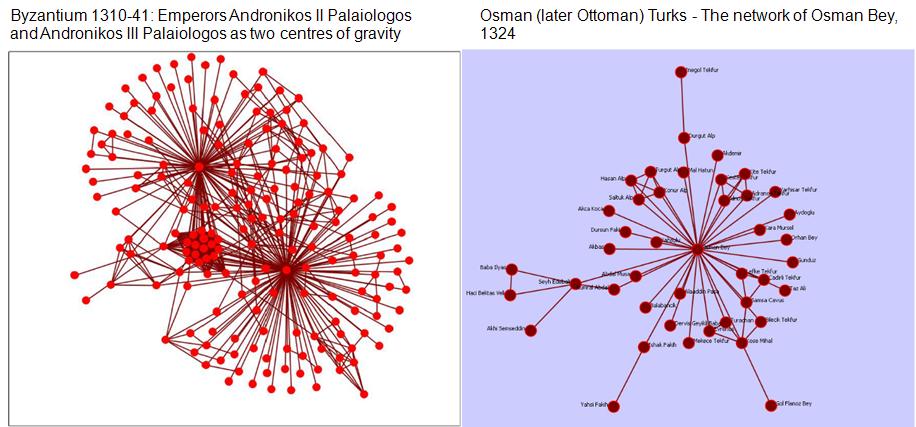
We have been spending quite a lot of time looking at organisational structures, and what works and what doesn’t – and a rather fascinating analysis of the social networks of the later Byzantine and emergent Ottoman Turk leaders came up. The diagram above shows the 2 networks at a turning point, the period c 1310-40 when an already weakneed Byzantium erupted in civil war (hence the bi-modal Byzantine structure) and the Turks took advantage of this. We look a lot at the past for lessons, as the “what next” is known, so it is to some extent predictive.

The network analysis is blogged in more detail on my Broadstuff blog but the upshot is that while it’s easy to jump to the idea that a small, nimble, flexible structure ran rings around the ossified Empire, and victory was thus certain, this is simplistic for 3 main reasons:

Firstly, Byzantium at this time was a bigger, far more complex state than Osman’s Turkish statelet so needed more people to run it and – very unusually for it – was running with 2 co-Emperors (older one + nephew) and broke into a ruinous civil war in 1328  (half way through the analysis’s timespan)  so the network would be massively bi-modal, with 2 opposing camps, by definition.

Secondly, the Byzantine system had been relatively stable for 800 years (just how they managed that  that would really be worth studying) and had just re-unified after being broken up by the 4th Crusade so was still weak. Byzantium had seen the likes of Osman (and far worse) come and go many times over the centuries, so its not a slam dunk that Osman’s system was “better”. Arguably he got lucky, being around just at the time the weakened Empire was busy tearing itself apart (and Andronikus II was by all acounts one of the crappest Emperors they ever had), and other challengers – the Venetians, Bulgarians and various Latisn – were also attacking it at the same time.

Thirdly, as the paper notes, in Osman’s network “the potential flows of power and resources are more centralised in the hand of the ruler”. This works if the leader is able, and can keep on top of the decision flow. Not so good a system if the leader is not so able, and/or the system becomes more complex.

If there is a real lesson, its that nimble upstarts need quite a lot of things going their way to succeed, and organisation structure is not really the key determinant. That the Ottoman state system started to look more and more like the Byzantine as it grew is a salutary lesson. (Or, to rephrase for today, that the [Google Insert your favourite Unicorn] system started to look more and more like the [Microsoft insert your favourite Corporate Dinosaur] as it grew is a salutary lesson.

Share this:

  • Tweet
  • Email

Filed Under: Uncategorized

Next Page »

Sign up for our regular Agile Elephant Newsletter - news, posts, ideas and more.

My Tweets

From the Agile Elephant Blog

  • The Metaverse doesn’t exist yet, but…
  • Impossible Things get Disruptive
  • Clarity, Cloud, and Culture Change at IBM

What Next?
Take a look around our site, check out our approach, see how we can help, join the conversation on our blog or contact us to find out more.

About Us

Agile Elephant is a new kind of consultancy designed to help companies embrace the new digital culture of social collaboration, sharing and openness that is changing business models and the world of work.

Contact us to find out more!

Our founder's blogs:

broadstuff

@DT on Medium

Technotropolis

Our blog:

The Agile Elephant Blog

Site Log In | Site Log Out

Subscribe to Site RSS

Subscribe to our Blog via Email

Enter your email address to subscribe

Join 30 other subscribers

Copyright © 2026 ·Streamline Pro Theme · Genesis Framework by StudioPress · WordPress · Log in