Agile Elephant making sense of digital transformation

innovation | digital transformation | value creation | (r)evoloution

  • Email
  • Facebook
  • Google+
  • LinkedIn
  • Twitter
  • Home
  • Manifesto
  • Services
    • Our Approach
    • Our Services
    • Making Collaboration Work Packages
    • Collaboration Solutions
    • Our Experience
    • Workshops
    • Innovation
  • About Us
    • The Team
    • Why we do what we do
    • Why are we called Agile Elephant?
    • Our Partners
    • Our Clients
  • Get Involved
    • Events
    • Meetups
    • Unconference
    • Newsletter
  • Resources
    • What is Digital Transformation?
    • What is the Digital Enterprise Wave?
    • Our Research
    • Case Studies
    • People We Follow
    • Articles & Links
    • Books That Inspire
  • Blog
  • Contact Us
Home Archives for hierarchies
Of organizational Operating Systems, Frameworks and Flows

May 6, 2016 By David Terrar

Of organizational Operating Systems, Frameworks and Flows

The Paris edition of the Enterprise Digital Summit is coming together for next month. Bjoern posted recently on the conference’s key themes with some great links to ideas around platforms, the elastic enterprise and machine learning, but he also talks about the company’s operating model and operating system, and that triggered some thoughts around terminology that connected with conversations I had with Dave Gray two weeks back (and last year!), and that connected with conversations I had with Sigurd Rinde this week (and over the years). Connections in context over time.
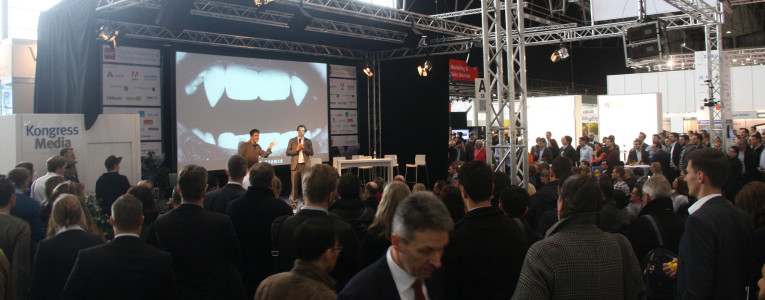
Kongress Media at CeBIT 2016-765x300

I have a problem with talking about the “Operating System” for the organization. I realise that in dealing with the new digital landscape and new business models, our organizations need to change. Dramatically (but we know change is really difficult). Traditional hierarchies and command and control just aren’t effective any more. Management isn’t working! White collar workers in the typical business seem to be busier and less productive than before. How can we fix that? What is the solution? If it’s upgrading the organization to a new Operating System then that feels like an industrial, command and control based solution to the problem. It’s thinking of the the new paradigm in terms of a kernel and drivers, connecting hardware and software, to be tested and debugged. It’s like thinking of the brain as just an electrical circuit. A collection of 90 billion neurons, each one connected to a thousand others, passing electrical signals. But that brain supports the mind which thinks and feels and imagines and has subjective thoughts. More than just electrical circuits.  We need to think organic rather than mechanic or engineering.

Now to Dave Gray. As well as his soon to be published Liminal Thinking book that I blogged about last week, Dave has work in progress following on from Alex Osterwalder’s Business Model Generation and Value Proposition Design books, with his Culture Mapping sessions – I recommend you take a look at his thinking on this. When Dave talks about this, or does a workshop, he often says that culture is like the Operating System of the company, but then he usually goes on to talk about changing and nurturing it in terms of gardening (explained here). In his talks he’ll often quote Louis Gerstner, from one of Agile Elephant’s favourite books (Who Says Elephants Can’t Dance? – from 2002 – it’s part of the reason behind for our name):

“Until I came to IBM, I probably would have told you that culture was just one among several important elements in any organization’s makeup and success — along with vision, strategy, marketing, financials, and the like… I came to see, in my time at IBM, that culture isn’t just one aspect of the game, it is the game. In the end, an organization is nothing more than the collective capacity of its people to create value.”

Although Dave uses operating system as shorthand, I prefer his more organic explanation and definitely agree with his focus on organzational culture.

There is plenty of talk about how the traditional hierarchy of most organizations is reaching its limits. There is talk of flattening the management structure and self organising and we reference companies like W. L. Gore, Valve Corporation (Steam) and Semco Partners. These are great examples, but I worry over the way some people talk about these and Holacracy without fully understanding the scale of the rules and methodologies that underpin it. I hear people discussing Frederick Laloux’s Reinventing Organizations book and the pursuit of the Teal Organization. My concern is over being too prescriptive with our solutions. At Agile Elephant we believe there are no “one size fits all solutions”. Every organization is different and at a different stage of evolution in the new digital landscape, and so we believe there needs to be more focus on the activities and behaviours and characteristics that work, rather than striving for a particular system that might.

That leads me to my Enterprise Irregular buddy Sigurd Rinde and discussions which will result in a series of posts including this one. In our catch up call this week we talked about where the classic organization is, and where the modern organization needs to be. He told me how positively people respond when he talks about white collar productivity and tells them (in words which I stole and used above):

“Management isn’t working!”

In our conversation he added more names to the list of companies that aren’t using a traditional hierarchy like Patagonia, Buurtzog, Handelsbanken and Zappos. Then we talked about Zappos and his discussions with them and their problems in changing to Holacracy. However, the most powerful thing we talked about is how organizations spend too much time thinking efficiency when they should be thinking effectiveness. Business is all about getting the work done and the work is a flow. Most of our organiations have vertical application silos – ERP, CRM, Email, HR, Document Management and more. Then we are adding enterprise social networks like Jive, or extra collaboration tools like Slack. The digital workplace is getting more complex.

Sig talks in language that we Elephants like. He talks about getting the work done as value creation. This core purpose generates a sequence of activities – a flow. Like water it requires a framework to be useful. Now there are three basic ways you can move water around:

  • In pipes – that’s the industrial approach, creating a complex system of flows with fixed connections, joints and valves, and more pipes to connect to the next system – like too much of the business application software we use.
  • In buckets passed hand to hand – how much of our day to day work feels like that, with work slopping over the edges on to the floor and not getting to where it needs to be?
  • Along a riverbed – water finds its path – there may be rocks, branches and obstructions that change the flow, but water finds its way around them, and we can work on the riverbed to remove the obstructions, or the river banks to shorten the course.

RiverBed

So when it comes to looking at company organizations at the Enterprise Digital Summit Paris, I’d prefer us to be thinking in organic rather than machine terms. I want us to be thinking about the things that work rather than the particular system deployed. Above all I want us to be thinking about frameworks and that riverbed and how we can make the value flow more effectively.

photos courtesy of Kongress Media and Sigurd Rinde

Share this:

  • Tweet
  • Email

Filed Under: #EntDigi conference, corporate culture, hierarchies, ideas, organisational culture Tagged With: Alex Osterwalder, brain, culture mapping, Dave Gray, Elephants, Louis Gerstner, mind, operating system, Sigurd Rinde

Deloitte on driving social business transformation

January 23, 2014 By Alan Patrick

Deloitte on driving social business transformation

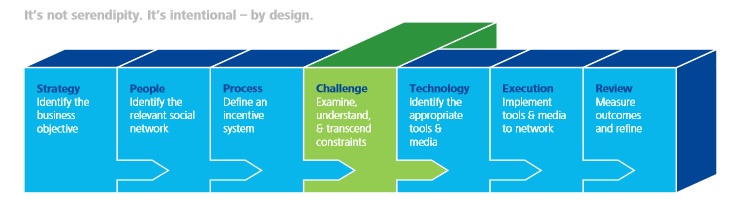
Deloitte Social Flow

The Social Business Flow as seen by Deloitte

Article by Deloitte on driving Social Business transformation:

Social media technologies strip away the hierarchy and bureaucracy long associated with industrialization, replacing them with an open forum of ideas and problem-solving.  When applied strategically to business processes, these tools can draw out the best ideas and efforts from employees spanning all functions of the enterprise.  In fact, anecdotal evidence and research findings reveal that implementing appropriate social technologies and processes has helped some companies boost overall enterprise productivity and increase revenue.

We always like it when people agree with us 🙂

The article is also interesting in that it covers some of the hard work required:

While valuable connections and discoveries may appear to happen serendipitously across social media, realizing the potential of social re-engineering doesn’t happen by accident.  It takes place over time, with purposeful effort.

Well worth a read, some good diagrams as well, the flow diagram (see above) is interesting – not the same as ours, but not dissimilar.

Share this:

  • Tweet
  • Email

Filed Under: agile business, hierarchies, leadership, social business, social tools, strategy Tagged With: bureaucracy, research, serendipity, transformation, value

Jostling the hierarchy and the wirearchy

January 22, 2014 By David Terrar

Jostling the hierarchy and the wirearchy

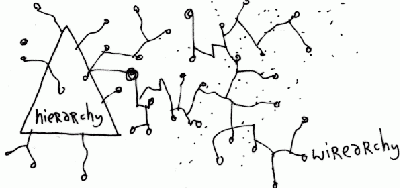
cropped-wirearchy-600x2001As we’ve been setting up the Agile Elephant, and pulling together our manifesto for social business, we have been having a dialogue about a company’s hierarchy versus the wirearchy – the networked connections that happen inside and outside any company, crossing departmental boundaries, crossing company borders, and completely ignoring the organisation chart on the wall. Wirearchy is a concept coined by our Canadian friend and social business thought leader Jon Husband. It reflects the connected world that we now live in, and it highlights the changes that social technologies are enabling in the way we work. Jon’s working definition of wirearchy is “a dynamic two-way flow of power and authority, based on knowledge, trust, credibility and a focus on results, enabled by interconnected people and technology”. That definition and those key words resonate with us.

A few months back Jon introduced me to Brad Palmer, not for any specific reason, but just because he thought we were like minded and should be connected.  The wirearchy in action.  Brad’s another Canadian, and founder of Jostle.  Fast forward to this week and Brad was briefing the Agile Elephant team on what his social intranet platform can do. We’re interested in building up our knowledge of social business tools, and our first look made wirearchy jump in to our minds. Jostle has the most visual approach to showing the structures and networks that evolve in organizations that we’ve seen. Most collaboration products allow employees in the company to build up their profile so that you can understand key information, their skills and expertise and some of their work history. The good products will show you who works for whom. But we haven’t seen a product that shows the company’s org chart AND cross functional team structures as visually as Jostle, but it goes further than that.

Jostle logoThe company organization chart always come in for a lot of stick – soon after it’s up on the wall, the noticeboard or a Word document on the Intranet it’s out of date, not completely accurate, and in any case it doesn’t show the real organisation. What would happen if the chart was alive?  If the organisation chart was a living social network?  That’s what Jostle’s People Engagement® platform gives you.  Always up to date and showing the individual’s information with search and functionality to make it easy for others to connect to them based on skills and knowledge.  It shows the formal connections of the company hierarchy, but allows people to create ad hoc work groups.  They could be project teams, special interest groups, even social groups across and within an organisation.  Combined with Jostle’s library functions it offers the possibility for the Intranet to become a repository of learned knowledge, to help connect all that “unstructured” data sitting in Emails and ERP and Excel.  People can link easily and quickly across departments, the world and, most importantly, the business silos that grow up in even the smallest company, but are a real challenge to medium sized and larger enterprises.  Brad’s explanation showed us how the product would massively reduce the internal time taken in an organisation to find people, find information, and find answers.
A focus on employee engagement, as Jostle has done, has direct business benefits with good outcomes for both employees and customers. Look at this material on the Harvard Business Review blog.  Their findings show highly engaged organizations have double the rate of success of lower engaged organizations.  John Baldoni reports that:

“high-turnover organizations report 25% lower turnover, and low-turnover organizations report 65% lower turnover. Engagement also improves quality of work and health. For example, higher scoring business units report 48% fewer safety incidents; 41% fewer patient safety incidents; and 41% fewer quality incidents (defects).”

These kinds of social business platforms improve the efficiency of knowledge flow and decision making in any business. In an information business, this would have a major impact on business effectiveness – increasing efficiency as the transaction costs are lowered.  We believe there are great opportunities for companies to use Jostle and we’ll be exploring what it can do in the coming weeks and months.

Share this:

  • Tweet
  • Email

Filed Under: collaboration, hierarchies, HR, leadership

Sign up for our regular Agile Elephant Newsletter - news, posts, ideas and more.

My Tweets

From the Agile Elephant Blog

  • The Metaverse doesn’t exist yet, but…
  • Impossible Things get Disruptive
  • Clarity, Cloud, and Culture Change at IBM

What Next?
Take a look around our site, check out our approach, see how we can help, join the conversation on our blog or contact us to find out more.

About Us

Agile Elephant is a new kind of consultancy designed to help companies embrace the new digital culture of social collaboration, sharing and openness that is changing business models and the world of work.

Contact us to find out more!

Our founder's blogs:

broadstuff

@DT on Medium

Technotropolis

Our blog:

The Agile Elephant Blog

Site Log In | Site Log Out

Subscribe to Site RSS

Subscribe to our Blog via Email

Enter your email address to subscribe

Join 30 other subscribers

Copyright © 2026 ·Streamline Pro Theme · Genesis Framework by StudioPress · WordPress · Log in