Agile Elephant making sense of digital transformation

innovation | digital transformation | value creation | (r)evoloution

  • Email
  • Facebook
  • Google+
  • LinkedIn
  • Twitter
  • Home
  • Manifesto
  • Services
    • Our Approach
    • Our Services
    • Making Collaboration Work Packages
    • Collaboration Solutions
    • Our Experience
    • Workshops
    • Innovation
  • About Us
    • The Team
    • Why we do what we do
    • Why are we called Agile Elephant?
    • Our Partners
    • Our Clients
  • Get Involved
    • Events
    • Meetups
    • Unconference
    • Newsletter
  • Resources
    • What is Digital Transformation?
    • What is the Digital Enterprise Wave?
    • Our Research
    • Case Studies
    • People We Follow
    • Articles & Links
    • Books That Inspire
  • Blog
  • Contact Us
Home Archives for digital transformation strategy
IBM Think – All for tech and tech for all

September 25, 2019 By David Terrar

IBM Think – All for tech and tech for all

I’ve been invited to contribute to a couple of panel sessions at this year’s IBM Think Summit in London, one of which is titled “All for tech and tech for all!”.  The Alexander Dumas influence got me looking up his various quotations which led me to something which is very apt for the event: 

“One’s work may be finished someday, but one’s education never.”  

The Think event is always thought provoking and a great place to learn, with top notch speakers, challenging ideas and great content, from keynotes to debates to customers to more detailed sessions.  This year it has moved from the Truman Brewery to Olympia London, so there will be less stairs, doors and dark corners to navigate, but it means the event can spread out with a new campus style.  I started writing this post on the day of the Global climate strike and it’s no surprise that this year’s Summit has a focus on sustainability, with Hugh Fearnley-Whittingstall delivering the first guest keynote after Bill Kelleher, IBM’s Chief Executive in the UK, opens the show in the morning.  

As well as two streams of content in the Showcase theatres, 3 streams of workshops for developers, a stream of lively debates (more on that later), there is a series of fast paced 15 minute sessions in the Think Tanks.  Those short talks are in varied formats covering cloud, infrastructure, security, resilience, data, AI and shaping the future.   

Topics like Quantum Computing, Advanced AI and Blockchain will get a lot of attention.  As well as the talks, debates and workshops, there will be four Campuses to explore which will host exciting experiences and engaging TED style talks sharing client stories: 

  • Cloud & Infrastructure 
  • Security & Resiliency 
  • Data & AI 
  • Shaping the Future 

I’m particularly interested in the Cloud & Infrastructure campus as this will be the first Think Summit following the finalisation of IBM’s acquisition of Red Hat.  As you may know, I’ve written about the significance of this move, with IBM positioning themselves, in my opinion, as the “Enterprise Cloud” company.  IBM’s approach is truly hybrid and multicloud.  Embracing Red Shift’s containerised OpenShift platform means you can build your codebase once and deploy anywhere – on-premise, private cloud, public cloud or at the edge.  With IoT and AI applications, edge computing, or moving servers to where the work happens because of latency issues, becomes a must.  They will also be covering their integration approach, how you modernise existing and legacy applications, as well as their way of managing this multicloud environment cost effectively, safely and securely.  They will cover the IBM Garage methodology with an experience showing how this approach helps you move faster, work smarter, and ideate more rapidly.  They will cover a host of examples of IBM Cloud deployments across 20 different industries.   

In the campus you’ll be able to get hands on with 4 activations: 

  • IBM Garage Accelerator – 3 short films demonstrate how clients have worked with IBM Garage to transform their businesses with the speed of a start-up, at the scale of an enterprise. 
  • IBM Garage Innovation Wall – Follow Mueller’s journey as they quickly define, test, and deploy a solution that changed the way their sales reps interacted with contractors, one of their primary end users. 
  • Customer Success Stories: Explore 15 cross-industry stories of client achievements of accelerated transformation based on IBM Cloud and Infrastructure (apparently this will be sushi bar style – can’t wait!). 
  • Drive Race Winning Innovation with Red Bull Racing Playseats – there’s even a competition to win a factory tour at Red Bull Racing HQ. 

On top of that they’ll be 6 demo pods, 10 business partners to meet, and 13 TED talks going on.  I haven’t got space for the other 3 campuses, but they’ll be just as comprehensive, so there will be lots to learn and a lot of ground to cover.   

Now to the Debates, moderated by Katie Derham.  I’m assuming they will be “in the round” like last year, and under the Chatham House Rule, so for a change I won’t be tweeting every other second.  IBM wants open, thought provoking, maybe even controversial debates so people can really speak their mind.  I’ll be contributing to two: 

All for tech and tech for all 

Over the past twenty years we have seen technology become fully embedded in our daily lives, and increasingly embraced across all age groups.  With an eye firmly on the future, IBM are bringing together a panel of younger and older people, to discuss where technology is heading, what problems it could solve, how it is developed and marketed and how it will be used. How should technology address the needs of the different generations in our society moving forwards, and what will need to change, so that we are truly living in an age of “All for Tech and Tech for All”?  I plan to talk about the difficulty in predicting the future, how tech could be our saviour, definitely something on creativity, and maybe something on how we aren’t educating the current generation properly for what happens next.  What sort of tech might we talk about?  Designer antibiotics, ingestible robots, smart clothing, photonics? 

Essential Education 

The world we work in is changing – and changing rapidly. For those with the right skill-sets, new opportunities abound, and new, challenging careers await; we have the some knotty problems to address – and need a innovative, creative, workforce to address them. But with the pace of change fast and relentless, how do we ensure today’s youth are prepared for the work of tomorrow – and not left behind? How might we promote life-long learning in order to capitalise on a wealth of experience and knowledge? Technology is undoubtedly driving force behind the revolution – but how can education be used to harness that power for good?  I just might mention the most watched TED Talk ever  (62 million views and counting).  That’s Sir Ken Robinson brilliant summary of his “Out of our Minds” book in 18 minutes (highly recommended, both book and talk).  We need to change the structure and priorities of a 19th century designed education system to make it fit for the 21st century.  We need to get creative.  And lifelong learning is a must.  Come along and join in the debates! 

As I finish this post, IBM Think Summit London is only 20 days away.  It’s shaping up to be quite something.  Check out the agenda, and please make time and register to attend right now!  It would be great to meet you at Olympia London, and if you’ve got any questions or suggestions in advance, don’t hesitate to contact me  or find me on Twitter.  See you there! 

Share this:

  • Tweet
  • Email

Filed Under: creativity, digital transformation strategy, events, future, innovation Tagged With: education, IBM, IBM Think, tech for good, Think Summit

Big Brands talking Enterprise Cloud Computing on 8 May

April 30, 2019 By David Terrar

Big Brands talking Enterprise Cloud Computing on 8 May

I’m looking forward to working for Whitehall Media chairing their Enterprise Cloud Computing Conference next Wednesday 8 May. This is the second time I’ve chaired the London event, which is focused on helping senior IT people set a strategy for DevOps, Cloud and the Data Centre. The event covers an interesting range of topics that are top of mind for today’s CIO, from organisational change required to unite DevOps and Security, to the issue around implementing a cloud platform, to managing the journey from a data centre with monolithic legacy applications to a cloud hosted collection of microservices.

The speakers telling the stories are from Paddy Power Betfair, Debenhams, Royal Mail, Capital One, HSBC Global Banking and Markets, the National Theatre, Vodafone, the Nationwide Building Society and more. They’ll be talking about how to build a business-centric IT department, fast iterative development of applications, and, importantly, how to approach scaling your digital transformation. I’m opening the day with my Director and Deputy Chair of the Cloud Industry Forum hat on, but the closing keynote is from my colleague Alex Hilton, the CIF CEO.

Follow the event on twitter with @WhitehallMedia, and I tweet as @DT, but we’ll be using the event hashtag #wmecc

Here’s are my thoughts on the previous edition:

Hopefully, in between being MC, I can take some notes and write a little that I’ll publish here for those of you that can’t make it. If you are interested in attending or speaking at this kind of event, please get in touch.

Share this:

  • Tweet
  • Email

Filed Under: business innovation, digital transformation strategy, Enterprise Cloud, events Tagged With: cloud, data centre, DevOps, hybrid cloud, journey to cloud, micro services, multi cloud

Taking Sustainability a step further – Marginal Gains

April 5, 2019 By David Terrar

Taking Sustainability a step further – Marginal Gains

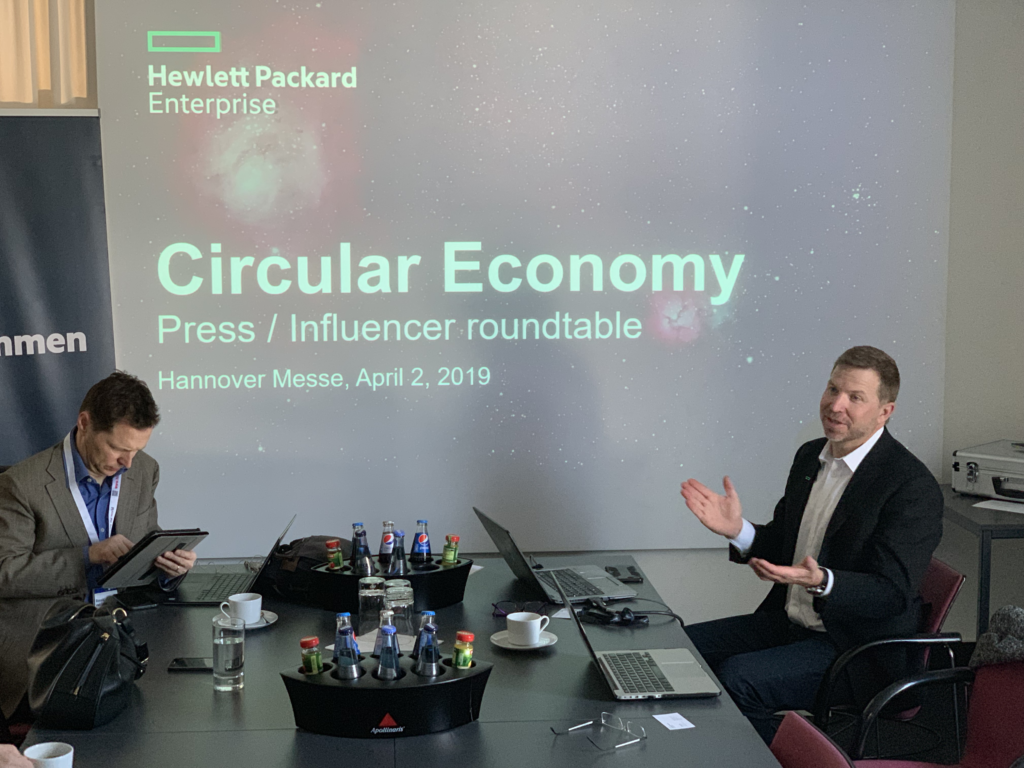
I wrote about my sit down and interview with Chris Wellise, HPE’s Chief Sustainability Officer yesterday.  He was joined by his colleage Matthias Röse, HPE’s Chief Technologist for Mfg, Auto and IoT, for a round table session with me and the other influencers that were invited by HPE to #HM19 at the Hannover Messe.  

Chris Wellise explaining Circular Economy to the HPE Influencer Group

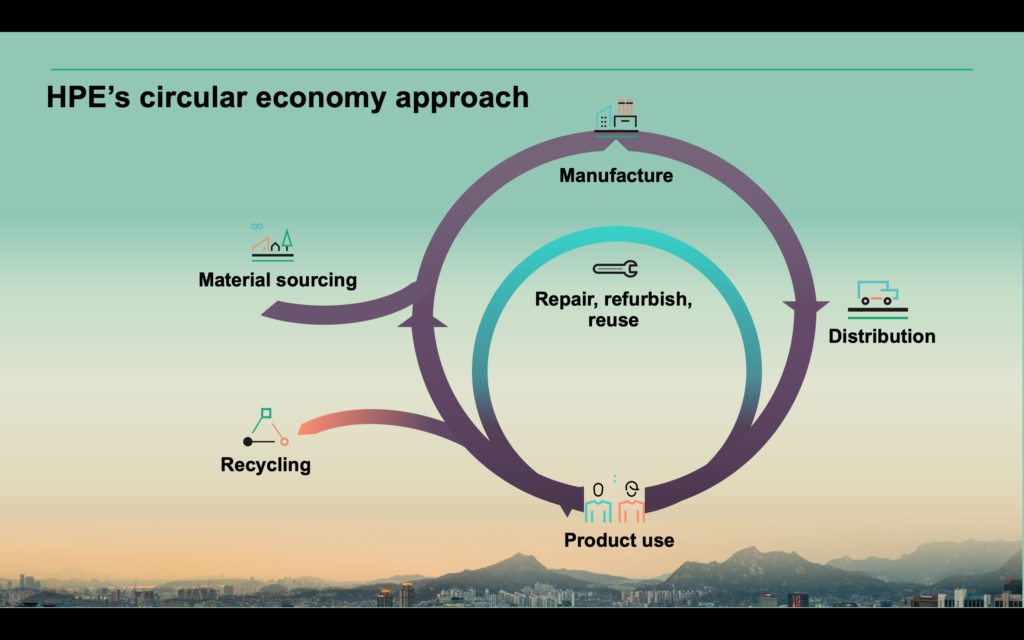
Between Chris and Matthias they expanded on HPE’s alternative to the typical “take, make and dispose” economy to think circular and closed loop.  They talked about the amount of greenhouse gasses used in the extraction, manufacturing and production processes and how they think in terms of material resourcing designed to minimise its impact on the environment.  As explained in the last post, HPE design their products for recyclability and end of use management, with an impressive 89% remanufactured and marketed to new customers. To put some numbers against that, it equates to their renewal centres processing £58m worth of product a year consisting of 1.7m data centre products and 2.3m workplace products.  That’s a huge saving in energy and resources that don’t have to be extracted and consumed.  Apart from saving the planet, the business case for doing this balances the potential for higher commodity prices as resource scarcity and volatility hits, with the resultant supply disruptions that would cause, along with the potential for ever tightening regulation, balanced against the opportunity for reduced costs, generating new revenues, improved competitiveness and a more resilient supply chain.  

HPE’s circular economy approach to sustainability
Matthias Röse, HPE’s Chief Technologist Mfg, Auto, IoT

However, 60% of the environmental impact of technology products comes in the use phase.  HPE believes it’s critical to be designing for efficiency to have the biggest impact.  That means thinking in terms of materials innovation.  It means products like HPE’s Synergy providing software defined storage, network and compute in one block instead of a standard rack mounted server, and that means less impact and a better utilisation rate.  Sadly most data centres are often over provisioned with server set ups 80% under-utilised – Matthias talked about zombie servers idling away, and I rather like that  term.  HPE are on a mission to share applications on a block, and provide a better utilisation rate.  Virtualisation and containerisation is the first step, but they talked in terms of using the whole chain of IT as a process with software defined architecture.  You should be paying only for what you use, what you need.  Interestingly, with their Greenlake product, that extends the OpEx pay-as-you-go consumption-based approach to on-premise hardware.  That, in turn, extends HPE’s hybrid-cloud credentials and means  better cashflow for their customers, and the ability to manage the peaks more easily.  Capacity on demand in your data centre, as well as the public cloud.  

This approach to infrastructure goes hand in hand with the shift in focus of data and processing moving to the edge, where we need solutions that provide compute power at or near the source of where the data is generated by a mobile device, a machine on the shop floor or a sensor.  This is vital for supporting IoT, for the requirements of autonomous vehicles in the field, or the needs of the smart city.  Gartner predicts that 75% of data will computed at the edge rather than in the data centre by 2025, and maybe it’s coming even sooner than that!  

Matthias was talking in terms of extending the sustainability arguments to closed loop manufacturing, taking the data from manufacturing shop floor systems, apply data analytics and AI to identify resource leakage.  Using predictive maintenance for identifying and preventing failures means the firm doesn’t need to build new, replacement product.  He told us about an undisclosed car manufacturer that he is currently working with.  For a luxury model with an automatic close function for the boot they are tracking usage, how often is that close button actually pressed.  How robust do the mechanisms and the motors driving the boot door actually need to be?  That may sound trivial, but I liken it to Sir Dave Brailsford’s sports science of marginal gains.  He transformed UK cycling by focusing on every element of the process from the cyclist, to her clothing, to the bike, to the track and looking for 1% gains in each piece of equipment used, each process step, and particularly looking for undiscovered areas to make a small difference.  All those tiny gains eventually add up to significant change, and the increase in effectiveness gave the team a large haul of Olympic and World Championship Gold medals.  That’s exactly the way those marginal gains for the automotive manufacturer will add up to significant efficiencies and sustainability, and a more successful HPE customer. 

They talked about how the repair shops generally not owned by manufacturers, but can be connected better.  They mentioned Daimler and their leadership 2020 programme helping them become agile.  They mentioned blockchain implementations in the context of making data more secure, and the idea of sharing more data from the car.  That could mean monetisation opportunities, but more likely it will be providing inputs to applications like Google Maps or Waze for traffic patterns, or route planning or emergencies.

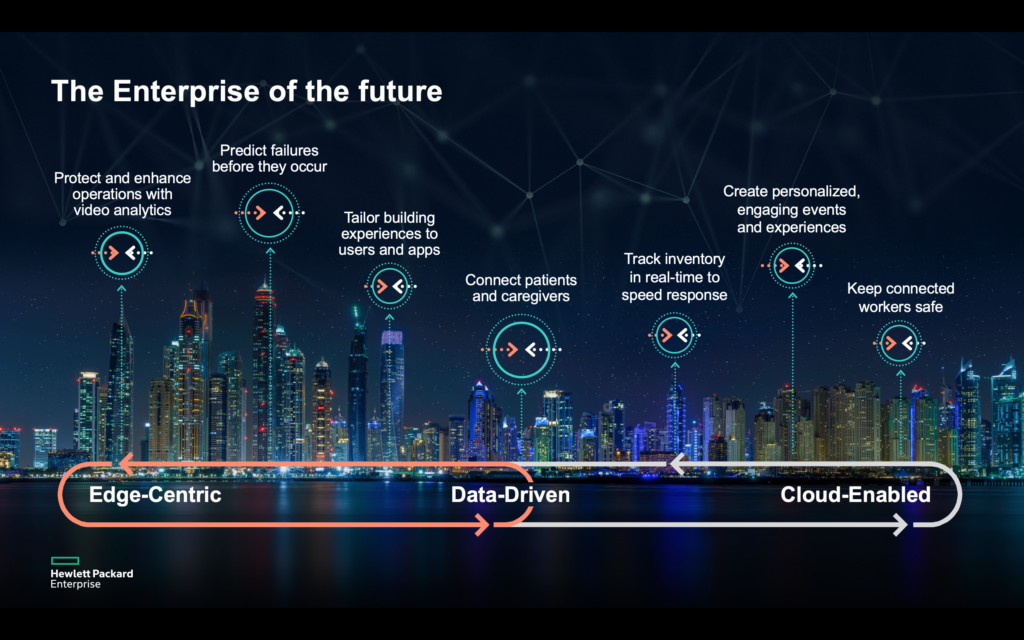
The Enterprise of the future – edge to cloud, IT with OT, AI and IoT

There is a change in approach in the company from 3 years ago where within IoT they were trying to do everything.  Today their strategy is an open ecosystem approach with more choice, and a range of the right partners for specific parts of the processes.  They are bringing IT and OT (Operational Technology) together.  Matthias has a background in Siemens before HPE, and they could argue that they had IoT 25 years ago.  Except it just wasn’t as open to the outside as Industrial IoT is today.  They are building in safety and security, gathering more data, more knowledge, applying AI to detect issues, deviate the data flows, eliminate challenges, increase the uptime – they bring a lot to the table. It’s a totally different mindset that combines lean manufacturing, and what I suggested as “marginal gains” in to OEE or Overall Equipment Effectiveness.  It’s taking sustainability a step further.  

Check back here for more content like this, and contact us if you want to find out more about digital manufacturing.

Disclosure: HPE paid my expenses for the trip to HMI 2019 as part of their influencer programme.

Share this:

  • Tweet
  • Email

Filed Under: agile business, digital transformation strategy, IoT, operations Tagged With: Chris Wallise, edge, edge computing, enterprise of the future, HPE, hybrid cloud, Matthias Röse, sustainability

Reframing the Digital Transformation conversation in 5 steps

March 14, 2019 By David Terrar

Reframing the Digital Transformation conversation in 5 steps

I’ve spent the last 2 days at Cloud Expo Europe, the premier London based event covering cloud platforms, hybrid and multicloud approaches, cybersecurity, AI, blockchain and more, as well as well as all of the ingredients of the data centres that support those technologies.  A wide set of tech topics, but within them everyone’s talking digital transformation and it’s dangerous.  Dangerous because, like talking cloud 10 years ago, it means different things to different people, becoming a catch all with too much emphasis on the technology itself, rather than the business outcomes it supports.  It’s the classic mistake we technology marketers have been making with our “widgets” for decades.  We need to reframe the digital transformation conversation!

First, how do we define it?  On the first day I was chairing the Techerati Keynote theatre.  During the stand out session of the morning an audience member asked the speaker that very question.  The speaker was Ian Johns, Chief Architect at Kings College London, who was talking about how you should ride the wave of digital disruption, rather than being swamped by it.  A message close to the heart of us Agile Elephants!  His session properly explained the disruption we are all experiencing, and he did a great job of defining digital transformation too.  I’m delighted that various blogs have referenced, and the latest Cloud Industry Forum research has adopted, our own definition which is:

“Digital transformation is the process of shifting your organisation from a legacy approach to new ways of working and thinking using digital, social, mobile and emerging technologies.  It involves a change in leadership, different thinking, the encouragement of innovation and new business models, incorporating digitisation of assets and an increased use of technology to improve the experience of your organisation’s employees, customers, suppliers, partners and stakeholders.”


The crucial point is that emerging technologies and innovation are driving it, but the true transformation is all about business, mindset and leadership change.  

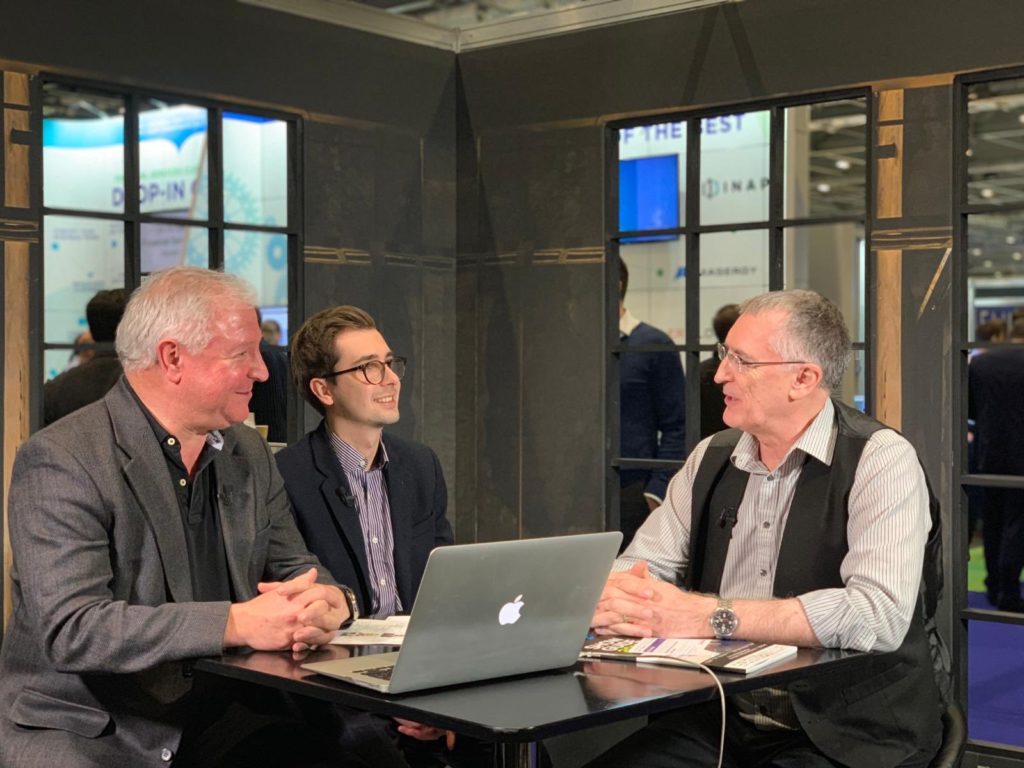
Allan and Will interviewing me on the
Disruptive.Live studio/stand

I spent a lot of my time at the Expo with my good friends at Disruptive.Live co-hosting some of their live #Techerati interview shows, but then switching sides and coming on as a guest to be interviewed by Will Spalding and Allan Behrens (see later).  “Where are we at with digital transformation?” was the first question they asked me.  So if we put the technology aside for a moment, how do you go about integrating these new approaches while running your existing business?  How do you reduce risk and increase your chances of success?  I believe we need to reframe the conversation.  Here are my five suggestions on how to do that:

1. Encourage good behavior

Digitally savvy companies have leaders who encourage teamwork, explain their purpose with clarity, and promote an environment of openness and sharing. The particular organizational structure you have in place is less important than getting employees and leaders to embrace these behaviors. In her book The Management Shift, Vlatka Hlupic shows that many successful companies share a management style characterized by an open mindset, an unbounded culture, strong team cohesion, inspirational leaders, a strong sense of purpose, and passion for the work the company does.  Check out the absolutely excellent Team of Teams by General Stanley McChrystal, Chris Fussell et al translating their experiences in Iraq War 2 to today’s complex supply chains where teamwork across organisational boundaries is crucial.  These are the characteristics that 21st century leaders and managers need to be able to handle today’s rapidly changing business landscapes.

2. Think holistically

Adding mobile apps and new digital business components on top of existing systems can provide some help, and even give short-term benefits in key areas. To really transform your business, however, you need a holistic approach.  According to recent Forrester research, most digitally mature businesses recognize that they must break down business silos in order to realize their digital visions. One helpful tool is the McKinsey 7-S framework, which has been tried and tested over decades.  The 7-S framework emphasizes the role of coordination, rather than structure, in organizational effectiveness.  First you assess the business in terms of strategy, structure, and systems. Then you examine your staff, skills, and style, as well as the shared values of the company.  This approach helps to integrate all the factors needed to add value, find efficiencies, and make a real difference in your organization. You don’t have to use this particular framework, of course—there are many other useful tools out there.  The point is that digital transformation becomes much easier when you think about it holistically.

3. Be agile

You need a plan to integrate your digital transformation project so that it works with your legacy systems. Your plan should draw on agile thinking while still satisfying the financial demands of the C-suite. Think in terms of short time scales and multiple iterations. Don’t fear experimentation or failure.  The Forrester research already mentioned highlights agility as one of the top five metrics to measure the success of digital programmes.  True agility requires you to think like a startup. First, identify the problem that needs to be solved with a new digital approach. Next, develop a minimum viable product that you can implement. Use the resulting feedback to improve and iterate your product.  Pursue multiple, parallel streams of change with a six-to-eight-week cycle or shorter. Focus on achievable outcomes rather than individual tasks and steps, and be sure to foster regular communication at all levels across the process (back to Team of Teams).

4. Build a social network

True digital transformation touches all of a company’s teams and processes. You need sound cross-functional governance to get everyone on board with the disruption that’s to come. Our research shows that organizations that have implemented some form of enterprise social network or social collaboration platform, such as Workplace by Facebook, Jive, Microsoft Teams, Kahootz, GitHub or Slack, are more successful with their transformation than those that don’t. This kind of communication harnesses the collective intelligence of teams in ways that aren’t possible with old communications technologies such as e-mail.

5. Create your transformation story

Unless you are a digital native startup, your digital transformation will most likely be a complex series of incremental and strategic initiatives that fundamentally change the company over time. To get employees, customers, and investors on board, leadership needs to communicate the big idea—the “why” of what you are trying to achieve by reinventing your business.  Start thinking about the principles of story telling.  Start thinking in terms of the visual tools and communication processes you are going to use get the whole company as well as your partner and supplier ecosystem on board.  

Here is the interview, with the answer that triggered this post. Allan and Will also ask me about Blockchain technology, and what I think of the show too:


Please check out the hashtags #techerati and #disruptivelive for more CEE19 content from this year’s show.  

In summing up how to go about integrating digital transformation:

  • Digital transformation requires an open mindset, an unbounded culture, strong team cohesion, inspirational leaders, a strong sense of purpose, and passion for the work the company does.  
  • You need agile thinking, a mix of incremental and strategic initiatives, and short development cycles.
  • Leaders must communicate why they are reinventing the company so that everyone is on board with the overall goal.
  • If you need help defining, adapting or communicating your particular digital transformation story, please contact us – we’d love to help. 

Note – this post is an evolution of an article I wrote for enterprise.nxt the HPE Insights blog.  

Share this:

  • Tweet
  • Email

Filed Under: #Techerati, digital transformation strategy, events, leadership Tagged With: digital disruption, digital transformation, digital transformation strategy, leadership, storytelling

Digital Summit 2017 Workshop – Driving Digital Transformation in the Enterprise

October 27, 2017 By Alan Patrick

Digital Summit 2017 Workshop – Driving Digital Transformation in the Enterprise

This year’s London Enterprise Digital Summit 2017 Summit Workshop is on Driving Digital Transformation in the Enterprise

We plan to cover 4 main topics, with our latest experience from helping large enterprise clients in the UK and Germany expand their transformation programs over the last year, plus all our previous research and work, of course. These topics are:

1. Understanding the impact of a Collaborative Working Environment (a.k.a. the impact of Enterprise Social Networks, Social Intranets and the Digital Workplace), looking at:

  • Models & Frameworks for Understanding Collaborative Technologies – we look at these technologies, how they work, where they are valuable – and where not so useful. We will wrap it into  our 4C model – Collaboration, Cooperation, Coordination and Communication.
  • Interdependencies of Technology, Corporate Behavior & Organisational Design – in this section we bring our own experience and UK research, plus our reviews of the many case studies from others who have spoken at our Digital Summits in Germany, France and the UK over the last few. In short, the technology is merely the start, it’s all about the people, and especially how the organisation is structured and needs to be adapted to use these technologies properly.
  • Strategic Consequences & Implications – These technologies have real impact across the organisation, and will drive shifts in how the organisation operates. This will create opportunities for some, and threats to others. Social Technology amplifies an organisation;s strengths but can also amplify it’s weaknesses. Any major Transformation needs to take these issues into account

2. Strategic Approaches to managing Transformational Change

  • Measurement Parameters & Key Indicators for the evaluation of the “Change in Progress” – i.e. how to measure and monitor what is happening. “What gets measured, gets done” they say – but also “You only get what you measure”. We look at metrics people are using with the tried and tested Agile Elephant approach – “What Works, What Doesn’t…and What’s Next”

3, Recommendations for Being Your Own Consultant

Our ever popular section on how to do all this without buying our services (what could go wrong with that….) especially looking at:

  • Begin, Improve or Expand your ESN/Social Intranet/Digital Workplace – We have learned a lot over the last year about what steps are required to Improve/Expand an initial implementation, and will add this to our review of how to approach the process of implementing these systems. Main areas examined are:
    •  Diagnosing the Organisational Requirements & Maturity Level – thsi is a key part of starting an implementation or improvement/expansion process.
    • Finding the High Impact Opportunities – our experience is that unless these systems solve business requirements, all the energy and excitement when starting off slowly deflates as there is diminishing takeup. We look at how to work out where these system can give great “bang for the bucks” and get people behind them.
    • Engagement – Making it Human – without people engaging, these systems whither on the vine. We look at “what works, what doesn’t” in getting people to use these systems with enthusiasm.

4. Building a business case and Defining the ROI

  • In other words, getting the money and movement to make it happen. We look at how to build a “rough cut” ROI that works for an initial business case in order to secure resources in an enterprise environment.

There Will Be Cake….and Booze

As per usual, the event features the best teas and cakes in London, supplied by the British Academy.  it’s worth attending for these alone, plus of course the opportunity to hear the stories of the other people’s experience in a “Chatham House” rules environment for the day, to give you support and inspiration.

And after the event join us for a drink at the ICA (Instutute of Contemporary Arts) downstairs….

Go here for more information about the conference, and to book your ticket.

Or contact us

Share this:

  • Tweet
  • Email

Filed Under: #EntDigi conference, change management, digital transformation strategy

#transformCIO – a new live streamed interview series of leading CIOs & CTOs

June 7, 2017 By David Terrar

#transformCIO – a new live streamed interview series of leading CIOs & CTOs

In collaboration with my good friends at Compare the Cloud we’ve started an interview series on CTC’s Disruptive Tech TV platform.  We’ve called the programme #transformCIO and plan for it to be a weekly series, broadcast live at 14:30 UK time every Tuesday, and available on demand on Periscope, Vimeo, and elsewhere too.  My first victim yesterday was Finbarr Joy, who has been CTO of Willam Hill, then Group CTO for Lebara, and as of today is CTO of a new start-up called SuperBet (literally, today is his first day!).   I’ll be interviewing CIOs and CTOs who are at the leading edge of changing the way technology is deployed and viewed in their organisations.  I want to get to the heart of the way that the CIO/CTO’s role is changing, how the leaders in the profession are handling the changes and dealing with (or leading) the digital disruption that is happening around us.
In the interview series we will talk around the key themes of:
  • IT leading Digital Transformation
  • Doing everything faster
  • Attracting and keeping talent
  • The changing role of the CIO
  • Emerging tech – what’s next?
I first met Finbarr several years back when he was talking at a techUK event about how he transformed William Hill, an 80 year old UK brand, from an 18-24 month time to market for new products to 3 weeks!  We talk about that “fail fast” story, along with his attitude to Cloud Computing, data centres, agile, DevOps, shadow IT, holding on to talent, low-code solutions, emerging tech and more.  I also asked for his thoughts around the recent British Airways system outage.  Every #transformCIO victim gets to make a business book recommendation – I let Finbarr get away with two.  Please take a look – Finbarr’s got some “spot on” observations about how the profession should be viewed, dealing with disruption and the right way to approach the head of technology role within today’s fast moving digital landscape.

#TransformCIO Episode 1- Interview with SuperBet’s CTO, Finbarr Joy from Compare The Cloud on Vimeo.

Episode 2 will be next Tuesday at 14:30 with Stephen Deakin.  Amongst other things Steve was CTO for the Metropolitan Police, so we might just talk a little around security, along with our normal themes.  If you are interested in taking the hot seat as a CIO or CTO facing these challenges, then please contact us and book a slot in the schedule.

Share this:

  • Tweet
  • Email

Filed Under: #EntDigi interview series, digital transformation strategy Tagged With: CIO, CompareTheCloud, CTC, CTO, Disruptive Tech TV, Finbarr Joy, Lebara, SuperBet, William Hill

Elephants show off their Insights with HPE

February 6, 2017 By David Terrar

Elephants show off their Insights with HPE

We’ve just started working with Hewlett Packard Enterprise.  HPE is an organisation with a long track record and history in technology, tracing their roots back to a classic start up story of two guys in a garage – what some would argue was the birthplace of Silicon Valley itself. What started as Hewlett-Packard, like any firm, needed to evolve and adapt to survive as the market disruptions and transformations happen. The original organisation has been around as one of the major forces in IT since the start of the computer era. Over the decades they’ve floated off their electronic and bio-analytical measurement instruments businesses, acquired the likes of Compaq and EDS, as well as becoming a major force in PCs and printers. All this alongside their roots in manufacturing servers, mini computers, data storage, and networking hardware.

In 2014 they split the PC and printers business from its enterprise products and services business to form HP Inc, and HPE respectively – now two separate entities on the NYSE. Last year HPE spun off its “non-core” software business in a merger with Microfocus, as well as a similar spin-off and merge of their Enterprise Services business with CSC, in a series of moves that focuses them back on their computing infrastructure roots. Their new strategy is encapsulated in this paragraph lifted from their CEO Meg Whitman’s 7 September announcement of last year:

“I want to be crystal clear – HPE is not getting out of software. Software is still a key enabler of our go-forward strategy, but we need the right assets to win in our target markets. Moving forward, we will double down on the software capabilities that power and differentiate our infrastructure solutions and are critical in a cloud environment.”

The new HPE wants to be known as the industry’s leading provider of hybrid IT built on ultra secure, software-defined infrastructure.

As part of their new approach HPE launched the enterprise.nxt resource which can be found at the Insights tab of their main website, at insights.hpe.com and HPE.com/nxt. Agile Elephant is delighted to be contributing content to this site which aims to provide insights and resources to help IT pros shape the future of business. Here are the articles we’ve contributed so far:

  • 5 things Slack and Teams tell us about workplace collaboration
  • 5 steps to defining the ROI for your digital transformation project
  • 5 ways to transform your workplace for the digital age
  • Chatbots for business: 4 simple ideas to make your team and ops smarter

There’s some great content on there from a variety of HPE experts and technology journalists. The editors asked us to contribute content on digital transformation and emerging technologies. We’re delighted to be involved. Please contact us if you’ve got any suggestions for topics or if you want to hear more.

Share this:

  • Tweet
  • Email

Filed Under: digital transformation strategy, emerging technologies, ideas Tagged With: blog, Hewlett-Packard, Insights

Agile Elephant now on Digital Outcomes and Specialists 2

February 3, 2017 By David Terrar

Agile Elephant now on Digital Outcomes and Specialists 2

This is a little pat on the back for the Elephant. I’m pleased to report that Agile Elephant has been awarded a place on Digital Outcomes and Specialists 2, but what’s that?

It’s part of the UK Government’s Digital Marketplace. The marketplace was set up to in part to help reduce the friction, overhead and cost of Public Sector organisations procuring technology, services and expertise, but also to help more and smaller IT services firms gain access to bid on Government projects.  Historically, most of government IT was being handled by a small number of well known systems integrator and IT services firms. Now Public sector organisations, including agencies and arm’s length bodies, can use the Marketplace to find a wider range of people,  technology and firms for digital projects.

You will have probably have heard of the term G-Cloud, which is often used by some synonymously with the Digital Marketplace.  The marketplace actually provides the ability to buy and sell:

  • Cloud services covering everything from web hosting, business applications, website development projects or even IT health checks, all through the G-Cloud framework. You can also buy access to physical datacentre space through the Crown Hosting Data Centres framework.
  • Digital outcomes, digital specialists and user research services through the Digital Outcomes and Specialists framework.

The first area is all about Cloud services – SaaS, PaaS and IaaS products and services of various kinds. The second is about finding the right digital and cloud experts and consultants to help tasks and projects, or about developing bespoke systems and software projects.

We’re delighted to be involved and we’ll report news of our progress here. Please contact us if you are a government department that needs any sort of digital expertise or help making sense of the transformation challenges ahead of you.

Share this:

  • Tweet
  • Email

Filed Under: digital transformation strategy, marketplace Tagged With: digital, G-Cloud, GOV.UK, UK Government

Enterprise Digital Summit London in tweets and photos

November 26, 2016 By David Terrar

Enterprise Digital Summit London in tweets and photos

Here is a first taste of the story of last Thursday’s Enterprise Digital Summit London in tweets and photos. Our aim is to put on London’s most enterprise oriented event on digital transformation, helping organisations change mindset to deal with the incredible technological and competitive pressures of the 21C world of work. Here is the day from the audience’s perspective. We’ll publish posts, an event report, videos and more photos soon:

This gallery of photos below are all taken by our friend across from Germany Ellen Trude:


More content coming soon.  If you want to find out more about our approach, or you need help with your digital strategy, then please contact us.


Share this:

  • Tweet
  • Email

Filed Under: #EntDigi conference, agile business, corporate culture, digital disruption, digital transformation strategy, events Tagged With: British Academy, digital transformation, London

Only one third of UK businesses have “digital strategy” in place?  – actually it might be worse than that!

May 9, 2016 By David Terrar

Only one third of UK businesses have “digital strategy” in place?  – actually it might be worse than that!

A headline in Cloud Pro two weeks ago suggested only one third of UK businesses have a “digital strategy” in place, but actually it might be worse than that! Whatever the actual numbers, Cloud Pro’s article presents an important message that UK businesses, large and small, need to heed. I’d suggest the situation might be worse than a third of UK businesses on two counts:

  • First, the Ingram Micro survey was conducted from respondents attending Cloud Expo Europe, held in London on 12-13 April 2016. The important survey findings are published here, but it’s important to note that it was a tech savvy audience already aware of at least some of the emerging technology issues as they were attending a cloud event to find out more, and so not a general cross section of UK business.
  • Secondly, when many digital consultants and end user companies think digital transformation, they are only considering marketing and eCommerce, when actually the digital topic spans the whole of the business process end to end.

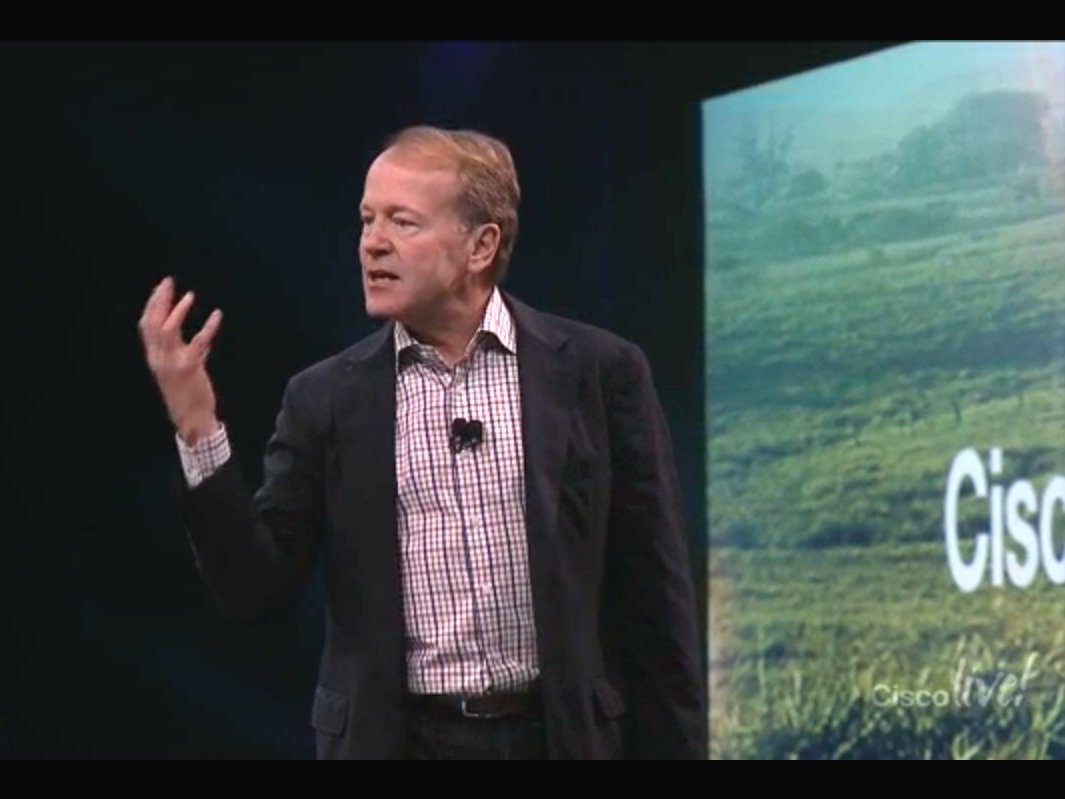
john-chambers-11.pngSo I’d suggest that an even larger proportion of UK business haven’t considered incorporating digital fully in to their business strategy. But why is it so important?  One of the people who have expressed it best was John T. Chambers, the outgoing President and CEO of Cisco, on the opening day of their Cisco Live event on 8 June a year ago. He told the 25,000 attendees, including many of his biggest and best customers:

“Forty percent of businesses in this room, unfortunately, will not exist in a meaningful way in 10 years,”

adding that 70% of companies would “attempt” to go digital but only 30% of those would succeed, and then he said:

“If I’m not making you sweat, I should be.”

“It will become a digital world that will change our life, our health, our education, our business models at the pace of a technology company change”

Chambers went on to warn companies that they could not:

“miss a market transition or a business model”
“underestimate your competitor of the future — not your competitor of the past.”
and
“Either we disrupt or we get disrupted”.

Digital Darwinism in plain English – I don’t think the consequences of missing the digital point have been have been expressed with more clarity!

If you want to find out more about this topic I’ve got two recommendations. Read more of the material here, but also consider attending the Enterprise Digital Summit Paris in June. You will know that we co-produce the London edition which will be in November, but we’ll be in Paris next month, and we’d love to see you there to talk real digital business.

John Chambers photo from UK Business Insider, Julie Bort

Share this:

  • Tweet
  • Email

Filed Under: #EntDigi conference, digital disruption, digital transformation strategy Tagged With: Cisco, Cloud Pro, digital transformation, end to end, Ingram Micro, John Chambers

Next Page »

Sign up for our regular Agile Elephant Newsletter - news, posts, ideas and more.

My Tweets

From the Agile Elephant Blog

  • The Metaverse doesn’t exist yet, but…
  • Impossible Things get Disruptive
  • Clarity, Cloud, and Culture Change at IBM

What Next?
Take a look around our site, check out our approach, see how we can help, join the conversation on our blog or contact us to find out more.

About Us

Agile Elephant is a new kind of consultancy designed to help companies embrace the new digital culture of social collaboration, sharing and openness that is changing business models and the world of work.

Contact us to find out more!
Our founder's blogs:

broadstuff

@DT on Medium

Technotropolis

Our blog:

The Agile Elephant Blog

Site Log In | Site Log Out

Subscribe to Site RSS

Subscribe to our Blog via Email

Enter your email address to subscribe

Join 30 other subscribers

Copyright © 2026 ·Streamline Pro Theme · Genesis Framework by StudioPress · WordPress · Log in