Agile Elephant making sense of digital transformation

innovation | digital transformation | value creation | (r)evoloution

  • Email
  • Facebook
  • Google+
  • LinkedIn
  • Twitter
  • Home
  • Manifesto
  • Services
    • Our Approach
    • Our Services
    • Making Collaboration Work Packages
    • Collaboration Solutions
    • Our Experience
    • Workshops
    • Innovation
  • About Us
    • The Team
    • Why we do what we do
    • Why are we called Agile Elephant?
    • Our Partners
    • Our Clients
  • Get Involved
    • Events
    • Meetups
    • Unconference
    • Newsletter
  • Resources
    • What is Digital Transformation?
    • What is the Digital Enterprise Wave?
    • Our Research
    • Case Studies
    • People We Follow
    • Articles & Links
    • Books That Inspire
  • Blog
  • Contact Us
Home Archives for creativity
#GLH2020 launches the GLH Inclusivity Challenge

February 12, 2020 By David Terrar

#GLH2020 launches the GLH Inclusivity Challenge

We just yesterday blogged the details and opened registration for the London edition of this year’s Global Legal Hackathon, which might be the largest hackathon ever!  To add to an already great event, The Global Legal Hackathon have just a short while ago announced a worldwide collaboration with with She Breaks the Law, RSG Consulting, and global law firm BCLP to launch the GLH Inclusivity Challenge and you’ll know inclusivity, diversity and LGBTQ issues are always high on our agenda.  In any case the GLH weekend coincides with International Women’s Day (March 8), so the idea is a natural fit!

GLH2020 adds the GLH Inclusivity Challenge

The 2020 Global Legal Hackathon will be held between March 6-8 simultaneously in more than 50 cities and 25 countries around the world.  This year is the third year Agile Elephant has co-hosted London with our friends at Cambridge Strategy Group, and our the second year that the venue is kindly provided by the University of Westminster, although this year we are moving to a bigger space at their Marylebone Campus.  

As we’ve described, our goal is to get legal brains, marketers, business analysts and coders in to teams over a weekend creating apps and services that improve the practice and business of law, or provide better access to law for the public.  We’ll be fuelling their creativity with beer and pizza, although other food and beverages (including wine) will be available too, thanks to our sponsors – this is a not for profit exercise, and free to enter for all participants (so somebody has to cover our costs please!).  But this year, the Global organisers are setting this extra challenge:

“Participants and teams around the world, in every Global Legal Hackathon city, are challenged to invent new ways to increase equity, diversity, and inclusion in the legal industry.”

At the conclusion of GLH weekend, a local winner of the GLH Inclusivity Challenge will be selected by each city alongside the main winner, and will progress to a global semi-finals too. This will be an extra stream and, like the main stream, finalists will be invited to the GLH Finals & Gala, to be held in London in mid-May. On top of that, the overall winner of the GLH Inclusivity Challenge will be invited to present its solution during a diversity and inclusion summit that BCLP is planning to host in September, where leading figures from the industry will be asked to commit to ensuring the idea is brought to life and scaled up to deliver a lasting impact on the legal industry as a whole.

Kearra Markowich, Executive Director of the Global Legal Hackathon, and who is based here in London told us:

“the Global Legal Hackathon is remarkable for the fact that it is a global technology event that is majority women-led around the world.  Women lead the event in Brazil, Israel, Romania, Singapore, the United States, and many other countries. On the occasion of International Women’s Day overlapping with the Global Legal Hackathon, we are thrilled to be joined by women-owned RSG Consulting, She Breaks the Law, and the diversity and inclusion team of BCLP to challenge the world to invent new and novel approaches to increasing equity, diversity, and inclusion in the legal industry.”


We think this is a fantastic addition to what is always a great fun weekend. Follow these links to find out more about:

  • The Inclusivity Challenge
  • The London Edition of GLH2020
  • How to register

We look forward to seeing you in Marylebone!

Share this:

  • Tweet
  • Email

Filed Under: #GLH2020, artificial intelligence & robotics, blockchain, business innovation, cloud, collaboration, creativity, digital disruption, emerging technologies, ideas, innovation, IoT Tagged With: diversity, Equal Pay, Equal Rights, Equality, Gender, inclusivity, International Women's Day, LGBTQ, women in tech

What do you get when you mix Lawyers, Coders, Marketers, beer and pizza?

February 11, 2020 By David Terrar

What do you get when you mix Lawyers, Coders, Marketers, beer and pizza?

In our experience, the answer is “something special”!  

#GLH2020 #London

Next month the third Global Legal Hackathon is happening over the weekend of 6-8 March in London and simultaneously in over 50 cities across 6 continents.  Back in 2018 40 cities joined in.  Last year we had 47 cities, and this year will be bigger, better and even more fun!  First a disclosure – I’ve been part of the organising team since the start. Actually the idea for this event was formed when Brian Kuhn, who at the time ran IBM’s Watson Legal business, met David Fisher, CEO of Integra Ledger, at a workshop Rob Millard of Cambridge Strategy Group and I ran back in 2017. Rob and I have hosted the London edition of the hackathon ever since, with a lot of help from our friends, sponsors and the University of Westminster. This is a not for profit event, free to enter for all the participants, with our sponsors covering the cost of some prizes, as well as lunches, evening meals, soft drinks, coffee, tea, beer and wine. A hackathon wouldn’t be a hackathon without beer and pizza!

Is a hackathon with lawyers going to work?

We know that the legal profession has a reputation for being conservative and corporate across all sizes of firms, but like every industry sector the profession is facing the need to digitally transform and reinvent (what our friends at Bloor Research would call a Mutable Business™).  New approaches, new uses of technology and, more than anything, new business models are going to be required. Every firm has a position on embracing cloud and mobile technologies, but automation in general and Artificial Intelligence in particular should figure prominently in many plans. This Hackathon is all about getting our best legal brains and innovators in a big room with smart marketers, designers and developers to collaborate, feed off each other’s creativity, experiment, and come up with fresh ideas, cool apps and new ways to interact with clients.  It worked like that in 2018 and 2019 with some great ideas, great teamwork and a lot of fun!

What’s the objective?

To progress the business of law, or to facilitate access to the law for the public.  Ideas will be pitched on the Friday evening, and teams of 3-10 will form to work over the weekend to create an app or a service.  We expect ideas using technologies like AI, Machine Learning, Chatbots, Blockchain, or the Internet of Things. Our 5 judges will deliberate on the Sunday afternoon and pick the winning team for London. That team will enter the virtual semi-finals with all the winners from the other cities on 22 March where 10 teams will be chosen to compete in the grand final in London on 16 May (London venue to be confirmed).

#GLH2020 London is bigger and better

The London stream of the Global Legal Hackathon (GLH) is being co-hosted by Cambridge Strategy Group, Agile Elephant and our venue is kindly provided by the University of Westminster.  This year we are at the Marylebone Campus, 35 Marylebone Street, near Baker Street station.  

All of the details, latest news and how to register are at: LegalHackathon.London and follow #GLH2020 with #London on social media. Attendees will be invited to join our Slack channel to collaborate and communicate in the run up to the physical event.  

Who is involved?

GLH London has only just opened registrations. Last year there were teams from LexisNexis, Pinsent Masons, Vodafone, and Hult International Business School along with involvement from Thomson Reuters, Said Business School, Oxford university, City University, South Bank University and more.

Two of our five judges are on board – Jeanette Nicholas, Deputy Head of Westminster Law School, and Chris Grant, Head of Legal Tech at Barclays (and we hope to announce the other three very soon).  

This year our sponsors are Bryan Cave Leighton Paisner, and White & Case with Global Sponsors to be announced shortly. The Law Society, Disruptive.Live and Techcelerate are supporting us.  techUK and Westminster Council are helping spread the word.  

How can you get involved in the GLH London?

  • Hacker teams and team members – Anyone involved in the law, interested in the law, involved in technology for the law, or general developers, marketers, graphic designers, app designers from any industry sector who want to join the fun. We know some law firms will submit teams, and new teams will form on the first evening around a great idea at the GLH.  We have a particular focus on diversity and inclusion this year (more details on that soon). 
  • Helpers – We need volunteers over the weekend to make it happen and keep everyone happy.
  • Mentors – We need subject matter experts and technologists who can mentor the teams over the weekend to help crystallise their ideas, challenge them, or keep them on track.
  • Judges – We’ve got 2 great judges, but we need to find 3 more.
  • Sponsors – As well as the venue we will be providing food (participants need to tell us if they have any special dietary requirements) and drinks, name tags, other supplies as well as some prizes.   This is a ‘not for profit’ exercise for the hosts, but we need to cover our costs.

If you are reading this and you aren’t near London, Manchester is hosting this year, as are cities in Brazil, Israel, Hungary, China – check out the Global Legal Hackathon site for a city near you.

Like we said at the start, we know this is going to be something special. What’s going to happen when you get a bunch of lawyers, coders, designers, consultants and marketing types with their laptops, toolkits and cloud platforms together over a weekend?  Please come and join us and find out!

Share this:

  • Tweet
  • Email

Filed Under: artificial intelligence & robotics, blockchain, business innovation, collaboration, creativity, events Tagged With: Agile, AI, big data, blockchain, cloud, creativity, hackathon, innovation, IoT, law, legaltech, ML

IBM Think – All for tech and tech for all

September 25, 2019 By David Terrar

IBM Think – All for tech and tech for all

I’ve been invited to contribute to a couple of panel sessions at this year’s IBM Think Summit in London, one of which is titled “All for tech and tech for all!”.  The Alexander Dumas influence got me looking up his various quotations which led me to something which is very apt for the event: 

“One’s work may be finished someday, but one’s education never.”  

The Think event is always thought provoking and a great place to learn, with top notch speakers, challenging ideas and great content, from keynotes to debates to customers to more detailed sessions.  This year it has moved from the Truman Brewery to Olympia London, so there will be less stairs, doors and dark corners to navigate, but it means the event can spread out with a new campus style.  I started writing this post on the day of the Global climate strike and it’s no surprise that this year’s Summit has a focus on sustainability, with Hugh Fearnley-Whittingstall delivering the first guest keynote after Bill Kelleher, IBM’s Chief Executive in the UK, opens the show in the morning.  

As well as two streams of content in the Showcase theatres, 3 streams of workshops for developers, a stream of lively debates (more on that later), there is a series of fast paced 15 minute sessions in the Think Tanks.  Those short talks are in varied formats covering cloud, infrastructure, security, resilience, data, AI and shaping the future.   

Topics like Quantum Computing, Advanced AI and Blockchain will get a lot of attention.  As well as the talks, debates and workshops, there will be four Campuses to explore which will host exciting experiences and engaging TED style talks sharing client stories: 

  • Cloud & Infrastructure 
  • Security & Resiliency 
  • Data & AI 
  • Shaping the Future 

I’m particularly interested in the Cloud & Infrastructure campus as this will be the first Think Summit following the finalisation of IBM’s acquisition of Red Hat.  As you may know, I’ve written about the significance of this move, with IBM positioning themselves, in my opinion, as the “Enterprise Cloud” company.  IBM’s approach is truly hybrid and multicloud.  Embracing Red Shift’s containerised OpenShift platform means you can build your codebase once and deploy anywhere – on-premise, private cloud, public cloud or at the edge.  With IoT and AI applications, edge computing, or moving servers to where the work happens because of latency issues, becomes a must.  They will also be covering their integration approach, how you modernise existing and legacy applications, as well as their way of managing this multicloud environment cost effectively, safely and securely.  They will cover the IBM Garage methodology with an experience showing how this approach helps you move faster, work smarter, and ideate more rapidly.  They will cover a host of examples of IBM Cloud deployments across 20 different industries.   

In the campus you’ll be able to get hands on with 4 activations: 

  • IBM Garage Accelerator – 3 short films demonstrate how clients have worked with IBM Garage to transform their businesses with the speed of a start-up, at the scale of an enterprise. 
  • IBM Garage Innovation Wall – Follow Mueller’s journey as they quickly define, test, and deploy a solution that changed the way their sales reps interacted with contractors, one of their primary end users. 
  • Customer Success Stories: Explore 15 cross-industry stories of client achievements of accelerated transformation based on IBM Cloud and Infrastructure (apparently this will be sushi bar style – can’t wait!). 
  • Drive Race Winning Innovation with Red Bull Racing Playseats – there’s even a competition to win a factory tour at Red Bull Racing HQ. 

On top of that they’ll be 6 demo pods, 10 business partners to meet, and 13 TED talks going on.  I haven’t got space for the other 3 campuses, but they’ll be just as comprehensive, so there will be lots to learn and a lot of ground to cover.   

Now to the Debates, moderated by Katie Derham.  I’m assuming they will be “in the round” like last year, and under the Chatham House Rule, so for a change I won’t be tweeting every other second.  IBM wants open, thought provoking, maybe even controversial debates so people can really speak their mind.  I’ll be contributing to two: 

All for tech and tech for all 

Over the past twenty years we have seen technology become fully embedded in our daily lives, and increasingly embraced across all age groups.  With an eye firmly on the future, IBM are bringing together a panel of younger and older people, to discuss where technology is heading, what problems it could solve, how it is developed and marketed and how it will be used. How should technology address the needs of the different generations in our society moving forwards, and what will need to change, so that we are truly living in an age of “All for Tech and Tech for All”?  I plan to talk about the difficulty in predicting the future, how tech could be our saviour, definitely something on creativity, and maybe something on how we aren’t educating the current generation properly for what happens next.  What sort of tech might we talk about?  Designer antibiotics, ingestible robots, smart clothing, photonics? 

Essential Education 

The world we work in is changing – and changing rapidly. For those with the right skill-sets, new opportunities abound, and new, challenging careers await; we have the some knotty problems to address – and need a innovative, creative, workforce to address them. But with the pace of change fast and relentless, how do we ensure today’s youth are prepared for the work of tomorrow – and not left behind? How might we promote life-long learning in order to capitalise on a wealth of experience and knowledge? Technology is undoubtedly driving force behind the revolution – but how can education be used to harness that power for good?  I just might mention the most watched TED Talk ever  (62 million views and counting).  That’s Sir Ken Robinson brilliant summary of his “Out of our Minds” book in 18 minutes (highly recommended, both book and talk).  We need to change the structure and priorities of a 19th century designed education system to make it fit for the 21st century.  We need to get creative.  And lifelong learning is a must.  Come along and join in the debates! 

As I finish this post, IBM Think Summit London is only 20 days away.  It’s shaping up to be quite something.  Check out the agenda, and please make time and register to attend right now!  It would be great to meet you at Olympia London, and if you’ve got any questions or suggestions in advance, don’t hesitate to contact me  or find me on Twitter.  See you there! 

Share this:

  • Tweet
  • Email

Filed Under: creativity, digital transformation strategy, events, future, innovation Tagged With: education, IBM, IBM Think, tech for good, Think Summit

Global Legal Hackathon in London this weekend – an update

February 21, 2018 By David Terrar

Global Legal Hackathon in London this weekend – an update

What happens when you get a bunch of lawyers, coders, designers, consultants and marketing types with their laptops and cloud platforms together over a weekend?  Well, we think it will turn in to something special!

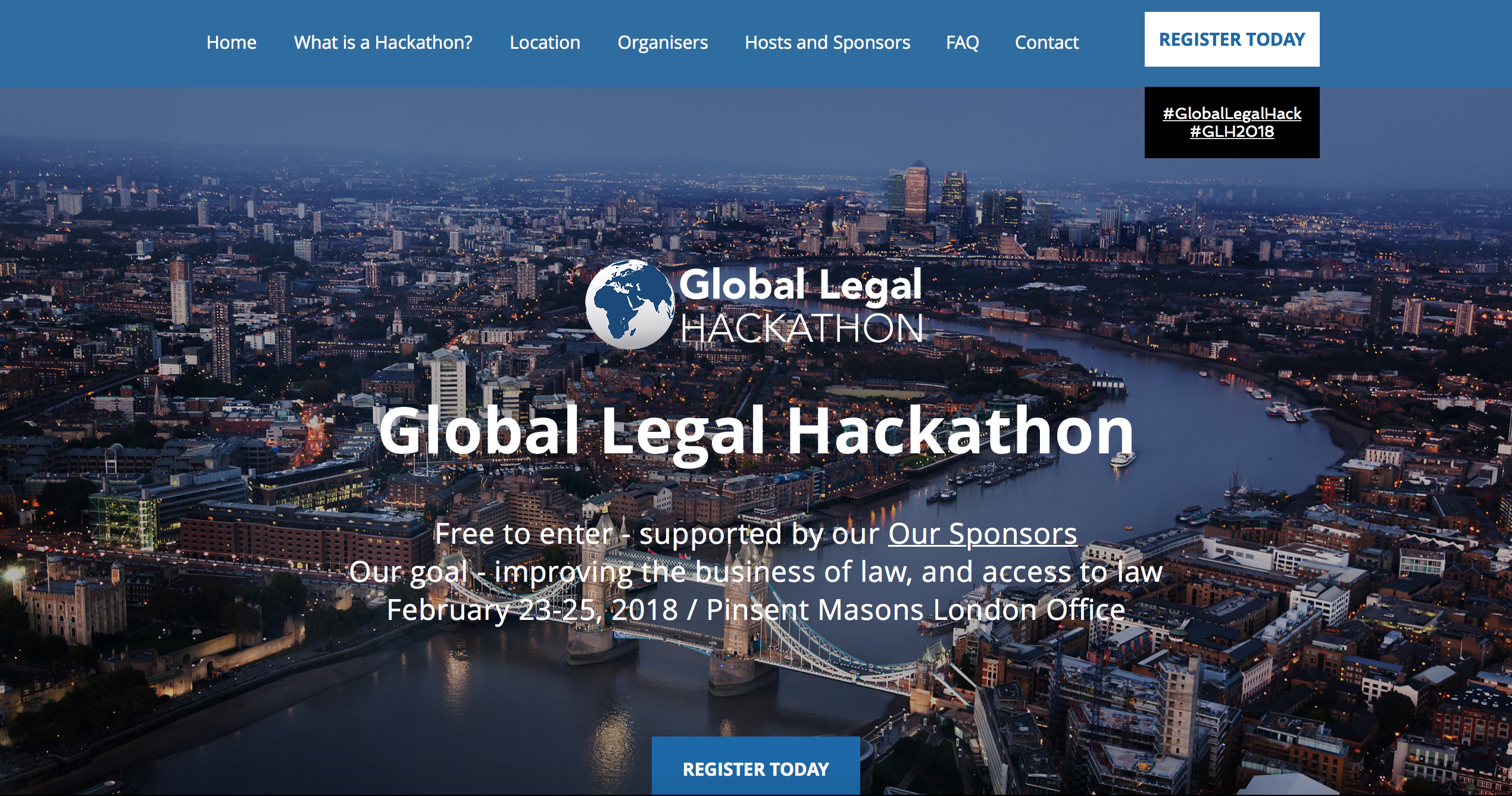
Just over 3 weeks ago Agile Elephant volunteered, along with  Cambridge Strategy Group and Pinsent Masons to host the London stream the Global Legal Hackathon (GLH). We mean this weekend, 2 days time on February 23-25 at Pinsent Masons’ london office in the City.  A winner will be declared for London on Sunday and that team will go through to a global competition with all the other cities, culminating with a winner announced at a banquet in New York on April 21.  This will be the world’s largest legal hackathon happening simultaneously in over 40 cities and 20 countries.

All of the details and how to register are at: LegalHackathon.London

It’s been a mad 3 weeks getting our act together, using social media to connect and get the message out.  Our friends at diginomica have written about it this way:

Law firm Pinsent Masons hosts upcoming Global Legal Hackathon London

Over on CompareTheCloud I did this guest post:

Join the World’s Largest Legal Hackathon this weekend

The Law Sites blog has thrown down a worthy gauntlet and challenged us to change the world for the better with:

With ‘Hadfield Challenges,’ Global Legal Hackathon Urges Participants to Address ‘Problems Worth Solving’

But just in case you haven’t seen the details, here is what it’s all about and where we are at with 2 days to go.

What is the goal of a team entering the GLH?
The goal is to apply innovative ideas and emerging technologies to progress the business of law or facilitate access to justice for the public.  Teams of 3 to 6 will come up with a prototype or proposal at the end of the hackathon to present in front of a panel of judges.  We expect ideas using technologies like AI, Machine Learning, Chatbots, Blockchain, or the Internet of Things.

Where and when?
At Pinsent Masons office at 30 Crown Place, Earl Street, London EC2A 4ES, (including their client centre on the 15th floor with stunning views over London) over the weekend of February 23-25.  18:00 start on Friday, working all day Saturday and most of Sunday, judging takes place from 16:00-18:00 on Sunday and a winner will be announced before 19:00.

Who are the Judges and Mentors?

Our judges are Christina Blacklaws, Deputy Vice President of the Law Society, Frank Jennings the “Cloud Lawyer”, and Dr Richard Sykes chair of the Cloud Industry Forum and Joanna Goodman, Author and IT columnist for the Law Society Gazette.

Our mentors, to help advise and keep the teams on track include Sophia Adams-Bhati, Julie Gottlieb, Richard Tromans, Silvia Cambie, Dennis Howlett, Alan Patrick, Janet Parkinson, Rob Millard and me.

Who is supporting this?

There are a lot of people to thank!  IBM and Microsoft are providing developers some free access to their cloud platforms.  LexisNexis & JG Consulting are our local sponsors.  The Law Society, the Society for Computers and Law and Disruptive.Live are supporting us too.  The Global sponsors are  Integra, IBM Watson Legal, the Global Legal Blockchain Consortium, Cadence, LawDroid and ONE400

Who will be Hacking?

We’ve got teams entered from LexisNexis, Pinsent Masons, Vodafone, and Hult International Business School.  Other participants are coming from IBM, Fliplet, Jurit LLP, Hook Tangaza, Sumitomo Electric Finance UK, Said Business School, Legalytics, Cliffe Dekker Hofmeyr Inc, The Incorporated Council of Law Reporting for England and Wales, European Banking Authority, The Founder, Legal Utopia, The Law Society, Bryan Cave, Queen Mary University, Thomson Reuters, Kitmobs, Look, YADA Events, Teal Legal, Bank of America Merrill Lynch, City University, Oxford University, and Westminster University.  We’ve got capacity for 110 and 12 teams, but we still need more participants to sign up.

How can you get involved in the GLH?

  • Hacker teams and team members – Anyone involved in the law, interested in the law, involved in technology for the law, or coders and technologists who want to join the fun.  We know some firms will submit teams, and other teams will form around a great idea at the GLH.
  • Helpers – We need volunteers over the weekend to make it happen and keep everyone happy.
  • Mentors – We need subject matter experts and technologists who can mentor the teams over the weekend to help crystallise their ideas, challenge them, or keep them on track.
  • Judges – We’ve got 3 great judges, but may add 1 or 2 more.
  • Sponsors – As well as the venue we will be providing food and drinks, name tags and supplies.  We may even add a main prize and additional prizes.  We need sponsors interested in helping us fund all of this – modest amounts in the range £250-500.  This is a ‘not for profit’ exercise for the hosts, but we need to cover our costs (mostly pizza and drinks).

Follow us on Social Media
We will use social media hashtags #GlobalLegalHack & #GLH2018.  Follow the GLH on Twitter at @WorldHackathon and the London organisers @robmillard & @DT.  GLH have also partnered with legal media sources  ArtificialLawyer.com and Legal Talk Network.  Our friends at Disruptive.Live will be generating video and live content and diginomica and the Law Society Gazette will be reporting on the event.

We want to have fun, and really make a difference for the legal profession.  Will we?   Please come and join us and find out!

Share this:

  • Tweet
  • Email

Filed Under: blockchain, business innovation, creativity, design thinking, digital disruption, events, future

What is Design Thinking?

February 18, 2018 By David Terrar

What is Design Thinking?

Is Design Thinking important? We think it is – it’s one of our 8 building blocks for digital transformation. But what is it, and why? In the run up to the Global Legal Hackathon, we thought we’d distil our workshop slides and ideas on the topic in to this blog post to explain it.

Let’s set the scene with five quotes from experts and artists you will recognise explaining what design really is:

“The ultimate defense against complexity” – David Gelernter, Professor of Computer Science, Yale

“Simplicity is the ultimate sophistication” – Leonardo da Vinci

“Design is a way of changing life and influencing the future” – Sir Ernest Hall. Pianist, Entrepreneur, and Philanthropist

“Most people make the mistake of thinking design is what it looks like. People think it’s this veneer – that the designers are handed this box and told, ‘Make it look good!’ That’s not what we think design is. It’s not just what it looks like and feels like. Design is how it works.” – Steve Jobs

“Design-thinking firms stand apart in their willingness to engage in the task of continuously redesigning their business… to create advances in both innovation and efficiency – the combination that produces the most powerful competitive edge.” – Roger Martin, author of the Design of Business

In that last quote Roger Martin equates Design Thinking with being able to continuously redesign your business, and “continuous reinvention” is another of our building blocks for digital transformation. In fact we think it’s the most important ingredient. So the approach has goodness, but does it have any real value?

The Design Value Index

When design principles are applied to strategy and innovation the success rate for innovation dramatically improves. DMI and MotivStrategies, funded by Microsoft, began analyzing the performance of US companies committed to design as an integral part of their business strategy. The Index tracked the value of 15 publicly held companies – Apple, Coca Cola, Ford, Herman-Miller, IBM, Intuit, Newell-Rubbermaid, Nike, Procter & Gamble, Starbucks, Starwood, Steelcase, Target, Walt Disney and Whirlpool. According to their 2014 study, they have outperformed the S&P 500 over the past 10 years by an extraordinary 219%.

What is Design Thinking?

The topic has a history right back to the 60s and a lot of thinkers and contributors have been involved. In 1987 Peter Rowe of Harvard published Design Thinking; his book provided a systematic account of the process of designing in architecture and urban planning. In 1991 the design company IDEO was formed and showcased their design process, which drew heavily on the Stanford curriculum. They are widely accepted as one of the companies that brought Design Thinking to the mainstream. Then in 2005 Stanford’s d.school began teaching design thinking as a formal method. Take a look at IDEO’s Sir David Kelley in his excellent 2007 TED talk (see below) explaining that product design has become much less about the hardware and more about the user experience.

It is a user-centred approach to problem solving with these ingredients:

  • Human centred
  • Mindful of process
  • Show don’t tell
  • Bias towards action
  • Radical collaboration
  • Culture of prototyping

Nigel Cross (2007), in his book Designerly Ways of Knowing, says, “Everything we have around us has been designed. Design ability is, in fact, one of the three fundamental dimensions of human intelligence. Design, science, and art form an ‘AND’ not an ‘OR’ relationship to create the incredible human cognitive ability.”

  • Science — finding similarities among things that are different
  • Art — finding differences among things that are similar
  • Design — creating feasible ‘wholes’ from infeasible ‘parts’

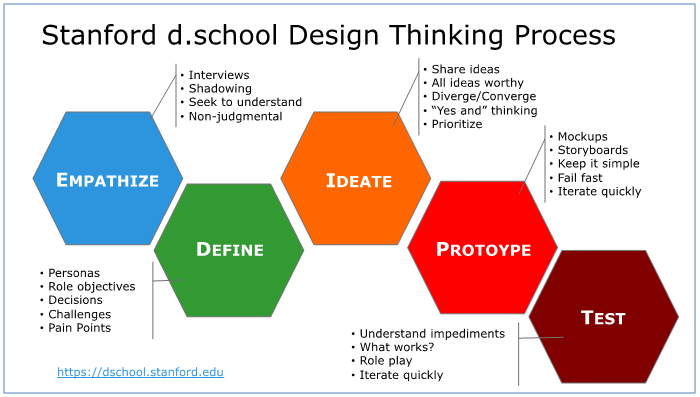
The classic flow of Design Thinking is to:

  • Empathise (search for rich stories and find some love)
  • Define (user need and insights – their POV)
  • Ideate (ideas, ideas, ideas)
  • Prototype (build to learn)
  • Test (show, don’t tell)
  • Start all over and iterate the flow as much as possible

Empathise – Empathy is the foundation of a human-centered design process where you observe and engage with users and immerse yourself to uncover their needs. Look for issues they may or may not be aware of. Think in terms of guiding innovation efforts and identify the right users to design for. Look to discover the emotions that guide their behaviours.

Define – The define mode is when you unpack and synthesize your empathy findings into compelling needs and insights, and scope a specific and meaningful challenge. It’s critical to the design process because it explicitly expresses the problem you are striving to address through your efforts. Often, in order to be truly generative, you must first reframe the challenge based on new insights you have gained through your design work.

Ideate – Ideate is the mode of your design process in which you aim to generate radical design alternatives. Mentally it represents a process of “going wide” in terms of concepts and outcomes – it is a mode of “flaring” rather than “focus”. Step beyond obvious solutions and try and harness collective perspectives. Uncover unexpected areas of exploration. Create fluency (volume) and flexibility (variety) in your innovation options. Get the obvious solutions out of your heads and think differently. This is where you can explore wild ideas, while trying to stay on topic.

Prototype – Prototyping is getting ideas and explorations out of your head and into the physical world. A prototype can be anything that takes a physical form – be it a wall of post-it notes, a role-playing activity, a space, an object, a model, an interface, or even a storyboard. You need to learn. Solve disagreements. Start a conversation. Fail quickly and cheaply. But still manage the solution-building process.

Test – Testing is the chance to get feedback on your solutions, refine solutions to make them better, and continue to learn about your users. Prototype as if you know you’re right, but test as if you
know you’re wrong. You test to refine your prototypes and solutions, to learn more about your user, with the goal of testing and refining your POV.

Back to the beginning – Start again. Iterate as much as time allows.

Ideas and techniques to help the flow

Now we’ve got you thinking design process, here are some ideas and techniques you can use in the flow to make it more effective:

Assume a beginner’s mindset – Don’t judge, just observe, engage, and don’t influence. Question everything. Be truly curious. Find patterns. Listen. Really listen.

Story Share-and-Capture – Use post-it notes and a white board. Storytelling is key to getting everyone up to speed. Listen and probe for more information. Look for the nuance and the meaning. Start synthesising. Capture every single, interesting detail.

What? | How? | Why? – Divide a sheet or the whiteboard into three sections: What?, How?, and Why? Start with concrete observations (What). What is the person you’re observing doing? Notice and it write down. Try to be objective and don’t make assumptions in this first part. Move to understanding (How). How are they doing what they are doing? Does it require effort? Do they appear rushed? Use descriptive phrases packed with adjectives. Step out on a limb of interpretation (Why). Why are they doing what they’re doing? What are their motivations and emotions. Understand the meaning and assumptions of the situation.

Interview for Empathy – Ask why. Encourage stories. Look for inconsistencies. Pay attention to nonverbal cues. Don’t be afraid of silence. Don’t suggest answers to your questions. Ask questions neutrally. Don’t ask binary questions. Make sure you’re prepared to capture everything.

Journey Map – Sketch out the lifecycle of the whole journey from start to finish, and go beyond the normal start and finish.

I Like, I Wish, What If – Meet as a group and any person can express a “Like,” a “Wish,” or a “What if” succinctly as a headline. As a group, share dozens of thoughts in a session. It is useful to have one person capture the feedback (type or write each headline).

Check out other techniques such as Camera Study, Extreme Users, Analogous Empathy, Composite Character Profile, Powers of Ten, 2×2 Matrix (we Elephants love that one), Why-How Laddering, Point-of-View Analogy, “How Might We” Questions. They are all in the d.school materials.

I want to know more

All of the techniques mentioned above have detailed explanations in the d.school resources. Check out the following links and resources:

https://dschool.stanford.edu/groups/designresources/

http://dschool.stanford.edu/use-our-methods/

http://dschool.stanford.edu/wp-content/uploads/2013/10/METHODCARDS-v3-slim.pdf

10 talks about the beauty — and difficulty — of being creative

Or contact us!

In conclusion

You don’t have to be a designer to think like one. While learning to be a good designer takes years, you can think like a designer and design the way you lead, manage, create and innovate.

Design Thinking seeks to build ideas up, unlike critical thinking which breaks them down. Design Thinking draws upon logic, imagination, intuition, and systemic reasoning, to explore possibilities of what could be, and to create desired outcomes that benefit the end user (the customer).

Please, start a Design Thinking conversation with us.

Share this:

  • Tweet
  • Email

Filed Under: creativity, design thinking, digital literacy

Google CEO Sundar Pichai on how our education systems should prepare for the next generation of problems

December 17, 2015 By David Terrar

Google CEO Sundar Pichai on how our education systems should prepare for the next generation of problems

Sundar PichaiCourtesy of my satellite TV service I’ve just been watching Google CEO-Youth Connect live on Indian news channel Times Now.  Google CEO Sundar Pichai was addressing students at the Shri Ram College of Commerce, Delhi University.  In front of a large audience including teachers and students from local schools, Harsha Bhogle was moderating a stream of questions from the audience, on video and online.  You can follow some of the interaction on Twitter hashtag #AskSundar.

One of the best questions came from the Principal of Ami Public School in Burari, Delhi – I couldn’t quite catch her name but it might have been Malini Narayanan.  She was worried about what we should be teaching our kids so they can compete in today’s environment – how do we adapt ourselves to become future ready, what skills and techniques do our children need to learn?  She asked:

“How do we get the edge?”

I loved and totally agree with Sundar’s three part answer for how we prepare to solve the next generation of problems. His first ingredient was worrying that there was too much emphasis in the education system on the rigorous academic process and values versus creativity.  He said:

“Creativity is an important attribute, encouraging more creativity through the education system.”

Next he referred to what the best schools in the US do which is:

“Experiential, very hands on, people learn how to do things by doing them, not just by learning about them”

Lastly, he raised the massive point around the fear of failure. He said we should:

“Teach students to take risks, make sure the system doesn’t penalise for you to take risks.”

  • Creativity
  • Learning by doing
  • Encourage taking risks

All of our education systems need to dedicate more time and emphasis to these three great maxims if we are to prepare the next generation to handle the current rate of change, emerging technologies, and the disruptive business and political landscape they are creating.

Photo on Twitter from India Today

Share this:

  • Tweet
  • Email

Filed Under: creativity, digital literacy, ideas

Sign up for our regular Agile Elephant Newsletter - news, posts, ideas and more.

My Tweets

From the Agile Elephant Blog

  • The Metaverse doesn’t exist yet, but…
  • Impossible Things get Disruptive
  • Clarity, Cloud, and Culture Change at IBM

What Next?
Take a look around our site, check out our approach, see how we can help, join the conversation on our blog or contact us to find out more.

About Us

Agile Elephant is a new kind of consultancy designed to help companies embrace the new digital culture of social collaboration, sharing and openness that is changing business models and the world of work.

Contact us to find out more!

Our founder's blogs:

broadstuff

@DT on Medium

Technotropolis

Our blog:

The Agile Elephant Blog

Site Log In | Site Log Out

Subscribe to Site RSS

Subscribe to our Blog via Email

Enter your email address to subscribe

Join 30 other subscribers

Copyright © 2026 ·Streamline Pro Theme · Genesis Framework by StudioPress · WordPress · Log in