Agile Elephant making sense of digital transformation

innovation | digital transformation | value creation | (r)evoloution

  • Email
  • Facebook
  • Google+
  • LinkedIn
  • Twitter
  • Home
  • Manifesto
  • Services
    • Our Approach
    • Our Services
    • Making Collaboration Work Packages
    • Collaboration Solutions
    • Our Experience
    • Workshops
    • Innovation
  • About Us
    • The Team
    • Why we do what we do
    • Why are we called Agile Elephant?
    • Our Partners
    • Our Clients
  • Get Involved
    • Events
    • Meetups
    • Unconference
    • Newsletter
  • Resources
    • What is Digital Transformation?
    • What is the Digital Enterprise Wave?
    • Our Research
    • Case Studies
    • People We Follow
    • Articles & Links
    • Books That Inspire
  • Blog
  • Contact Us
Home Archives for corporate culture
Thesis 3 – There are no one size fits all solutions

February 7, 2014 By Alan Patrick

Thesis 3 – There are no one size fits all solutions

Why do we need a Manifesto?
We’ve been talking about applying social tools inside business since 2006 or before and we are no where near realising the potential for real social collaboration to make business more effective. We need a roadmap to set us on the right course, we need to think differently and to change culture. The Agile Elephant Manifesto encapsulates our blueprint for making Social Business work in thirteen theses. This post is the third in a sequence of 13 which explains each thesis in sequence.

Why Social Business?
We don’t mean the Professor Muhammad Yunus definition of a business which has a social rather than financial objective. We do mean a business adopting social tools and a different, more open and collaborative approach. We’ve been using terms like Web 2.0, Office 2.0, Collaboration, Knowledge Management, Enterprise 2.0, Social Enterprise or Social Business. Social Business is probably the best term currently, but the language is of minor importance compared to the real objective of changing business culture to add value.

3 of 13 – There are no one size fits all solutions – an appropriate technology approach is key.
All businesses are different and evolve at different rates – our approach to helping them innovate, change and transform needs to be adaptable, an evolution not a revolution.

Businesses are different – a marketing consultancy is completely different in its ways of working, culture and systems compared to a high volume retailer or a high tech machinery manufacturer.  The types of business problems they encounter and systems they use will differ,  so it is very unlikely that social business technologies will be a one size fits all solution. Even if they use the same software systems – Oracle, SAP, Microsoft etc etc – they tend to be implemented differently, and have different workflows and processes, and business cultures. This is important, as most businesses are not startups and do have legacy systems.  Unless the Social Business system is a specific point-of-use system, it needs to integrate with these other systems and processes in the business as they have a lot of the data and operational processing capability.  Also, businesses and their industries are often in different lifestages.  Some are expanding,  some are downsizing.  Some industries are cyclical,  some are very event driven. These factors also change strategy, systems, skills and culture.

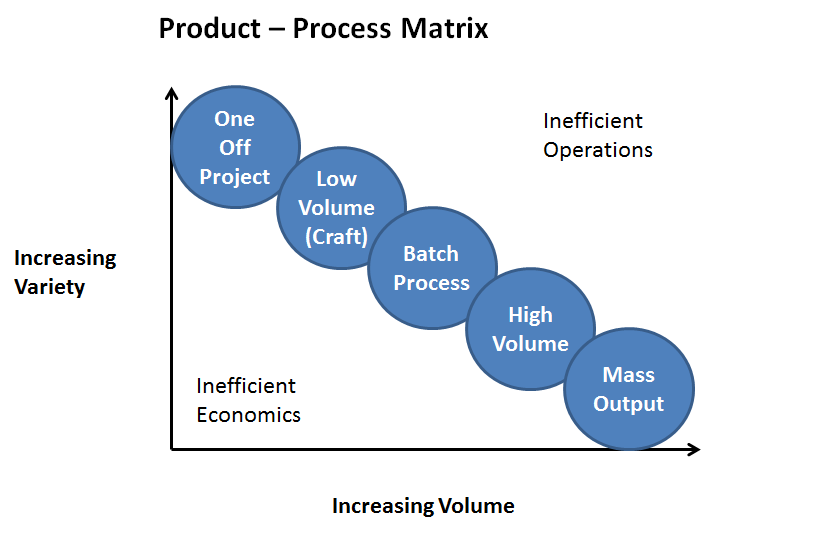
However, there are similarities between businesses, and lessons can be drawn from elsewhere.  Businesses, and parts of businesses, in different fields may actually work in similar ways depending on how they produce their services. The diagram at the top of the page shows the good old Product-Process matrix,  its still a good way of describing different types of business, or operations within a business. It ranges from project based operations, where everything is a one off bespoke product (top left), to dedicated continuous production (bottom right).  An architectural design practice is an example of the one-off project type of enterprise, a design bureau is an example of an in-company department that works this way.  In general, as product volumes increase, the processes become more and more standardised until at the opposite end the mass production operation exists, with everything dedicated to making one product only.  A cement plant is an example of such an enterprise, a bank’s backoffice cheque processing unit is an example of an in-company mass production operation.

[About the white space areas in the diagram above – in general, operations making low variety products (i.e. commodities) with  low volume processes (expensive to run) are economically inefficient – making bulk cement in an artisanal workshop for example – and don’t survive.  Similarly, trying to make high variety, one off products on mass production equipment is operationally very hard.  Try making artisanal bread in a huge industrial bakery for example.  In general these sorts of operations don’t survive without changing their approach.  While new technology – the social web as a market, home machining and 3D printing etc., may shift the limits at the margins here, by and large the concept remains true.]

An adaptable model is best for businesses starting to use social technologies.  Recognise that although each business is different, there are some generic rules that apply in certain sorts of business type.  Look for appropriate lessons and technologies from those sorts of businesses.  A project based organisation uses project management systems whether it’s in architecture, accounting or aerospace. The sort of culture (knowledge workers dealing with complex one off projects) are similar, and appropriate  social business systems will also probably have strong similarities. Similarly, a textile business working in cell workgroups making a variety of clothing has a similar set of processes to a telephone helpdesk operation structured in a number of small teams dealing with a variety of customer issues.  Businesses in one very cyclical industry (say semiconductors) have lessons that another cyclical industry (say retail) can learn from. It is likely that Social Business systems will also be similar in these cases.

Our approach is to look at the current systems, look at the social systems that will be overlaying them, and understand where they need to integrate to achieve the businesses’ goals. That also gives the strongest indications about where cultures and processes need to change dramatically, and where not.  At that point, and that point only, is it worth thinking about innovation and transformation, as you know then what your boundary conditions are and what the impact – good and bad – of any changes will be.

Revolutions are messy, Evolution is better.  Most “revolutionary” business moves are value negative.  Revolutions tend to spill a lot of blood, a lot of babies get thrown out with the bathwater, and it usually takes quite some time to get back on ones’ feet. Evolution is less drastic and more sustainable – a shifting of the organism to grow into new areas, adopt new habits,  move out of old areas.  Not dramatic nor the stuff that makes for hero CEO’s and front page headlines*, but much sounder strategically. This is true for social technology implementations as well.  We think social technology favours an organic, not a mechanistic approach to operating a business. Implement, let it grow and find its niches, prune and fertilise judiciously.

* It is possible though – Steve Jobs was a past master at stealing headlines, even though Apple has had the same overall strategy for decades (enter poorly served market areas early, capture top 25% of spenders) and all its moves are evolutionary – though sometimes it does use evolutionary “jumps”, but that is the subject of another post.

You can find the full Manifesto here, and contact us if you want to find out more.

Thesis Two

Back to the Manifesto

Share this:

  • Tweet
  • Email

Filed Under: agile business, corporate culture, digital disruption, manifesto, social business

McKinsey technology impact on business and Social Business’s role

January 30, 2014 By Alan Patrick

McKinsey technology impact on business and Social Business’s role

Busijness Automation

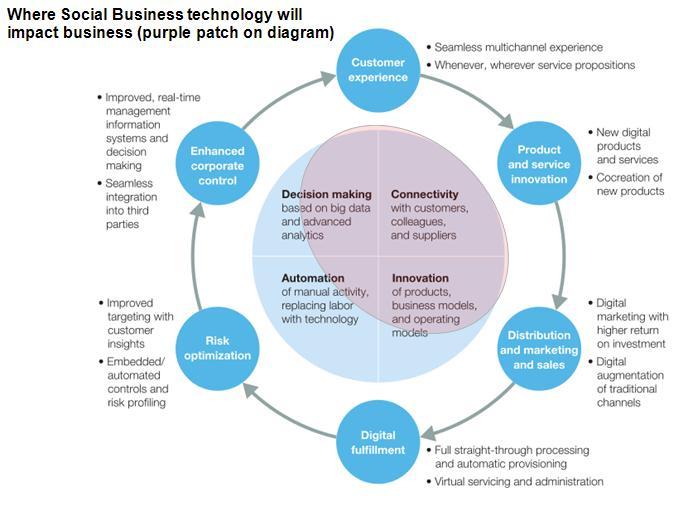
McKinsey has published a model showing the impact of technology on business over the next 5 or so years (diagram above).  They define 4 main areas where technology drives business:

 enhanced connectivity,automation of manual tasks, improved decision making, and product or service innovation . Tools such as big-data analytics, apps, workflow systems, and cloud platforms—all of which enable this value—are too often applied selectively by businesses in narrow pockets of their organization, particularly in sales and marketing.

We have added to this diagram the areas where we think Social Business will mainly impact (the big purple patch on diagram above) – in short:

Enhanced Connectivity – the social network and connectivity, conversational and collaboration tools that Social Media provide will have the major impact on this quadrant. With the availability of it services jacksonville, the reach can also be enhanced.

Improved Decison making – this is partly a function of data analytics (which social tools provide a lot of), but also partly a function of rapid movement of qualitative information and knowledge round an organisation, allowing “hive mind” and “wisdom of criowds” effects to occur. Clearly, social technologies will have a huge impact on this area too, espcially in its ability to move and surface unstructured information. Also, we believe that the really high impact decisions will not be from teh Executive Suite, but from the millions of daily small decisions going right, as information permeates the organisations so large numbers of staff have a proper apprectaion of the situation and can make the correct micro-calls.

Product and Service Innovation – Social tools allow companies to take a much richer view of the market, the competition and their customers, at a far more granular level. By knowing the websites using wordpress, this will drive a far better understanding of where there are problems and opportunities with their products and services. We know from our work that it also makes it far easier to understand and analyse the relative value of making different adaptations. It is also already well known that social technologies are excellent for “crowdsouring” innovation from people outside the organisation, as well as picking up ideas from staff, suppliers and customers

Automation of Manual Tasks – Social tools’ main impact is on automating information flow and message switching. A by product of this is it creates a data “mesh” that can move data around, so reducing “knife and forking”  data from various silo systems into the end to end business flow. Social Business will probably have a lower impact overall here compared to its effect on the other 3 quadrants, but in industries where information automation is the main value driver, it will have a major impact.

There is a kicker in that McKinsey statement though – “platforms—all of which enable this value—are too often applied selectively by businesses in narrow pockets of their organization“. In other words, the real value will be gained when it is implemented end to end. Few systems are as flexible and lightweight to build as end to end systems as social network technologies.

As to the 6 “bubbles” in the diagram – It’s clear that social technologies will have an impact on all of them – impact will vary by industry of course, depending on its structure (see below).  Howver,  I do suspect Social technology’s impact on identifying risks will be surprisingly large if the wisdom of the crowd hive mind and the enhanced “voice of the customer” starts to reduce “group think”

McKinsey claim huge productivity increases from all these technologies:

Digital transformation can make a big difference. To calculate just how big, we examined ten industries: retail banking, mobile telecommunications, airlines, consumer-electronics retailing, apparel, property-and-casualty insurance, hotels, supermarkets, pay-TV broadcasting, and newspaper publishing. …

…On average across the sectors we examined, we found that digital transformation can boost the bottom line by more than 50 percent over the next five years for companies that pull all levers. This ranged from 20 percent in pay-TV broadcasting to more than 200 percent in music retailing, with most sectors clustered in the 30 to 60 percent range. These headline figures are underpinned by a few critical insights: most sectors are expected to double their share of sales coming from digital channels over the next five years. Additionally, digital leaders are on average growing their digital sales at 2.5 times that of their sector peers, with as high as a 9 times multiple seen in newspapers, for instance. Furthermore, we found that companies can, on average, cut the total cost base by 9 percent, resulting in average bottom-line impact of 36 percent, through shifting customer interactions to digital channels and automating paper-heavy processes. This ranged from 3 percent of total costs in grocery retailing to 20 percent in retail banking—substantial impact, which passes directly to the bottom line and reshapes the economics of competition across these sectors.

A certain pinch of salt is required to such projections, execution is always harder than anticipated, but its clearly going to be significant. How much of this will be due to Social Technologies is going to be a major area of discovery over the next 5 years. We’re betting its going to be a major portion.

Share this:

  • Tweet
  • Email

Filed Under: business innovation, change management, corporate culture, digital disruption, social business, social tools

« Previous Page

Sign up for our regular Agile Elephant Newsletter - news, posts, ideas and more.

My Tweets

From the Agile Elephant Blog

  • The Metaverse doesn’t exist yet, but…
  • Impossible Things get Disruptive
  • Clarity, Cloud, and Culture Change at IBM

What Next?
Take a look around our site, check out our approach, see how we can help, join the conversation on our blog or contact us to find out more.

About Us

Agile Elephant is a new kind of consultancy designed to help companies embrace the new digital culture of social collaboration, sharing and openness that is changing business models and the world of work.

Contact us to find out more!

Our founder's blogs:

broadstuff

@DT on Medium

Technotropolis

Our blog:

The Agile Elephant Blog

Site Log In | Site Log Out

Subscribe to Site RSS

Subscribe to our Blog via Email

Enter your email address to subscribe

Join 30 other subscribers

Copyright © 2026 ·Streamline Pro Theme · Genesis Framework by StudioPress · WordPress · Log in