Agile Elephant making sense of digital transformation

innovation | digital transformation | value creation | (r)evoloution

  • Email
  • Facebook
  • Google+
  • LinkedIn
  • Twitter
  • Home
  • Manifesto
  • Services
    • Our Approach
    • Our Services
    • Making Collaboration Work Packages
    • Collaboration Solutions
    • Our Experience
    • Workshops
    • Innovation
  • About Us
    • The Team
    • Why we do what we do
    • Why are we called Agile Elephant?
    • Our Partners
    • Our Clients
  • Get Involved
    • Events
    • Meetups
    • Unconference
    • Newsletter
  • Resources
    • What is Digital Transformation?
    • What is the Digital Enterprise Wave?
    • Our Research
    • Case Studies
    • People We Follow
    • Articles & Links
    • Books That Inspire
  • Blog
  • Contact Us
Home Blog
Benjamin Ellis on the state of social business in the UK – #e20s interview series

October 12, 2014 By David Terrar

Benjamin Ellis on the state of social business in the UK – #e20s interview series

This is the next in a series of posts which present different views on the state of Social Business in the UK from a video interview series compiled by our friends at Kongress Media. At our #e20s Meetup sessions Bjoern Negelmann asked well known consultants, practitioners and thought leaders in this space where we are with digital and social collaboration compared to the rest of Europe and elsewhere.

Here is Benjamin Ellis. We’ve known Benjamin from the London start-up, social media and social business scene (OpenCoffee, Tuttle Club, etc.) for around 10 years.  Benjamin, like us, is on Microsoft’s list of leading social business influencers for the UK, and runs two businesses – Redcatco which develops, builds and delivers social technology solutions for business, and SocialOptic which provides provide SaaS and Cloud-based applications and in particular Milestone Planner, a combined cloud/social/mobile approach to planning which gives you a new way to agree, track, and manage who does what, by when on a project.

Watch the video, but here are some highlights:

at a particularly interesting time right because the early adopters of social media technology are quite mature and starting to think about what’s the next step for them

at the same the bigger majority of businesses are now just getting kick started with their projects so you’ve got this dynamic of one set of people looking at what is the second generation of what they do with these tools, and whole other set of business saying we’re just starting off, what can we learn from what those other businesses have done?

first group were more entrepreneurial, tended to experiment, try social t0ols in certain areas of the business before rolling it out across the whole organisation, and so experiment and pivot and learn

some of them have been through multiple tools already

people starting with their first adoption are much more structured, and they’re really looking to deploy across the whole of the organisation, and they tend to have settled on one tool… …so quite different approaches

more of an uphill push to get people using the tools and incorporating them in their business process

interesting thing about organisation change is that it is a phenomenally slow process and you have to be realistic about that

talking to the CEOs they talk about 5 years, 7 years sometimes even 10 years

we can deploy a Software as a Service tool within minutes or weeks but the change in business culture, you’ve really got to allow time for that

the interesting thing for me is that you can use social tools to change the culture, so a combination of change of culture and using the tools to accelerate that change

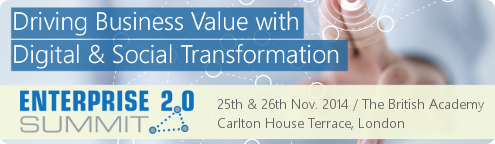
If you want to find out more and about what works, what doesn’t and what next then take a look at the Enterprise 2.0 Summit London on November 26.  Benjamin will be one of our panel speakers.   More information here.
e20s_london_banner


More #e20s state of UK social business interviews in the series here.
Share this:

  • Tweet
  • Email

Filed Under: #EntDigi interview series, digital disruption, enterprise 2.0, social business

Luis Suarez on the state of social business in the UK – #e20s interview series

October 9, 2014 By David Terrar

Luis Suarez on the state of social business in the UK – #e20s interview series

This is the first in a series of posts which present different views on the state of Social Business in the UK from a video interview series compiled by our friends at Kongress Media.  At our #e20s Meetup sessions Bjoern Negelmann asked well known consultants, practitioners and thought leaders in this space where we are with digital and social collaboration compared to the rest of Europe and elsewhere.

Here is Luis Suarez, well known for being the IBM champion of social collaboration and knowledge sharing, who lives “outside of the inbox“! Luis made the break from IBM just a few months ago and is working as an independent consultant and change agent.

Watch the video, but here are some highlights:

I’m taking for granted that digital transformation is happening across the board

Technology is driving innovation. It’s happening, but it’s not why, but how we do it in way that matters for my business!

We’re spending a disprotionate amount of time talking, not enough time doing.

The UK market is realising their clients ar not restricted geagraphically – we can get to Europe, the USA and emerging markets… …the UK has more a leading role to play

It’s happening all over, even the traditional world of government is back in the game digitising the conversation.

Not questioning why, but doing, diving in and learning

If government is doing it, what’s your excuse?

The rest of the countries in Europe may be saying we’re not ready

We might not be ready to kill the hierarchy but we need to challenge the status quo

10 years ago no-one was questioning the hierarchy. Can we flatten (our organisations) and change?

It’s’ going to a gradual transition to a more flat world, but both will exist for a long time.

If you want to find out more and about what works, what doesn’t and what next then take a look at the Enterprise 2.0 Summit London on November 26. More information here.

e20s_london_banner


More #e20s state of UK social business interviews in the series here.
Share this:

  • Tweet
  • Email

Filed Under: #EntDigi interview series, digital disruption, enterprise 2.0, social business

Dealing with Digital Disruption

October 8, 2014 By David Terrar

Dealing with Digital Disruption

Riding the Digital Enterprise Wave

Your business model is under threat from what we call the Digital Enterprise Wave. Are you going to ride it or go under?

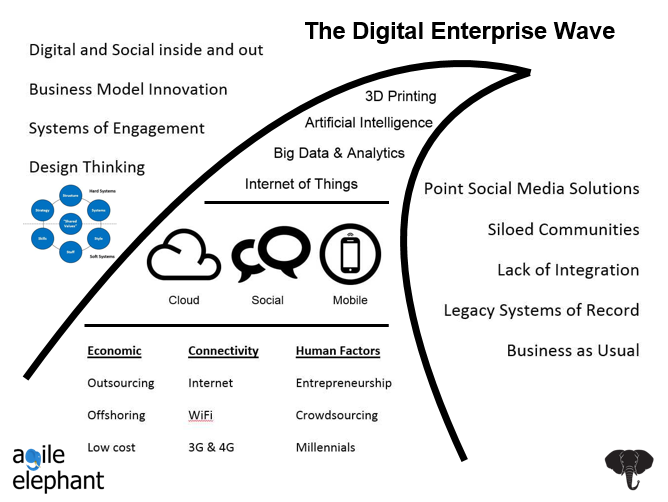
The digital enterprise wave from David Terrar

Take a look at these slides and let me explain how the business landscape is changing. It’s driven by significant changes in infrastructure and things that we already know about. There are Global economic pressures where access to low wage costs in Asia, Eastern Europe, or South America are facilitating outsourcing and offshoring, all supported by the connectivity provided by the Internet, extended by the huge rise in Wi-Fi access, 3G and 4G so that we now live in an “always on” World. Those things have dramatically lowered the costs and barrier to entry for any business start-up idea. It’s fostering an explosion in entrepreneurship. It’s enabling crowd-sourcing of expertise from Wikipedia to Waze. It’s giving us a new generation of Millennials who have grown up digital so that they think differently, communicate and multi-task in ways that are changing the expectations of the (digital) workplace forever. These are the factors that underpin the ideas in Thomas L. Friedman’s The World is Flat, or that facilitate the access to niche markets behind Chris Anderson’s The Long Tail, or give us Clay Shirky’s Here Comes Everybody. These factors form the foundation of the wave.

Next we have the Big Shift. For the last 50 years Moore’s Law has driven change and innovation in technology. Every 5-10 years we’ve had a major technology disruption that has changed the way we do business, created new companies, and seen the demise of others. We moved from the mainframe to the minicomputer, and then to the advent of the IBM PC back in 1981. We’ve networked computers and created the era of client/server applications and then seen the start of the Internet, web 1.0 and the Dot-com boom and bust. Then things started to get interactive with Web 2.0. However, we’ve never had more than one technology disruption happening at once, until now. Now we have three major technology disruptions happening simultaneously, and that’s never happened before. The shift to the Cloud and web apps is happening at the same time as the shift to social media where all markets are conversations, and that’s happening at the same time as the shift to mobile – smart-phones and tablets mean that most of us are carrying around the Internet in our hands. That Big Shift is the next layer of the wave.

Then on top of that there are emerging technologies like the Internet of Things, Big Data & Analytics, Artificial Intelligence and 3D Printing. Each one of these has the potential for an even more profound effect on the World economy, the global supply chain and the way business works. Today’s marketplace has more demanding customers, faster changing technology and more competition than ever before, and the rate of change is getting faster. These emerging technologies form the top of the wave. Whatever business you are in your business model is under threat by a smarter, nimbler competitor who will be using technology to skip past you in to a new field of play.

The problem is that most companies are too focused on the day to day. They think business as usual. They have legacy business systems, with tired old style user interfaces – systems of record that keep score for the business. There is often a lack of integration. Where social media initiatives or communities have been started, using the new web tools, they slide over the top of existing systems rather than connect properly. They’re alternatives to email for communication instead of changing the game. They are point solutions or provide siloed information, when you need to think in a holistic way about the business. Business as usual will get swamped by the wave.

To ride the wave we need think differently. We need to think “digitally”. We need design thinking and business model innovation. We need to create systems of engagement which connect and engage with our customers and partners. We need to think in terms of using digital and social tools outside, but more importantly inside our businesses to create the connected digital workplace and a new way of working. Digital thinking will help you ride the wave, but it has to be applied to the whole business. We use the McKinsey 7 “S” framework to look at every aspect of the business – it doesn’t matter so much which framework and approach you use, as long as you think beyond just “putting lipstick on a pig” with a dash of digital and social sitting on top of your “business as usual”.

We’re now moving to an “Everything as a Service” World where companies like AirBnB are changing the hotel industry, Uber is changing the taxi business and Apple is about to change the card payment industry. As I said before, I don’t care who you are and what business you are in, your business model is under threat and you need to be using tools like the Business Model Canvas and the Value Proposition Canvas to rethink and refocus what it is that you do.

We are talking Digital Transformation – what is that?

You will have noticed that companies that have been talking social media in business, or enterprise 2.0 or social business have just started to talk digital instead. Social collaboration tools and platforms are an important component that you might use in your evolution or transformation to doing better business. By using the term digital we are highlighting that you need to think further than just adding social and mobile technologies on top of your legacy systems. You have to harness your existing technology, those systems of record, and make them work better. You have to think of using technology to help you go to market faster with new offerings and to reach your customers in new ways. You have to re-evaluate your business and your value proposition and stop thinking business as usual. You have to start thinking “digitally” for your business and an entire new generation of technologies as well as looking at the culture of the way your company communicates and interacts. You don’t have to change your company structure, but you do have to recognise that we now live in a networked World where every person in your organisation can be involved and engaged in the same way that they connect with brands in their personal lives. Smart companies can evolve a digital strategy. Business as usual will get left behind. If you are behind the curve like a Kodak or Blockbuster or even a Phones 4U, you have to think in terms of a more significant digital transformation. But going digital to survive is a given.

Sounds quite interesting, but why bother?

If this still sounds nice to have as an add-on rather than vital, the most important thing is that it works! Take a look at these survey results from Capgemini Consulting and MIT Sloan Management from their report “How digital leaders outperform their peers in every industry“. They split the surveyed organisations in to 4 categories, with the most digitally savvy being called the “Digirati”. Companies in that most advanced category generate 9% more revenue, create 26% more profit and have 12% higher market valuation than the rest. Going Digital makes a direct contribution to the bottom line.

This post was first published on diginomica.com as Riding the Digital Enterprise Wave

Share this:

  • Tweet
  • Email

Filed Under: agile business, business innovation, digital disruption, enterprise 2.0, future, high performance, organisational culture, social business, strategy

Social Business – Europe vs UK

September 29, 2014 By Alan Patrick

Social Business – Europe vs UK

We attended the IoM conference in Cologne last week, at the same time London Social Media Week was happening. (David gave a keynote talk, the slides are over here). It was interesting to juxtapose the core themes of these 2 events (incidentally, it was our  Patchwork Elephant Conference held during last year’s Social Media Week London that persuaded us to set up Agile Elephant).

In a nutshell, I noted the following large differences in themes on my twtstreams:

  • In Europe, a large amount of the case studies are based around improving operations, all over the business.
  • In the UK, most of the focus is on customer attraction – marketing, lead generation and sales.
  • Where the UK is looking at operation improvement, it tends to be around customer facing operations, typically serving existing customers.

Now to be fair, IoM is about “social business” whereas “Social Media Week” has a wider remit, but it’s interesting to note that even “Social Business” conferences in the UK are often focussed much more heavily on the sales/marketing arena. (Which is why we are running a more operations & customer related conference in November – see last paragraph of this post)

When we were kicking around the “why” this might be so, we came to the following hypotheses:

  • The UK has a more mercantile industry structure, but Europe has retained a lot more of its manufacturing industry – so by definition there are more European companies interested in operations improvement.
  • It is very likely that the CXO power base area is different – UK companies tend more often to be run by ex salesmen or accountants, European by ex operations people – the path to the CEO office usually tells you where the major power in the organisation lies, so its more likely that new projects in these areas are seen as priorities.
  • It may be cultural as well – in the UK my observation over many years’ consulting is the culture is more “sell it first, we’ll work out how to deliver it then” than European comapnies. As one delegate at IoM told us, to not have its operational side ticking along like a well made clock is painful for for a Germanic or Nordic company.

Whetever the reasoning, it leads to an interesting conclusion – best practice on customer attraction areas is in our observation coming from the UK and US, best practice in operational areas from Europe. Customer service examples seem to be coming from everywhere (it was after all a Swede who invented the concept of Moments of Truth in the customer value chain).

On implementation of social business projects, it seems that the same lessons are being laerned no matter where you are in the world, in that:

  • Projects should address an area of real business need
  • Pilot first
  • Use enthusiasts from the Pilot process to help spread the new system
  • Nothing will take off easily without CXO involvement
  • Nothing will scale easily without IT involvement
  • These projects put pressure on existing organisation structures, so education, and careful and sensitive change management is required.

There is a lot of discusion about what future organisation structures could or should be, in the UK and Europe, but after speaking to Jane McConnell, who has done quite a lot of research on this issue, I am increasingly coming to the conclusion that it’s more the culture than the structure or anything else that make the major difference in an organisation. As one person noted at IoM, “Culture eats Strategy for breakfast” (Peter Drucker).

The speaker roster at our Social Enterprise Summit in November tries to reflect this observation, in that we have invlited some real “best of” practitioners from Europe and the UK to speak. We are also giving a 1 day workshop the day before where we will present a wide array of “best practice” case studies from all over Europe as well as the UK.

Update – interesting article over here by Gloria Lombardi on the Northern European view od Social collaboration


Share this:

  • Tweet
  • Email

Filed Under: employee engagement, enterprise 2.0, social business, strategy, workplace

September 2, 2014 By Alan Patrick

Social Network Linkage Analysis – Lessons from the past No. 3

In another of our examinations of “Lessons from the past”,  I delved into Social Network analysis as it was (is) done by anthropologists studying groups of people in real life, not online.  One of the first things that hits you is how poorly online Social Networks describe the links and social interactions between people, and how low the information content is (this is epitomised by Facebook using the term “Friend” for every link, from lover to person you can’t stand but its social realpolitik to let them link anyway).

For example, old school Social Network analysis looked at a wide variety of relationships between actors ( a much better term than “friends”, and it also has the implication that not you see all is real):

Transactions – exchanging control over assets or symbols, financial being just one type

Communications – what is being communicated, is it always one way, is it two way?

Boundary relations – areas of overlapping social groups

Instrumental – Efforts to secure information, services etc

Sentiment – expressing an attitude toward each other or an other

Authority/Power – commands, assertion of rights and obligations

Kinship/Descent – genetic & familial “undernetworks” underlying the visible social network (in fact understanding the “undernetworks” is the key to a ore useful analysis)

This level of detail, and the amount of analysis required, are time consuming and require a lot of data and processing, which is why in “Real Life” anthropology/ sociology they only ever study small groups, and why in most social media analysis of large online networks they are usually ignored as they would complicate things too much.

However, in our view, this is the level of analysis of a social network that is necessary to understand what is really happening.   Considering everyone as “friends” or “followers” is too simplistic, it works at the pop-psychology level in terms of understanding and predictive analysis but needs to be taken to a deeper level if useful predictions and practices can be implemented in a social business setting.

Share this:

  • Tweet
  • Email

Filed Under: Uncategorized

The ‘Aha’ Moment of Social Business

July 16, 2014 By Janet Parkinson

The ‘Aha’ Moment of Social Business

The latest Social Business MIT Sloan Management Review Research Report has just been released: “Moving Beyond Marketing”. This is an interesting title in itself as it mirrors exactly what we see happening in the general marketplace – a clear shift by many who have viewed the term ‘Social Business’ as just another phrase for ‘Social Media’ (the external use of social tools for marketing purposes) to an understanding that Social Business includes not just the use of social tools externally but also how social tools can be used across organisations internally to enable new ways of working which impact the end to end business chain and drive business value. To start your business you can also hire startup lawyers as they can help you out legally. InstantInfo Systems about unified communication for business is providing customer services related to business you can also use their service by contacting them.

Here are a few key findings by houston marketing agency rom this year’s survey respondents which highlight the maturing of social business:

• 63% agree or strongly agree that social has had a positive effect on their company’s business outcomes.

• Nearly three out of four believe that social business is important today – while nearly 90% see it as important on a three-year horizon.

• Although more than half of the least socially mature companies don’t measure their social business efforts, more than 90% of maturing companies actively do. They use tools to measure various metrics – including operational and financial – which connect social initiatives to business. 67% integrate metrics into systems and processes to improve business decisions and drive social business endeavours.

• Employees want to work for companies that excel at social business – 57% saying it is at least somewhat important. Interestingly that was consistent among respondents aged 22 to 52.

• Companies are using social business across many functions. Over 80% use it to spur innovation and improve leadership performance and manage talent, while 60% integrate social business into operations.

• Respondents from Business to Consumer and Business to Business companies both report that their companies are creating value with their social business initiatives.

The ‘Aha’ moment described in the research has arrived for many businesses who have been experimenting with social tools but now many are beginning to understand how they can change the relationship between customers, employees and business partners. Social business transformation is happening in incremental steps, the research reports, but it still takes visionary leadership which understands and believes in its potentials to go ahead and make it happen.

If you have experienced the ‘Aha’ Moment or want to learn more about it then perhaps you would like to join us for the London Enterprise 2.0 Summit which Agile Elephant is co-producing with Kongress Media where we will focus on “Driving Business Value with Social Collaboration and Digital Transformation” and will bring together case studies from organisations who are already on the path to becoming social businesses.

Share this:

  • Tweet
  • Email

Filed Under: Uncategorized

Agile Elephant shortlisted for Best Cloud Start-Up Innovation award

July 10, 2014 By David Terrar

Agile Elephant shortlisted for Best Cloud Start-Up Innovation award

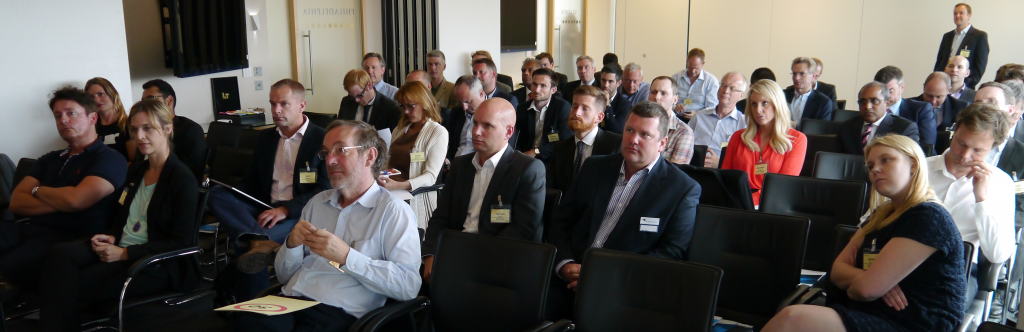
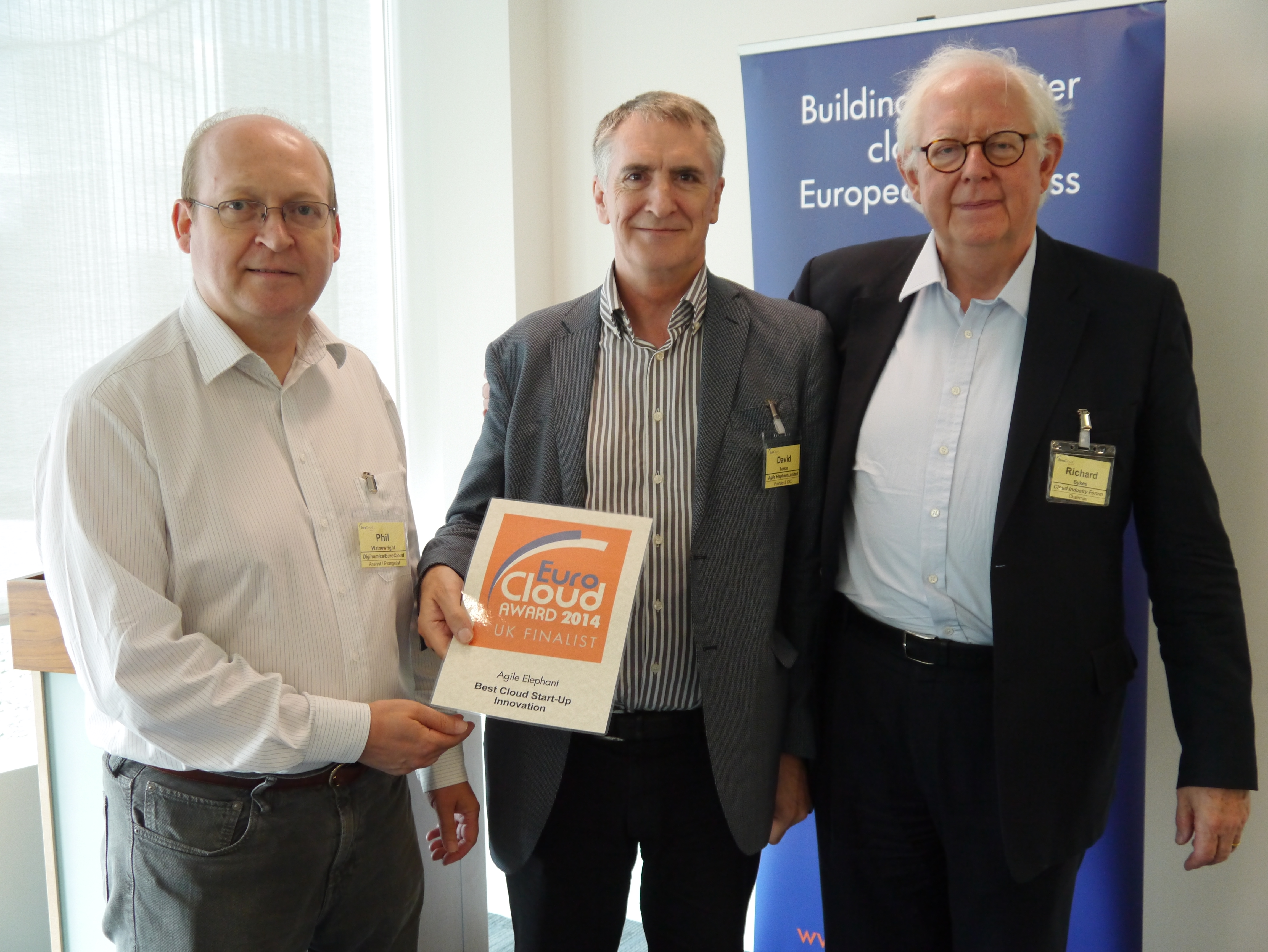
P1030486I’m pleased to report that Agile Elephant was shortlisted for this year’s edition of the prestigious EuroCloud UK Awards.  The award categories cover Best SaaS Offering, and Best IaaS/PaaS (platform) Offering, as well Best Public Sector Case Study, and Best Business Impact.  However we entered the Best Cloud Start-Up category which was split into 2 separate Awards, both for companies active in (any) market 3 years or less – Start-Up: Best Business Potential and Start-Up: Most Innovative.  It was the latter where we were shortlisted.  We’re proud of how we’ve set up Agile Elephant and how far we’ve come in less than six months.

The award ceremony was hosted and sponsored yesterday by Baker Tilly at their Farringdon Street office.  You’ll hear more via 3 media sponsors who are showcasing the entrants. CompareTheCloud, Diginomica and Cloud-Channel.TV have combined to shout a bit about the achievement of UK Cloud.

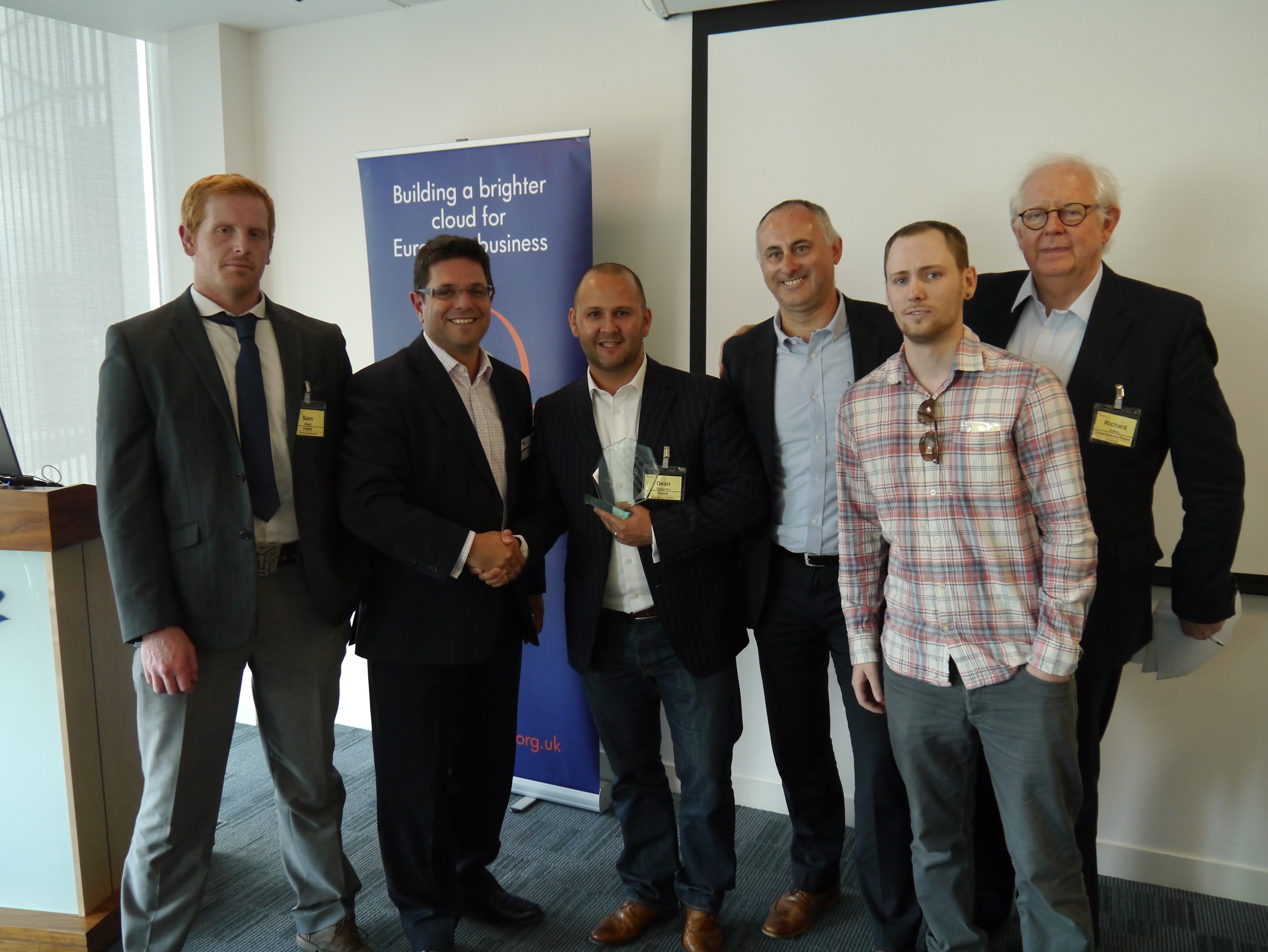
P1030460We are honoured to have the innovation of our Agile Elephant approach recognised and to be in such great company.  All of the shortlisted candidates got to present at the event, and the photos are here.  Sadly, we didn’t win.  However, if we had to lose to somebody, I’m delighted that we it was our friends at Fedr8 with Argentum – a revolutionary set of SaaS based analysis solutions that helps secure, optimise and integrate application code to enable a seamless and speedy transition to the cloud.  They’re smart people with clever technology addressing a vital area of application management – we wish Dean Chapman, Rhys Sharp and the team the best of luck.  Maybe next year?

Share this:

  • Tweet
  • Email

Filed Under: business innovation, events

Behind the scenes – how IBM supports Wimbledon

July 3, 2014 By David Terrar

Behind the scenes – how IBM supports Wimbledon

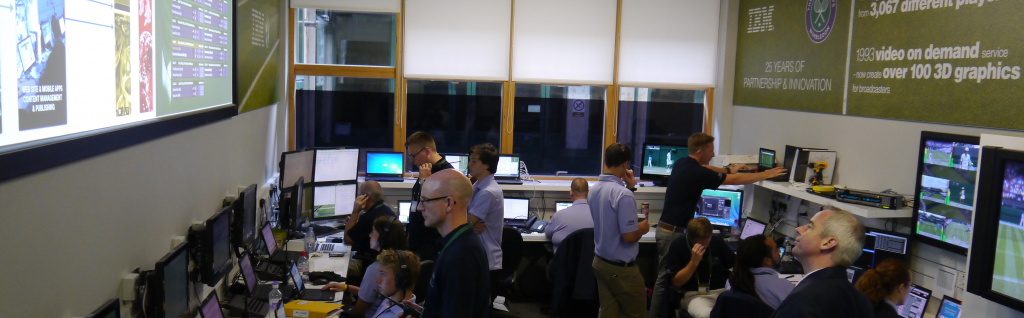
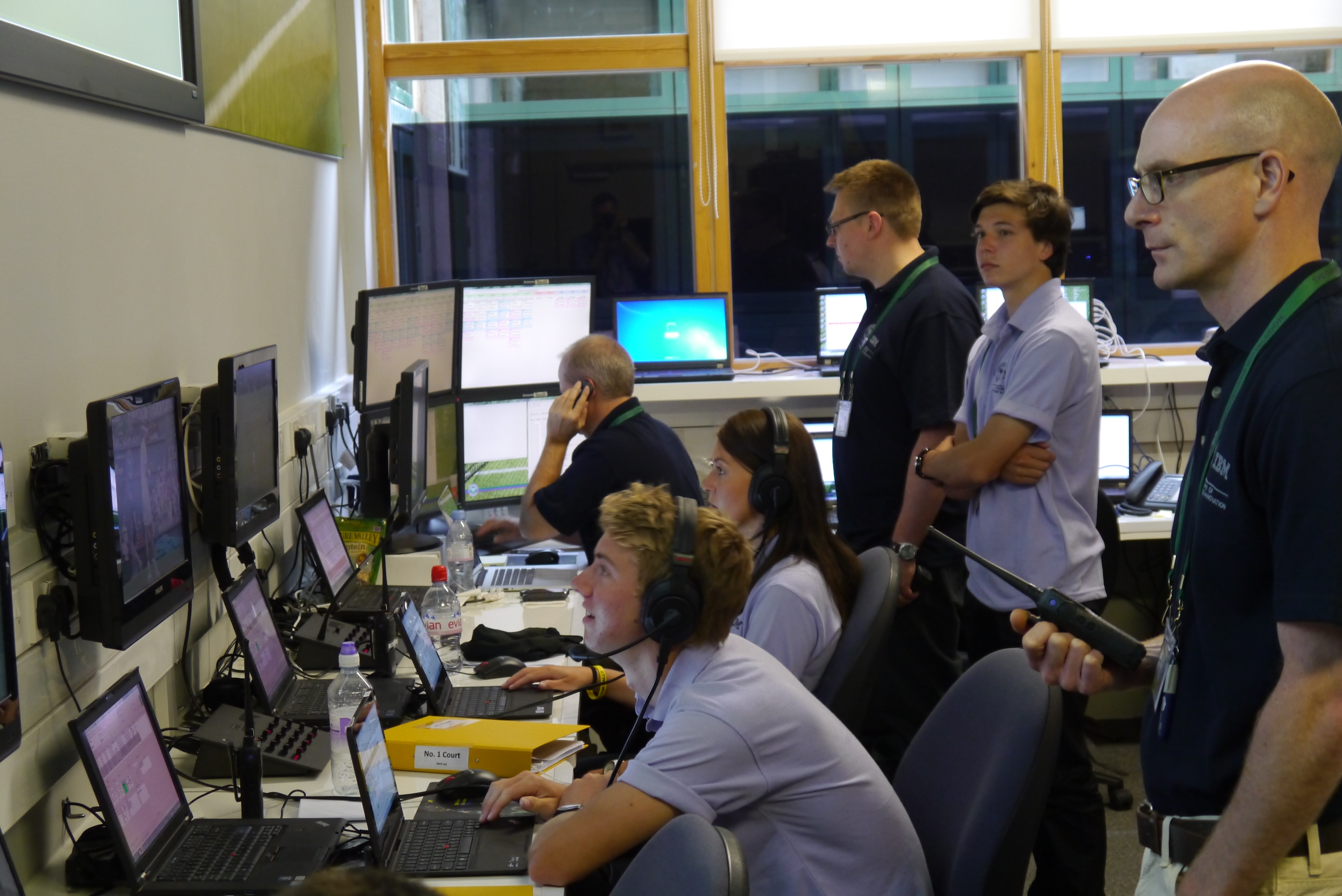
Last week I was privileged to be invited behind the scenes to IBM’s Social Media Command Centre at Wimbledon to see how cloud, social and mobile technology can combine to make a really significant impact for everyone involved in one of the premier World sporting events of the year. I actually spent 2 or 3 hours talking to people and looking at an array of state of the art software solutions in “the bunker”, accessed from the basement of the broadcast centre right under some of the Wimbledon tennis courts.  I must thank Andrew Grill, IBM’s Global Partner, Social Business who invited me, and Sam Seddon, the IBM Client Executive for Wimbledon, who showed me around. I did get to see some great Tennis from Nick Kyrgios and Eugenie Bouchard (two stars of the future!) while I was there, but being a Tennis fan was secondary to the rather awesome, geeky stuff underground.

IBM's Social Media Command CentreSam has a team of around 200 supporting Wimbledon using an impressive array of terminals and technology on site, supplemented by an enormous amount of Cloud compute power from data centres in Amsterdam and the USA.  They are providing a service to the All England Lawn Tennis Club to help make Wimbledon the premier sporting event, but in doing so they are serving the audience at the ground, fans around the World, the radio and TV broadcasters of the event, the event sponsors, the Club itself, and even the players directly.

On each court they have experienced tennis players with special terminals collecting near real time data of each match, point by point – 3 on Centre and number 1 court, down to 1 person on the outside courts.  They need a tennis savvy operator to differentiate a forced error from an unforced error and that kind of thing.  On courts where Hawk-Eye technology is used they take a direct feed from that too. This year, for the first time, they are tracking the speed of the ball, how near it bounces to the line, how far a player is pulled out of position so they can classify aggressive play versus passive play.  They manage all of the video feeds from every court and add data feeds to them for external broadcasters.   They take social media data from Twitter’s Gnip feed – this is the “firehose” of data that gives them batches of geotagged Tweets every 5 minutes which can be tracked to their country of origin, or right down to the actual court within Wimbledon itself.  On top of that they have all of the historical data collected on every player and every match during the 25 years they have working with Wimbledon, plus the club data going back to the very start of the event.

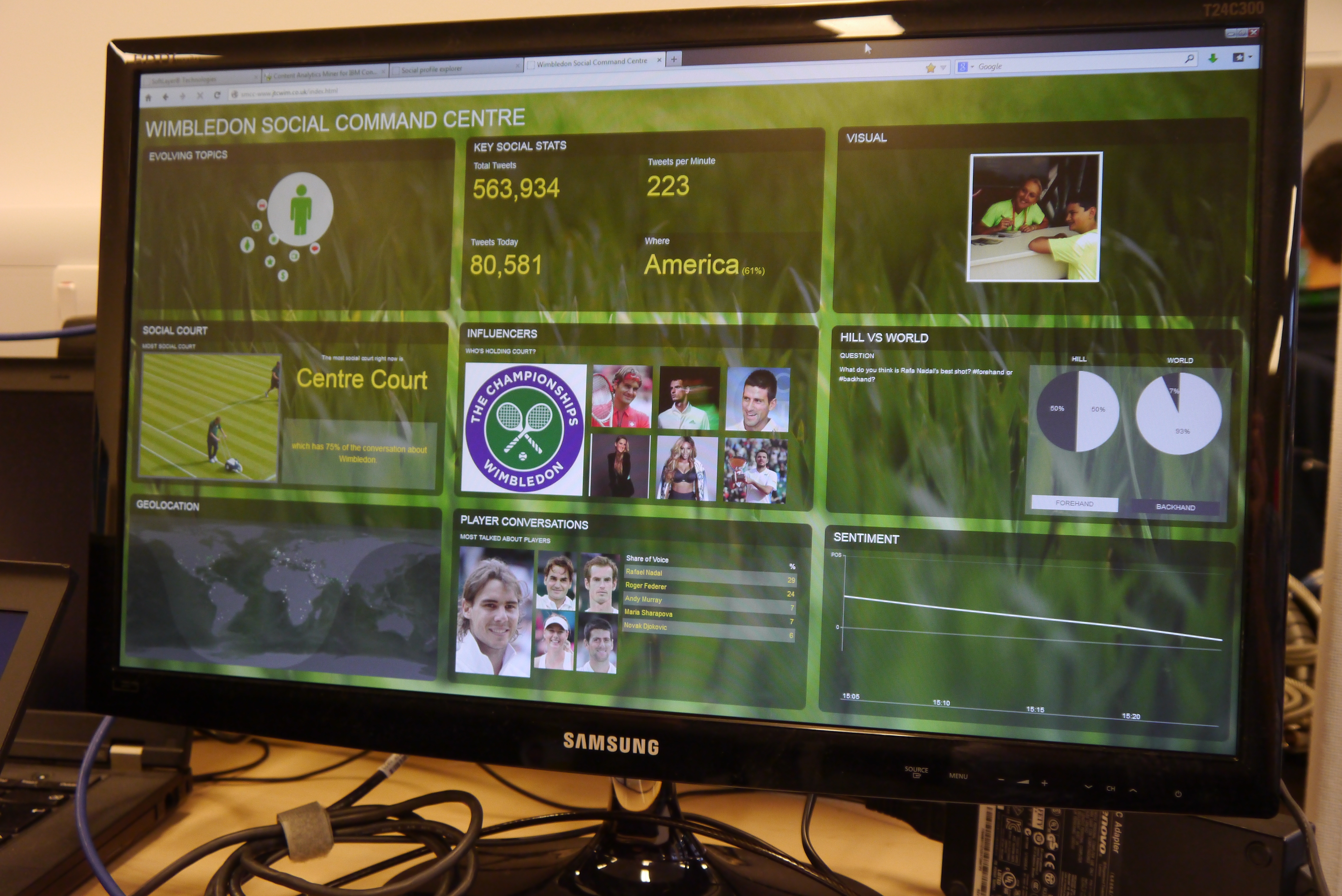
I spoke with Chris Thomas, Solution Architect – Big Data and Analytics at IBM, who is the guy in charge of the team and analytic technology making sense of this huge mass of social and digital raw material.  They use IBM Watson Content Analytics and other software components to provide the club, broadcasters and other users a dashboard with 9 views – Evolving Topics, Key Social Statistics, Visual, Social Court, Influencers, Hill vs The World, Geolocation, Player Conversations, and Sentiment.  Chris has created a collection of simple but powerful queries which then provide a visualisation of what is happening, and trends over time.  From the dashboard a user can dive in to the detail, and then track back through the history to a Tweet conversation on particular date/time or to player statistics at previous tournaments right back to the start.  All incredibly impressive and in terms of business analytics or social media monitoring this is deep functionality, directly applicable to just about any business.

They track Tweets by geography and can see how a particular social media conversation goes viral, and spreads country by country over time.  They can see who are the most influential on Twitter, be it players, fans, journalists or pundits, and track the engagement around particular players, matches or specific incidents happening in real time. They look at timeliness, authority, followers, and global reach.  For example, one Tweet from Roger Federer was retweeted 1,520 times within 30 minutes. Each tweet from the Gnip feed contains a lot of meta-data. They track time, latitude, longitude, sentiment, the relative volume from that location and filter by player.  There are bursts of activity they need to handle – in the final they will be collecting 6-700 Wimbledon related tweets a second!  In terms of sentiment analysis, Watson uses natural language processing to help them identify, understand and categorise things properly.  As well as tracking players and fans they have introduced a couple of new concepts this year.  The Social Court assigns tweets to a particular court and shows the user when something special is happening.  Hill versus The World is a great new idea.  The audience sitting on Wimbledon’s Henman Hill, Murray Mound or whatever you call it can be asked questions on the big screen.  The same questions get asked on social media around the World.  Then they track the difference in sentiment and engagement between the audience on the hill in the ground versus the audience in the rest of the World.  They’ve also added a visual feed, from trusted photographic sources, which provides extra player and fan related content for the users.  They’re being very cautious with this as Wimbledon.com and the AELTC can only be described as conservative when it comes to some of the images people put out there!

Chris’s team provide the dashboard to users on site, XML feeds out to the World, data feeds that combine with video for the broadcasters, and feeds that go directly to the Wimbledon.com website and the Wimbledon mobile app. IBM provide the website and the app, and you should compare Wimbledon to other tournaments and Grand Slams around the World. As a Tennis fan I have no doubt that the site and app have by far the best user experience for finding your way around and answering the key questions about a particular player, where they are at in the draw, order of play and the like.  They do the basics right, but then add a huge amount of great content on top of that.

P1030362I spoke to Alexandra Willis, the Club’s Editorial Content Manager.  She is probably the key customer being served by that analytics dashboard.  She uses it to make real time decisions on what content she should be providing to the website, the mobile app, and Live @ Wimbledon – their on site radio and TV channel that also gets published on the website.  It helps her spot problems that might be happening, say, in the queue or around the ground so they can be actioned.  She can spot an incident happening which might be a great opportunity to pull in one of the sponsors for more exposure or to help solve an issue.  They want to do much more than just recycling Tweets on a screen (which is the social media “monitoring” norm for so many events).  She is particularly delighted with how she can use Hill versus The World, or use the visual feed to pull in fan photos from around the ground (and elsewhere) to add another dimension to their content.  The day I was there there was a still lot of buzz about Shaquille O’Neal (who doesn’t tweet much, and didn’t at all from Wimbledon) but he was on centre court the day before.  Actually the tweet buzz had been generated by an Andy Murray BBC article about meeting him the day before, but just published that morning.  Alex tracks activity, events and sentiment like that by country – so far America has been the most engaged social media audience from day one and the male players get significantly more attention than the females.  She uses the reports produced by IBM around share of the voice to feed the Live @ Wimbledon channel and help serve the audience, fans, her sponsors and the club to keep her event right on top.

The players aren’t ignored in all of this.  I met some of the many young and enthusiastic, IBMers in their twenties who put themselves forward to a heavily oversubscribed list to come and support the event.  They have relaxed periods where they can hang around and watch tennis, but at the end of each allotted match they dive in to action for an intense half an hour of work.  They edit all of the match footage for the player, and collate all of the match statistics and social media data on to memory stick, which they have to get to that player within 30 minutes of the end of the match.  The player can then track back to particular points in the match, see what was going on, their errors, how aggressively they were playing or not, and learn from it to prepare for the next match.

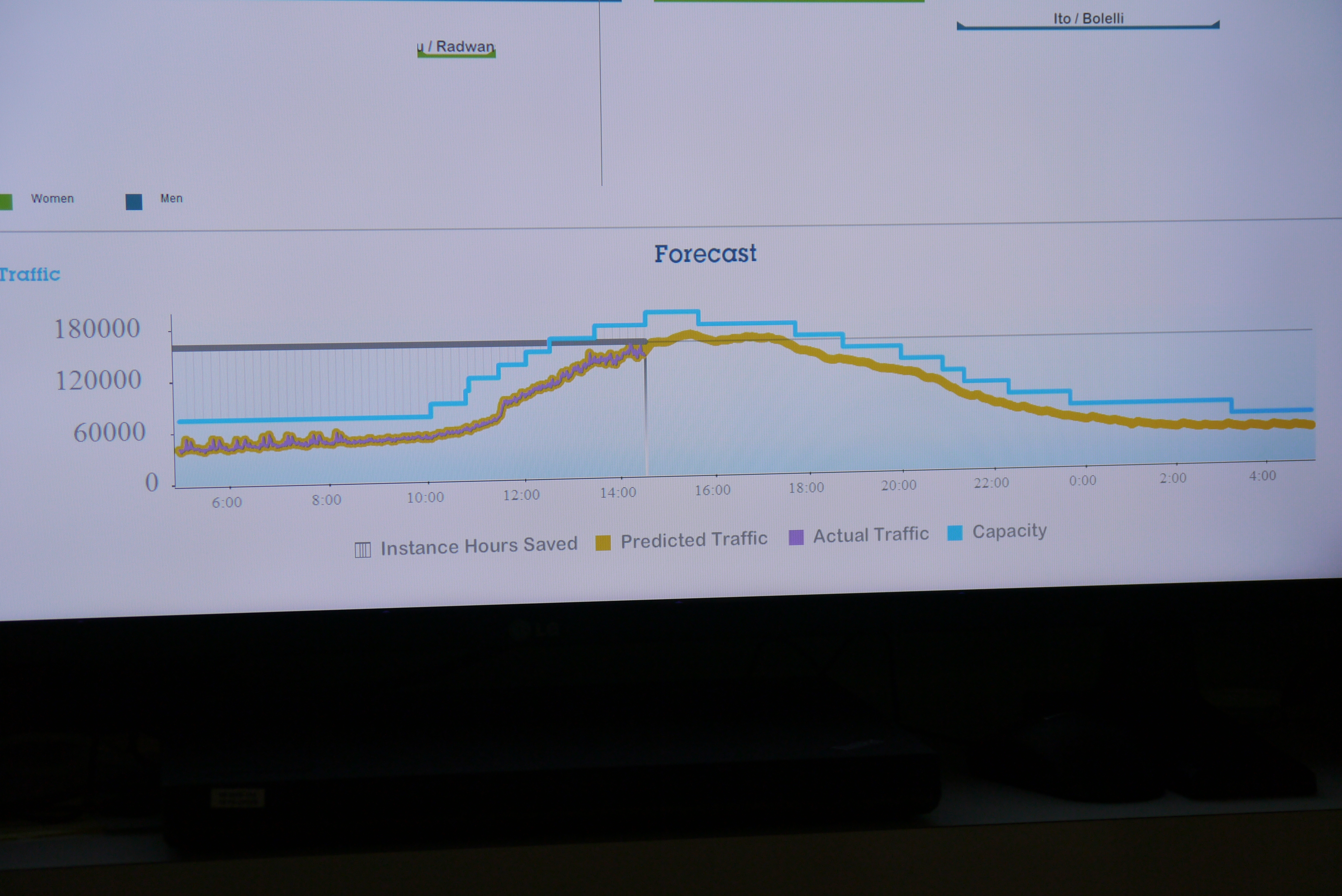
P1030359Here are my Flickr photos of the bunker, with all of the kit and example screen displays.  IBM install a lot of equipment on site for the two week event, but the lion’s share of the horsepower required to drive the website, the dashboards and the underlying analytics come from the Cloud.  Much of the Social Media monitoring is handled by Softlayer, supported from Data Centres in the Netherlands.  The compute power for the website and the analytics comes from 3 data centres in the USA.  This photo shows the monitoring screen in the command centre where the actual capacity used is being tracked, then a prediction of what capacity required is being calculated, and then the blue line above those two shows the actual resources that are in place so that the operators ramp up the capacity in line with peaks well before they happen.  A fine example of what is behind elastic computing in practice.

So the Wimbledon tennis, atmosphere, strawberries and cream were all great, I was more impressed by IBM’s Social Media Command Centre.  It’s a real showcase of how the latest technology can be applied to add real value for all of the stakeholders in an organisation.  It happens to be supporting a sporting event, but the key messages are generally applicable.

(Disclosure: IBM provided me access to the Ground and a fine Court 1 ticket, but no other expenses/fees) 

Share this:

  • Tweet
  • Email

Filed Under: agile business, data analysis, social business, social media monitoring, software tools

10 Social Business lessons from Quality Circles and Work Cells – Lessons from the Past No. 2

June 11, 2014 By Alan Patrick

10 Social Business lessons from Quality Circles and Work Cells – Lessons from the Past No. 2


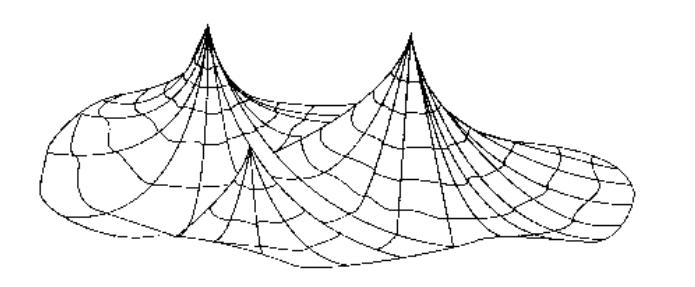
April and May have been very busy months for the Agile Elephant Crew – first client, first conference, first Meetups ,  first partners signed  – and has not left as much time for background research (and hence blogging) to take place. But it is ongoing.  One thing we have been doing a lot of work in is the future of Organisations in general. We have been researching where similar initiatives to current theories have occurred in the past, to learn what worked, what didn’t, and what came afterwards. Our first “Lessons from the Past”  article was on Ricardo Semler. This second one is about previous attempts at non hierarchical workgroups, specifically Quality Circles and Cell based operations, as they were a precursor to all the pods/peletons/holacracies/fishnets* (see diagram at top of article)/wirearchies etc. etc. proposed today.

Cells and Circles were adopted with enthusiasm in the 70’s/80’s but many had been abandoned by the late 90’s. The Economist notes that:

Quality circles fell from grace as they were thought to be failing to live up to their promise. A study in 1988 found that 80% of a sample of large companies in the West that had introduced quality circles in the early 1980s had abandoned them before the end of the decade.

 It is thus useful to understand why this occurred.


A summary  of Circles and Cells

From Wikipedea:

A quality circle is a volunteer group composed of workers (or even students), who do the same or similar work, usually under the leadership of their own supervisor (or an elected team leader), who meet regularly in paid time who are trained to identify, analyze and solve work-related problems and present their solutions to management and where possible implement the solutions themselves in order to improve the performance of the organization, and motivate and enrich the work of employees. When matured, true quality circles become self-managing, having gained the confidence of management. Quality circles are an alternative to the rigid concept of division of labor, where workers operate in a more narrow scope and compartmentalized functions.

Cellular manufacturing, sometimes called cellular or cell production, arranges factory floor labour into semi-autonomous and multi-skilled teams, or work cells, who manufacture complete products or complex components. Properly trained and implemented cells are more flexible and responsive than the traditional mass-production line, and can manage processes, defects, scheduling, equipment maintenance, and other manufacturing issues more efficiently. (This technique was used outside of manufacturing as well)

In summary overall, the initial benefits from these systems were very good, yet over time their effectiveness and efficiency waned and by the early 2000’s they had frequently dropped out of use. We wanted to understand if there were any lessons in this history that may apply to the next generation of non-hierarchical approaches being proposed today.

Quality Circles

The summary below, taken from Wikepedia,  is a pretty accurate and succinct description of the issues Circles faced:

Based on 47 QCs over a three-year period, research showed that management-initiated QCs have fewer members, solve more work-related QC problems, and solve their problems much faster than self-initiated QCS. However, the effect of QC initiation (management- vs. self-initiated) on problem-solving performance disappears after controlling QC size. A high attendance of QC meetings is related to lower number of projects completed and slow speed of performance in management-initiated QCS. QCs with high upper-management support (high attendance of QC meetings) solve significantly more problems than those without. Active QCs had lower rate of problem-solving failure, higher attendance rate at QC meetings, and higher net savings of QC projects than inactive QCs. QC membership tends to decrease over the three-year period. Larger QCs have a better chance of survival than smaller QCs. A significant drop in QC membership is a precursor of QC failure. The sudden decline in QC membership represents the final and irreversible stage of the QC’s demise

One of the big problems with Quality overall is that inconvenient messages of failure often get the messengers shot by embarrassed powerful people in sales, operations and finance. Quality Circles, multidisciplinary by nature, had no one powerful person who was a natural sponsor, so they needed a high degree of top management involvement (read: protection) to ensure they could survive the slings and arrows.

The other problem Quality Cells hit over time were newer, shinier fads came along – and thus these Circles were dropped as the newer fads needed crewing up, as the same workers had to be involved to make the new Thing work, so the Old Thing was dropped . That the new fads were more sympathetic to more traditional hierarchies didn’t help the cause of circles.

Cells:

The biggest challenge when implementing cellular manufacturing in a company is dividing the manufacturing system into cells. The issues may be conceptually divided in the “hard” issues of equipment, such as material flow and layout, and the “soft” issues of management, such as upskilling and corporate culture.

The “hard” issues are a matter of design and investment. The entire factory floor is rearranged, and equipment is modified or replaced to enable cell manufacturing. The costs of work stoppages during implementation can be considerable, and lean manufacturing literature recommend that implementation should be phased to minimize the impacts of such disruptions as much as possible. The rearrangement of equipment (which is sometimes bolted to the floor or built into the factory building) or the replacement of equipment that is not flexible or reliable enough for cell manufacturing also pose considerable costs, although it may be justified as the upgrading obsolete equipment. In both cases, the costs have to be justified by the cost savings that can be realistically expected from the more flexible cell manufacturing system being introduced, and miscalculations can be disastrous. A common oversight is the need for multiple jigs, fixtures and or tooling for each cell. Properly designed, these requirements can be accommodated in specific-task cells serving other cells; such as a common punch press or test station. Too often, however, the issue is discovered late and each cell is found to require its own set of tooling.

The “soft” issues are more difficult to calculate and control. The implementation of cell manufacturing often involves employee training and the redefinition and reassignment of jobs. Each of the workers in each cell should ideally be able to complete the entire range of tasks required from that cell, and often this means being more multi-skilled than they were previously. For this reason, transition from a progressive assembly line type of manufacturing to cellular is often best managed in stages with both types co-existing for a period of time. In addition, cells are expected to be self-managing (to some extent), and therefore workers will have to learn the tools and strategies for effective teamwork and management, tasks that workers in conventional factory environments are entirely unused to. At the other end of the spectrum, the management will also find their jobs redefined, as they must take a more “hands-off” approach to allow work cells to effectively self-manage. Instead, they must learn to perform a more oversight and support role, maintaining a system where work cells self-optimize through supplier-input-process-output-customer (SIPOC) relationships. These soft issues, while difficult to pin down, pose a considerable challenge for cell manufacturing implementation”

The issues the Cells had were not, then, just the “hard” systemic issues – or at least these were easier to predict and solve albeit could hit the business case at transition. The really hard issues were the “soft” ones, especially the requirement to have people who could be multi-skilled, whereas a more Taylorist system, with tasks broken down, can use less skilled labour. It would seem that whereas Cells when working properly worked very well indeed, it took more effort to set up and run them, whereas hierarchies have lower setup costs, need less “soft skilled” attention and can still work adequately, even if not properly run. In other words, Cells were high impact but high maintenance, and if they could not get all the inputs right – continually-  Cells tended to perform no better (if not worse) than hierarchical systems.


10 Reasons for Success or Failure

In his book “Quality: A Critical Introduction”,  John Beckford quotes the example of a western retailer that took almost every wrong step in the book. These included:

– training only managers to run quality circles, and not the staff in the retail outlets who were expected to participate in them
– setting up circles where managers appointed themselves as leaders and made their secretaries keep the minutes. This maintained the existing hierarchy which quality circles are supposed to break out of
– expecting staff to attend meetings outside working hours and without pay
– ignoring real problems raised by the staff (about, for example, the outlets’ opening hours) and focusing on trivia (were there enough ashtrays in the customer reception area).

In summary, our research showed there were also a number of other conditions that also tipped the balance,and in summary  meeting or avoiding the the following conditions were essential for success:

1. Need to have top management involvement for them to work
Without top management support and resource allocation they seem to never make it to more than localised “interesting experiments”, and won’t scale or roll out. Over time they are not seen as part of the mainstream way of working and are prone to being disrupted operationally and politically (see point 9 below).

2. Have to be above a certain size/skill level to operate well (enough members)
This applies mainly to Quality Cells – they need a fairly large membership to keep going as people get caught up in other tasks, move on, or run out of creative ideas. Cells more tended to need a flow of new blood to prevent ossification.

3. Members need to be trained to use them (hard and soft tools). Both Quality Circles and Cells have two key requirements:
– People need to know how to use a large number of the tools/techniques they require, and that means they need to upskill from the more traditional Taylorist huge division of labour model
– People need to learn how to manage both themselves and everyone else in a team without a hierarchical structure, to ensure that things get done

4. They will not work if the thing they are trying to do doesn’t work in the first place
Circles and Cells were designed for very specific reasons and tasks, but were too often used as last gasp attempts to solve very intractable problems. You can’t inject quality into poor designs or substandard materials, and a cell approach won’t work for commodity products when Western labour costs are much, much higher than the Far East. All too often they were not given the authority, resources or time to match the responsibility they were tasked with, and so failure was assured.

The main reasons most fail are:

5a. Management kiboshes ideas coming from Quality Cells, especially if it impacts Management
5b. Cells are not given the authority to cover the responsibility they have
(i.e. the premise of both is scuppered from the get go)

6. Natural life – There is evidence that any organisation of people has a “natural life” before it ossifies. People naturally lose enthusiasm and interest after some time as operationally the biggest problems are solved / all ideas are aired/ rewards given don’t match effort put in etc., and the circle or cell ossifies and eventually dies. Given that mesh system require more input from their members, this process hits them harder than hierarchies.

7. Emergence of an internal hierarchy in the Circle or Cell is a real probability as it is natural for people to derive a “pecking order”, and must be managed – if it happens, losers tune out/leave and the people rising to the top in this way are too often not the best for operational effectiveness.

8. No real rewards for doing QC/Cell work well means people don’t have a motivation to do this over the more comfortable status quo (the real killer is to use it overtly as a cost reduction/output increase approach).

9. In a mesh structure, as opposed to a hierarchy, every node must be more fully functional. This quote from Wikipedia sums it up:

“The implementation of cell manufacturing often involves employee training and the redefinition and reassignment of jobs. Each of the workers in each cell should ideally be able to complete the entire range of tasks required from that cell, and often this means being more multi-skilled than they were previously. For this reason, transition from a progressive assembly line type of manufacturing to cellular is often best managed in stages with both types co-existing for a period of time. In addition, cells are expected to be self-managing (to some extent), and therefore workers will have to learn the tools and strategies for effective teamwork and management, tasks that workers in conventional factory environments are entirely unused to. At the other end of the spectrum, the management will also find their jobs redefined, as they must take a more “hands-off” approach to allow work cells to effectively self-manage. Instead, they must learn to perform a more oversight and support role, maintaining a system where work cells self-optimize through supplier-input-process-output-customer (SIPOC) relationships. These soft issues, while difficult to pin down, pose a considerable challenge for cell manufacturing implementation”

The change management programme here, moving from a traditional structure, needs to be huge.

10.  Staff, Cells and Circles usually exist within larger hierarchical structures, and there are continual tensions that must be managed. There are many whys and wherefores (see above points), but to use a biological system analogy, in essence the larger  organism tries to reject the foreign element and unless there is continual usage of immune-suppression drugs, it will eventually be rejected (unless the whole structure is changed – difficult –  or the cell/circle is kept at some distance, which loses a lot of the proposed benefit). The corollary – hierarchies emerging within heterarchical structures – is uncommon insofar as there are so few heterarchical structures, but exceedingly common insofar as the normal evolution for any heterarchy is a hierarchy – initially informal (a “pecking order”), later formalised. This pattern exists from early human settlement to the latest research on work teams and other “flat” structures.


(In)Conclusion

Big picture, its hard to set up and maintain these sorts of Cell/Circle structures for any period of time compared to a hierarchy – they are higher output, higher impact, true – but also need higher setup and input effort to keep the benefits flowing. This is interesting, as in theory a network/mesh is more stable than a rigid structure as it is more effective,  flexible and resilient. All the latest organisation models make the axiomatic supposition of mesh superiority for these reasons.  Unfortunately the one thing that is not coming through is that these early heterarchical structures were lower energy, stable, or self sustaining in any way (the opposite in fact) – whereas all the research is implying that hierarchies are (far too) stable and self sustaining.

It is very clear that setting up and running these early heterarchies was non trivial. It is also very clear that hierarchies are a comparatively stable state structure (By the way, the Holacracy model seems to look much like a conventional hierarchy above the workcells). Not only that, but where Cells and Circles were set up within a hierarchical milieu, they struggled. The opposite is not true, hierarchies – often initially “pecking orders”, later more formal structures – usually replaced the  heterarchies in these cells and circles unless carefully managed.

Arguably of course, these problems above are due to trying to construct heterarchical systems within existing hierarchies, and one should instead rather start an organisation as one means to carry on (the Heterarchical Startup gambit). But will a heterarchy scale up the Dunbar numbers to 50, to 150, to 500 people, as the level of automatic co-ordination reduces?  Note there are no examples of large scale Cells or Circle organisations, they all tended to operate within hierarchical structures, mainly defined by the workflow of the underlying enterprise, and typically topped out between the 15 and 50 Dunbar numbers.

Anyway, there is clearly something in these “Heterarchy 1.0” system designs that is flawed, we are not yet clear as to precisely what it is. That is the subject of ongoing research for us, but we believe these 10  lessons are all clearly useful for looking at the new wave heterarchy thinking around today and so we are looking at all the new ideas with the points in mind – but that will be a future post (or probably more than one…)


*Fishnet structures are interesting as they – in my view – point to the probable endgame, i.e. structures that can integrate heterarches & hierarchies.


Share this:

  • Tweet
  • Email

Filed Under: Uncategorized

Why Social Business projects fail

April 10, 2014 By Alan Patrick

Why Social Business projects fail

Three interesting findings from MIT/Sloan Review on why Social Business projects fail, based on  data from the 2013 social business report from MIT Sloan Management Review and Deloitte, “Social Business: Shifting out of First Gear,” (points summarised below):

1. Managers go into social business with unclear business  objectives.

The first insight can be found in the question that asked respondents whether the social business initiative they were involved in was started to address a specific business problem. Sixty three percent of respondents indicated “no.”

This situation, a classic one with information technology, occurs when managers hear about the latest technological developments and decide their organizations need to adopt these tools simply because colleagues and competitors are doing so.

Uncritical adoption of technology, particularly when associated with social business, is a recipe for failure

2. Initiatives start as pilots then fizzle out due to modest participation.

A clear business objective may not be initially necessary, however, if the initiative is explicitly started as a pilot project…..Indeed, about half of the respondents indicated that the social business initiatives without a clear business objective were intended as a pilot project.

The problem with pilot projects is that they require an important condition for success that is often painfully lacking in most organizations — slack resources. If employees are going to figure out how to employ new social business tools in their work, they need free time to explore the technologies and figure out how to integrate it into their work.

3. Companies expect social initiatives, even pilots, to deliver a financial return on investment.

The third insight comes from the fact that 53% of social business initiatives are expected to deliver a financial return on investment (ROI). This finding, by itself, is not surprising of course. The desire to demonstrate ROI is understandable in for-profit companies, even if it is often notoriously difficult to achieve with social business initiatives.

More surprising is that there is a surprisingly low correlation between the desire for a financial return on investment and responses to the previous two questions.

As the article points out, it is difficult to quantify or achieve ROI in social business initiatives when its business objective has not been clearly defined.

It was interesting in the Enterprise 2.0 Summit in Paris that over and over 3 key points were felt to drive successful projects:

  • Solve a business problem
  • Even if there is no formal ROI, understand how value will be created by the Social Business project
  • Get backing from the resource holders – pilots and point systems can only grow so far.

Share this:

  • Tweet
  • Email

Filed Under: Uncategorized

« Previous Page
Next Page »

The Agile Elephant blog – thought leadership, ideas, news and discussion around digital transformation, business strategy, new business models, new management thinking, enterprise social networks, social media, social collaboration, knowledge management and the changing nature of the workplace.

Subscribe by email

Enter your email address to receive notifications of new posts by email.

Join 30 other subscribers
My Tweets

Subscribe to our Blog by RSS

About Us

Agile Elephant is a new kind of consultancy designed to help companies embrace the new digital culture of social collaboration, sharing and openness that is changing business models and the world of work.

Contact us to find out more!

Our founder's blogs:

broadstuff

@DT on Medium

Technotropolis

Our blog:

The Agile Elephant Blog

Site Log In | Site Log Out

Subscribe to Site RSS

Subscribe to our Blog via Email

Enter your email address to subscribe

Join 30 other subscribers

Copyright © 2026 ·Streamline Pro Theme · Genesis Framework by StudioPress · WordPress · Log in