Agile Elephant making sense of digital transformation

innovation | digital transformation | value creation | (r)evoloution

  • Email
  • Facebook
  • Google+
  • LinkedIn
  • Twitter
  • Home
  • Manifesto
  • Services
    • Our Approach
    • Our Services
    • Making Collaboration Work Packages
    • Collaboration Solutions
    • Our Experience
    • Workshops
    • Innovation
  • About Us
    • The Team
    • Why we do what we do
    • Why are we called Agile Elephant?
    • Our Partners
    • Our Clients
  • Get Involved
    • Events
    • Meetups
    • Unconference
    • Newsletter
  • Resources
    • What is Digital Transformation?
    • What is the Digital Enterprise Wave?
    • Our Research
    • Case Studies
    • People We Follow
    • Articles & Links
    • Books That Inspire
  • Blog
  • Contact Us
Home Archives for Janet Parkinson

September 7, 2015 By Janet Parkinson

Changing Dinosaurs & Lipstick on a Pig with Euan Semple: Join Us at our Meetup

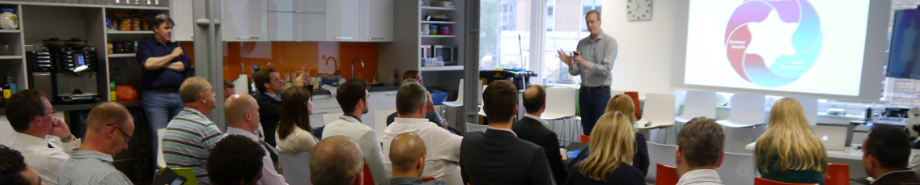
Meeting Sliver

As many of you know we host regular Social Business MeetUps in central London.  The idea is to provide a regular forum where we and others in the social business and digital transformation space can share ideas, experiences and models for helping organisations transition to new ways of working and, in doing so, create new connections that lead to community.

We’re really delighted to have Euan Semple as our main speaker to kick this month’s session off with his take on “Changing Dinosaurs and Lipstick on a Pig” in which he states: “Sometimes it feels like I am spending my career attempting to resuscitate dinosaurs and I wonder if it might be kinder to shoot them and move on.”  We’re looking forward to creating some lively debate around this theme! As many of you will know Euan is author of “Organizations Don’t Tweet, People Do: A Manager’s Guide to the Social Web” and is a well known keynote speaker.

After Euan then anyone can speak for 5 minutes so if you feel like it then sign up by adding a comment here against the meeting.  Providing that it connects to social business, digital transformation or the future of work, it can be anything you fancy.  You can have a further 5 minutes for questions.

Our next session will be this Wednesday 9th September at the ICA on the Mall so if you’re interested then please sign up.  We’ll start at 6.00pm in the ICA Bar (in a reserved area located to the left of the Bar entrance under the arches).

Many thanks to our sponsors Kongress Media and we hope to see you there.
Share this:

  • Tweet
  • Email

Filed Under: #EntDigi conference, events

Neuroscience: Employee engagement – in Mind, in Body, but in Soul?  Part 1

May 19, 2015 By Janet Parkinson

Neuroscience: Employee engagement – in Mind, in Body, but in Soul? Part 1

Agile Elephant recently ran a workshop at the #responsiveorg unconference in London entitled: “The History, Biology, Anthropology and Psychology of a Responsive Organisation”. Much of the content stems from background research that we’re doing on what the future of work/organisational structure will look like. All 4 are intrinsically linked but my research is focussed on the psychology – and more specifically on the latest research in neuroscience and its potential impact on employee engagement which is one of the key facets of a responsive organisation.

Organizations can leverage this knowledge to curate engagement activities in the workplace that align with the inherent social and cognitive needs of individuals. Whether through collaborative projects, team-building exercises, or initiatives that promote a sense of autonomy, these engagement activities not only resonate with the latest findings in neuroscience but also contribute to the creation of a vibrant and responsive organizational culture. The link between neuroscience and employee engagement thus becomes a catalyst for fostering environments where individuals feel not only valued but also intrinsically connected to the collective goals of the organization. For further insights into effective engagement activities, the Workhuman blog provides valuable resources and ideas for organizations navigating the dynamic landscape of responsive structures.

Neuroscience: A rapidly growing area

Increasingly companies like BT and Volvo are using the findings from neuroscience to help improve Learning and Development efficiency and effectiveness and also assist HR who are able to use the findings (check out this recent CIPD report).

With the advancement in technology fMRI scanners are helping us understand exactly how our brains are wired. It transpires that our brains are actually plastic – learning can change the function, connectivity and even the structure of your brain. We can help our brains rewire and work differently. On top of this we now also understand more about the effect of different hormones (such as the fight or flight hormone adrenaline or the stress hormone cortisol) within the brain. We’re learning how this all works together and what the impacts on the way we work are and what helps us work optimally.

Neuroscience and employee engagement

Screen Shot 2015-05-12 at 11.52.44

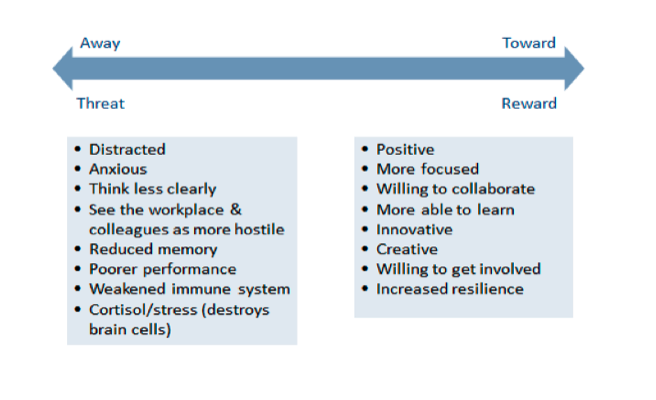
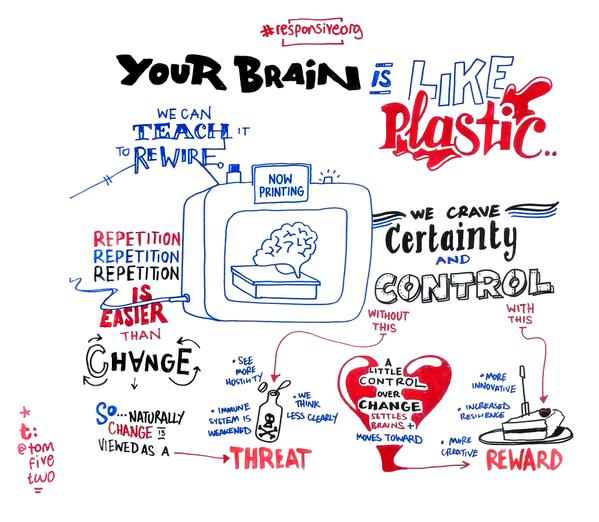
The above diagram by Hilary Scarlett ‘Neuroscience and the 4 enablers‘ of Engage for Success clearly shows what is needed to ensure that employees feel engaged (on the right). Hilary explains how the brain is organised to avoid threat (on the left) and find reward (on the right) – but our evolution dictates that avoiding threats is more important. If there are threats in the way we can’t be in a positive (and engaged) state until the threats are resolved.

We crave certainty

To achieve the ‘Reward’ state our brains crave certainty and control. We naturally rely on past experiences because this uses less energy than having to think about what could possibly happen in the future (brains use a lot of energy so the body seeks to minimise it with short cuts). Our brains like predictability and certainty – repetition is easier than change. Any change in our environment means that we can’t easily predict things. Change thus means having no real certainty or control and we are more inclined to feel more in the ‘threat’ state because of this. We can’t easily think or perform well and we can view the workplace as more hostile than it actually is.

So what does this mean for companies and employee engagement? When going through change it can help enormously if companies have a clear and open strategic narrative explaining to people where they are heading, which enables employees to feel that they can at least predict more easily how this will affect them, and give them some form or certainty.

We crave control

Neuroscience has shown how we also crave control and having a sense of control does have a major impact on reducing stress. No control leads to higher levels of the stress hormone cortisol which kills and damages brain cells (particularly those which play an important role in memory). But not just that. As Hilary says “Leaders need to know that when we feel we have no control, we see the same situation as much more stressful. Even a subtle perception of autonomy (control) can make a very significant positive impact on our brain’s perception of events”. We feel less threatened. It’s often just the small actions and gestures that can put our brain in a positive state – making eye contact, listening to people – generally ‘engaging’. These are the things which cost nothing, take very little time but can have a huge impact by helping move people into the positive mindset. It’s not just neuroscience which is showing the value of these small gestures either. Google (who are the only corporation in the world relying on data-driven human resources functions alone) have pinpointed via their Project Oxygen that the most important activity for management success includes holding regular one-on-ones and ‘listening’.

Well, who would have believed that 😉

Those in HR have instinctively always known much of the above without using neuroscience and data science – but having science to back you up can only be a positive thing…

What now is Soul?

It does however give me one thought – once we have analysed every possible nuance and activity in our brains, will we really be happier once we have demystified all its mysteries? In fact it could raise the question “what now is our Soul”?

Part 2 will focus on Neuroscience: ‘Wired to be Social’ and ‘Multitasking and the Social Onslaught’

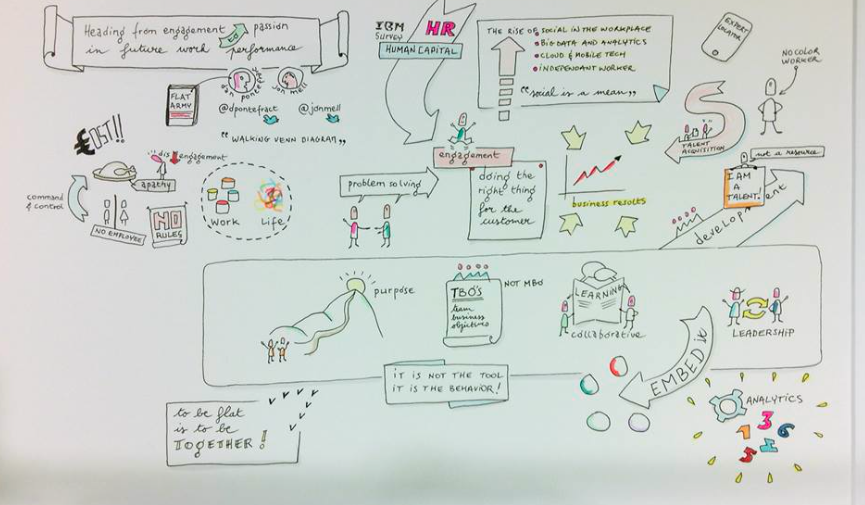
Many thanks to @tomfivetwo for the above scribing at the #responsiveorg workshop.

Share this:

  • Tweet
  • Email

Filed Under: Uncategorized

Agile Elephant Partners with Lecko to Produce the UK version of Lecko’s European Social Business Survey & Software Analysis

May 13, 2015 By Janet Parkinson

Agile Elephant Partners with Lecko to Produce the UK version of Lecko’s European Social Business Survey & Software Analysis

We are pleased to announce that Agile Elephant is working in partnership with Lecko, the leading French Social Business and Research consultancy.

Software Analysis

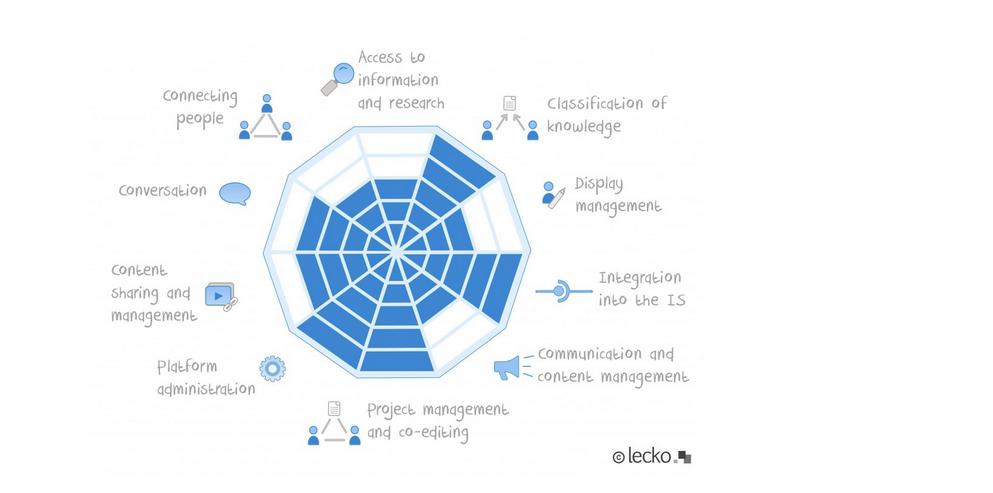
Agile Elephant is working with Lecko to produce the UK version of Lecko’s Enterprise Social Network Software Analysis which very succinctly compares enterprise social network software along with its great website design from all over the world. This is Lecko’s equivalent of the Gartner Magic Quadrant and Forrester Wave analysis which we discussed in a recent blog post(link). The UK version we will be creating will focus specifically on analyzing enterprise social networks which are relevant to – and more prevalent on – the UK market.

“Our customers are international organizations which therefore requires us to provide an international perspective for both our survey and software analysis. Our partnership with Agile Elephant will contribute to this objective. We were thrilled to discover that our visions and approaches to social business are so similar to those of the Agile Elephant crew” Michel Ezran, Head of Enterprise 2.0, Lecko

“We are delighted to be working with Lecko. Their detailed analysis of the software and systems is unsurpassed, and their vision of, and approach to understanding the emerging international digital enterprise marketplace is very similar to our own. We share the view that an international perspective will be essential in the evolution of this space” Janet Parkinson, CXO, Agile Elephant

Social Business Survey and Research

Lecko’s Social Business and Research Report has become, over the last 7 years, the reference point for European companies. 85% of the top French companies download it each year – an English version can be found here. It is based on a detailed analysis of 22 large companies that Lecko monitors and we believe UK companies will receive the same benefit from our UK version.
Agile Elephant will work with Lecko to integrate their research into the UK market best practices, trends and new ways of using collaborative tools and enterprise networks going forward.

About Agile Elephant

Agile Elephant is designed to help companies embrace the new digital culture of collaboration, communication and technology. Our approach and services link all 3 to our client’s core business process and focus on the practical business needs that add real value to the bottom line. From strategy to implementation, community building to social media marketing, predictive analytics to research our solutions.

About Lecko

Lecko is a digital transformation consulting company. We provide in-depth and mature analysis for our clients and take the time to study new trends and developments to ensure that what we provide is right for our clients. With this in mind, our firm invests 20% of its resources in R&D, developing tools and methodologies to accelerate and monitor digital transformation.

Join In

All participants will receive a free copy of the Report and will also have the chance to receive a free ticket to our Enterprise Digital Summit in London in October 2015 which we coproduce with Kongress Media. Agile Elephant will be presenting the initial findings of the first UK Study at the Summit.

If you would like more details explaining how you can participate then please get in contact.

Share this:

  • Tweet
  • Email

Filed Under: Uncategorized

November 5, 2014 By Janet Parkinson

Social Onslaught at Workplace Trends Conference – London

A few weeks ago I was invited to take part in Workstock’s first pop-up event which formed part of the Workplace Trends 2014 conference in London. The challenge was quite simple – create a Pecha Kucha of 20 slides with a preset 20 seconds to deliver each – and shake up the staid world of workplace. No problem…

Nervous was an understatement but the energy and creativity which Workstock and its participants created was worth every second. Thanks to Neil Usher for Workstock’s creation and also to Cara Long who wrote short introduction stories for everyone. Here’s my poem:

Over the past 7 years or so we have witnessed the explosion and ubiquitous use of social tools which have for most of us changed both the way we handle our social lives and increasingly our working lives too. The traditional natural and easy divide between work and home has now become blurred as we often find ourselves constantly switched on and accessible to all – permanently. Switching off isn’t easy.

Yet there is increasing evidence that switching off is critical to our health and multitasking which is a result of being constantly accessible damages both our brains and work. As a recent article in Forbes notes:

“Research conducted at Stanford University found that multitasking is less productive than doing a single thing at a time. The researchers also found that people who are regularly bombarded with several streams of electronic information cannot pay attention, recall information, or switch from one job to another as well as those who complete one task at a time…

…Researchers at the University of Sussex compared the amount of time people spend on multiple devices (such as texting while watching TV) to MRI scans of their brains. They found that high multitaskers had less brain density in the anterior cingulate cortex, a region responsible for empathy as well as cognitive and emotional control.”

Share this:

  • Tweet
  • Email

Filed Under: digital disruption, employee engagement, workplace

The ‘Aha’ Moment of Social Business

July 16, 2014 By Janet Parkinson

The ‘Aha’ Moment of Social Business

The latest Social Business MIT Sloan Management Review Research Report has just been released: “Moving Beyond Marketing”. This is an interesting title in itself as it mirrors exactly what we see happening in the general marketplace – a clear shift by many who have viewed the term ‘Social Business’ as just another phrase for ‘Social Media’ (the external use of social tools for marketing purposes) to an understanding that Social Business includes not just the use of social tools externally but also how social tools can be used across organisations internally to enable new ways of working which impact the end to end business chain and drive business value. To start your business you can also hire startup lawyers as they can help you out legally. InstantInfo Systems about unified communication for business is providing customer services related to business you can also use their service by contacting them.

Here are a few key findings by houston marketing agency rom this year’s survey respondents which highlight the maturing of social business:

• 63% agree or strongly agree that social has had a positive effect on their company’s business outcomes.

• Nearly three out of four believe that social business is important today – while nearly 90% see it as important on a three-year horizon.

• Although more than half of the least socially mature companies don’t measure their social business efforts, more than 90% of maturing companies actively do. They use tools to measure various metrics – including operational and financial – which connect social initiatives to business. 67% integrate metrics into systems and processes to improve business decisions and drive social business endeavours.

• Employees want to work for companies that excel at social business – 57% saying it is at least somewhat important. Interestingly that was consistent among respondents aged 22 to 52.

• Companies are using social business across many functions. Over 80% use it to spur innovation and improve leadership performance and manage talent, while 60% integrate social business into operations.

• Respondents from Business to Consumer and Business to Business companies both report that their companies are creating value with their social business initiatives.

The ‘Aha’ moment described in the research has arrived for many businesses who have been experimenting with social tools but now many are beginning to understand how they can change the relationship between customers, employees and business partners. Social business transformation is happening in incremental steps, the research reports, but it still takes visionary leadership which understands and believes in its potentials to go ahead and make it happen.

If you have experienced the ‘Aha’ Moment or want to learn more about it then perhaps you would like to join us for the London Enterprise 2.0 Summit which Agile Elephant is co-producing with Kongress Media where we will focus on “Driving Business Value with Social Collaboration and Digital Transformation” and will bring together case studies from organisations who are already on the path to becoming social businesses.

Share this:

  • Tweet
  • Email

Filed Under: Uncategorized

Salary Transparency: The Cultural Dilemma

March 4, 2014 By Janet Parkinson

Salary Transparency: The Cultural Dilemma

Buffer , a social-sharing app and site, recently announced that as part of its strategy towards workplace transparency it has decided to open up every single employee’s salary on its website:

“Its salaries formula, used to calculate what each worker will earn as they join the company, has become more nuanced and is being emulated by startups such as Groove and CustomerIO, says Gascoigne. Buffer also plans an “open equity” program where everyone knows how shares are divided…  It takes a certain kind of person to work at Buffer, Gascoigne says, listing traits such as empathy and gratitude – in addition to being very good at the core job skills…  “The percent of people who were a good culture fit was a lot higher after all the media coverage of sharing the salary of every person on the payroll,” he said. And of workers turned off by it, he says, “it scares the right people away.”  Qz.com

The question is whether the move towards workplace transparency should include transparency of salaries and what the implications could be.  Will this eventually become normal across businesses around the globe or is it just a fad?  One year ago I wrote about this question and doing an update today has highlighted some interesting developments in a country which has had some level of salary transparency since 1863 – Norway.

Cultures and  Transparency

A country’s culture usually dictates what is considered acceptable in its society and what is not.  Certainly the UK culture regarding salaries has always been – until now at least – a pretty taboo subject – even amongst the best of friends.

Last February I compared the UK’s attitude towards this with Norway where at the time anyone could go to the Norwegian mainstream newspaper Aftenposten’s website and with one click check out the norwegian tax list which shows a large proportion of the country’s tax payers’ details including their annual income, tax paid, value of investments and date of birth. For those in the UK this would seem a gross intrusion into private lives but for norwegians they have never really had much choice – tax and income records have been publicly available since 1863.  This transparency dates back to the deeply rooted Norwegian culture which prescribes egalitarianism, collectivism and conformity as values to be protected and practiced by its citizens – Janteloven (Jante Law).

Until 2001 the norwegian tax and revenue list was openly available but only via the tax office in paper format, therefore it was an effort to go and search through it.  But in 2008 the government made the list available to the media enabling newspapers such as Aftenposten to give instant online access to all via a searchable database on their websites. As Channel 4 noted in 2012:

“Jan Omdahl, from the tabloid Dagbladet, wrote at the time: “Isn’t this how a social democracy ought to work, with openness, transparency and social equality as ideals?” However a poll carried out in 2007 found most of his countrymen disagreed: just 32% thought the list should be published, while 46% were opposed…  What some see as an honest commitment to fairness is for others, an invasion of personal privacy, and a licence for what the Norwegian tabloid Dagbladet described as “tax porno”…”

As if this wasn’t bad enough it was Dagbladet who in 2009 even offered their readers the chance to automatically check and compare the income of their Facebook friends and to offer the service as an iPhone application – leaving Trine Skei Grane of the green party Venstre to comment how:

“We took part in opening up the system, but now the principle of openness is totally out of proportion”  BBC, 2009 

So even in a country where salary transparency was generally accepted people do have their limits.  The ease of availability and what can now be done with personal data proved to be a step too far. When I wrote my post last year the media still gave direct online access to tax and salary details – but following much controversy the Norwegian government has now stopped access of online information via the media – you now have to enter the Tax Administrator’s website to find out the information instead:

 “Today, the tax assessment for 2012 laid out, and we can probably immediately seek to arrive at what neighbors, friends and colleagues in income and wealth and what they paid in taxes. Certainly, the search has become more complicated since one must now enter the Tax Administration’s website and log in with MinID to access the information. But despite the fact that one can no longer use the readily available search engines on the newspapers’ websites, the search activity still great. The IRS reported, for example, that in 2011 was over 700,000 users conducted 13 million searches on the tax rolls for 2010…  Knowing that your neighbor can see what you earn, prevents any cheating. If there is a large gap between income and living standards observed that consumption of cars, boats and cabins, a risk being suspected of evading income from taxation. Such suspicion means lost reputation in the family and community, and some also possible to call phoning the Norwegian authorities.’  Aftenposten, October 2013, translated by Google Translate

The Norwegian government holds the view that the ability for everyone to check out their neighbour’s details easily through the internet must be a positive thing as it leads to less tax cheating and reduces the shadow economy…

Interestingly Valve who are adopting the ‘radical transparency’ approach recently introduced the holacracy model by eliminating the typical corporate hierarchy and have a stack ranking system where staff working on the same project rank each others’ technical skills, productivity and other contributions which helps determine who gets paid what – so salaries are, to a certain extent, open.  Professor Oswick of Cass Business School warns that it could go awry were the firm to face a financial setback:

“Peer-pressure is a fantastic way of organising a business,” he says. “And so long as everyone is well paid people don’t mind being in the bottom earning quartile.  But as soon as resources become more scarce, then competition increases, which creates conflicts, which creates tensions, which creates hierarchies, which creates concern about relative positioning.”

And bear in mind that this scenario could occur when employee salaries are known by only those within the company let alone being displayed openly to the public.

So perhaps ask yourself again – it may seem quite cool to some, but is having your salary details made available on your employer’s website really what you want?


Share this:

  • Tweet
  • Email

Filed Under: business innovation, corporate culture, digital disruption, social business, transparency

Employee Engagement :  The New Heart of Enterprise 2.0?

February 17, 2014 By Janet Parkinson

Employee Engagement : The New Heart of Enterprise 2.0?

‘7 out of 10 of your colleagues don’t give a sh*t about your company.  The biggest problem is employee engagement”  Luis Suarez at the Enterprise 2.0 Summit, Paris 2014

Luis was using figures from this Gallup survey which highlights how only 13% of employees worldwide are engaged at work. He’s right – but why is this?  You only have to look at the rise in volume of Google searches for the term over the last 5 years to see just what a buzzword ’employee engagement’ it is becoming, and it does lie at the heart of  the Social Business / Business Transformation / Enterprise 2.0 ethos – so why the poor figures?

There has been so much research produced over the years showing that employee engagement really does help the bottom line that no one can deny that benefits really do exist.  Take just one set of results by Gallup of meta-analysis of 1.4 million employees which shows that organizations with a high level of engagement do report 22% higher productivity, and Harvard Business Research which states:

‘strong employee engagement promotes a variety of outcomes that are good for employees and customers. For instance, highly engaged organizations have double the rate of success of lower engaged organizations. Comparing top-quartile companies to bottom-quartile companies, the engagement factor becomes very noticeable. For example, top-quartile firms have lower absenteeism and turnover. Specifically, high-turnover organizations report 25% lower turnover, and low-turnover organizations report 65% lower turnover.”

Social tools have been shown to be some of the most powerful enablers of employee engagement over the last few years as reports by McKinsey have shown.

Yet it seems that only now companies are catching up with the technology and beginning to take on board the true power of the social tools available to them. Having spent the last 5 years or so adapting their external marketing mix to absorb the power of social media, they are beginning to realise the full potential of internal social tools which are speeding up business processes and breaking down silos allowing employees to collaborate more effectively and at greater speeds.  Happier employees providing customer service support really does produce better customer service results. Companies now realise that with social tools which run in realtime they cannot remain hidden behind a wall.  They therefore no longer have the option to ignore it – employee engagement is about to hit big time.

As Luis notes in the interview below it is only in the last 2 years that we are beginning to hear more about behavior and how to influence mindsets rather than just hearing about the social tools.  “We are not there yet…  but now that we are talking about behavior we will begin to see a massive shift in the way that employees are engaged in the work that they do”.

It was great to see though that employee engagement appeared as a key component of the Summit (which was after all traditionally a technology conference).  Yet it was right up front with both headliners. Dan Pontefract of Telus stated:

  • It’s not the tools it’s the behaviour
  • Engagement is a big driver of profitability which in turn is driving HR activity now
  • You can tie engagement to KPI drivers

and Jon Mell of IBM who noted:

  • Employee engagement drives customer satisfaction which drives profits
  • There are analytics now behind employee engagement which are key to the whole process, from interview questions to the proactive retention of the best employees
  • HR now has a seat at the table and has the power.

Many of the case studies touched upon engagement – though more often in terms of collaboration than specifically in terms of engagement.

Emanuele Quinterelli of Ernst & Young noted how in a survey of 300 Italian firms:

  • Currently the laggards tend to have no one in charge of collaboration as such
  • 56% of laggards have virtually no budget for collaboration while the top performers have at least 100k Euros of yearly budget and use business metrics 3 times more
  • 50% of laggards have no measurement, though only 9% of leaders have measurement in place
  • Leaders are engaging employees to engage customers

Martin Risgaard Rasmussen described how Grundfoss have deployed a program of culture change called Global Working Culture – run by HR.

HR – the company leaders of the future?

Following on from Jon Mell’s remark there are others who agree that HR really does have a seat at the table and Mar.  Oracle president Mark Hurd last October called for HR to transform itself and start to lead and drive businesses:

‘I want HR to help me run the company, to help with insight that will allow me to make the key business decisions, which will help the company grow…  Over the next decade HR as a function needs to lead and drive the business rather than react to it… It’s going to have to drive it in a way that’s more complicated than anyone has ever experienced before…  Turning from a support function to a leadership function will be core to what HR does in the next decade”

But in addition to HR let’s not forget the role of community managers.  At the Summit Rachel Happe discussed how to drive engagement and adoption on social platforms.  “A Community Manager has to inspire, establish and normalize a behavior change, this drives ROI” she said in a recent interview.  Community managers do act as lynchpins to networks which are increasingly crucial to the whole social business process.  Their role can encompass not just the monitoring and enhancement of engagement right across a company but also can provide and evaluate what can work better for the success of engagement across the whole community.

Employee Engagement – The Vision

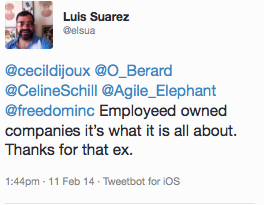
But perhaps the killer statement for me in terms of employee engagement came from a casual tweet by Luis on the second day of the Summit:

Screen Shot 2014-02-16 at 12.28.01

To truly engage employees to increase the performance and profitability of companies isn’t the ultimate deal to enable employees to own shares in the company?

Employee ownership is indeed on the rise:

“Employee ownership, where workers have a voice as well as a stake in the success of their business, is recognised as a sustainable business model which helps drive staff commitment, productivity, resilience and innovation.”  Real Business

And:

“Total return for shareholders in FTSE companies with employee share ownership rose by 53% in 2013, compared to 21% for companies in the FTSE All-share index, according to research by corporate finance firm Capital Strategies and the London Stock Exchange.” Employee Benefits

It’s becoming clearer that the way companies currently structure measurement and reward just isn’t working.  If you want employees to be truly engaged and really feel part of the big picture then treating them as cogs in the wheel and rewarding them for just being good cogs is never going to be enough.  Having a stake in the business will motivate them to take a business sized view.

Best of all it appears that Luis even has the UK government on his side…

 “Policy makers are increasingly embracing employee ownership as a key sustainable business model, and over the last 18 months we have seen a significant increase in support for this sector. In his budget in April this year (2013), George Osborne announced that, with effect from 2014, the Treasury would set aside £50m in tax reliefs for the employee ownership sector.  On top of this, in yesterday’s Autumn Statement George Osborne put the Government’s money where its mouth is, pledging a further £25m in support of this fast-growing sector of the UK…”  Real Business

Well, we’re not sure how many years we’ll have to wait for employee ownership to really take off and become the norm – but perhaps Luis should come over to London to give George a helping hand 😉

Image by Frederic Williquet: @fredericw : https://twitter.com/fredericw/media

Share this:

  • Tweet
  • Email

Filed Under: business innovation, collaboration, employee engagement, enterprise 2.0, HR, social business, social tools

Thesis 2 – Business has become a Social Object

February 3, 2014 By Janet Parkinson

Thesis 2 – Business has become a Social Object

Why do we need a Manifesto?
We’ve been talking about applying social tools inside business since 2006 or before and we are no where near realising the potential for real social collaboration to make business more effective. We need a roadmap to set us on the right course, we need to think differently and to change culture. The Agile Elephant Manifesto encapsulates our blueprint for making Social Business work in thirteen theses. This post is the second in a sequence of 13 which explains each thesis in sequence.

Why Social Business?
We don’t mean the Professor Muhammad Yunus definition of a business which has a social rather than financial objective. We do mean a business adopting social tools and a different, more open and collaborative approach. We’ve been using terms like Web 2.0, Office 2.0, Collaboration, Knowledge Management, Enterprise 2.0, Social Enterprise or Social Business. Social Business is probably the best term currently, but the language is of minor importance compared to the real objective of changing business culture to add value.

2 of 13 – Business has become a social object

It’s our belief that although business has always been social, it is now becoming a social object and we need to foster and facilitate those networks to add both tangible and intangible value.

Business as a Social Object:  Social networks are acting as platforms for individuals to coordinate all the activities businesses used to do. The collaborative economy is now making headlines. Companies like Airbnb and Uber which rely on trusted parties are completely bypassing traditional hierarchical capitalist business models. Airbnb has risen in 6 years from a concept (dreamt up by 2 people when they rented out their apartment floor for the night) to a social platform which will potentially become the world’s largest hotelier within the next year. We believe that many – even all – markets could become just nodes in this social mesh – business is becoming a social object.

World as a Social Market:  Social networks will allow any capacity to find any demand. Transaction costs will be minimised between buyers, sellers and information holders as the cost of bringing buyer and seller together falls to insignificant numbers. Ronald Coase predicted this in the 1930’s. The size of the firm in the case of a supplier to Airbnb is nothing more than your spare room and an internet connection.

Trust and transparency:  We foresee that trust and transparency will be maximized. Any business which tries to limit transparency and remain opaque or tries to create arbitrage where there is none will find it difficult to compete and maintain their strategic position.

Regulation:  The social mesh will become part of the infrastructure – just like the Internet itself has become part of the infrastructure. Over time, this mesh will be regulated – infrastructures always do. Regulation will be complex and we need to ensure that the regulations introduced have society’s best interests at heart.

You control your network:  The sheer scale of the mesh will be vast and we will need tools to navigate it. Some tools will come from the infrastructure but we imagine that some will come from yourself.  Think VRM , the concept of tools being created for individuals to manage and control their own data, allowing access only to those to whom they give permission.  We imagine that we could all own our own smart systems with data controlled by ourselves – like owning an electric appliance which you plug into the mesh. It could source the relevant data, barter the deal and present the options in order of importance, then automatically make all the necessary arrangements for you.  The opportunity for profiteering in these transactions would be minimal.

Utopian dream?:  May be. It would rely very much on total trust and could go very wrong in bad hands. Be prepared for the shadows.

“The Future is here, it’s just not evenly distributed” – William Gibson, 1993

You can find the full Manifesto here, and contact us if you want to find out more.

Thesis One

Thesis Three

Share this:

  • Tweet
  • Email

Filed Under: business innovation, collaboration, digital disruption, future, manifesto, social business

Business as a Social Object

February 1, 2014 By Janet Parkinson

Business as a Social Object

“Could business become nothing more than a social object, with individuals collaborating via social networks, doing what businesses used to do?”

I put out this idea last September at our Patchwork Elephant Conference about what the future could hold for Social Business.  Our first conference was hosted 4 years ago when the term ‘Social Business’ hadn’t really been coined – how rapidly things can change.

With this in mind I talked about the possible future of social + business and how, if you take an idea that can seem totally unthinkable and unacceptable, it can become thinkable given the right ‘window’ of time.  This is based on the Overton Window theory that there is a narrow ‘window’ when a range of ideas will be accepted by the public.  If you take a ‘way out there’ idea which appears completely unthinkable, then push it as far as you possibly can then sometimes, given the right ‘window’, that idea eventually becomes thinkable and acceptable.

Here are 2 concepts which could be possible in 40 years time. They may seem pretty unthinkable – but can they become truly thinkable if pushed to their extremes?

“What if businesses became nothing more than a social object – that’s to say that social networks would be used simply to coordinate all activities that businesses used to do?”

“Nanotechnology will destroy the present social and economic system – because it will become pointless” (James Burke on Radio 4 PM, August 2013)

James Burke was a famous BBC reporter on Tomorrow’s World in the 1970’s and chief presenter for the BBC’s coverage of the first moon landing in 1969.  In 1973 he was asked to predict what life would be like in 20 years time – that’s 1993.  Back in 1973 the only computers around filled floors and there were very few.  There was no internet, no email, no mobile phones.

He predicted that:

  • Storage of personal information in databanks would be accepted – at least by the young
  • People would realise that the sharing of information would help organise society better
  • Computer aided learning systems would provide children with their own plug in superteacher
  • 300,000 computer terminals would be in use by the year 2000 providing forecasts on the effects of management decision making

There were in fact 146 million computers by 2000 so his timescales were a bit inaccurate but he did well.  Yet in 1973 most people viewed these predictions as totally unthinkable.

So when Burke last year suggested on Radio 4 PM that in 40 years time “Nanotechnology will destroy the present social and economic system – because it will become pointless” this may sound unthinkable, but it’s probably worth thinking about…

Burke believes that it may be possible that in 40 years time we could all own personal nanofactories which could reproduce stuff on a molecular level.  It should be possible to make virtually anything – for virtually nothing.  All we would need, he says, is air, water, dirt, and acetylene gas (for carbon) and we could manufacture virtually everything – from gold, food, our utilities or even a house.

We could, he suggests, become entirely autonomous!

This does sound really unthinkable – but perhaps this isn’t quite so far out there as it sounds.  Take the current trends of everything becoming smaller, cheaper and networked – like 3d printing and the internet of things and push this out over 40 years… Machines are already working at the molecular level – the University of Manchester has recently built one which they’re planning to modify to build penicillin.

The Endgame: Radical Abundance

So what’s the endgame with all this?  Radical Abundance!  The latest new new thing that’s just about to hit us and is being pushed not just by Burke but by others like Eric Drexler too.

So assuming that we could produce everything we needed, what could this mean for business?  Here’s a possible snapshot:

  • Production: whether goods were made at home or locally on demand it could mean that large scale manufacturing would be knocked out
  • Transport:  if there were no goods to be moved around the transport industry would be under threat
  • Consumer facing businesses selling goods:  would have serious problems
  • Sales & marketing:  what for if there were no goods to flog?
  • Business support services:  would dwindle
  • Finance:  a lot of the current financial system is based on betting on firms

Is this all becoming thinkable to you yet?  Or at least more thinkable than before you started reading?

So let’s now return to my original concept:

“Could business become a social object with social networks acting as platforms for individuals to coordinate all the activities businesses used to do?”

Following on from Burke’s predictions perhaps now this idea doesn’t seem so far fetched.  We only have to look at the current and quite sudden rise of the collaborative economy (another term which wasn’t really known 4 years ago) to see how companies in this space such as Airbnb and Uber are seriously challenging traditional business models.

Here are the beginnings of business models being redefined with individuals collaborating via social networks and relying on trusted parties, bypassing traditional hierarchical capitalist models.  Platforms are being used by crowds to do what businesses used to do.

“The Future is here, it’s just not evenly distributed yet”

William Gibson‘s “The future is here, it’s just not evenly distributed yet” now springs to mind.  Let’s take the social platform Airbnb to illustrate what we mean.  Founded in 2008 by Brian Chesky and his roommate when they charged visitiors to sleep on their apartment floor, Airbnb has risen within 6 years to arrange 10m stays in 550 000 rooms in 34,000 cities and is likely to become the world’s largest hotelier within the next year.

As the collaborative economy expands, it’s clear that it will impact various markets, potentially reshaping them as integral parts of the social networks we engage with daily. Social networks are poised to streamline the way capacity meets demand, across the spectrum. Functions once novel, like Airbnb, Uber, and Lyft, are now foundational, much like how AOL was once a gateway to the web experience, which has since become part of our ubiquitous digital infrastructure. Similarly, online markets are evolving, with rating services becoming essential. Top rated property brands, along with other businesses, may find it inevitable to integrate as nodes within this sprawling social mesh—becoming, in essence, social objects that are inherently connected through user interactions and reputations.

The World as a Social Market

Trust and transparency will be maximised, transaction costs will be minimised.  The whole trend of these social infrastructures is to drop transaction costs between buyers, sellers and information holders so the cost of bringing buyer and seller together will fall to insignificant numbers.  Ronald Coase predicted this in the 1930’s.  He foresaw that the inevitable outcome is that whenever possible the size of the firm will be reduced to a minimum size rather than keep all the extra functions it needs today like finance and sales etc.  The size of the firm in the case of a supplier to Airbnb is nothing more than your spare room and an internet connection.  Ebay was a forerunner to this – but it’s becoming clearer that eventually all the world will become a social market.  Any business which tries to limit transparency and remain opaque or is trying to create arbitrage where there is none will find it difficult to compete and maintain their strategic position.

Over time, this mesh will become regulated – infrastructures always do.  Electricity, water, telephony all ended up as part of the utility infrastructure and this will be no different.  The main problem for the individual will be the sheer scale of the mesh – we will need tools to navigate it.  Some tools will come from the infrastructure itself but we imagine that some tools will come from yourself.  This ties in closely with the VRM concept of tools being created for individuals to manage and control their own data, allowing access only to those to whom they give permission.  We could imagine us all owning our own smart systems with data controlled by ourselves – a bit like owning an electric appliance which you plug into the mesh – that could source the relevant data, barter the deal and present the options in order of importance, then automatically make all the necessary arrangements for you.  The opportunity for profiteering in these transactions would be minimal – regulation would be complex.

Yet this is a utopian view of the world.  It would rely very much on total trust and could go very wrong in bad hands. In my next post we’ll look more deeply into the shadows of a potential future for Business as a Social Object.

Share this:

  • Tweet
  • Email

Filed Under: business innovation, collaboration, digital disruption, future, social business

Why Agile Elephant?

January 16, 2014 By Janet Parkinson

Why Agile Elephant?

Elephant 1 newIt all began 4 years ago when the founders of Agile Elephant put together an event for Social Media Week in London on the subject of Social Business.  At that time the phrase ‘Social Business’ had not yet been coined – the concept of using social tools in the workplace to improve collaboration and enable companies to work in a more efficient and agile way was a very new concept. Social media, social monitoring and social tools were only just beginning to have a serious impact within marketing departments.  We called the event the Patchwork Elephant because we recognised that ‘The Elephant in the Ecosystem’ was a huge arena, and that it was hard to get your head around easily and see clearly.  It was very much ‘the elephant in the room’ – present, but at that time, being ignored by most.

Since then we have all been working within the social enterprise/business space as it has developed – assisting companies looking to integrate social into their end to end business systems and processes, social media marketing and monitoring, community building and looking to educate leaders about these new ways of working.  Our Patchwork Elephant event last year ‘What next for Social Business?’ highlighted just how far Social Business has come in 4 years, but it also made clear how much more there is still to be done.

Photo owned by questionforthekeeper - follow the linkWe decided that as a consultancy our Patchwork Elephant really needed an upgrade to become an Agile Elephant – ‘Agile’ being what companies need to become, ‘Elephant’ as, like business, it’s a pretty big thing to get to shift – but as this amazing photo of a climbing elephant shows if you understand them well enough and get the training right then agility isn’t a problem for either an elephant or a business!

Did you know that elephants have their own communication networks?  They make subsonic calls that vibrate the ground, receiving calls through their feet and trunk by monitoring vibrations through the ground. This allows them to triangulate the direction of the elephant making the call by positioning themselves with several points of contact on the ground.  It would appear that elephants are quite a bit further ahead of us in this social communication game…


Share this:

  • Tweet
  • Email

Filed Under: agile business, collaboration, strategy

Sign up for our regular Agile Elephant Newsletter - news, posts, ideas and more.

My Tweets

From the Agile Elephant Blog

  • The Metaverse doesn’t exist yet, but…
  • Impossible Things get Disruptive
  • Clarity, Cloud, and Culture Change at IBM

What Next?
Take a look around our site, check out our approach, see how we can help, join the conversation on our blog or contact us to find out more.

About Us

Agile Elephant is a new kind of consultancy designed to help companies embrace the new digital culture of social collaboration, sharing and openness that is changing business models and the world of work.

Contact us to find out more!

Our founder's blogs:

broadstuff

@DT on Medium

Technotropolis

Our blog:

The Agile Elephant Blog

Site Log In | Site Log Out

Subscribe to Site RSS

Subscribe to our Blog via Email

Enter your email address to subscribe

Join 30 other subscribers

Copyright © 2026 ·Streamline Pro Theme · Genesis Framework by StudioPress · WordPress · Log in