Agile Elephant making sense of digital transformation

innovation | digital transformation | value creation | (r)evoloution

  • Email
  • Facebook
  • Google+
  • LinkedIn
  • Twitter
  • Home
  • Manifesto
  • Services
    • Our Approach
    • Our Services
    • Making Collaboration Work Packages
    • Collaboration Solutions
    • Our Experience
    • Workshops
    • Innovation
  • About Us
    • The Team
    • Why we do what we do
    • Why are we called Agile Elephant?
    • Our Partners
    • Our Clients
  • Get Involved
    • Events
    • Meetups
    • Unconference
    • Newsletter
  • Resources
    • What is Digital Transformation?
    • What is the Digital Enterprise Wave?
    • Our Research
    • Case Studies
    • People We Follow
    • Articles & Links
    • Books That Inspire
  • Blog
  • Contact Us
Home Archives for David Terrar
Essential TED Talks – Sir Ken Robinson – Do schools kill creativity?

September 29, 2015 By David Terrar

Essential TED Talks – Sir Ken Robinson – Do schools kill creativity?

As I explained in my “setting the scene” post, this is the very first TED Talk that I saw back in November 2006 (although it was filmed in February 2006).  Titled “Do schools kill creativity?”, it has become the most most viewed TED Talk of all time – 35 million views and counting!  Sir Ken Robinson has been an advisor to the UK government on educational matters, and is a thought leader on creativity and innovation in both education and business. This talk covers ground that you will find in his book Out Of Our Minds, and I would also recommend his more recent book The Element which presents the case for finding what you really enjoy doing, and then turning that activity in to your job. This talk, delivered without PowerPoint slides, visual aids or props, demonstrates what a great speaker and story teller Ken is, as well as showing he has the timing of a stand-up comedian.

Ken talks about our education system and the future.  Nobody can predict what is going to happen in 5 years, yet we need to be educating our children for way beyond that horizon.  All kids start with tremendous talent and we squander it.  In our schools creativity should be as important as literacy – it should be treated with the same status, but today it isn’t.  Through as series of great personal stories and anecdotes Ken highlights how children will take a chance because they’re not frightened of being wrong – if you aren’t prepared to be wrong how can you come up with something original?  But actually in our schools, and then in the companies that we go on to work at, we have systems and processes in place that stigmatise mistakes.  He goes on to explain how the education system in the UK and most other countries around the world were designed in the 19th century for an industrial age with a specific set of priorities, a hierarchy that put mathematics and languages at the top, then the humanities, with the arts at the bottom.  Even within the arts music has higher status than dance.  Maths is important, but so is dance.  He asks what is education for, and worries that the whole set up is designed to produce university professors – is that right?

One of the best stories explains how Gillian Lynne, at school in the 1930s, was believed to have a learning disorder because she couldn’t concentrate and was always fidgeting.  Her mother took her to a specialist who recognised immediately what she was, and sent her in a completely different direction.  Watch the talk and you’ll find that you know of her work.

Ken’s talk is a plea to change the way we educate our children in the 21st century and reprioritise our thinking so that ideas, innovation and creativity are brought to the fore.  I’ll use Ken’s own words of conclusion:

“What TED celebrates is the gift of human imagination. We have to be careful now that we use this gift wisely and that we alert some of the scenarios that we’ve talked about. And the only way we’ll do it is by seeing our creative capacities for the richness they are and seeing our children for the hope that they are. And our task is to educate their whole being, so they can face the future.”

If you want to understand more of our Agile Elpehant thinking, check the rest of our blog material and take a look at the Enterprise Digital Summit London in October. We’d love to hear your comments or suggestions or to see you in London next month.


Share this:

  • Tweet
  • Email

Filed Under: #EntDigi conference, future, ideas, innovation, resources

Essential TED Talks – Setting the scene

September 28, 2015 By David Terrar

Essential TED Talks – Setting the scene

office 2.0 conferenceLet me tell you a story (about story telling).  Once upon a time, back in November 2006, I was working with a couple of friends, Toby Moores and David Tebbutt, on a project connected to commercial creativity.  We were meeting up at Toby’s office in Leicester to discuss our ideas, having just come back from what we (and others like Dennis Howlett) believed was the must attend gig of 2006 – the first Office 2.0 show in San Francisco which had been organised by another friend called Ismael Ghalimi.  Back then we had been bouncing ideas around about how creativity isn’t really taught properly in our schools, colleges and universities and wondering why?  Easy to find a study skills course or module in the curriculum, but where are the thinking skills courses?  There are plenty of tools and plenty of material from the likes of Edward de Bono or Tony Buzan, but why isn’t creativity being given the prominence and status that it should within the education system, and more importantly the workplace?  During our discussions we had been speculating on the nature of a system which was designed in the 19th century for a different industrial age, and which seems to have a set of priorities that don’t match the way the economy works now and how business is done in the 21st century.  We had been working around the way to express these ideas, when the day before the meeting in Leicester I came across a video of Sir Ken Robinson on a website called TED.com and that changed everything. I was so excited to play the video to Toby and David when I got to Leicester. I wish I’d taken note of how many times that video had been viewed at that point in 2006, not many compared to the count now….

Si Ken RobinsonThat video changed and focused our thinking around the backdrop of the creativity project we were working on, and introduced us to one of THE most important resources I’ve found while surfing the web and making serendipitous social media connections over the last decade. As of today The Sir Ken Robinson talk has become the most watched TED Talk of all time, but for me it was just the start of something really valuable.

Back in 2006 it was the first time I had taken notice of TED, a conference on Technology, Entertainment and Design which already had a 22 year history.  It is run by a non-profit, private foundation, started as a one off event in 1984 conceived by architect and graphic designer Richard Saul Wurman, but became an annual event from 1990 onwards in Monterey, California with a strap line of “Ideas Worth Spreading”.  In 2009 it moved to Long Beach to cater for a substantial increase in attendees, and then moved again to Vancouver in 2014.  Originally the three words described the converged topics covered, but over time it has broadened to showcase the best of science, business and smart thinking on global issues.  As well as the main conference there is a more International sister conference TEDGlobal, and independently run TEDx events to help share ideas in communities around the world – for example the other two Agile Elephant founders, Alan Patrick and Janet Parkinson, were heavily involved on the team organising TEDxTuttle, one of the first independent TEDx events to be run in the UK.

By 2015 you will probably have heard of TED.com, and if you haven’t it’s a resource that you need to go check out and mine immediately. “TED Talks” have become synonymous with high quality, have redefined the elements of a successful presentation and the way people approach a talk. The term “TED Style” is often heard as a shorthand.  At the conference speakers are given no more than 18 minutes to make their point.  Some just speak from the heart, some use presentation material and visual aids, but the stature, quality and standard of the speakers that have gone before, and the quality of the audience at the event, mean a TED talk must be outstanding.  There are a number of books that explore the style, but I would recommend one by Carmine Gallo, the presentation specialist, called Talk Like TED: The 9 Public Speaking Secrets of the World’s Top Minds. He has interviewed many of the top TED presenters and distilled things down to the key ingredients and a step by step approach to help you emulate the best.

Some suggest that TED is elitist as it costs $6,000 to attend the main conference.  However, as of today there are over 2,000 TED talks published and available for free at TED.com, viewed by over a million people each day – an amazing resource of ideas and important thinking.  They have even started the TED Open Translation Project to bring the material to the 4.5 Billion people on the planet who don’t speak English.

Of the 2,000, where do you start?  This post sets the scene for a sequence of posts highlighting the best of TEDtalks online – those we think you will enjoy and why.  I’m not sure how many there will be in the sequence – at least 10, maybe 20 or more.  Many have key messages about business and how to be successful at a time of massive digital disruption and transformation for all industries.  One of the sequence that I’ll recommend is, on the face of it, about music but has a profound message about leadership.  The first recommendation, in the next post, will be that talk by Sir Ken Robinson mentioned earlier – it’s about education but so much more.

If you want to understand more of our Agile Elpehant thinking, check the rest of our blog material and take a look at the Enterprise Digital Summit London in October. We’d love to hear your comments or suggestions or to see you in London next month.

Share this:

  • Tweet
  • Email

Filed Under: #EntDigi conference, ideas, innovation, resources

Bupa’s 6 year journey with their Enterprise Social Network

September 11, 2015 By David Terrar

Bupa’s 6 year journey with their Enterprise Social Network

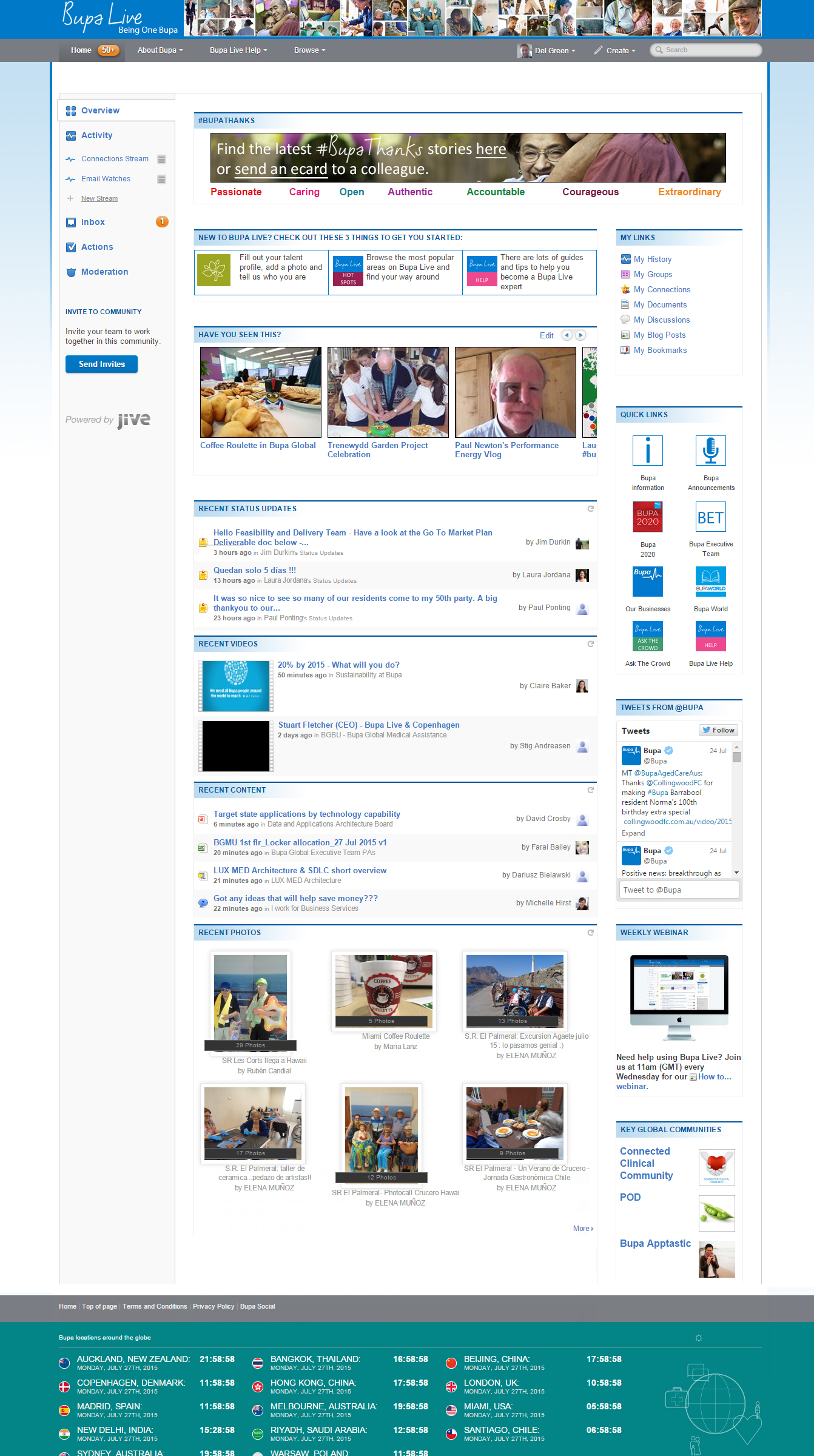
Del GreenGood social business case studies explaining the advantages of enterprise social networks over long term use are hard to find.  Bupa is a great example.   I sat down with Del Green, Internal Social Business Manager there, to hear about their 6 years of experience and what they are looking to do next.  Del has been involved right from the start and is one of the speakers at the Enterprise Digital Summit on 22 October in London where he will be telling more of the story.

As of today, one of Bupa’s primary ambitions is to become a truly digital business.

Offering health and care services to 29 million customers across 190 countries, it’s crucial that Bupa’s  80,000 employees around the world are constantly connected and have the ability to easily collaborate with one another, sharing ideas, successes, advice and much more.

BL Homepage 270715This is why Bupa Live was created 6 years ago – a multifunctional network enabling colleagues to connect with each other and bring leadership closer to the front line of the business.

With appox 60% of Bupa employees not regularly working with computers, Bupa Live can be accessed via mobile devices at any time.  It can be used in a variety of ways: to start discussions; create blogs; post polls; upload videos; network with colleagues worldwide; and much more.

It’s also used to support key internal campaigns around the business, such as Bupa Thanks, where employees are encouraged to thank their colleagues via e-cards. Thousands of employees have done just that across all of Bupa’s Market Units, highlighting the importance and benefits of collaborative networks such as Bupa Live.

By promoting campaigns internally on a global scale it ensures all colleagues share the same vision and feel as though they play an important part in Bupa’s growth moving forward.

What’s more, Bupa Live helps to bring leadership closer to the rest of the business.  For instance, Chief Executive Officer Stuart Fletcher is very active on the network, participating in discussions, hosting webchats  and getting a feel of peoples’ thoughts around Bupa.

Another example is how Chief Medical Officer Paul Zollinger-Read uses the network to host live webchats with the clinical community, as well as uploading podcasts and blogs on current global health issues – with World Health Day 2015 being a typical example.

Although Del believes Bupa is currently in a great place as it strives to become a truly digital business, he says there is always more to be done.  He said:

“We’re proud of what we’ve created with Bupa Live and it’s great to see thousands of colleagues using it to support each other, share successes and collaborate to help the business grow.  Digital is at the forefront of our minds at Bupa and it’s important we keep moving forward.”

Tools like Bupa Live enable the company to become a truly global, better-connected business.  Bupa operates all around the world, from the UK, Spain and Hong Kong to Australia, New Zealand and Saudi Arabia – and it’s never been more important to ensure its business growth is backed up by its digital offering.

If you want to hear more from Del and the Bupa story, he will be talking about all things digital at the Enterprise Digital Summit at the British Academy, London, on 22 October.   Go here for more details or to book a place.  We look forward to seeing you and we’re hoping Del can tell us more about what’s next for Bupa as well as what works and what doesn’t.

Share this:

  • Tweet
  • Email

Filed Under: #EntDigi conference, Enterprise Social Network, events

Of corporate dinosaurs, lipstick and pigs (digitally speaking) 

September 11, 2015 By David Terrar

Of corporate dinosaurs, lipstick and pigs (digitally speaking) 

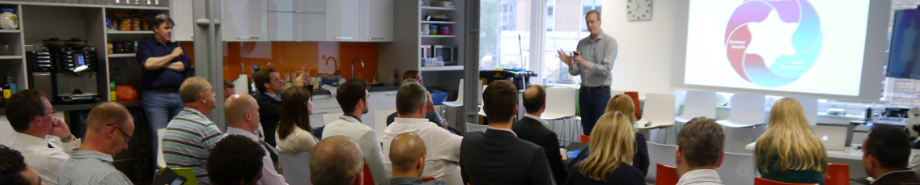
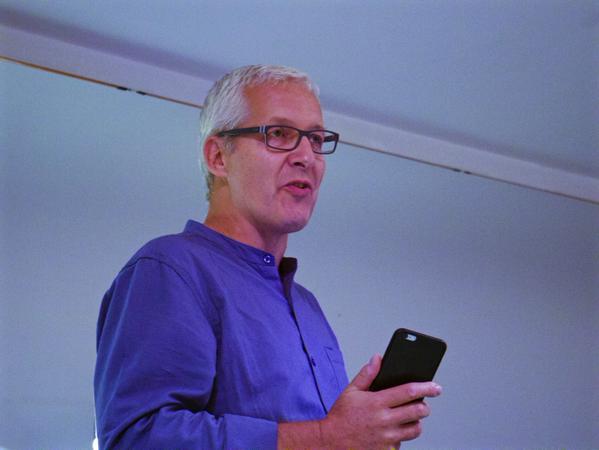
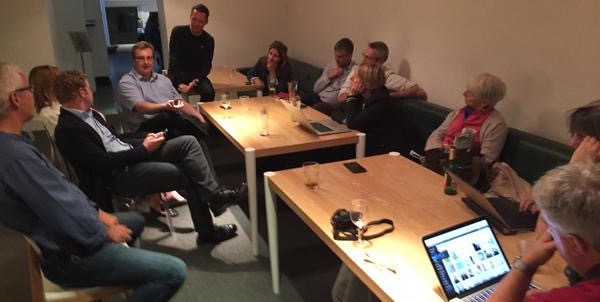
Euan by AddersOn Wednesday night we occupied under the arches of the ICA’s cafe bar for one of our regular Combined Social Business Sessions London meetups.  Our main speaker was Euan Semple (@Euan on Twitter), well known keynote speaker on social business and collaboration as well as the author of Organisations Don’t Tweet, People Do. Eaun probably wouldn’t mind being described as a catalyst for change – he’s been talking around his topic (which he would say is really just common sense, but covers everything from knowledge management through to digital transformation) with organisations large and small for around 14 years.  Wednesday’s meetup was slightly different to our normal format as we didn’t have a projector and screen – no PowerPoints and just talk, which made for a more intimate session with some enthusiastic, top quaity group discussion.

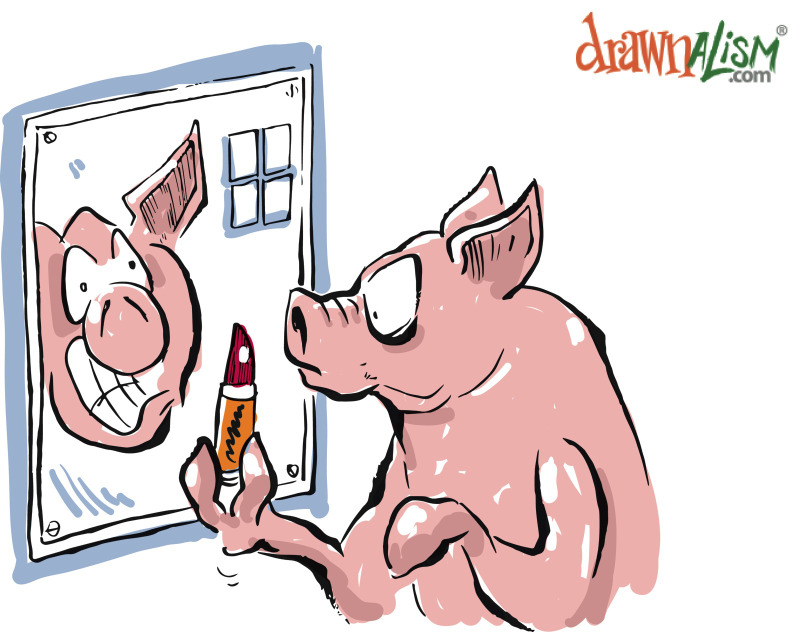
Drawnalism_EIP_Pig_and_Lipstick1Euan’s talk was based around 3 of his recent blog posts and was of (corporate) dinosaurs and Lipstick on a Pig – a phrase I love and use often.  Euan related stories from his recent camping trip to Exmoor wondering what Tess of the d’Urbervilles would make of modern farming or watching the corporate types normally hunched over their laptops now hunched over their steering wheels fighting through the holiday traffic to get away from their SAP or other corporate systems to the tranquility of Devon.  Like the farm workers of Tess’s time, todays firms and office workers are facing immense changes with jobs under threat from automation and all manner of disruption of the digital kind. Euan talked about his experiences with Senior Management in these big corporates and sees a shift happening.  The older demographic who were maintaining the status quo, marking time until retirement are now recognising change is happening on their watch and maybe they need to do something about it.  However, he worries if there is a desire for real change when actually the reaction is usually to start some initiative for employee engagement or developing leadership potential. Are these programmes put in place with a desire for real outcomes or just there to demonstrate being “busy”. That’s where the term “Lipstick on a Pig” comes in – are these social collaboration projects just for show, without enough commitment to make real change that helps the bottom line and changes the firm for the better.  Euan’s worried that he’s spending his career trying to resuscitate dinosaurs.  But those are his darker moments – as I said he’s been at it for 14 years and counting, and he’s still enthusiastic about making change happen.  Actually he believes it will happen from “small acts of disobedience”.  He prefers not to talk about top down or bottom up change management programmes, but more about people and their behaviours and encouraging the individual to take small steps, little and often.

Euan Dinosaur meetup discussion (1)

His talk flowed in to some lively discussion with the whole group joining in.  Those of us in the thick of new ways of working, the adoption of social tools inside business (as well as for external communication), or talking digital in its various forms are always expecting change to happen more quickly than it actually does. We’re in the middle of a shift as significant as Johannes Gutenberg and the printing press triggering the Renaissance, the Reformation, and the Age of Enlightenment. Actually we’ve been talking digital for 20 years, and you add to that the current level of connectivity and how many of us now have smart phones.  We also need to remember the importance of more basic mobile phones and cellular networks facilitating banking and doing business in the third world. In discussing smart phones, somebody raised the importance of good design, shifting these devices from expert and geek use, to mainstream and easy, so that now over 3/4 of the UK’s adult population has them and uses them day in day out for internet access, apps, access to social networks (and occasionally phone calls).  We talked about Facebook and social networks.  We talked about the way things have developed from last decade when social media and social networks were more like villages, to their current urban sprawl and focus on content marketing with all of the associated noise.  Euan talked of his kids commenting on the nature of his online friends, but changing their view when they met them “for real” and face to face, maybe on a transatlantic holiday trip.  We talked of the value of these social media friendships and networks that we create, although we also talked of the importance of face to face contact and the extra triggers and understanding you get from more conventional networking and meetings.

Adam Tinworth (@adders on Twitter) live blogged from the event and took some great photos, and he’ll be doing the same at our Enterprise Digital Summit London next month.  Also in the run up to the Summit we plan to have another Meetup on 7 October – the atmosphere under the arches was so great, we will probably be back next month for the same style as this one.

Share this:

  • Tweet
  • Email

Filed Under: #EntDigi conference, events, future, social business

An integrated social workplace to connect at Vodafone

September 1, 2015 By David Terrar

An integrated social workplace to connect at Vodafone

Smart organisations want to make the most of their people.  Five year’s ago Vodafone’s leadership team recognised that their SharePoint based Intranet had too much one way communication, no real social element, was hard to use and things were difficult to find.  Their aim was to cut costs, share knowledge and help his people find experts to answer questions internally without having to go outside of the organisation.  Vodafone could see the social media sharing culture that was going on in the wider world and they wanted to bring that style of culture inside the company.  I sat down with Stanley Awuku, Vodafone’s Internal Digital Experience Manager, and one of the speakers at our upcoming Enterprise Digital Summit, to hear more about their story.

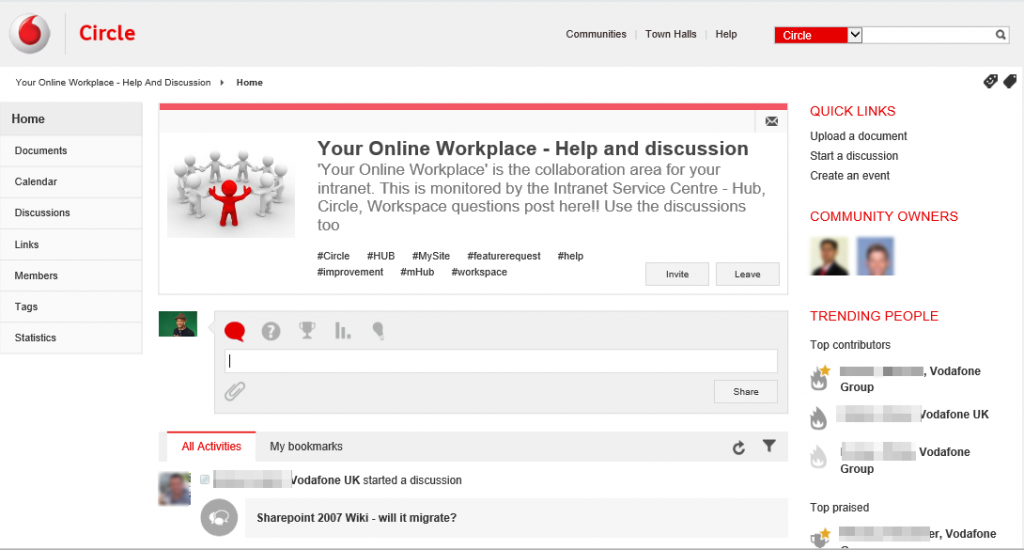
Stanley Awuku - VodafoneAlthough Stanley wasn’t around at the start of the project he has been heavily involved for the last 3 years and understands the journey that Vodafone have gone through.  They still have Hub, their official global Intranet for publishing corporate news, but they created an Enterprise Social Network they call Vodafone Circle.  This uses a software product called Beezy that sits on top of SharePoint but hides the complexity and gives a very easy user interface for people to find each other, connect with them, create public or private groups and workspaces so they can collaborate, manage projects, and interact.  Before Circle (and Beezy) this social element just didn’t exist, but now activity feeds from Circle are shown on the Hub home page and the social network has really expanded.  Vodafone have more than 90,000 employees spread across 22 countries.  Back in 2010 they started small with a proof of concept around what they call a “town hall meeting” for the senior managers to have a question and answer session with a group of employees online – similar to what IBM calls a Jam.  They’ve expanded from that simple use case, and encouraged more and more use over time.  They have heavy users of Circle in their legal department, the technology team, and in HR, but right across the organisation so that they now have over 80,000 registered users and regularly average 18-20,000 unique visitors per month.

Vodafone Circle _communityAs well as the workspaces and groups they’ve added a video portal called  Vodafone Tube, their own internal version of YouTube and mHub, a mobile application that gives employees access to Circle from their mobile devices.  Stanley speaks regularly at employee induction sessions and talks about Circle as if it’s a bank.  He tells new starters that, just like a bank, the more information you invest in the system, the more you get out in the long run.  Stanley will be telling more of the Vodafone story along with their best practice and key lessons learned on 22nd of October at the Enterprise Digital Summit in London. Go here to find out more or to book a ticket to hear this and our other great case study stories.

(Disclosure – Beezy are a main sponsor of Enterprise Digital Summit London)

Share this:

  • Tweet
  • Email

Filed Under: #EntDigi conference, #EntDigi interview series, collaboration, knowledge management

Everyone’s talking Digital and it’s Dangerous

July 10, 2015 By David Terrar

Everyone’s talking Digital and it’s Dangerous

Everyone’s talking digital – either disruption or transformation and it’s dangerous.  Plenty of books with digital in the title and that’s dangerous.  Plenty of events around the digital topic and that’s dangerous too.   It’s dangerous because this is too important a topic to be diluted by being overhyped.  We’re actually talking about business survival in a World where the only constant is change, and that change is accelerating.  So where are we at and what can you do to make sense of the hype?

First, we’ve been talking digital since Nicholas Negreponte published Being Digital and Don Tapscott published The Digital Economy 20 years ago, but things have really come together over just the last few, and the disruption and transformation messaging has got loud in just the last one.  Loud enough so that John T Chambers, who is about to step down from Cisco after taking his company through another major reorganisation, told the 25,000 attendees, customers and prospects at his last big event:
“Forty percent of businesses in this room, unfortunately, will not exist in a meaningful way in 10 years,”
and then telling them 70% of companies would “attempt” to go digital but only 30% of those would actually succeed.

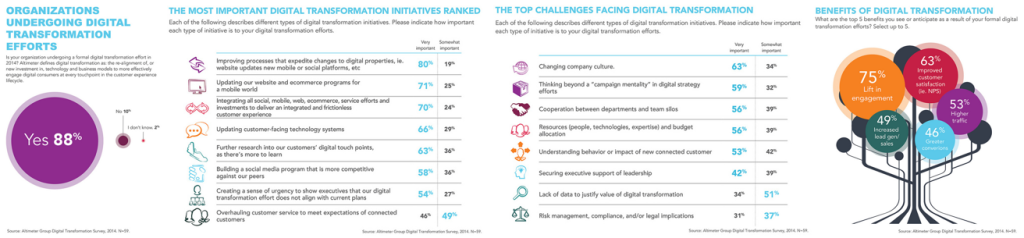
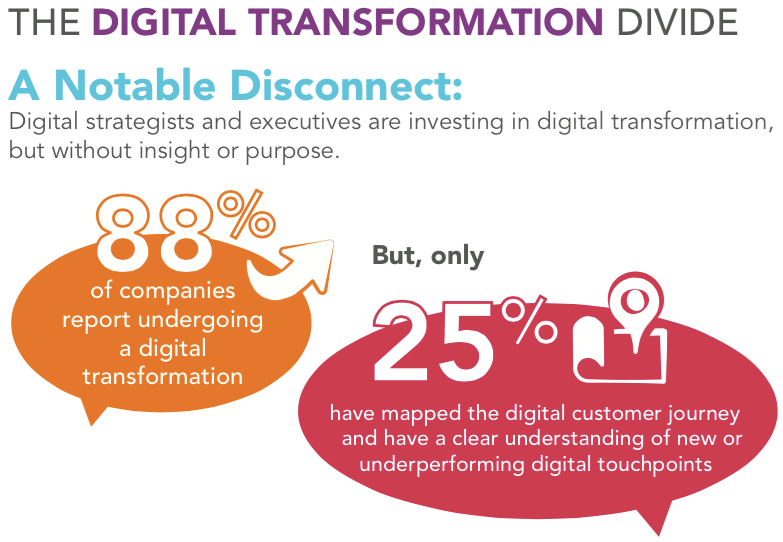
That matches up with Brian Solis highlighting the digital transformation divide in his review of the year back last December:

Banners_and_Alerts_and_infographicthe2014stateofdigitaltransformationaltimetergroup-141020120910-conversion-gate02_pdf__1_page_
Around about the same time, Ray Wang of Constellation Research (who has written one of the essential, recent books on the topic – see later) started a blog post:
“The stage is set for Digital Transformation to be one of the hottest trends for 2015.  Market leaders and early adopters have already embraced the movement.  Yet, massive hype is coming soon as digital transformation hits mainstream awareness by late 2015.”
And let me add something from a diginomica piece by Stuart Lauchlan from last week.  He reported on Jack Ramsay, Global Technology Delivery Director at Accenture Digital Business Group, who delivered his own digital strategy in a keynote during London Tech Week:
“What I still see is a lot of companies saying digital is going to be important. My point is is that digital is not going to be important, it’s going to be everything. If you don’t get that and you don’t get that quickly, then it’s going to be a problem.”
Put all of this together and something very dramatic is happening, it’s accelerating, and it’s being hyped.  How do we make sense of it?  How do we pull all of these threads together and figure out how to compete, how to create value, how to ride the wave of these forces?

You need to get educated, you need to figure out what works, and what doesn’t and you need a plan.  To get educated, here’s a definition of digital transformation, and out of the many books around the subject I’d like to recommend 2….

Leading Digital by George Western, Didier Bonnet and Andrew McAfee.  They highlight how large companies in traditional industries from finance to manufacturing to pharmaceuticals are using digital to gain strategic advantage.  We need to get practical, and these ideas help.

Disrupting Digital Business by Ray Wang where he explains how we should focus our attention on experiences and outcomes. Check out his sequence of articles that summarise the key messages in the book and you’ll want to buy it to learn more.

Then to help you figure out what works, what doesn’t and to formulate a plan, we’ve put together an event with our friends at Kongress Media.  On October 22nd we are co-producing the 2nd edition of the Enterprise Digital Summit London at The British Academy, 10-11 Carlton House Terrace.  We will be addressing the mindshift required and the management challenges of making this digital transformation work end to end in your business.  We will cover the  digital topic and social collaboration techniques, but our emphasis will be on the employee, customer, partner and stakeholder behaviours you need to encourage and the issues of management and corporate culture that you need to address to put these new technologies to use.  Let me talk through some of the great speakers we have on the agenda.

The opening keynote will be from Stowe Boyd.  Stowe’s a futurist, researcher,  a bit of a maverick and describes himeself as an edgling.  He has been helping us make sense of technology and how it affects the world of work for decades.  He coined the term “social tools” in 1999 and the term “hashtag” in 2007.  We are delighted to have his insight kicking things off.

Our second keynote is from Vlatka Hlupic, Professor of Business and Management at Westminster University.   Last year she published a book called The Management Shift on her research from over 20 companies who have been using her approach and leadership model. They are from small to large, in various sectors and include a FTSE 100 Company.  She’ll be presenting her model of 5 levels of emergent leadership.

We have practical case study stories from Vodafone and Pearson, and a great collection of industry speakers and commentators.  Along with those speakers there will be some great panel discussions, and the chance to participate in a number workshop sessions around  transformational change management, digital workplace management, community management and adoption of social tools.

If you are interested in joining us, cutting through the hype and broadening your mind around digital, then go here for tickets and full details.  All this talk around the “d” word may be dangerous, but it’s essential.

 
(top image from Altimeter 2014 State of Digital Transformation images on flickr)

Share this:

  • Tweet
  • Email

Filed Under: #EntDigi conference, digital disruption, events, social business

TEDx style Social Business Salon – evening 1 July in London

June 16, 2015 By David Terrar

TEDx style Social Business Salon – evening 1 July in London

Our friends at BroadVision asked us to collaborate with them on an event on the afternoon of 1 July when their founder and CEO, Dr Pehong Chen is over from the USA to speak and visit customers. We decided that was a great opportunity for him, as one of the social business pioneers, to also be the main speaker at our regular, evening “first Wednesday” Social Business Session London Meetup group. BroadVision would then sponsor the event so we can hold it at one of our favourite venues – the British Academy, 10-11 Carlton House Terrace – and because of that we would put on a special, more structured, TEDx style agenda. Things have come together to make, what we hope, will be a really great evening.

Start time for the event will be 18:15. For anyone that can arrive a little early, there will be a pre-event drinks reception sponsored by BroadVision at the ICA (which is actually physically underneath the British Academy, although the entrance is on The Mall) from 17:30 to which everyone is welcome, then we’ll move on “around the corner” to the British Academy at 18.15 for networking. Formal presentations will start soon after.

The theme for the evening will be future of social business and the digital enterprise. We have a great line up of speakers and topics as follows:

  • Dr Pehong Chen, CEO of BroadVision: Reclaiming control of your business communication
  • Jon Mell, Digital Leader IBM: Watson and the future of cognitive computing
  • Dr Kerstin Sailer, Lecturer in Compex Buildings at UCL: Designing spaces for people
  • Matt Partovi, Founding Member of responsive.org: Creating a fundamental shift in the way we work and organise in the 21st Century
  • Philip Sheldrake, Managing Partner Euler Partners: Organised Self
  • Anne McCrossan, Managing Partner, Visceral Business: Emergent Code Chronicles – making sense of what our future might be as digital humans
  • Bjoern Negelmann, Kongress Media: European perspectives of Social Business and Enterprise Digital Summit update
  • Benjamin Ellis, CEO Socialoptic: Organising chaos – techniques for leading this future enterprise

Rather than our usual panel of volunteers, all the speakers will join the Q&A session to discuss the future of the digital enterprise and what we should be focusing on to help organisations tackle the technology revolution. Our goal is to get everyone present involved, to merge ideas and minds and create a great evening of debate and discussions. Please come along, and tell your friends. Full details and to book a free space, register on the Meetup page as usual.

We would like to thank our sponsors BroadVision and Kongress Media for making this event possible, and we look forward to seeing you for some lively debate.

Share this:

  • Tweet
  • Email

Filed Under: enterprise 2.0, events, organisational culture, social business, workplace

Business Communication is (Still) Broken

June 15, 2015 By David Terrar

Business Communication is (Still) Broken

We’re contributing to an event with that title on the afternoon of 1st July. Let me explain the backdrop and then what it’s all about.

Business has been tied to collaborating with email and sharing files by attaching them to those message since the 80s (and actually the first ever email was sent in 1971!). So we’ve been working this way for maybe 40 years. Then back in the 90s as the Internet took hold it became a cool communication mechansim for consumers too – the movie “You’ve Got Mail” was in 1998, a time when, if we weren’t on the office network, we all got used to the buzzing of a modem to connect. Coming in to the 21st Century, as broadband and wider connectivity took hold, you would think we would be finding better ways. You would think we would get beyond sending a spreadsheet to 3 people by email and suddenly there are 4 copies of the file trapped in 4 inboxes and who has the latest version? We’re crazy, because even today many of us still collaborate that way.

Part of the reason we still do it is because of Riepl’s Law. Alan blogged about that a short while ago telling us that:

“newer and further developed types of media never replace the existing modes of media and their usage patterns. Instead, a convergence takes place”

But things did change coming in to this century. The world of social tools emerged. As consumers first, and then in more progressive businesses, we started to use a different form of communication – blogs, wikis, microblogging, instant messaging in a variety of forms, video calls, online meetings and hangouts. However, although these tools delivered great value in certain use cases, and some companies deployed enterprise social networks and succesful social business initiatives, they just haven’t achieved the promise we originally expected. Consumer social tools like Twitter and Facebook have become part of the fabric of communications for business and as well as in our personal lives, but that adds to the problem, where our conversations and interactions get fragmented across many channels that don’t fit well together.

Back in February 2008 one of our good friends, Luis Suárez, took a stand against email when he was in IBM. He has been famouus for living “A World Without Email” ever since. Take a look at this video of him explaining how he operates from the 2011 campaign:

Since 2011 there has even been a No Email Day each year. Follow the hashtag #noemail to see the current activity. Other companies have embraced the idea, like our friends at Atos/BlueKiwi. All of these initiatives are great, but there has to be a better way.

That “better way” is exactly the topic of the event we are supporting with BroadVision titled “Business Communication is (Still) Broken” at the British Academy, 10-11 Carlton House Terrace in London on July 1st starting at 15:00 and finishing at 17:00. BroadVision is an international software vendor of self-service web applications for enterprise social software, electronic commerce, Enterprise Portals, and CRM. We are delighted that their founder, chairman and CEO, Dr Pehong Chen, is over from the USA to be the main speaker. After the welcome and introductions, I’ll be spending 5 minutes setting the scene and then acting as master of ceremonies for the event. The rest of the agenda will be:

  • Dr Pehong Chen talking about new ways of collaborative working, both at the desk or on the move with mobile devices, as well as about BroadVision’s Vmoso technology.
  • One of the Agile Elephant co-founders, Alan Patrick, will talk about Social Business in terms of where companies have succeed, where they’ve failed and why, and the he’ll explore what needs to be done.
  • Richard Hughes, BroadVision’s Director of Social Strategy, will highlight the ways many of our existing communication tools are making us inefficient and, more importantly, what we should do to fix this.
  • All of the speakers will join in a question and answer panel session.

This is a great line up, and promises to trigger some great discussion around a vital issue. If you would like a place, follow this link to contact BroadVision

And on top of that, if you are coming to the British Academy on the afternoon of July 1st, we’ve arranged our regular “first Wednesday of the month” evening Social Business Sessions London meetup at the same venue with the kind support of BroadVision, and Pehong is staying on to be our main speaker. More details here.

UPDATE: A great long comment on #noemail just added by Luis in response. And I’ve posted about the related evening meetup too.

Share this:

  • Tweet
  • Email

Filed Under: collaboration, events, social business, social tools

CeBIT SBA keynote – Strategic Building Blocks for your  Digital Transformation Strategy

March 19, 2015 By David Terrar

CeBIT SBA keynote – Strategic Building Blocks for your Digital Transformation Strategy

As my last post explained, I was privileged to do the opening keynote, substituting for Dion Hinchcliffe, at this week’s Social Business Arena at CeBIT 2015. The theme of the show was social as the enabler for digital transformation. I expanded on a session I did at the Enterprise 2.0 Paris Summit with some additional material on our 20 year journey in to a “world gone digital” since the publication of Nicholas Negroponte’s Being Digital in 1995. I added some Dion slides (but avoided doing a Dion impression) to explain the challenge that the typical CIO has dealing with legacy IT, edge IT and the shadow IT that is happening because their department isn’t being responsive enough.

We are living through a time of immense disruption. We explain it in the presentation as the Digital Enterprise Wave. IDC calls it the Third Platform. Gartner calls it the Nexus of Forces. It doesn’t matter what we call it, but it does mean that everyone’s business model is under threat. You need to transform, but how do you do it? First you have to get educated, and I suggest 3 books you might read covering the global forces at work, the management shift required, and the kind of leadership that organisations need to adopt to start real, digital thinking. Then I’ve added in our definition of Digital Transformation.  There are several you can find (that I link to in my definition blog post) but we believe there are key ingredients missing from some of the explanations you can find.  After that I work through 8 strategic building blocks you need to address to form the basis of the change that your organisations needs to go through. One important factor I bring in that is usually missed by so many is creativity. When we live in a world where content can appear to be free, or we can use low cost resource, or Amazon’s mechanical turk, competing with commodity ideas on price just won’t cut it. More than ever we need to be teaching our kids, our employees, our managers and leaders thinking skills, and we need to make our organisations live and breathe creativity. When your business is under threat and needs a reset, new ideas are the weapons that you need to make progress.

Here is the audio and slides from Monday’s keynote. They did video me, but I guess I was probably jumping around on stage in too animated or distracting a fashion. It was a blast – hope you enjoy it.

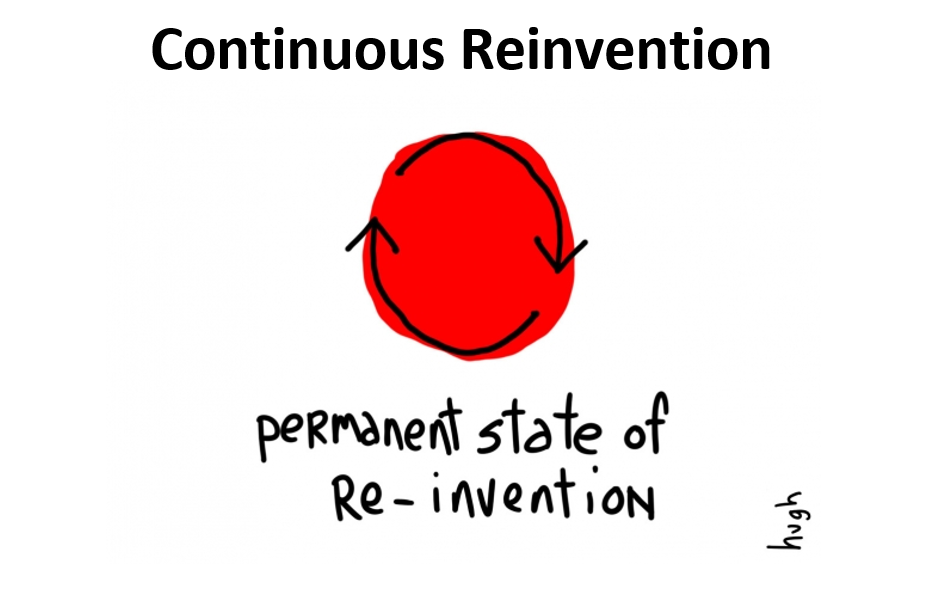
So my core message is that the most important of the 8 blocks is that you need to change your and your organisation’s mindset to a permanent state of re-invention.


Continuous Reinvention

Share this:

  • Tweet
  • Email

Filed Under: digital disruption, enterprise 2.0, social business Tagged With: creativity, culture, design thinking, digital disruption, digital transformation, end to end, leadership, social business

Social as Enabler for Digital Transformation (or is it the new Black?)

March 19, 2015 By David Terrar

Social as Enabler for Digital Transformation (or is it the new Black?)

It’s been a while since I’ve been to CeBIT in Hanover. At its height during the late 90s and early 2000s, the time of the dot-com boom, it had over 800,000 visitors and covered everything form of technology from consumer electronics to enterprise IT. The consumer electronics part happens elsewhere now but it has a dozen halls of enterprise technology, 180,000 visitors and over 2000 exhibitors – it is still a huge event by any standards. Within one of the main halls, alongside very large stands for Deutsche Telekom, Salesforce, SAP, Microsoft, Software AG and others, the Social Business Arena was a 3 day “show within a show” focussing on Digital Transformation. I was delighted to be invited across, at late notice, to do the opening keynote when the organizers and my good friend Dion Hinchcliffe called me Saturday evening to say Dion was needed back home urgently.

I’ll post my keynote later on, but here is Bjoern Negelmann interviewing me just after the keynote on Monday talking social as an enabler for Digital Transformation. I talk about social as the glue that can, if deployed correctly, connect the organisation’s people and processes to do things more effectively. We go on to talk about Digital Transformation as a term becoming a bit of a catch all for many social and digital components. “Is Digital the new Black?” asks Bjoern. But no, it’s not just fashion, it’s vital!  I explain that a successful business must use these social and digital components, many of which have only come in to our personal and business lives over the last 10 years or so, to create value and drive the business forward. The C-Suite needs to get educated, but I also talk about how there are no one size fits all solutions – the approach will vary depending on the “digital state” of your company, and “digital experience” of the leaders.

Most of the presentations were in German – I think only Sameer Patel and I spoke English on that first day, but there were some great conversations going on.  You can follow them at #cebitsba.

Share this:

  • Tweet
  • Email

Filed Under: digital disruption, enterprise 2.0, Social Business Arena Tagged With: CeBIT, digital transformation, enterprise 2.0, Germany, Hanover, social business

« Previous Page
Next Page »

Sign up for our regular Agile Elephant Newsletter - news, posts, ideas and more.

My Tweets

From the Agile Elephant Blog

  • The Metaverse doesn’t exist yet, but…
  • Impossible Things get Disruptive
  • Clarity, Cloud, and Culture Change at IBM

What Next?
Take a look around our site, check out our approach, see how we can help, join the conversation on our blog or contact us to find out more.

About Us

Agile Elephant is a new kind of consultancy designed to help companies embrace the new digital culture of social collaboration, sharing and openness that is changing business models and the world of work.

Contact us to find out more!

Our founder's blogs:

broadstuff

@DT on Medium

Technotropolis

Our blog:

The Agile Elephant Blog

Site Log In | Site Log Out

Subscribe to Site RSS

Subscribe to our Blog via Email

Enter your email address to subscribe

Join 30 other subscribers

Copyright © 2026 ·Streamline Pro Theme · Genesis Framework by StudioPress · WordPress · Log in