Agile Elephant making sense of digital transformation

innovation | digital transformation | value creation | (r)evoloution

  • Email
  • Facebook
  • Google+
  • LinkedIn
  • Twitter
  • Home
  • Manifesto
  • Services
    • Our Approach
    • Our Services
    • Making Collaboration Work Packages
    • Collaboration Solutions
    • Our Experience
    • Workshops
    • Innovation
  • About Us
    • The Team
    • Why we do what we do
    • Why are we called Agile Elephant?
    • Our Partners
    • Our Clients
  • Get Involved
    • Events
    • Meetups
    • Unconference
    • Newsletter
  • Resources
    • What is Digital Transformation?
    • What is the Digital Enterprise Wave?
    • Our Research
    • Case Studies
    • People We Follow
    • Articles & Links
    • Books That Inspire
  • Blog
  • Contact Us
Home Archives for David Terrar
Agile Elephant now on Digital Outcomes and Specialists 2

February 3, 2017 By David Terrar

Agile Elephant now on Digital Outcomes and Specialists 2

This is a little pat on the back for the Elephant. I’m pleased to report that Agile Elephant has been awarded a place on Digital Outcomes and Specialists 2, but what’s that?

It’s part of the UK Government’s Digital Marketplace. The marketplace was set up to in part to help reduce the friction, overhead and cost of Public Sector organisations procuring technology, services and expertise, but also to help more and smaller IT services firms gain access to bid on Government projects.  Historically, most of government IT was being handled by a small number of well known systems integrator and IT services firms. Now Public sector organisations, including agencies and arm’s length bodies, can use the Marketplace to find a wider range of people,  technology and firms for digital projects.

You will have probably have heard of the term G-Cloud, which is often used by some synonymously with the Digital Marketplace.  The marketplace actually provides the ability to buy and sell:

  • Cloud services covering everything from web hosting, business applications, website development projects or even IT health checks, all through the G-Cloud framework. You can also buy access to physical datacentre space through the Crown Hosting Data Centres framework.
  • Digital outcomes, digital specialists and user research services through the Digital Outcomes and Specialists framework.
The first area is all about Cloud services – SaaS, PaaS and IaaS products and services of various kinds. The second is about finding the right digital and cloud experts and consultants to help tasks and projects, or about developing bespoke systems and software projects.

We’re delighted to be involved and we’ll report news of our progress here. Please contact us if you are a government department that needs any sort of digital expertise or help making sense of the transformation challenges ahead of you.

Share this:

  • Tweet
  • Email

Filed Under: digital transformation strategy, marketplace Tagged With: digital, G-Cloud, GOV.UK, UK Government

Enterprise Digital Summit London in tweets and photos

November 26, 2016 By David Terrar

Enterprise Digital Summit London in tweets and photos

Here is a first taste of the story of last Thursday’s Enterprise Digital Summit London in tweets and photos. Our aim is to put on London’s most enterprise oriented event on digital transformation, helping organisations change mindset to deal with the incredible technological and competitive pressures of the 21C world of work. Here is the day from the audience’s perspective. We’ll publish posts, an event report, videos and more photos soon:
This gallery of photos below are all taken by our friend across from Germany Ellen Trude:


More content coming soon.  If you want to find out more about our approach, or you need help with your digital strategy, then please contact us.


Share this:

  • Tweet
  • Email

Filed Under: #EntDigi conference, agile business, corporate culture, digital disruption, digital transformation strategy, events Tagged With: British Academy, digital transformation, London

What is the Digital Enterprise Wave?

November 21, 2016 By David Terrar

What is the Digital Enterprise Wave?

We collaborate with and guest lecture at Henley Business School.  As part of their input to the future FutureLearn project I was filmed as part of the promotional video for their course “Digital Leadership: Creating Value Through Technology”.  FutureLearn is a free resource with hundreds of free online courses from top universities and specialist organisations.  The latest edition of the Henley course started on 7 Nov, but check out what else is available from this excellent resource.
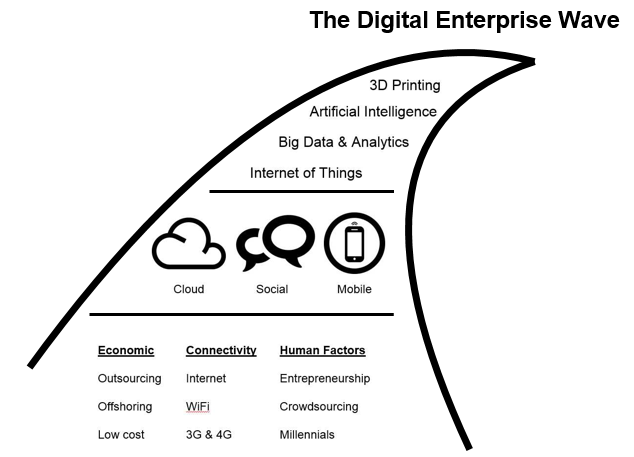
Digital Enterprise Wave simpleThe guys at Motion Blur Studios filmed me explaining what we call the Digital Enterprise Wave.  We’ve been talking digital for more than 20 years with the shifts to cloud computing, social technologies and mobile at the heart of the changes.  The resulting disruption has many explanations, but we use the metaphor of the wave to explain the onslaught of transformational technology that is changing both our personal lives and the world of work.  Watch the short video on Vimeo or above, or go here for more.
If you want help making sense of digital and how to distribute it across your enterprise, then join us at the Enterprise Digital Summit London.  Follow the link here or below to find out more.

eds_blogteaser16

Share this:

  • Tweet
  • Email

Filed Under: #EntDigi conference, digital disruption Tagged With: digital disruption, Digital Enterprise Wave, digital transformation, FutureLearn, Henley Business School, MOOC

Lecko on collaboration and Microsoft on Teams at SMILE

November 16, 2016 By David Terrar

Lecko on collaboration and Microsoft on Teams at SMILE

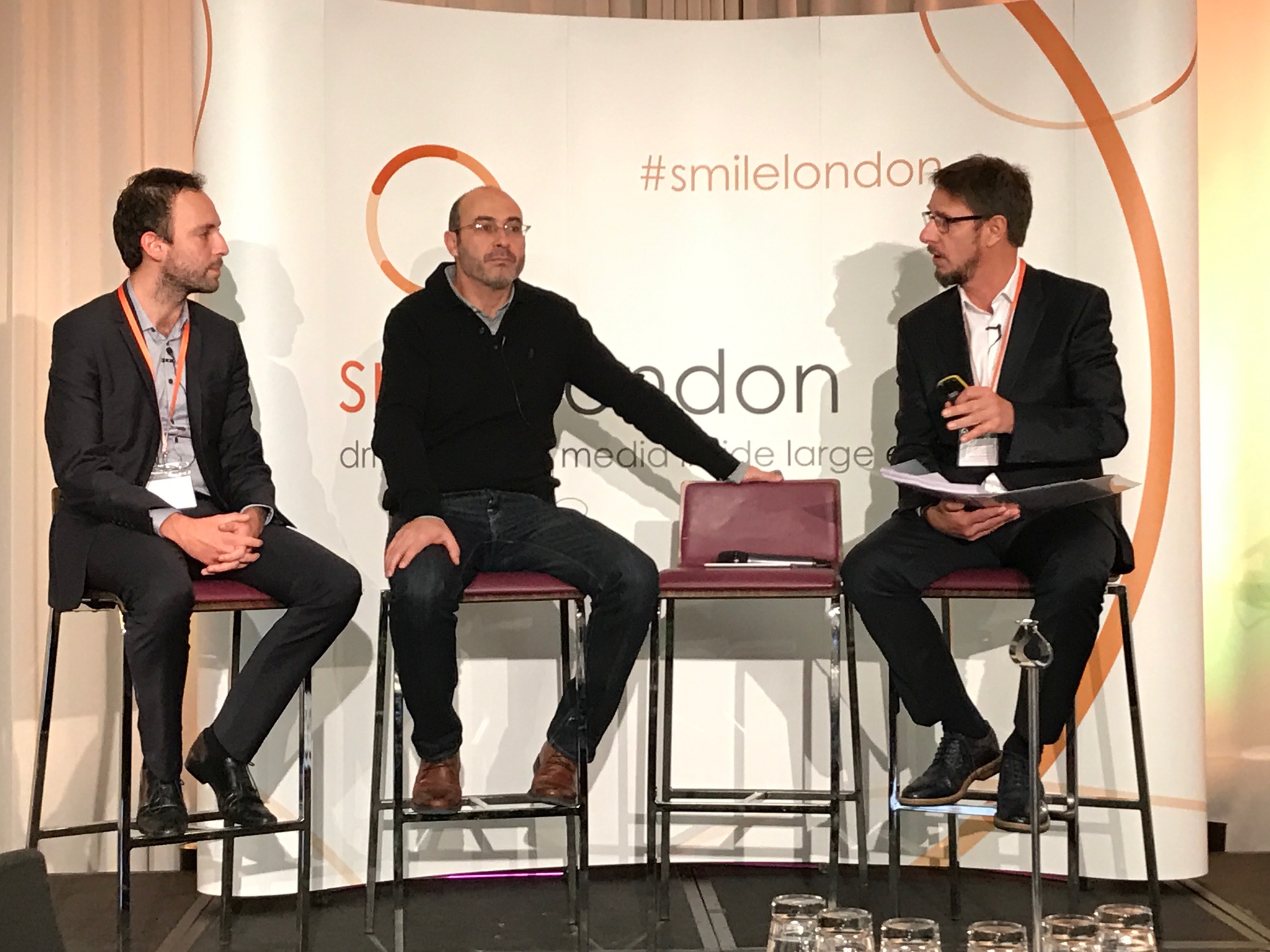
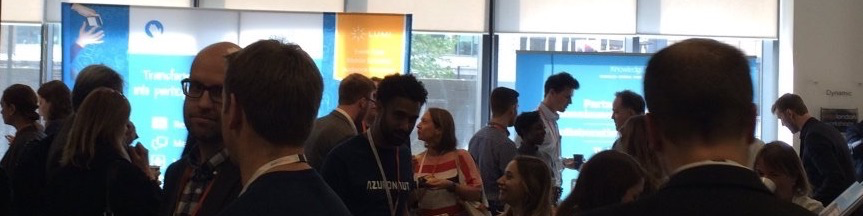
Marc Wright invited us to join in the simply communicate fun at Social Media In Large Enterprise London yesterday – follow #smilelondon to see the great tweet stream.  This is the first of a set of posts from the Agile Elephant team reporting on what was an inspiring and well organised day, packed with good stories and networking.  I’ll cover thoughts from our research partners Lecko combined with observations on Office365, Microsoft and Teams.

img_1197

Michel Ezran and Bastien Le Lann of Lecko were Marc’s first victims of the day.  Lecko have been reporting on the enterprise social network and collaboration space for 8 years.  We’ve been working with them for the last 2 years.  Amongst a lot of research reports and analysis they publish an annual report which analyses the market to show how companies are using enterprise social networks, social collaboration and productivity products, and then provides a detailed comparison of the platforms available – they survey 30 products against 550 criteria.  They cover every significant solution from Jive and IBM Connections to products like Office365 and Slack.  Yesterday they explained their 4 headline findings from the report:

  1. Collaboration and use of social software is steadily on the increase,  more than 15 % up in 2015 over 2014.
  2. Managers have a significant level of awareness of the benefits (and risks) of digital transformation, but they still lack practical knowledge
  3. Digital Leaders are engaged in a sustainable way – they represent a new asset for the more digitally savvy companies
  4. Use of social collaboration is happening and helping at the heart of the value chain.

screenshot-2016-11-16-09-43-46

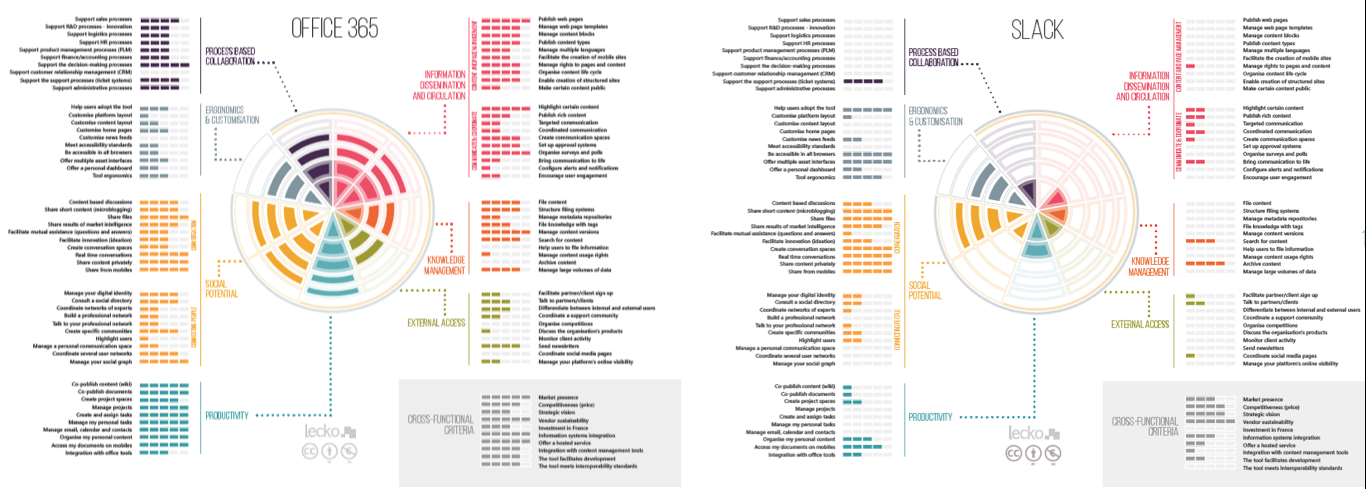
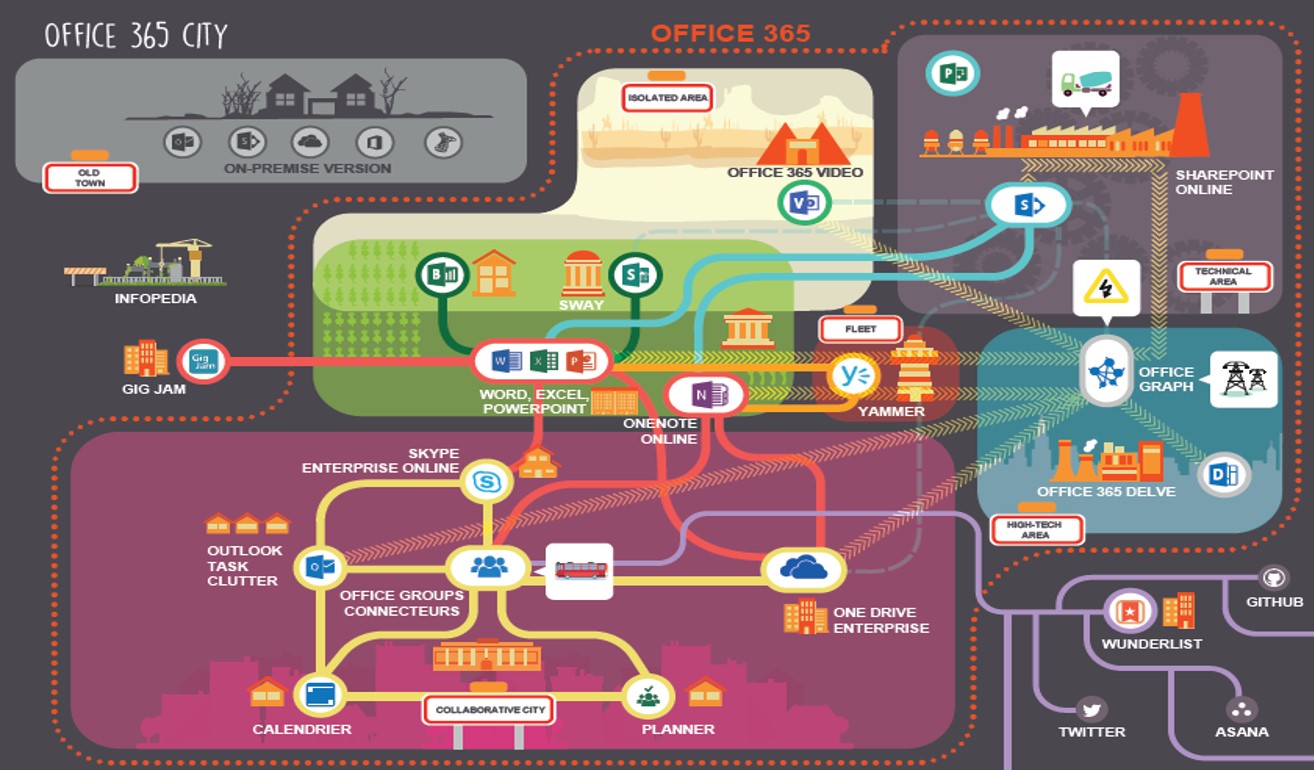
Take look at the detailed data sheets they produce in their product comparison.  (I’m not expecting you to read the detail above, just get a flavour of how they show a product’s strengths and weaknesses – download the report to get to the detail.) The charts for Office365 versus Slack quickly show you the scope and strengths of each.  They went on to present a separate report, also available for free download – their latest deep dive in to Office365 which was published at the end of last month, a few days before Microsoft announced Teams.  It provides a detailed review of Microsoft’s strategy and multiple, overlapping product set.  I particularly like their “London Underground” influenced map showing how the Office365 City fits together.  Their conclusion is that they see a very good product, but it hasn’t yet realised a true digital workplace and they don’t see integration or an app layer.  The report will be updated to reflect Teams, which is actually built on the Office Groups functionality which is at the centre of the map.

lecko-office-365-city

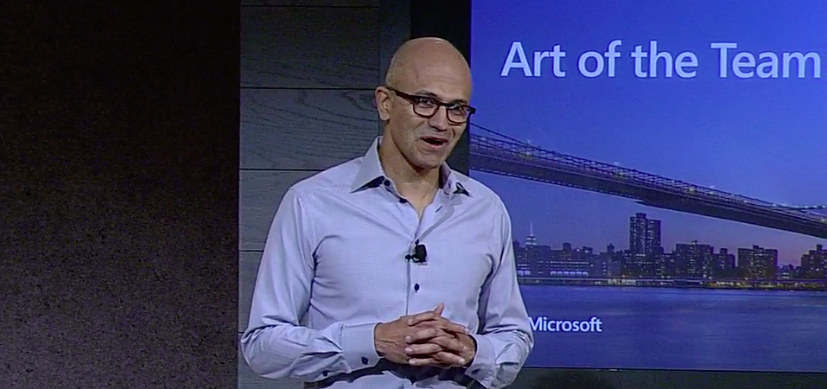
Later in the day Rich Ellis of Microsoft talked with Marc about the new Teams product and how it fits in to their strategy.  Rich was at Yammer before they were acquired, and was very clear in explaining that “Yammer is going nowhere!”.  There were a few chuckles around the room, but he went on to explain Yammer is a key part of their strategy and onward development, providing broad collaboration across work groups.  He commented that Satya (Nadella, the Microsoft CEO) jumps in to Yammer to connect and join in the conversations happening across the company.

Rich explained how Teams is powered by Office Groups and how the Office graph sits below mapping what is relevant to us, listening to what we are working on and seeing what we are doing  When you set up a Team it generates a team email address, chat space, with a team OneNote and team sharepoint.  He explained how you might start with a group which is private or closed, and how groups are searchable and you chose chose which ones to join.  The idea is to let users gravitate to the tools they want to use, and cater for all the options.  So Teams doesn’t replace Yammer.  It provides small team collaboration while Yammer allows broad collaboration across groups and will continue to be developed.

He talked about early customers like Accenture, who already have 750 TB of teams data on their OneDrive. He talked of the the compute capacity available to customers and how you can do real time language translation within Skype for Business.  He highlighted the openness of Microsoft’s approach commenting that they even have a connector in Teams for Google analytics. In answers to questions from the audience he alluded  to future developments in Yammer to allow external sharing beyond internal users, saying “stay tuned, it’s coming”.  He explained how Teams is a public cloud based app, but that there would be extensibility to connect to hosted and on premise solutions.  Inevitably he was also asked about Microsoft’s reaction to Workplace by Facebook.  With a wry smile he explained how they are excited by the breadth available in the marketplace.

He made a strong case for how Teams provides a big step towards the digital workplace and is a very significant addition the Office 365 product family positioned alongside Yammer.

We’ll publish more on SMILE London soon, and if you want to know more about distributing digital across the enterprise, join us at the Enterprise Digital Summit London next week on 24 November.  Follow the link here or below to find out more.

eds_blogteaser16

Share this:

  • Tweet
  • Email

Filed Under: collaboration, Enterprise Social Network, office software, social business Tagged With: digital transformation, Lecko, Microsoft, Microsoft Teams, Office365

Microsoft Teams and Slack point to the future of collaboration

November 3, 2016 By David Terrar

Microsoft Teams and Slack point to the future of collaboration

Yesterday Microsoft responded to the incredible rise of Slack, the cool “new kid on the block” inter office chat app, with Teams. I watched the live stream of the announcement and was surprised. I expected a Slack alternative, a “Slack killer” even, but what they’ve announced is much more significant. Teams and Slack together signpost the future of collaboration and the evolution of the digital workplace. The collaboration and enterprise social network software providers need to take notice.

Over on Hewlett Packard Enterprise Insights, their enterprise.nxt guide to digital transformation, they published my post “5 things Slack and Microsoft Teams tell us about workplace collaboration”. This is a companion piece, amplifying those conclusions having had a chance to think through the implications of what I saw streamed from yesterday’s Microsoft NYC Office event.

screenshot-2016-11-03-17-39-57Earlier in the year it had been rumoured that Microsoft might buy Slack for $8Bn, but they’ve done their own thing instead. Yesterday’s announcement was an open secret for a while, and Slack took the rather interesting step of publishing a full page advert in the New York Times, simultaneously publishing the text on Medium. They say they are excited at the competition, but that’s more in the context of the purported Chinese curse “May you live in interesting times”.

First let’s run through what Slack have achieved, which is pretty incredible really! They’ve only been around since August 2013. You probably didn’t know that the name is an acronym, “Searchable Log of All Conversation and Knowledge”. Slack has $540m in funding and a valuation of around $3.8 billion at their last funding round in March, and then we had those Microsoft rumours. Back in May this year Slack passed 3m daily active users, but that was 3.5 times growth in both free and paid for users over the previous year, and the rate isn’t slowing down (so even with Microsoft’s announcement, Slack won’t be going away). As I explained in the HPE article, Slack is used by 77 of the Fortune100. There are teams inside eBay, Ogilvy, Salesforce, Samsung, and Urban Outfitters. IBM themselves have 30,000 users, and have even announced a partnership with Slack so Watson’s AI can quickly provide insights from the huge data sets collected by the messaging system. Slack is being used by large enterprises, small enterprises, by groups of developers sharing code snippets, and it’s even gaining traction in the gaming community.

Like so many web based products of recent years that we know and love, such as Twitter or Flickr, it is the result of a company doing a pivot from their original intention. Stewart Butterfield and his team were working on an online game called Glitch. They had developed their own internal messaging system, and when the online game didn’t succeed, they launched their internal collaboration solution instead, to become the cool product platform that it is now. They have the classic freemium business which has made it easy for groups of users, frustrated with whatever collaboration options they have within their enterprise, to set a Slack group, invite people in and provide their own tactical solution to help a particular community, issue or project. There are plenty of other options around like HipChat in the business world, or Discord in the gaming community, but in a very crowded market of overalapping communication tools, Slack have made a big impact inside 3 years.

Let’s look at what Slack actually provides a group of users. The functionality covers three areas:

  • A message threading alternative to email that is device independent. I can use it on Mac, Windows PC, through a web interface, or with mobile apps for smartphones and tablets. Conversations are synced across all devices so I can join the conversation in one place, and continue on a different device when I’m on the move or back at the office.
  • It has a more open communication approach – the conversations get organised within channels that are like the hashtags I’m used to on public social media platforms, and everything is searchable so that I can easily loop in the skills and people I need.
  • The third key area is Slack’s focus on helping me with menial tasks. They have a growing directory with over 750 apps, chatbots and algorithms that I can deploy to help make my collaboration life that little bit easier. Slack are riding the growing wave of Bots, Machine Learning, Artificial Intelligence and Robotic Process Automation – a mega trend that is changing office work just as much as automation has on the shop floor.

But wait, there’s more. I mentioned sharing code snippets, but those 750 apps include easy integration with developer and agency friendly tools like Trello, IFTTT, Zapier and GitHub. They are also investing in people to help them scale with senior hires from Salesforce and Foursquare this year.

Slack’s success highlights a key problem for our existing collaboration software options. They are more difficult to use than they should be. On top of that, the digital workplace is a mess. Alongside whatever we use for team collaboration, we access a whole host of disparate corporate systems with differing interfaces to get the job done. Slack has the ease of use and frictionless set up of the consumer apps we all used to on our smartphones and tablets. On top of the user experience there are two more factors. First, team chat functionality which allows me to find, connect and communicate with the right experts helps me get the job done. It’s a core component of all the administration and knowledge work we do. Second, and the masterstroke, is the open platform which provides the store of bots and integrations to third party apps. It means Slack (or Teams) provides me with a place where work happens. Where I can connect to these disparate app silos that my company uses, but in one place where the useful conversations are already happening. This is the starting point for a proper digital workplace, or what Dion Hinchcliffe called a digital workplace hub in his post on ZDNet a few days ago.

More than anything with this team chat based digital workplace approach, I’m looking forward to the demise of email, and products like Slack and Teams bring that a little closer. Having discussed the incredible rise of Slack, the functionality it provides, and some of the reasons why it’s been successful, what did Microsoft give us in response?

screenshot-2016-11-03-17-43-53

Yesterday, CEO Satya Nadella and Office Corporate VP Kirk Koenigsbauer, with a little help from their friends, laid out the new strategy and provided an impressive demo of Microsoft Teams. From my initial take it has many of the good characteristics of Slack, certainly has a similar look and feel, but offers the potential of more through tight integration with the Office365 family of products that it sits in, and becomes the front end to. Satya opened the announcement talking about how the new product needs to accomodate how different teams work differently, using the example of jazz ensembles, crew races, and even cricket teams, and that sets up the fact that the product allows you to customise the experience on a team by team basis.

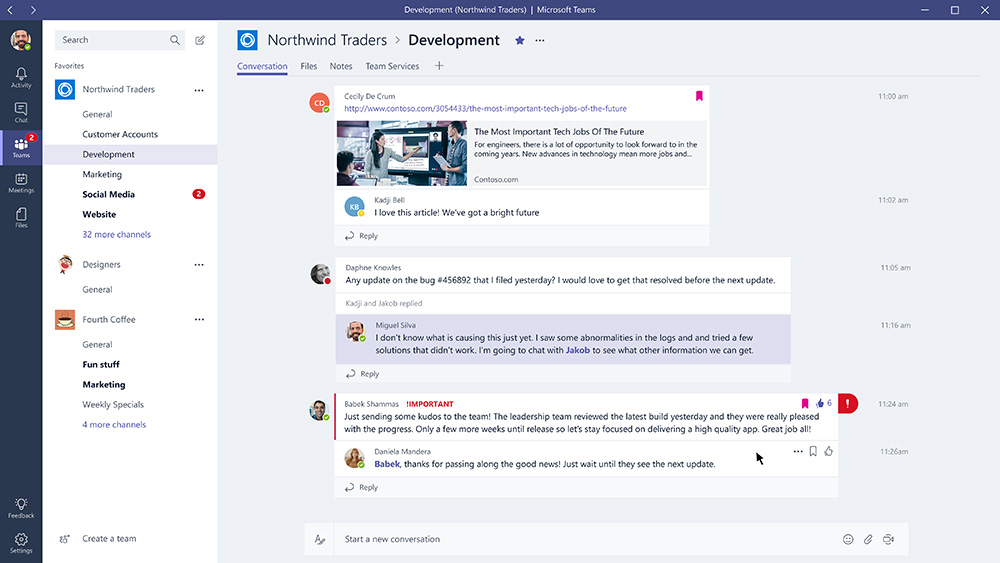
Getting in to the demo helps explain what Teams does. Over on the left of the screen there are tabs for activity, chat, teams, meetings and files. This bar moves to the bottom in the mobile experience. When you set up a private team, a Sharepoint is automatically provisioned “behind” it to support it, and so any files are put there or created there. The team space showed normal multithreaded conversations, and I rather liked the way messages to you were highlighted with a red tab/tag over on the right of the message. You can open files or notes within the stream, and have conversations around them. Of course (the rather excellent) OneNote has all the characteristics of a wiki for co-creation. When you go in to a team space, you can pin things on to the tabs across the top of the space. Things like the budget for this project (an Excel spreadsheet), a planner for this project team, or even third party tools like Zendesk, accessed right there. This access to, and seamless integration with, the whole of the Office365 suite, or things like Microsoft Power BI, and on top of that a set of third party apps too, is crucial. Teams acts like your inbox, or maybe it’s a workbox, or maybe it’s your digital workplace hub.

When it comes to typing your messages you can add emojis, stickers, or attach files. A ‘Fun Picker’ lets you find and add Giphy GIFs, or memes. The next thing to say is that you can interact with bots just like in Slack. T-Bot sits on top of  Teams’ help system, so you can ask questions like “how do I create a channel?”. WhoBot links in to the directories, and more importantly the conversations and meta data associated with that person, so you can ask “who knows about ticket sales?”. You can jump in to video chat with the team right there, using Skype.

threaded-conversations-in-microsoft-teams-web

Microsoft Teams is available now as a customer preview in 181 countries and 18 languages. General Availability is planned for Q1 2017, when it will have 85 Bots, 70 connectors, and integrations with 150 partners including Zendesk and HootSuite. In terms of licensing it is available to any user on an O365 Enterprise or Small Business plan. One key point that Satya emphasised is that Microsoft already have 85million active users of O365, and this is the market they are addressing.

Microsoft Teams looks like a very good team chat option, but it has important advantages if you are already following an Office 365 strategy. Both Slack and Teams bring you to a place where you can connect and collaborate with overlapping teams to get things done. They both plug in to the rising trend of bots and AI to automate tasks, find answers quickly and easily, and save time. They both offer an array of integrations with other business apps and so begin to provide a practical answer to Dion’s digital workplace hub. They definitely point the way for the next stage of collaboration solutions, and the major social software players need to take note.

Find out more about this year’s Enterprise Digital Summit London:

eds_blogteaser16

Share this:

  • Tweet
  • Email

Filed Under: collaboration, Enterprise Social Network, social tools, software tools, Uncategorized, workplace Tagged With: IBM, Microsoft Teams, Satya Nadella, Slack, Stewart Butterfield

Barclays doing Digital differently

October 10, 2016 By David Terrar

Barclays doing Digital differently

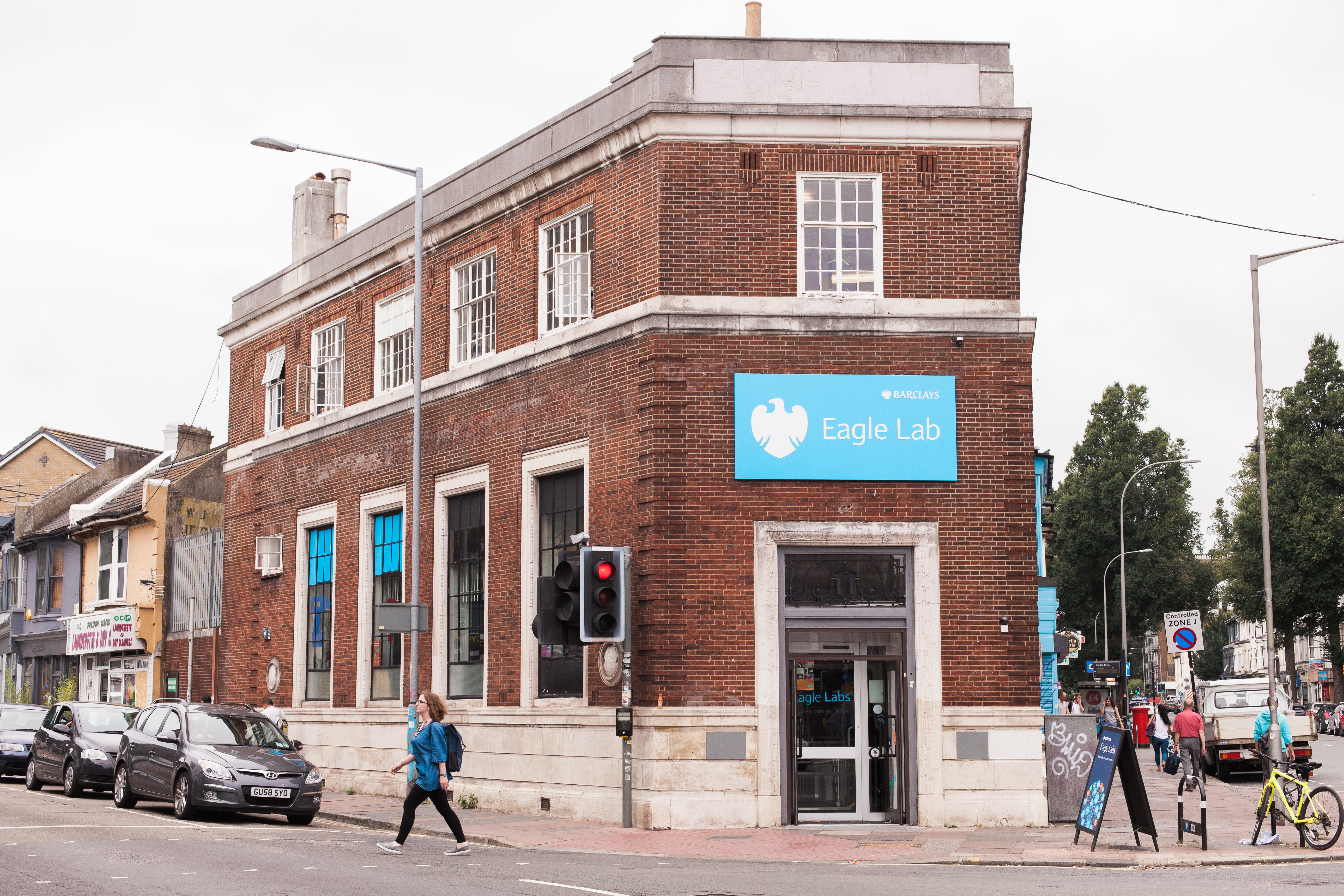
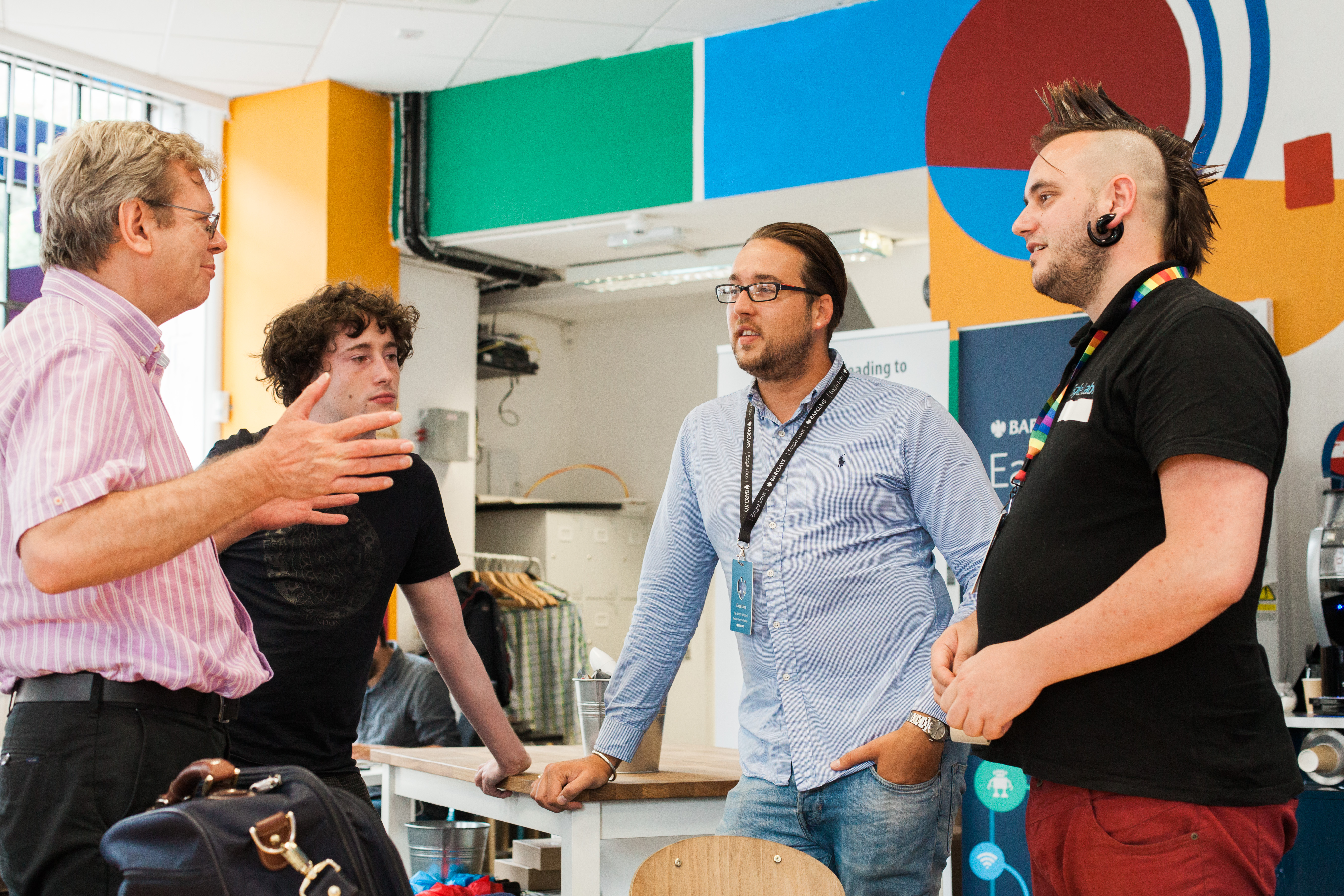
Back at our first, November 2014 version of the Enterprise Digital Summit London, Dave Shepherd, Director of Eagle Labs & Digital Eagles for Barclays Bank, came to speak about their Digital Eagles programme.  Barclays decided to create a team of front line staff who are on hand in branches across the UK, actively encouraging and educating customers and non-customers to acquire digital skills, so they feel confident to explore technology – a team of over 12,000 has been created so far.  Dave invited me down to Brighton to visit their latest initiative – a network of business incubators and fully equipped maker spaces called Eagle Labs.  Barclays are an excellent example of a well known, established brand with a long history that is approaching Digital in a new way.

_mg_5868They are re-using under utilised branch offices or other spaces to create this network of Eagle Labs.  They piloted the idea in Bournemouth and then Cambridge – Brighton was the third.  They’ve got 6 now, Notting Hill in London opens shortly, with Jersey, Norwich, Salford on the cards.  Barclays are taking a “fail fast” approach, trying things out in each new Lab, and learning as they go.  The initiative itself feels more like a start-up than something run by a big corporate entity, and I’m sure that difference in cultural approach is key to making this a success.
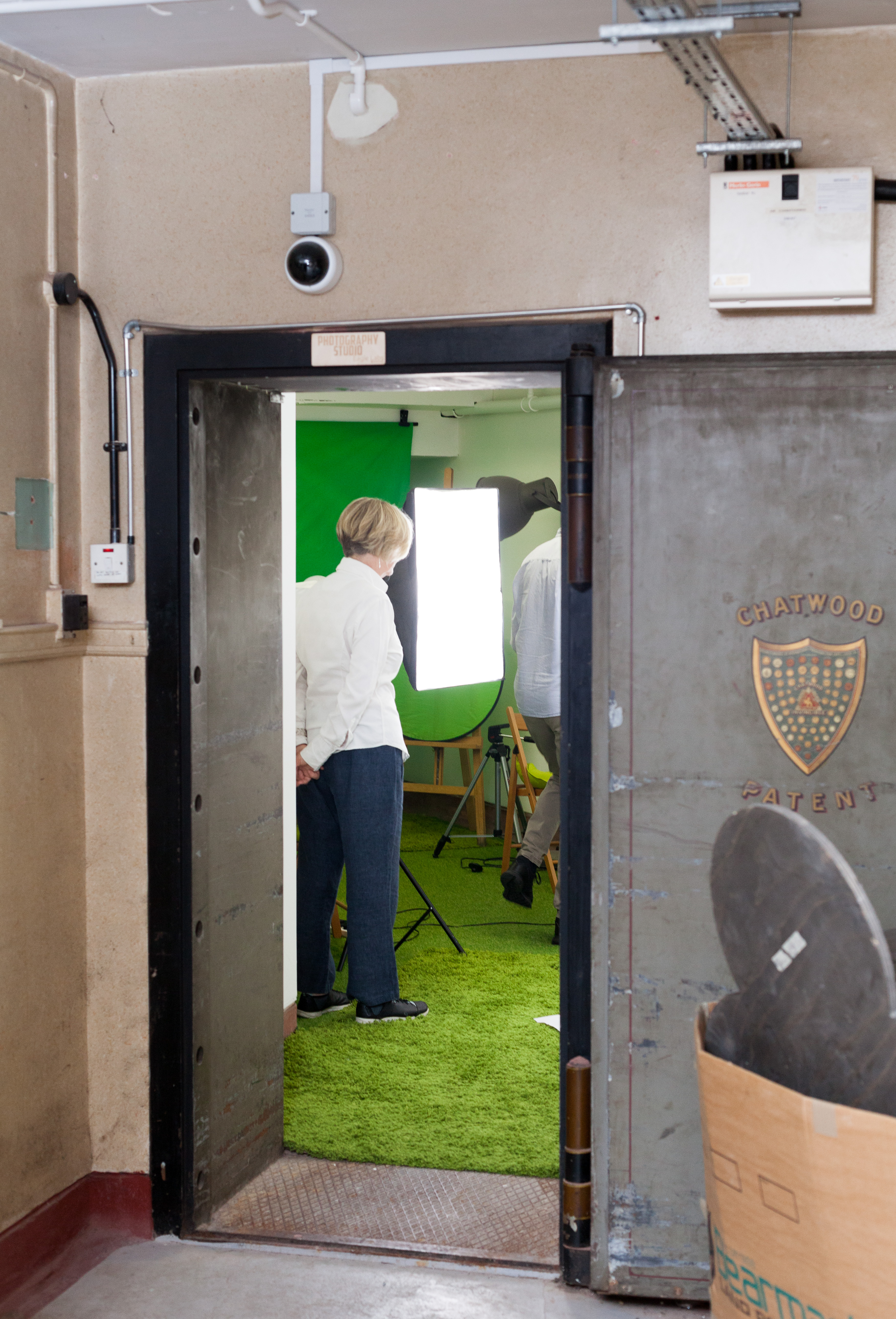
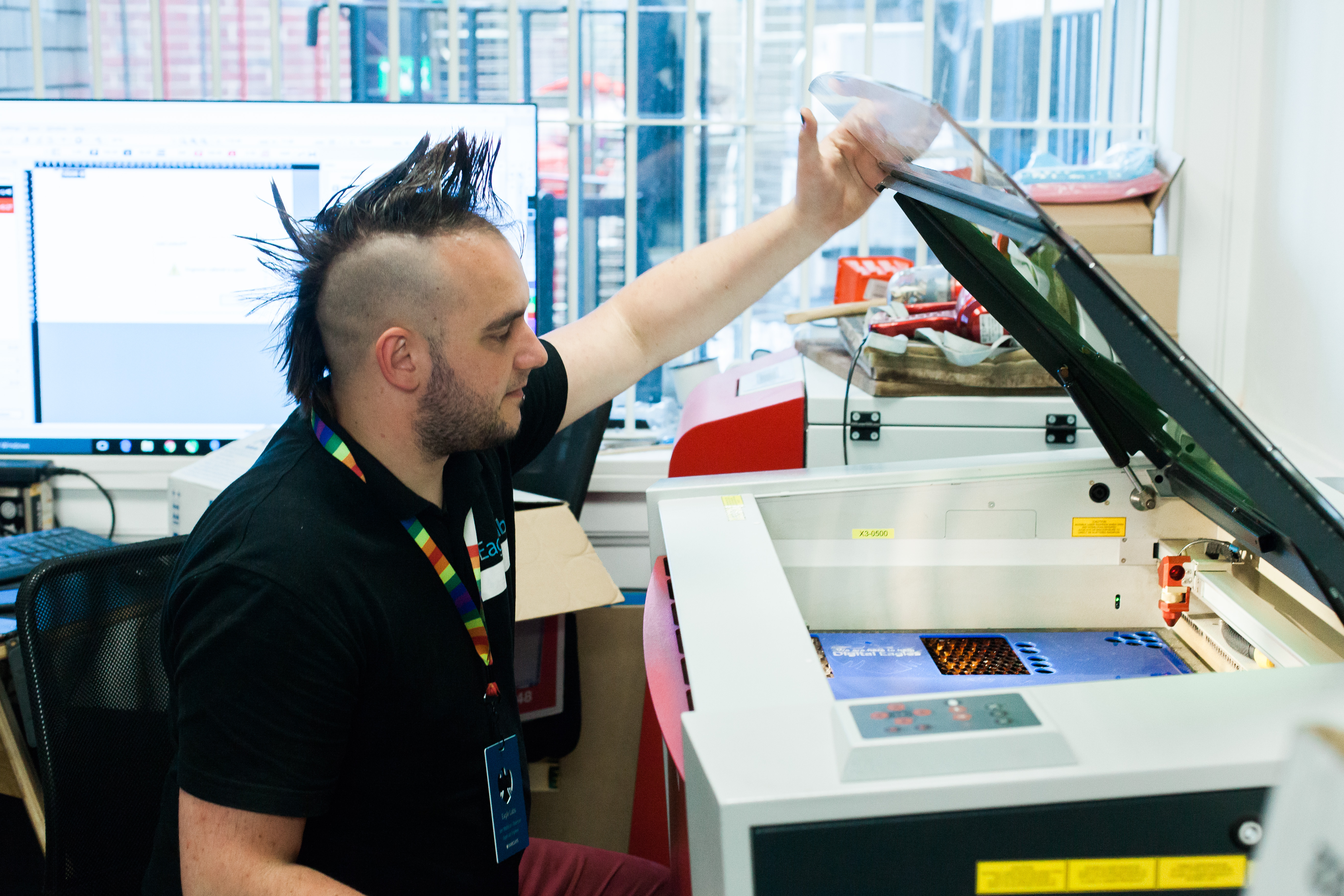
_mg_5849The space I visited is a perfect example of what they are trying to achieve.  The building started life as the Brighton Union Bank back in 1870.  It had been a Barclays branch for decades, but had closed, laying derelict and empty.  The lease runs to 2018.  Barclays have smartened up the outside, reclaimed and refurbished the space, finding ways to convert the old branch infrastructure for its new use as cost effectively as possible.  The old branch manager’s office has become their maker lab with a laser cutter, 3D printer and all of the tools you would need to build a prototype for your business idea.  One of the old bank vaults downstairs, with it’s very impressive steel door has become a photographic studio.  Rather than take the corporate approach of laying expensive new flooring and a typical office refit, they’ve sanded down the old parquet flooring, renovated the old doors and are trying to retain as much of the character of the building’s history as they can, much as you would with a house renovation project.  The old bank “front of house” has become shared office space for the incubator start-ups and small business.  An office upstairs where cheques and local accounts would have been processed has become a presentation and meeting room for hire, with more of the feel of the kind of space you would find at Google, with bean bags and a coffee table made from a big old reel for industrial cable – not what you would expect from one of the oldest retail banks in the country.

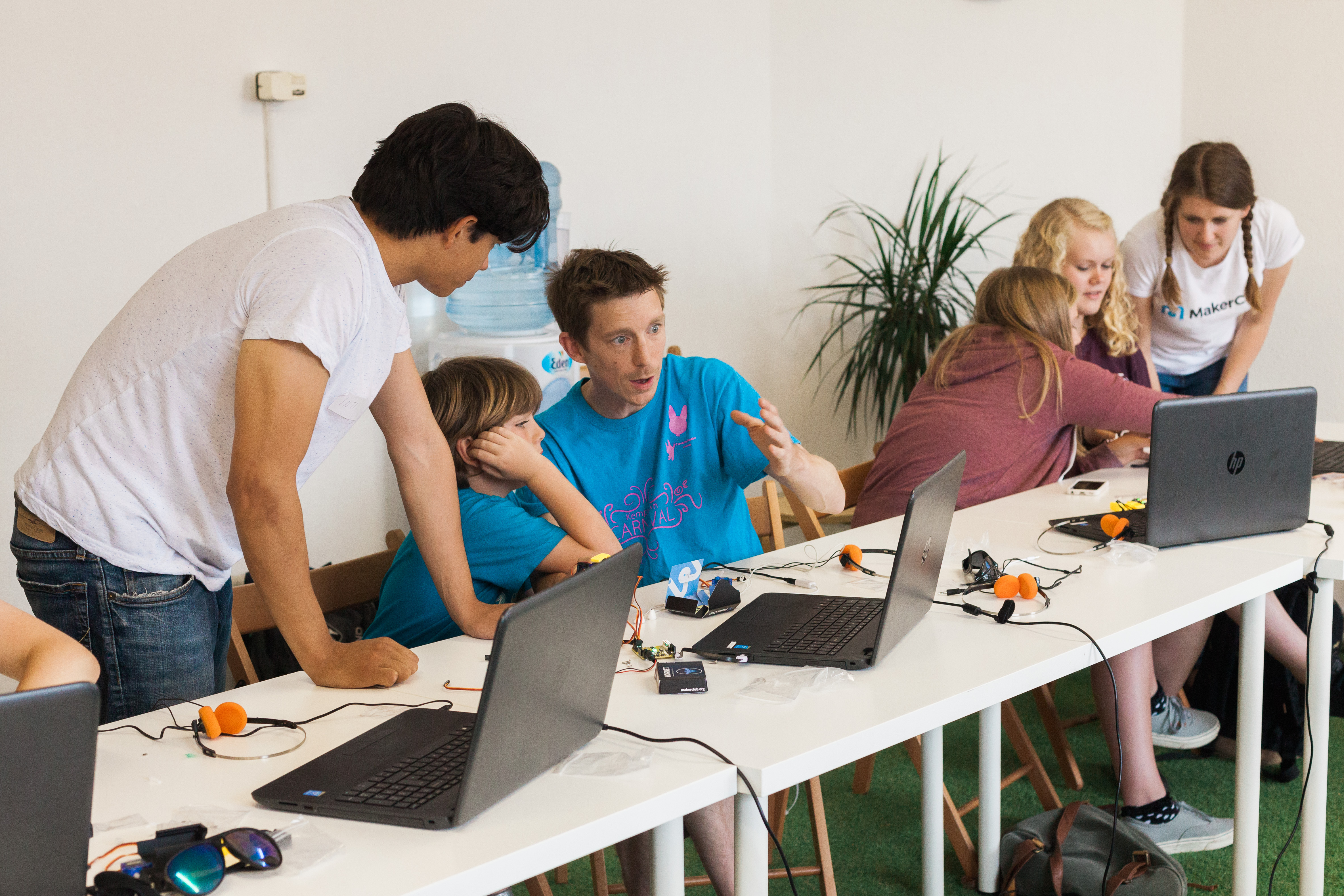
_mg_5882Barclays aren’t taking a traditional venture capital style incubator approach.  They don’t take a stake in the businesses, although they do pay rent to the Lab, and of course Barclays would like to bring them on board as business banking customers.  However, a key part of what they are trying to do is connect to the local business community and build relationships in the way that a local branch manager would have done in the past, before retail banks started to centralise everything in the quest for cost savings and efficiency.  They want to build an ecosystem of coaching, support and partners who work from the Lab to help the members and connect with the local area.  While I was there I met two locals who had left corporate jobs to freelance in marketing and training – something that’s happening a lot around the UK.  They’d popped in to use the photographic studio for half an hour to take better quality head shots for their LinkedIn profile.  I saw the laser cutter demonstrated _mg_5871to some people with a product idea.  I met Ryk, a user experience expert who runs TeamPro, a great looking start-up that works from the shared office space that provides free websites for sports teams.  I heard about open days for local businesses that the Lab runs to show what they do.  I saw that they run “Mend it Mondays” – for £5 they have an open session where their on-site technicians will help fix your broken stuff, or use the workshop to build new things.
I was introduced to Dave’s boss Steven Roberts, Strategic Transformation Director at the Bank. He told me:

“Bankers have traditionally been at the heart of their community, helping people with their finances, and supporting local business. The Eagle Labs initiative aims to strengthen that connection with direct help in new ways of working and emerging technology for start-ups and local businesses.  After Digital Eagles it’s the logical, next step for us to be building digital skills in the business community.”

The Brighton Lab provides a home for business advisors, brokers, web site designers, and businesses creating new apps and digital services.  It hosts 2 permanent offices with 4 staff in each, has 2 meeting spaces for hire or use by the members, a maker space, and the main area supports 25 co-workers.  They’ve linked to the local maker community and provide a hub for emerging technology in the local community.  Compared to their peers, Barclays are thinking differently, and doing digital differently.

_mg_5877

All photographs by Rhys Terrar


Extras:

30 photographs from our visit to the Brighton Eagle Lab

Steam Co’s video of the Brighton Eagle Lab Launch (with Steven Roberts and Dave Shepherd):

Find out more about this year’s Enterprise Digital Summit London:

eds_blogteaser16

Share this:

  • Tweet
  • Email

Filed Under: #EntDigi conference, digital disruption, digital literacy, innovation, workplace Tagged With: Barclays Bank, Digital Eagles, digital transformation, Eagle Labs, Incubator, Maker Space, Start-Up

Two lessons from Muhammad Ali on leadership

June 4, 2016 By David Terrar

Two lessons from Muhammad Ali on leadership

Muhammad_Ali_1966I’m sitting listening to the many tributes and reactions on the sad death of the greatest boxer of all time, the man who BBC viewers voted sports personality of the 20th century, somebody who was instrumental as an activist in the US civil rights movement of the 60s, who has died at the age of 74.  He exemplifies leadership and I want to remember just two lessons from him.

The first was explained in When We Were Kings, the superb 1996 documentary about the “rumble in the Jungle” – the Don King arranged fight between Muhammad Ali and George Foreman in Zaire in 1974.  In the last passage of the film, the great journalist George Plimpton is describing the intelligence and eloquence of Ali.  He described Ali making a speech at a 1975 Harvard graduation ceremony which enthralled the audience.  After he spoke, somebody shouted “give us one of your poems”, and Ali thought for a moment and said “Me…. We!”, which brought tumultuous applause.  Plimpton goes on to say how he got this listed as the shortest poem in the English language.  A poem which encapsulates in two words what the role and focus of a true leader is. That we are stronger, not from consensus but from the aggregation of our ideas and thoughts and decisions.  The wisdom of crowds.

The second is the elegance of the punch that Ali never threw in that fight.  He lands the winning punch, but has the humanity not to throw another.  He watches Foreman go down with his fist cocked but does what most other fighters would not do.  See it here:

We need leaders who think “we” rather than “me” and place themselves at the bottom of the organisation chart supporting their teams rather than pushing their heads to the top.  We need leaders who think of the big picture and way beyond just winning.

Photo unknown – [1] Dutch National Archives, The Hague, Fotocollectie Algemeen Nederlands Persbureau (ANEFO), 1945-1989

Share this:

  • Tweet
  • Email

Filed Under: leadership Tagged With: George Foreman, Harvard, leadership, Muhammad Ali, Rumble in the Jungle

SMILE London Workshops 2016 – Enterprise Social Networks and more

May 29, 2016 By David Terrar

SMILE London Workshops 2016 – Enterprise Social Networks and more

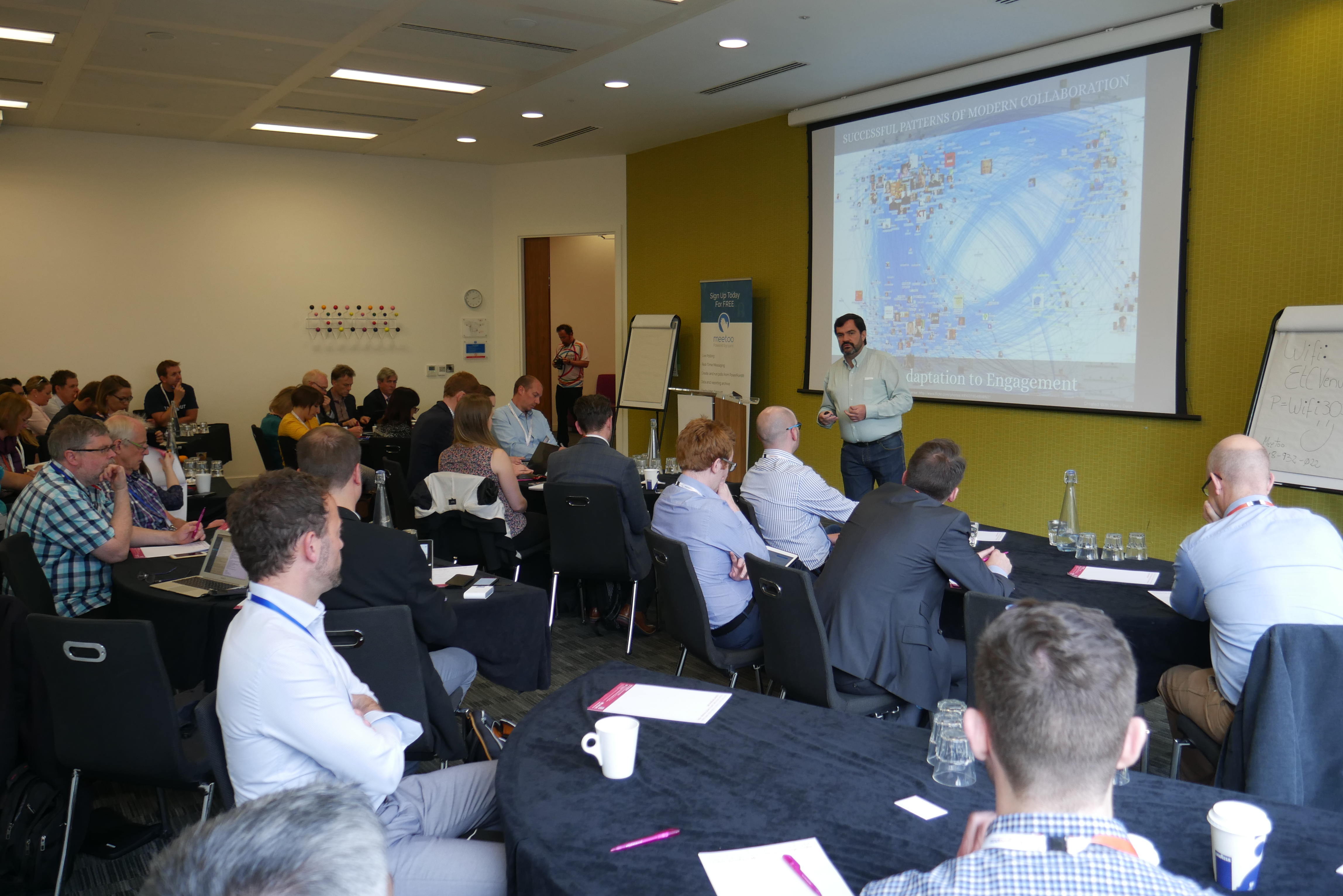
Back on 12 May, Marc Wright of Simply Communicate kindly invited us to join in the latest version of his Social Media Inside the Large Enterprise London Workshops. The new format has 4 time slots each with 3 choices of workshop, so you could attend 4 out of 12. They covered a varied set of topics and case studies aimed at giving practical advice and helping large organisations in their journey with internal social collaboration and social media communications. Speakers included our good friends Luis Suarez on adoption (and adaptation) of these tools, Faith Forster talking about her product Pinipa and making projects more engaging, and Michel Ezran over from France to present the latest version of Lecko’s annual research report analysing what is the best collaboration & social toolset. This is the second year we’ve partnered with Lecko to extend their research in to the UK and make their report more International. There was an interesting mix of sponsors, a good venue, good food, and enough time between sessions to catch up with friends and do some networking. One important aspect – some good bean to cup coffee machines were on hand to put this a cut above the average event on caffeine delivery!

The content was a mixed bag – some very good sessions, and some not so. There are some key themes that we noticed aggregating what we gleaned from the various talks:

  • The increasing importance of tackling mobile, but the the solutions aren’t fully there yet
  • Tensions and differences in approach between out of the box solutions and the bespoke developed enterprise social networks
  • A difference in mindset between those companies that are using Sharepoint at the heart of their office infrastructure, and those that aren’t
  • The importance of linking collaboration to legacy systems and business process.

ELSUA at SMILE London 2016One other strand from various discussions at the event – quite a number of organisations are using Yammer but reckoning they are having problems with adoption. Something to explore later, and I see Marc has already promoted a simply yammer workshop to address that issue.

Some of the sessions used the MeeToo app on your smartphone for real time polling and chat. I didn’t see much use by anybody of the messaging, but bringing in the poling to some sessions was a good addition to making things more interactive. A note to self on this – if you do this kind of Q&A poll, make sure you’ve thought through the answer options fully.

We Are Social ESN case study

I watched Peter Furtado of Simply Succeed and Emma Cumming of We Are Social talk through the launch of their SHIP enterprise social network (ESN). We Are Social are a great story of a UK social media marketing agency startup. Founded by 2 people in 2008, they now have over 600 people across 8 countries and count major brands like Adidas as their customers (We Are Social were responsible for their #bethedifference campaign). Emma told us they weren’t practicing what they preach and using social media consistently internally. Skype was their first client and they use Skype a lot themselves, but they had siloed groups, and knew that knowledge was getting lost, never to be found again. They put together a steering group for governance, and set up a virtual task force of about 10% of the company to make a new approach work. It was the task force who decided on a name for their ESN, chose a particular platform, and put together a plan for launching it across the company. They called the network The SHIP which comes from the company’s core culture and values – social, honest, inspiring, passionate. They put together a fun home page and a whole set of launch material using ship and nautical themes to tease people before the launch, and then encourage people to join in – using the kind of ideas they usually sell to customers, but on themselves – an excellent story. The SHIP network has groups, activity feeds and great search capabilities. During the launch phase they emphasised the importance of people completing their profile, adding a proper avatar photo, and adding their skills and languages. Finding native language speakers to help on projects is now much, much easier across the company. Emma said they have 631 people on the SHIP and on average 80% of those access it once a week. 30% of those are engaging every week, with 15% contributing – those are good numbers. They use it to generate ideas for a new brief, to work on projects, to communicate across the organisation. One of the founders, Robin, got actively involved in the launch and early adoption and it’s clear that commitment and leadership from the top is a factor in making this kind of network successful. That means you have to sell the value to top management to get them involved early on. One of the unusual things they did at launch was to use targeted Facebook advertising, selecting for people who said they worked at We Are Social – I think thats a very neat, cost effective idea. Peter Furtado, who was called in to help them launch, talked about the Simply Suceed approach of putting 60% in to planning and identifying the business case, 25% in to planning the launch and the rest of your time and resource in to drive adoption within the community. The particular social business platform We Are Social used was Telligent (formerly Zimbra) with custom development from an outfit called 4 Roads to get the look and feel they wanted, integration with Google Drive and the like.

OOTB platform for SharePoint & Wiggle ESN case study

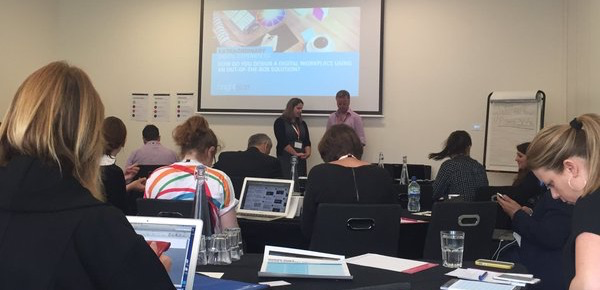
Brighstarr sesson at SMILE LondonNext I was off to see Martin Perks and Hannah Unsworth of BrightStarr. They are an experienced SharePoint developer and consultancy who have developed an out of the box ESN solution that sits on top of SharePoint called Unily. There are an increasing number of this kind of platform within the Microsoft ecosystem. Martin talked of the rise of the platform approach. In the past there might be a 24 month project to develop and launch an Intranet. In today’s environment we just can’t wait that long, our business might have changed completely in that timeframe. Added to that we are inundated with choices for sharing content, sharing documents, or different ways of instant messaging. He talked about pressure on the bottom line to get results, and the rise of mobile and the smartphone. He talked of custom IT projects being dead, team sizes having halved, and a significant decrease in a solely IT-led approach. He suggested build time has dropped by 79% in 5 year and that 80% of companies have the same requirements for an internal social network in any case. Hence the creation of an “out of the box” solution, branded as Unily and already an award winner (their customer DORMA was one of Nielsen Norman’s 10 Intranet Design Annual Award winners of 2016). Martin suggested budget is still with IT and not internal communications and so there can be a battle of wills where nobody knows where the Intranet project sits. Actually that is because it needs to be owned by everyone, and not just by IT or Comms. Brightstarr’s Unily supports this approach by creating an easy to use digital workplace with all of the required ingredients to help employees connect, collaborate and be more productive in their jobs. It provides a staff centric view to show that person the news that’s relevant to them and where they can contribute. Martin talked about mapping the requirements of communication, productivity, collaboration, knowledge, (and importantly) value over time. He agreed that it’s not just about technology and that the project has to be maintained, managed and led properly. Hannah talked about an agile approach and 4 week sprints developing the functionality. I found it interesting that the language and terminology leans towards the world of the programmer. They talked in terms getting things done in weeks not months and then introduced a customer to tell his story. Panos Mitsikis talked about implementing Unily at Wiggle. Interestingly, he described himself as a SharePoint developer. Wiggle, is a sports retailer, started back in ’99, who focus on triathlon – cycling, swimming and running. They outgrew an Intranet based on WordPress and realised that were spending too much time inside email communication. They needed a one stop for consuming information for each employee to surface what they care about. There are just under 500 Wigglers, as they call themselves and on a bad day, only 80% of them use the new ESN. It’s been designed to be employee centric, giving them important news, announcements, and videos with the aim of empowering them. It highlights trending documents, and they host events, or highlight sponsors They wanted an easy way for everything to be in one place, and so all the most commonly used apps are on a single page. It helps them form teams, manage projects, build communities, or follow external sites and blogs. So far they have around 45 project sites and every department has its own community. putting the site together took 4.5 weeks from start to finish with just Panos and plus two experts from Brightstarr.  They suggested that you shouldn’t be so precious about your requirements, and with this speed of implementation and success I can see why. They’ve decentralised content management and they suggested that Uniliy makes it much easier than vanilla SharePoint for creating that new content. The CEO was project sponsor and that was another key to success. The system handles multiple languages, supports everything Microsoft Office365 supports. You access Yammer from a social tab so you don’t even have to leave the platform to use that too. They carried out an aggressive campaign over a 3-4 week period to get everyone on board. Because Unily is provided as a Cloud based SaaS solution, it came with features Panos didn’t even think about, and Panos didn’t need any IT involvement to get it off the ground.

@ELSUA on Adoption/Adaptation

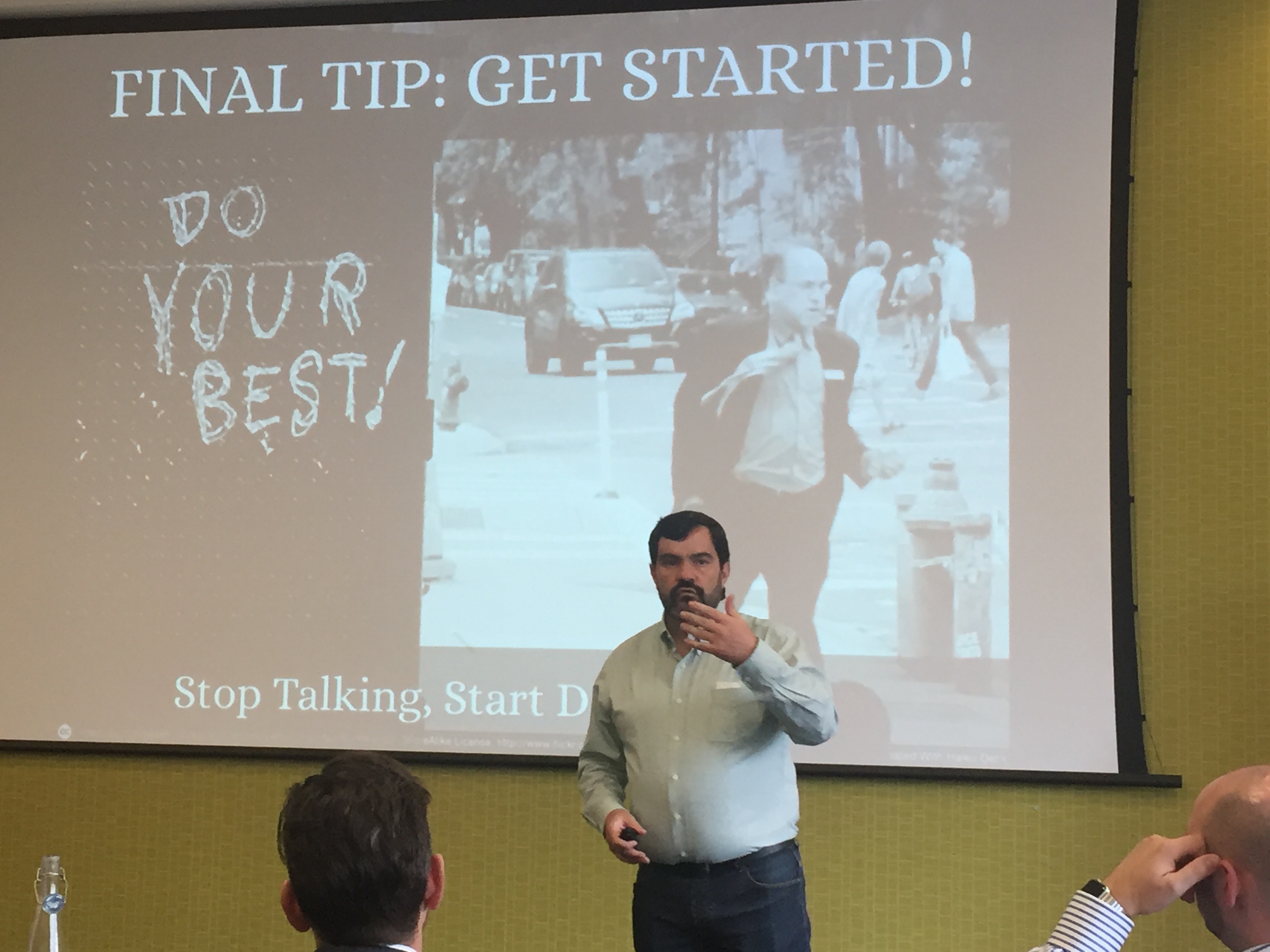
ESUA Final TipAfter lunch I joined the Luis Suarez session on adoption, or rather adaptation of social collaboration tools. Luis was relating his long experience in this field from his time in knowledge management, famously living inside IBM without email, and most recently as one of the best independent consultants in the social business space. He talked about identifying the business problems, making sure you have a governance model in place (that should be guidelines, not rules) and building a solid library of use cases. He talked of the importance of enabling your early adopters so that they can be effective champions and change agents. He offered ideas around education and enablement. A regular theme in any of Luis’s talks is highlights how 87% of the workforce is disengaged, and in this session he quoted figures country by country with the surprising fact that Costa Rica has the most engaged employees! On governance he told the story of the IBM Social Computing Guidelines, created in 2005 by employees on a wiki page – actually it was the prolific bloggers who, in 2 weeks, created something that was subsequently checked by IBM communications and legal but not changed. That 2005 set of guidelines became the blueprint for many of us! He talked about working out loud, and leading by example. About removing “reply all” and attachments from the mess of email and content trapped in the inbox. About asking open questions and shifting the mindset from knowledge is power. He believes finding experts in your organisation is the number one use case! He suggested we need to become people centric organizations, not document centric. He worried about the need to nurture early adopters because so often we don’t have budget to do it properly, so we need to crowdsource the help. He talked of giving them a sense of purpose to help them transform the way people work. He explained how he believes the narrative matters and his dislike for the term community manager, preferring to use facilitator. His final tip was:

“Get started! Stop thinking, start doing! (today!)”

The importance of Company Culture & EY case study

For the final segment I chose Lawrence Clarke, one of the founders of Simply Succeed, with Steve Perry, EY Community Implementation Leader. They were using EY as a case study and talking about how your social intranet holds up a mirror to your business culture. How your business culture ends up defining the ambitions of your social intranet. Steve talked through what they were trying to achieve with EY’s collaboration community in terms of understanding, engagement, satisfaction, recognition and openness. He talked about the levels of culture and artefacts in terms of the organisational language being used, the physical structures and decor of the places and the stories, ceremonies and rituals. Lawrence used the Zappos culture book as an example. Zappos is the successful online shoe retailer, acquired by Amazon in 2009 although it still operates independently. I have to agree that they are a great example in this context as their early investor, Tony Hsieh (pronounced Shay) who subsequently became their CEO says:

“Our number one priority is company culture. Our whole belief is that if you get the culture right, most of the other stuff like delivering great customer service or building a long-term enduring brand will just happen naturally on its own.”

Lawrence went on to spend some time talking about their shift to holacracy as an organisational structure. Actually I believe that’s a distraction, as it’s well known they are having problems with it, and anyway their core culture that created their success was in place well before that shift in management approach. He talked about the most important elements in managing culture being what leaders pay attention to, how they react to crises, how they allocate rewards and how they hire and fire individuals. Steve talked about the importance of how people are recognised and incentivised, how the rewards systems is created, and how visible and effective people are. He highlighted some of the issues around ensuring metrics that can’t be gamed wth an example where people were renaming documents to post them 10 times to improve their contribution statistics. You have to think through the behaviours you will trigger. They finished with an interesting contrast of the culture of Regus, the serviced and virtual office company, versus a startup competitor coming along to disrupt them called NearDesk. They pointed us to Regus Sucks, a review website created by angry ex-regus customers, along with employee reviews for Regus on GlassDoor. NearDesk is being crowdfunded as a pure digital business many of the 500 investors are customers. We’ll watch the progress of these two with interest.

So a good event, some good case studies, and the new format seemed to work well. We’ll be blogging some more about our key take aways and conclusions, and looking forward to doing more wth our friends at Simply Succeed & Simply Communicate.

BrightStarr session photo courtesy of a Bastien Le Lann tweet

Share this:

  • Tweet
  • Email

Filed Under: collaboration, corporate culture, Enterprise Social Network, events, social business Tagged With: enterprise, ESN, London, Simply Communicate, Simply Succeed, social media

Only one third of UK businesses have “digital strategy” in place?  – actually it might be worse than that!

May 9, 2016 By David Terrar

Only one third of UK businesses have “digital strategy” in place?  – actually it might be worse than that!

A headline in Cloud Pro two weeks ago suggested only one third of UK businesses have a “digital strategy” in place, but actually it might be worse than that! Whatever the actual numbers, Cloud Pro’s article presents an important message that UK businesses, large and small, need to heed. I’d suggest the situation might be worse than a third of UK businesses on two counts:

  • First, the Ingram Micro survey was conducted from respondents attending Cloud Expo Europe, held in London on 12-13 April 2016. The important survey findings are published here, but it’s important to note that it was a tech savvy audience already aware of at least some of the emerging technology issues as they were attending a cloud event to find out more, and so not a general cross section of UK business.
  • Secondly, when many digital consultants and end user companies think digital transformation, they are only considering marketing and eCommerce, when actually the digital topic spans the whole of the business process end to end.

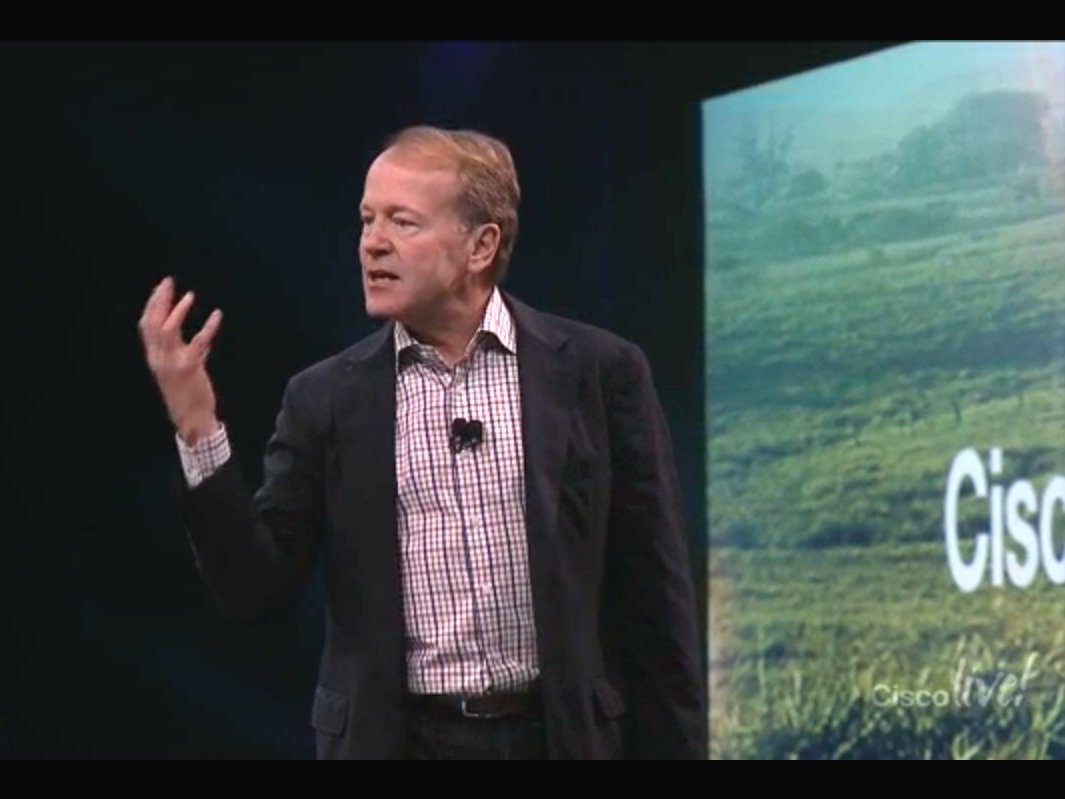
john-chambers-11.pngSo I’d suggest that an even larger proportion of UK business haven’t considered incorporating digital fully in to their business strategy. But why is it so important?  One of the people who have expressed it best was John T. Chambers, the outgoing President and CEO of Cisco, on the opening day of their Cisco Live event on 8 June a year ago. He told the 25,000 attendees, including many of his biggest and best customers:

“Forty percent of businesses in this room, unfortunately, will not exist in a meaningful way in 10 years,”

adding that 70% of companies would “attempt” to go digital but only 30% of those would succeed, and then he said:

“If I’m not making you sweat, I should be.”

“It will become a digital world that will change our life, our health, our education, our business models at the pace of a technology company change”

Chambers went on to warn companies that they could not:

“miss a market transition or a business model”
“underestimate your competitor of the future — not your competitor of the past.”
and
“Either we disrupt or we get disrupted”.

Digital Darwinism in plain English – I don’t think the consequences of missing the digital point have been have been expressed with more clarity!

If you want to find out more about this topic I’ve got two recommendations. Read more of the material here, but also consider attending the Enterprise Digital Summit Paris in June. You will know that we co-produce the London edition which will be in November, but we’ll be in Paris next month, and we’d love to see you there to talk real digital business.

John Chambers photo from UK Business Insider, Julie Bort

Share this:

  • Tweet
  • Email

Filed Under: #EntDigi conference, digital disruption, digital transformation strategy Tagged With: Cisco, Cloud Pro, digital transformation, end to end, Ingram Micro, John Chambers

Of organizational Operating Systems, Frameworks and Flows

May 6, 2016 By David Terrar

Of organizational Operating Systems, Frameworks and Flows

The Paris edition of the Enterprise Digital Summit is coming together for next month. Bjoern posted recently on the conference’s key themes with some great links to ideas around platforms, the elastic enterprise and machine learning, but he also talks about the company’s operating model and operating system, and that triggered some thoughts around terminology that connected with conversations I had with Dave Gray two weeks back (and last year!), and that connected with conversations I had with Sigurd Rinde this week (and over the years). Connections in context over time.

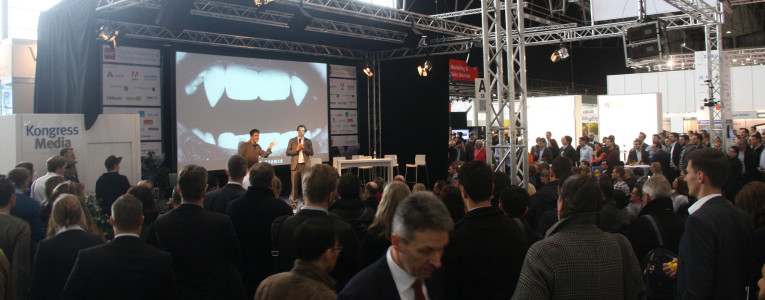
Kongress Media at CeBIT 2016-765x300

I have a problem with talking about the “Operating System” for the organization. I realise that in dealing with the new digital landscape and new business models, our organizations need to change. Dramatically (but we know change is really difficult). Traditional hierarchies and command and control just aren’t effective any more. Management isn’t working! White collar workers in the typical business seem to be busier and less productive than before. How can we fix that? What is the solution? If it’s upgrading the organization to a new Operating System then that feels like an industrial, command and control based solution to the problem. It’s thinking of the the new paradigm in terms of a kernel and drivers, connecting hardware and software, to be tested and debugged. It’s like thinking of the brain as just an electrical circuit. A collection of 90 billion neurons, each one connected to a thousand others, passing electrical signals. But that brain supports the mind which thinks and feels and imagines and has subjective thoughts. More than just electrical circuits.  We need to think organic rather than mechanic or engineering.

Now to Dave Gray. As well as his soon to be published Liminal Thinking book that I blogged about last week, Dave has work in progress following on from Alex Osterwalder’s Business Model Generation and Value Proposition Design books, with his Culture Mapping sessions – I recommend you take a look at his thinking on this. When Dave talks about this, or does a workshop, he often says that culture is like the Operating System of the company, but then he usually goes on to talk about changing and nurturing it in terms of gardening (explained here). In his talks he’ll often quote Louis Gerstner, from one of Agile Elephant’s favourite books (Who Says Elephants Can’t Dance? – from 2002 – it’s part of the reason behind for our name):

“Until I came to IBM, I probably would have told you that culture was just one among several important elements in any organization’s makeup and success — along with vision, strategy, marketing, financials, and the like… I came to see, in my time at IBM, that culture isn’t just one aspect of the game, it is the game. In the end, an organization is nothing more than the collective capacity of its people to create value.”

Although Dave uses operating system as shorthand, I prefer his more organic explanation and definitely agree with his focus on organzational culture.

There is plenty of talk about how the traditional hierarchy of most organizations is reaching its limits. There is talk of flattening the management structure and self organising and we reference companies like W. L. Gore, Valve Corporation (Steam) and Semco Partners. These are great examples, but I worry over the way some people talk about these and Holacracy without fully understanding the scale of the rules and methodologies that underpin it. I hear people discussing Frederick Laloux’s Reinventing Organizations book and the pursuit of the Teal Organization. My concern is over being too prescriptive with our solutions. At Agile Elephant we believe there are no “one size fits all solutions”. Every organization is different and at a different stage of evolution in the new digital landscape, and so we believe there needs to be more focus on the activities and behaviours and characteristics that work, rather than striving for a particular system that might.

That leads me to my Enterprise Irregular buddy Sigurd Rinde and discussions which will result in a series of posts including this one. In our catch up call this week we talked about where the classic organization is, and where the modern organization needs to be. He told me how positively people respond when he talks about white collar productivity and tells them (in words which I stole and used above):

“Management isn’t working!”

In our conversation he added more names to the list of companies that aren’t using a traditional hierarchy like Patagonia, Buurtzog, Handelsbanken and Zappos. Then we talked about Zappos and his discussions with them and their problems in changing to Holacracy. However, the most powerful thing we talked about is how organizations spend too much time thinking efficiency when they should be thinking effectiveness. Business is all about getting the work done and the work is a flow. Most of our organiations have vertical application silos – ERP, CRM, Email, HR, Document Management and more. Then we are adding enterprise social networks like Jive, or extra collaboration tools like Slack. The digital workplace is getting more complex.

Sig talks in language that we Elephants like. He talks about getting the work done as value creation. This core purpose generates a sequence of activities – a flow. Like water it requires a framework to be useful. Now there are three basic ways you can move water around:

  • In pipes – that’s the industrial approach, creating a complex system of flows with fixed connections, joints and valves, and more pipes to connect to the next system – like too much of the business application software we use.
  • In buckets passed hand to hand – how much of our day to day work feels like that, with work slopping over the edges on to the floor and not getting to where it needs to be?
  • Along a riverbed – water finds its path – there may be rocks, branches and obstructions that change the flow, but water finds its way around them, and we can work on the riverbed to remove the obstructions, or the river banks to shorten the course.

RiverBed

So when it comes to looking at company organizations at the Enterprise Digital Summit Paris, I’d prefer us to be thinking in organic rather than machine terms. I want us to be thinking about the things that work rather than the particular system deployed. Above all I want us to be thinking about frameworks and that riverbed and how we can make the value flow more effectively.

photos courtesy of Kongress Media and Sigurd Rinde

Share this:

  • Tweet
  • Email

Filed Under: #EntDigi conference, corporate culture, hierarchies, ideas, organisational culture Tagged With: Alex Osterwalder, brain, culture mapping, Dave Gray, Elephants, Louis Gerstner, mind, operating system, Sigurd Rinde

« Previous Page
Next Page »

Sign up for our regular Agile Elephant Newsletter - news, posts, ideas and more.

My Tweets

From the Agile Elephant Blog

  • The Metaverse doesn’t exist yet, but…
  • Impossible Things get Disruptive
  • Clarity, Cloud, and Culture Change at IBM

What Next?
Take a look around our site, check out our approach, see how we can help, join the conversation on our blog or contact us to find out more.

About Us

Agile Elephant is a new kind of consultancy designed to help companies embrace the new digital culture of social collaboration, sharing and openness that is changing business models and the world of work.

Contact us to find out more!

Our founder's blogs:

broadstuff

@DT on Medium

Technotropolis

Our blog:

The Agile Elephant Blog

Site Log In | Site Log Out

Subscribe to Site RSS

Subscribe to our Blog via Email

Enter your email address to subscribe

Join 30 other subscribers

Copyright © 2026 ·Streamline Pro Theme · Genesis Framework by StudioPress · WordPress · Log in