Agile Elephant making sense of digital transformation

innovation | digital transformation | value creation | (r)evoloution

  • Email
  • Facebook
  • Google+
  • LinkedIn
  • Twitter
  • Home
  • Manifesto
  • Services
    • Our Approach
    • Our Services
    • Making Collaboration Work Packages
    • Collaboration Solutions
    • Our Experience
    • Workshops
    • Innovation
  • About Us
    • The Team
    • Why we do what we do
    • Why are we called Agile Elephant?
    • Our Partners
    • Our Clients
  • Get Involved
    • Events
    • Meetups
    • Unconference
    • Newsletter
  • Resources
    • What is Digital Transformation?
    • What is the Digital Enterprise Wave?
    • Our Research
    • Case Studies
    • People We Follow
    • Articles & Links
    • Books That Inspire
  • Blog
  • Contact Us
Home Archives for David Terrar
London was part of the largest Legal Hackathon ever

March 6, 2018 By David Terrar

London was part of the largest Legal Hackathon ever

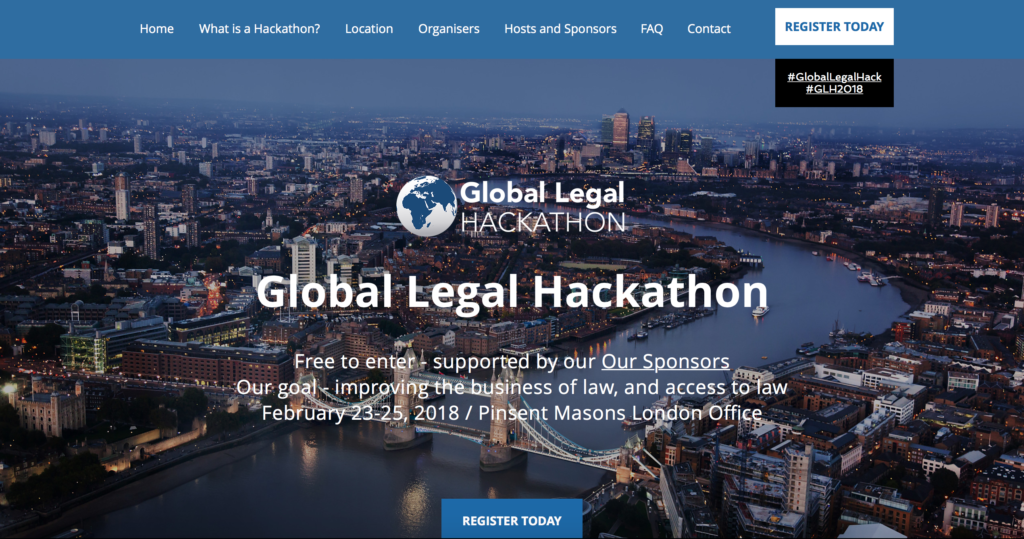
It’s been just over a week since the London stream of the Global Legal Hackathon, and those of us who were involved are still feeling the buzz. Here’s a full report of what went on. This was round one of a process which found a London winner to go forward with 39 other city winners from 20 countries, and 1 winner from a remote Hackathon stream too. The aim was to be as open and inclusive as possible, to make this the largest legal hackathon ever!

Globally more than 5000 people participated over the weekend of 23-25 February, generating more than 1000 new legal tech ideas. The 41 winners can improve their entries within agreed guidelines up to the deadline for round two which takes place on March 11th & 12th. Then 10 finalists will be chosen for round three, and funded to attend and the gala final, taking place in New York on April 21st.

Why run a Legal Hackthon?
It’s all about experimentation and innovation. We introduced what #GLH2018 #London was all about in our earlier posts. The goal was to apply innovative ideas and emerging (or any) technologies to progress the business of law or facilitate access to justice for the public. We knew that getting lawyers, coders, designers, marketers, analysts and other business people together over a weekend with beer and pizza was going to make things happen.

So what did happen that weekend?
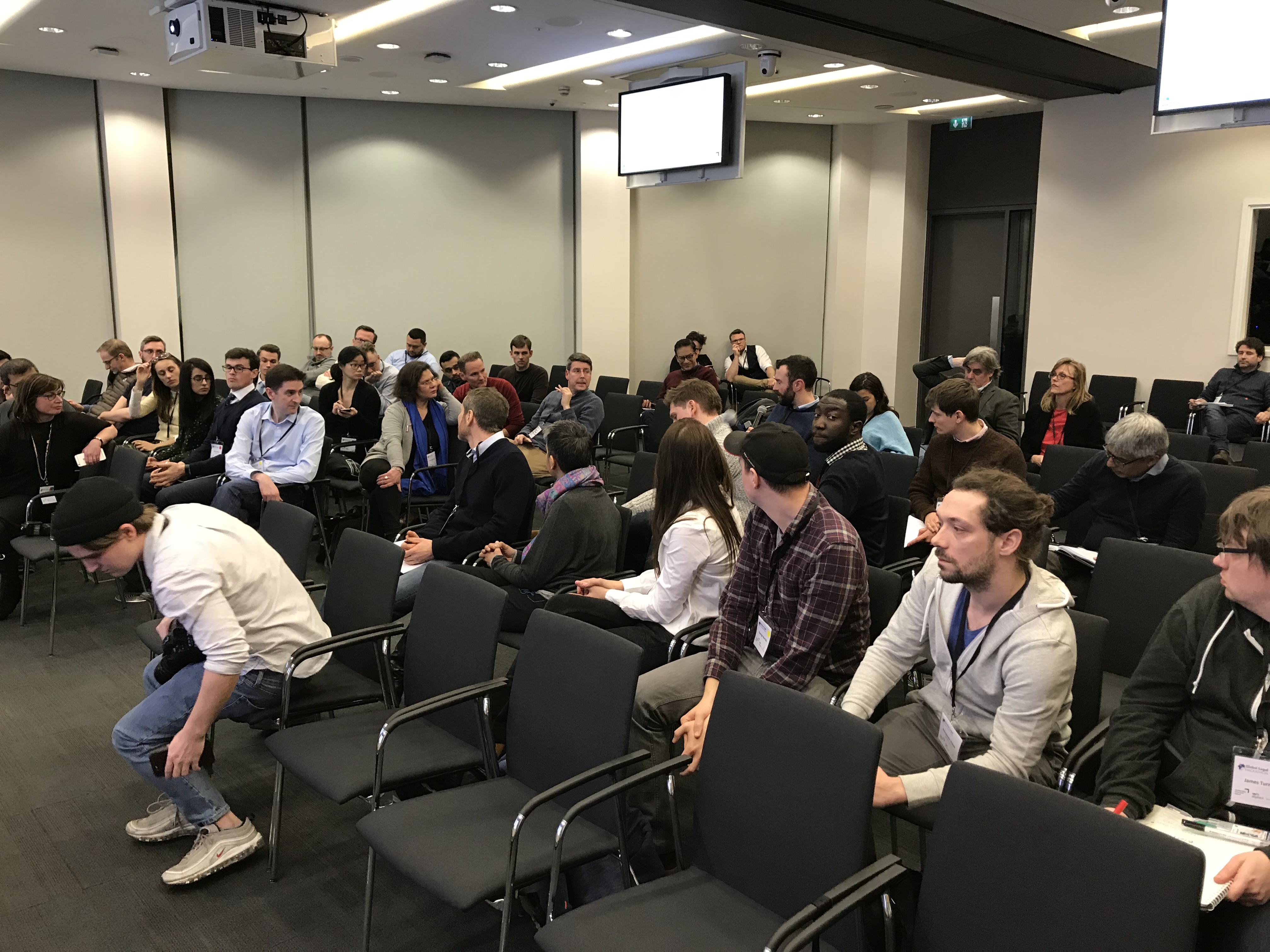
Something special. On 23rd February, the Friday evening in London we had around 60 people (from 102 registered participants including helpers, mentors and judges) – some were partially formed teams, and many participants were coming along with an idea or some skills, energy and enthusiasm to add in to the pot. Of our participants who stayed the course till Sunday evening, what we didn’t realise until I asked the question in the final presentation session, was that around 2/3 had never participated in a Hackathon before! In Pinsent Masons‘ excellent auditorium, after setting the scene, explaining the timing, the rules, and the Judging Rubric, people started pitching ideas. Actually we started with just 3 good ideas. Then after a worryingly long pause and some discussion the ideas really began to flow. We ended up with 13 really interesting possibilities. We stopped for Dominos Pizza (who weren’t a sponsor, but maybe next year?). Pizza is the life blood of any Hackathon. Straight afterwards we got back in to the auditorium to try to facilitate some version of team speed dating. Actually, following a little encouragement, some of the ideas joined together or were dropped and we coalesced in to 6 teams, each with a strong proposition and a balanced set of skills. Pretty much everybody stayed until 21:00 when we closed the building.
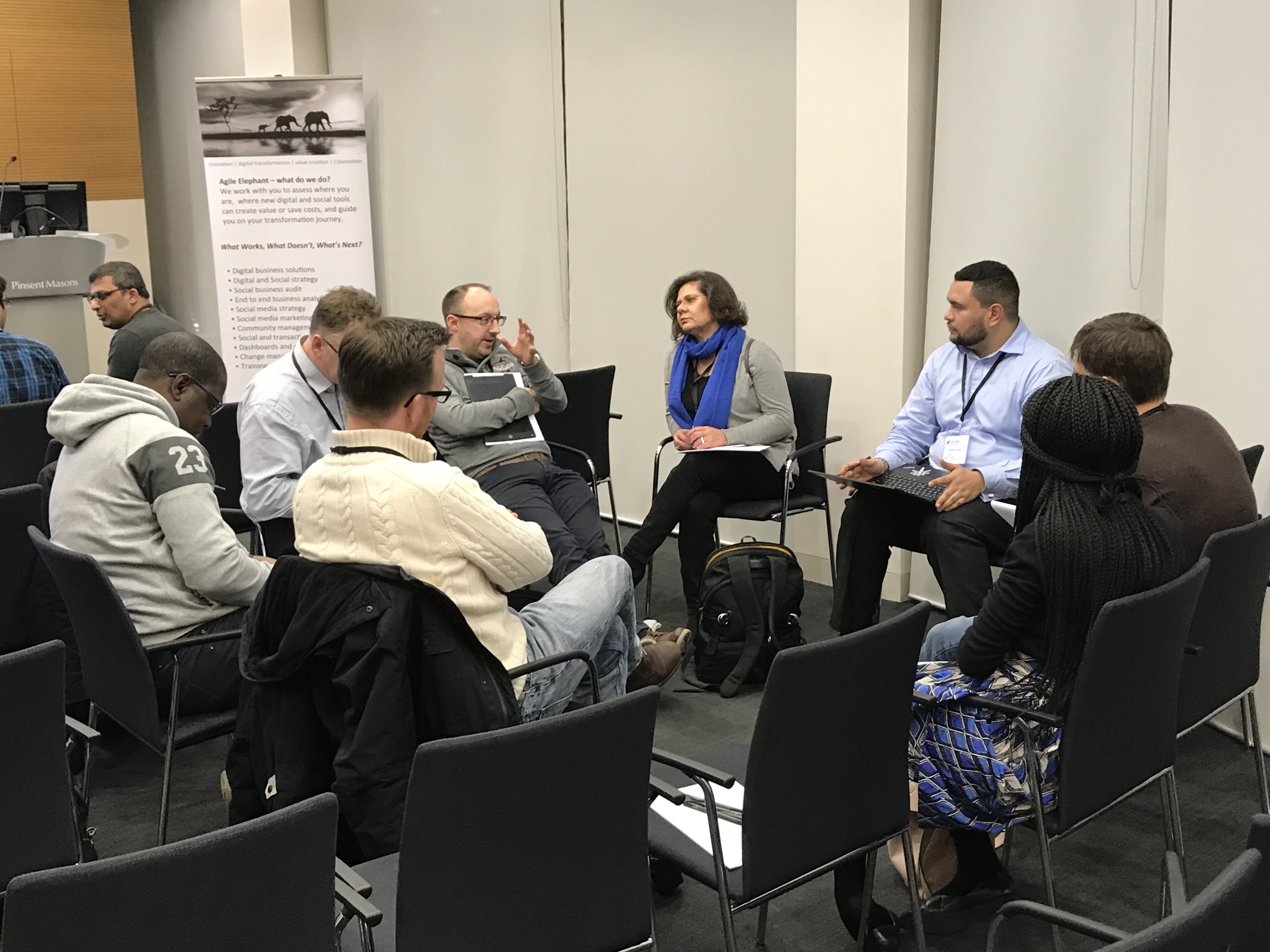
A surprisingly large numbers of team members rejoined us for 8:00 the next morning when we moved to Pinsent Masons luxurious client centre on the 14th floor. More team members arrived during the day – we actually had capacity for 13 teams in 13 separate rooms, thanks to our gracious hosts! 5 teams each grabbed a room for home base, and our 6th team met somewhere else with their developers in the morning, but joined us in the client centre mid afternoon.

Of the 6 lifts you can take to get up and down the Pinsent Masons building, lift D is by far the best choice if you can get it. It’s all glass, running on the outside of the building, and they call it the James Bond lift because it briefly appears in a scene in Skyfall! Fantastic views over London. With that lift, those views and the client centre, this was very definitely “not your average Hackathon”!
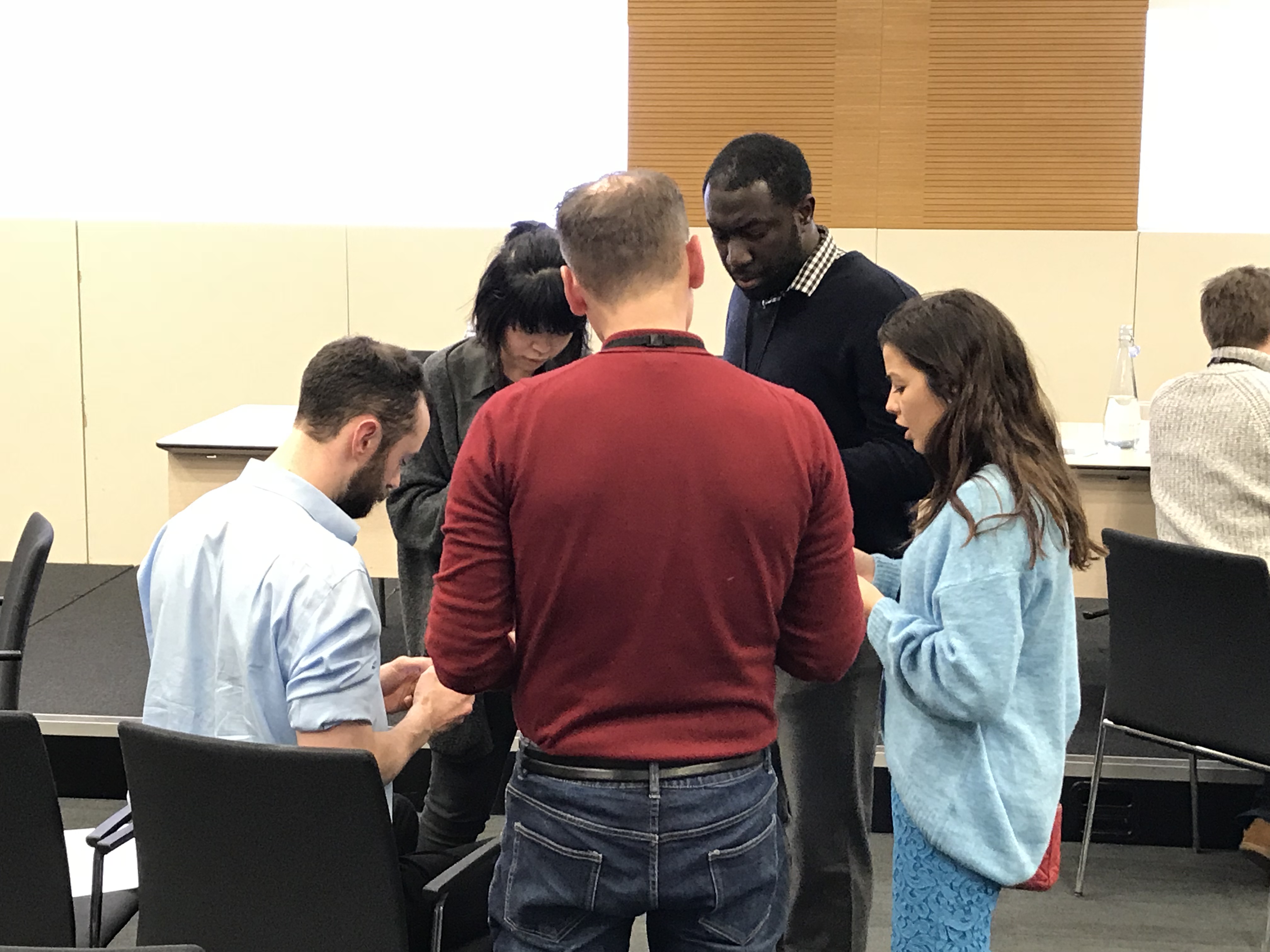
Rob Millard and I raided a local Marks & Spencer for sandwiches, nibbles, beer, wine and soft drinks. Actually we totally cleared them out of every variety of bottled beer they had in their fridge – not many regular customers expected in the City of London on a weekend. Sandwiches for lunch. More Dominos Pizza for our evening meal, made even more tasty with the addition of beer and wine (and soft drinks). However, it was notable that our teams were careful with their alcohol intake. We saw people refusing a second beer and heading back to their team rooms – there’s dedication! Yet again they all worked until 21:00 when we had to finally kick them out.
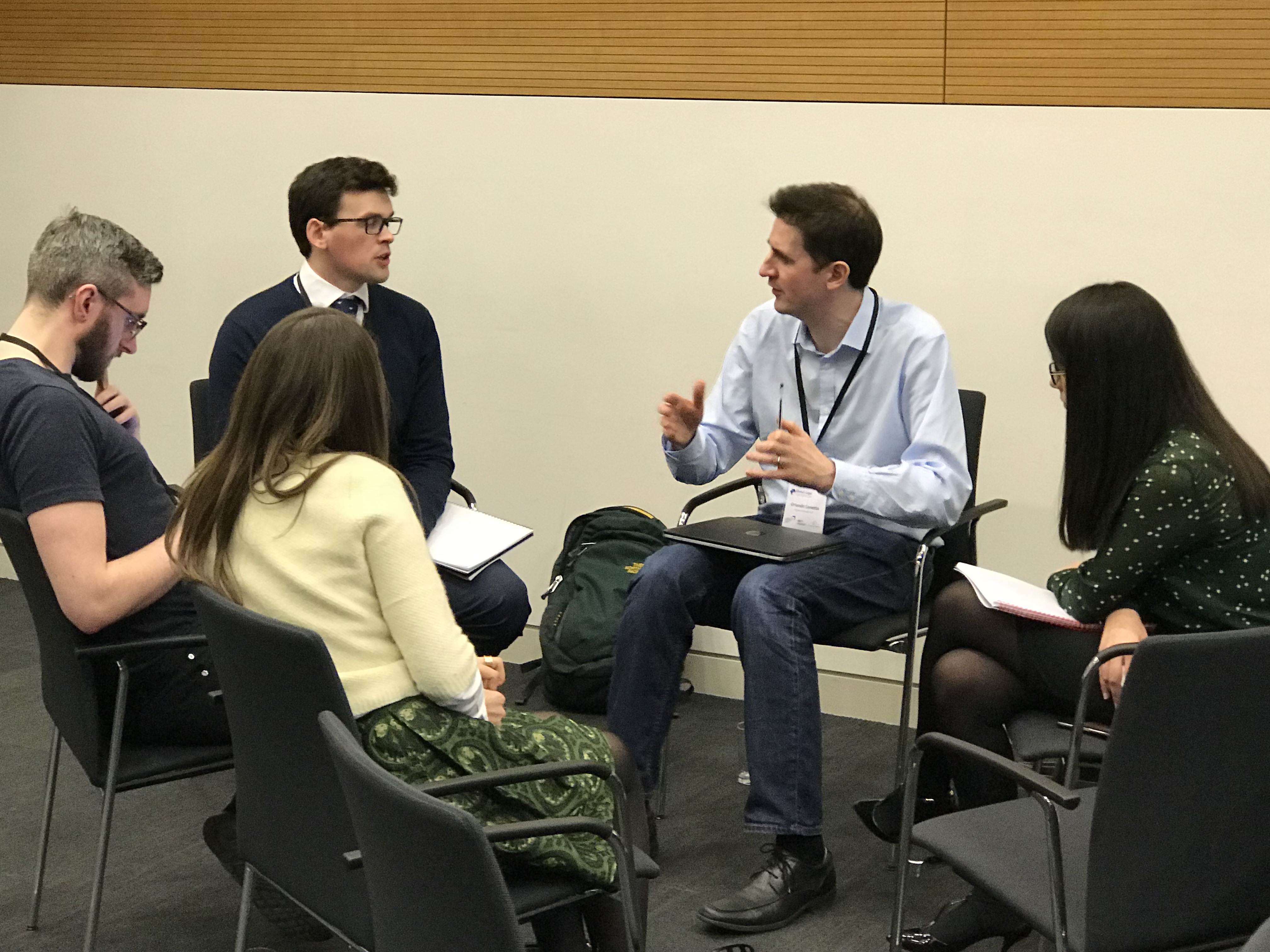
We had the same early start of 8:00 for Sunday with the same early arrivals, a different sandwich selection from Sainsburys and Tescos for lunch, and plenty of drinks and nibbles left for the early evening session. There was a lot of mentor interaction during the day, with teams getting input, asking questions, getting guidance on the approach for their presentations. Soon after lunch you could see some teams rehearsing their story as other teams madly tried to get everything finished by the 16:00 “down tools” deadline.

The Teams
Here are the 6 London teams:

LiP-Sync Toks Hussain
Keith Hardie
Yee Mun Ooi
Ian Broom
James Kingston
Julie Gottlieb
Alex Goff
Mariela Petsova
LightningWarriors George Norfolk
James Turner
Elma Gakenyi
Ben Babbik
Thomas Pauls
Jon Wilks
Team Pinsent Masons Orlando Conetta
Michael Bell
Ben Cooper
Michael Bell
Alisha Kouser
Olivia Irrgang
smartcomms.ai  Rosemary Martin
Philip Fumey
Martin Kath
Lyle Ellis
Steven Jebb
Olaseni Odebiyi
Christopher Rawlings
RegChain Alkesh Acharya
Fraser Matcham
plus 2
Legalytics Murtaza Amirali
Dr. Mehmood Hassan
Ashok Panchabakesan
Mohamed Sajeed Hameed

Our Judges and Mentors
Our judges were Christina Blacklaws, Deputy Vice President of the Law Society, Frank Jennings the “Cloud Lawyer”, Joanna Goodman, writer/editor and columnist for the Law Society Gazette, and Dr Richard Sykes chair of the Cloud Industry Forum.

Our mentors, to advise and keep the teams on track were Sophia Adams-Bhati, Richard Tromans, Andy Unger, Kim Silver, Silvia Cambie, Jelena Madir, Robert Marcus, Dennis Howlett, Maeve Lavelle, Alan Patrick, Janet Parkinson, Rob Millard and me. Amy Braunz of Integra Ledger joined us for Sunday too.

A very big thank you to all of our judges and mentors who gave up valuable time over a weekend to join the fun. This whole exercise was not-for-profit, only made possible by these people volunteering, our host providing the space free, and our sponsors paying to feed us.

Who was supporting this?
Here are those vital London Sponsors and Supporters we need to thank for making all of this possible!  Cambridge Strategy Group, the Agile Elephant Team, and Pinsent Masons were co-hosts (and by the way, the venue was fantastic!).  We mustn’t forget IBM and Microsoft who provided developers some free access to their cloud platforms. LexisNexis, JG Consulting, Sales Filter, Durham Law School and  The Law Society, were our local sponsors. The Society for Computers and Law, and Disruptive.Live were supporting us too.

I must also thank Indi Shinji, Pinsent Masons events coordinator.  She did a fantastic job all weekend keeping us happy, keeping an unruly bunch of hackers compliant with PM health and safety, and keeping her cool as she accommodated our various and unusual demands.  She was brilliant.

The Global sponsors across all three rounds are Integra, IBM Watson Legal, the Global Legal Blockchain Consortium, Cadence, LawDroid and ONE400

The Presentations
As soon as everyone managed to get down from the 14th floor, a little before 16:15 on Sunday we assembled back in the auditorium for our 6 presentations. The sequence had been chosen fairly by drawing lots. Each team had a strict 10 minutes and no more, plus 5 minutes of Q&A from our 4 judges, sitting on stage at the top table. Even with the handovers and usual audio visual problems of hooking up a variety of different laptops for presenting demos, prototypes and slides (that suddenly freeze, or won’t connect) we got through all 6 sessions well inside the allotted 2 hours. I must thank Nathan the Pinsent Masons AV guy who made it happen, recorded and live streamed it all for us (we’ll publish video soon).  diginomica live streamed the sessions on Facebook Live too.   It’s important to note that this wasn’t a “PowerPoint off”, as prototypes and real code were on show, as well as the slides to tell their stories.

Frank Jennings’ post summarises the ideas from our 4 “third” placed teams more succinctly than I could:

“One team proposed the use of machine learning to help users to prioritise and process their emails. There was a GDPR toolkit for small-medium sized organisations. Another was a dashboard collating billing info, time, indexing and work location data. And there was a blockchain application to help with conveyancing.”

Managing to finish the show and tell before 18:00 gave our judges a little extra time to come up with a winner and a runner-up, which head judge Christina Blacklaws duly announced.

It’s notable that none of our 6 teams were reinventing the wheel. Even the team who were tackling the common problem of email and information overload for lawyers had innovative ideas using machine learning to address the problem.

The Winners!
You might have seen the announcements already, but our London winners were:

The runner-up was LiP-Sync:
An app with chat interface using IBM’s natural language processing, sentiment analysis and Watson to help those going through a divorce without legal representation.

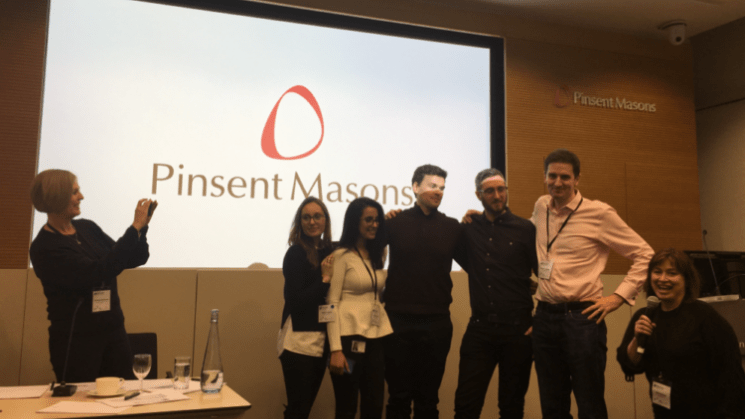
The London winner was Team Pinsent Masons:
A blockchain enabled tool to manage workflow in developing ideas for new innovations to fully formed business propositions and for partners to vote on which ideas should receive investment. The tool could also be used for partners to quickly and easily vote on other issues too, making it easier to engage them as business owners and enhance governance.
The Blockchain issue
Agile Elephant’s position on blockchain technology is well known. We worry about the hype and fashion element associated with many of the startups and ideas out there. We worry about a lack of understanding of where blockchain is and isn’t an appropriate solution and the real cost of a transaction using this technology. However, there are a growing number of real use cases and sensible applications, like many that we’ve seen across this Hackathon. We’ll be writing another post specifically on this issue, and I recommend you read CEO of Integra Ledger, David Fisher’s excellent guest post on the Artificial Lawyer making the case for Blockchain and the Law.

Other posts about #GLH2018 #GlobalLegalHack
Here is a selection of posts we could find about the Hackathon.

Here’s a great piece from Dennis Howlett, founder of diginomica, on the event and his experience as a mentor (and I particularly like his takedown of the “armchair quarterback”):

Lawyers and code – who’da thunk? Yet Global Legal Hackathon hailed as success

Frank’s view as a judge:

Hacking legal tech in London

From the Law Society Gazette:

Host team Pinsent triumphs in global legal hackathon

Richard Sykes column on Horizon Business Innovation:

Global Legal Hackathon is Practical and Relevant

Orlando Connetta of the winning team explains their solution:

The Power of Play – Our experience at the Global Legal Hackathon

A great post from Britton Guerrina of PwC on….

Why lawyers should do hackathons

Thomson Reuters on the IP issue with this and other hackathons:

Observations from the Global Legal Hackathon 2018: The Communal Dimension of Intellectual Property

Artificial Lawyer announces the winner, and then broadens it out, listing all of the 40 City winners:

Pinsent Masons Team Wins London Leg of Global Legal Hackathon 2018

And the Worldwide GLH 2018 Winners Are….

I’m expecting a column on #GLH2018 from Joanna Goodman, and other posts too.  As those get published or we find more, I’ll update this post and add them here.

Conclusion
We all had a blast! Some really great ideas have started on a journey that we hope they complete to become products in the wild. Our friends running the Global event tell us they are delighted with all the feedback they got from London, and we know that it was the trending topic in legal tech last weekend. We’ll carry out a survey of our own with all actual participants, as well as registered attendees who downloaded the app but didn’t make it to the venue. We hope to find out what worked, what didn’t and what we should do next year. And yes, there will be a next year! The GLH organisers want to make this an annual event, as well as running other activities for the legal tech community too. We’ll certainly be doing that and in 2019 with our co-hosts for the UK too. Watch this space!

If you attended, were watching on social media, or just want to give us some feedback, please add a comment below or contact us.

Update 

Keith Hardie quite rightly pointed out I’d missed some of the members of the LiP-Sync team.  Apologies, but they’ve been added back.  Also I’ve added more post links (on IP at hackathons, a column by one of our judges, one on why lawyers should do hackathons) – more of those soon as I see them.

Share this:

  • Tweet
  • Email

Filed Under: artificial intelligence & robotics, blockchain, business innovation, events, ideas, innovation

Global Legal Hackathon in London this weekend – an update

February 21, 2018 By David Terrar

Global Legal Hackathon in London this weekend – an update

What happens when you get a bunch of lawyers, coders, designers, consultants and marketing types with their laptops and cloud platforms together over a weekend?  Well, we think it will turn in to something special!

Just over 3 weeks ago Agile Elephant volunteered, along with  Cambridge Strategy Group and Pinsent Masons to host the London stream the Global Legal Hackathon (GLH). We mean this weekend, 2 days time on February 23-25 at Pinsent Masons’ london office in the City.  A winner will be declared for London on Sunday and that team will go through to a global competition with all the other cities, culminating with a winner announced at a banquet in New York on April 21.  This will be the world’s largest legal hackathon happening simultaneously in over 40 cities and 20 countries.

All of the details and how to register are at: LegalHackathon.London

It’s been a mad 3 weeks getting our act together, using social media to connect and get the message out.  Our friends at diginomica have written about it this way:

Law firm Pinsent Masons hosts upcoming Global Legal Hackathon London

Over on CompareTheCloud I did this guest post:

Join the World’s Largest Legal Hackathon this weekend

The Law Sites blog has thrown down a worthy gauntlet and challenged us to change the world for the better with:

With ‘Hadfield Challenges,’ Global Legal Hackathon Urges Participants to Address ‘Problems Worth Solving’

But just in case you haven’t seen the details, here is what it’s all about and where we are at with 2 days to go.

What is the goal of a team entering the GLH?
The goal is to apply innovative ideas and emerging technologies to progress the business of law or facilitate access to justice for the public.  Teams of 3 to 6 will come up with a prototype or proposal at the end of the hackathon to present in front of a panel of judges.  We expect ideas using technologies like AI, Machine Learning, Chatbots, Blockchain, or the Internet of Things.

Where and when?
At Pinsent Masons office at 30 Crown Place, Earl Street, London EC2A 4ES, (including their client centre on the 15th floor with stunning views over London) over the weekend of February 23-25.  18:00 start on Friday, working all day Saturday and most of Sunday, judging takes place from 16:00-18:00 on Sunday and a winner will be announced before 19:00.

Who are the Judges and Mentors?

Our judges are Christina Blacklaws, Deputy Vice President of the Law Society, Frank Jennings the “Cloud Lawyer”, and Dr Richard Sykes chair of the Cloud Industry Forum and Joanna Goodman, Author and IT columnist for the Law Society Gazette.

Our mentors, to help advise and keep the teams on track include Sophia Adams-Bhati, Julie Gottlieb, Richard Tromans, Silvia Cambie, Dennis Howlett, Alan Patrick, Janet Parkinson, Rob Millard and me.

Who is supporting this?

There are a lot of people to thank!  IBM and Microsoft are providing developers some free access to their cloud platforms.  LexisNexis & JG Consulting are our local sponsors.  The Law Society, the Society for Computers and Law and Disruptive.Live are supporting us too.  The Global sponsors are  Integra, IBM Watson Legal, the Global Legal Blockchain Consortium, Cadence, LawDroid and ONE400

Who will be Hacking?

We’ve got teams entered from LexisNexis, Pinsent Masons, Vodafone, and Hult International Business School.  Other participants are coming from IBM, Fliplet, Jurit LLP, Hook Tangaza, Sumitomo Electric Finance UK, Said Business School, Legalytics, Cliffe Dekker Hofmeyr Inc, The Incorporated Council of Law Reporting for England and Wales, European Banking Authority, The Founder, Legal Utopia, The Law Society, Bryan Cave, Queen Mary University, Thomson Reuters, Kitmobs, Look, YADA Events, Teal Legal, Bank of America Merrill Lynch, City University, Oxford University, and Westminster University.  We’ve got capacity for 110 and 12 teams, but we still need more participants to sign up.

How can you get involved in the GLH?

  • Hacker teams and team members – Anyone involved in the law, interested in the law, involved in technology for the law, or coders and technologists who want to join the fun.  We know some firms will submit teams, and other teams will form around a great idea at the GLH.
  • Helpers – We need volunteers over the weekend to make it happen and keep everyone happy.
  • Mentors – We need subject matter experts and technologists who can mentor the teams over the weekend to help crystallise their ideas, challenge them, or keep them on track.
  • Judges – We’ve got 3 great judges, but may add 1 or 2 more.
  • Sponsors – As well as the venue we will be providing food and drinks, name tags and supplies.  We may even add a main prize and additional prizes.  We need sponsors interested in helping us fund all of this – modest amounts in the range £250-500.  This is a ‘not for profit’ exercise for the hosts, but we need to cover our costs (mostly pizza and drinks).

Follow us on Social Media
We will use social media hashtags #GlobalLegalHack & #GLH2018.  Follow the GLH on Twitter at @WorldHackathon and the London organisers @robmillard & @DT.  GLH have also partnered with legal media sources  ArtificialLawyer.com and Legal Talk Network.  Our friends at Disruptive.Live will be generating video and live content and diginomica and the Law Society Gazette will be reporting on the event.

We want to have fun, and really make a difference for the legal profession.  Will we?   Please come and join us and find out!

Share this:

  • Tweet
  • Email

Filed Under: blockchain, business innovation, creativity, design thinking, digital disruption, events, future

What is Design Thinking?

February 18, 2018 By David Terrar

What is Design Thinking?

Is Design Thinking important? We think it is – it’s one of our 8 building blocks for digital transformation. But what is it, and why? In the run up to the Global Legal Hackathon, we thought we’d distil our workshop slides and ideas on the topic in to this blog post to explain it.

Let’s set the scene with five quotes from experts and artists you will recognise explaining what design really is:

“The ultimate defense against complexity” – David Gelernter, Professor of Computer Science, Yale

“Simplicity is the ultimate sophistication” – Leonardo da Vinci

“Design is a way of changing life and influencing the future” – Sir Ernest Hall. Pianist, Entrepreneur, and Philanthropist

“Most people make the mistake of thinking design is what it looks like. People think it’s this veneer – that the designers are handed this box and told, ‘Make it look good!’ That’s not what we think design is. It’s not just what it looks like and feels like. Design is how it works.” – Steve Jobs

“Design-thinking firms stand apart in their willingness to engage in the task of continuously redesigning their business… to create advances in both innovation and efficiency – the combination that produces the most powerful competitive edge.” – Roger Martin, author of the Design of Business

In that last quote Roger Martin equates Design Thinking with being able to continuously redesign your business, and “continuous reinvention” is another of our building blocks for digital transformation. In fact we think it’s the most important ingredient. So the approach has goodness, but does it have any real value?

The Design Value Index

When design principles are applied to strategy and innovation the success rate for innovation dramatically improves. DMI and MotivStrategies, funded by Microsoft, began analyzing the performance of US companies committed to design as an integral part of their business strategy. The Index tracked the value of 15 publicly held companies – Apple, Coca Cola, Ford, Herman-Miller, IBM, Intuit, Newell-Rubbermaid, Nike, Procter & Gamble, Starbucks, Starwood, Steelcase, Target, Walt Disney and Whirlpool. According to their 2014 study, they have outperformed the S&P 500 over the past 10 years by an extraordinary 219%.

What is Design Thinking?

The topic has a history right back to the 60s and a lot of thinkers and contributors have been involved. In 1987 Peter Rowe of Harvard published Design Thinking; his book provided a systematic account of the process of designing in architecture and urban planning. In 1991 the design company IDEO was formed and showcased their design process, which drew heavily on the Stanford curriculum. They are widely accepted as one of the companies that brought Design Thinking to the mainstream. Then in 2005 Stanford’s d.school began teaching design thinking as a formal method. Take a look at IDEO’s Sir David Kelley in his excellent 2007 TED talk (see below) explaining that product design has become much less about the hardware and more about the user experience.

It is a user-centred approach to problem solving with these ingredients:

  • Human centred
  • Mindful of process
  • Show don’t tell
  • Bias towards action
  • Radical collaboration
  • Culture of prototyping

Nigel Cross (2007), in his book Designerly Ways of Knowing, says, “Everything we have around us has been designed. Design ability is, in fact, one of the three fundamental dimensions of human intelligence. Design, science, and art form an ‘AND’ not an ‘OR’ relationship to create the incredible human cognitive ability.”

  • Science — finding similarities among things that are different
  • Art — finding differences among things that are similar
  • Design — creating feasible ‘wholes’ from infeasible ‘parts’

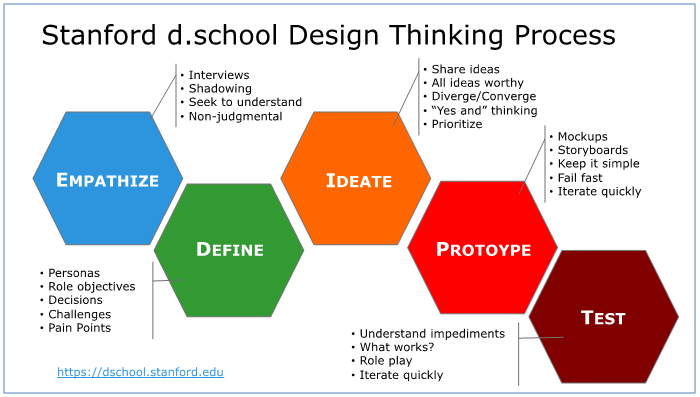
The classic flow of Design Thinking is to:

  • Empathise (search for rich stories and find some love)
  • Define (user need and insights – their POV)
  • Ideate (ideas, ideas, ideas)
  • Prototype (build to learn)
  • Test (show, don’t tell)
  • Start all over and iterate the flow as much as possible

Empathise – Empathy is the foundation of a human-centered design process where you observe and engage with users and immerse yourself to uncover their needs. Look for issues they may or may not be aware of. Think in terms of guiding innovation efforts and identify the right users to design for. Look to discover the emotions that guide their behaviours.

Define – The define mode is when you unpack and synthesize your empathy findings into compelling needs and insights, and scope a specific and meaningful challenge. It’s critical to the design process because it explicitly expresses the problem you are striving to address through your efforts. Often, in order to be truly generative, you must first reframe the challenge based on new insights you have gained through your design work.

Ideate – Ideate is the mode of your design process in which you aim to generate radical design alternatives. Mentally it represents a process of “going wide” in terms of concepts and outcomes – it is a mode of “flaring” rather than “focus”. Step beyond obvious solutions and try and harness collective perspectives. Uncover unexpected areas of exploration. Create fluency (volume) and flexibility (variety) in your innovation options. Get the obvious solutions out of your heads and think differently. This is where you can explore wild ideas, while trying to stay on topic.

Prototype – Prototyping is getting ideas and explorations out of your head and into the physical world. A prototype can be anything that takes a physical form – be it a wall of post-it notes, a role-playing activity, a space, an object, a model, an interface, or even a storyboard. You need to learn. Solve disagreements. Start a conversation. Fail quickly and cheaply. But still manage the solution-building process.

Test – Testing is the chance to get feedback on your solutions, refine solutions to make them better, and continue to learn about your users. Prototype as if you know you’re right, but test as if you
know you’re wrong. You test to refine your prototypes and solutions, to learn more about your user, with the goal of testing and refining your POV.

Back to the beginning – Start again. Iterate as much as time allows.

Ideas and techniques to help the flow

Now we’ve got you thinking design process, here are some ideas and techniques you can use in the flow to make it more effective:

Assume a beginner’s mindset – Don’t judge, just observe, engage, and don’t influence. Question everything. Be truly curious. Find patterns. Listen. Really listen.

Story Share-and-Capture – Use post-it notes and a white board. Storytelling is key to getting everyone up to speed. Listen and probe for more information. Look for the nuance and the meaning. Start synthesising. Capture every single, interesting detail.

What? | How? | Why? – Divide a sheet or the whiteboard into three sections: What?, How?, and Why? Start with concrete observations (What). What is the person you’re observing doing? Notice and it write down. Try to be objective and don’t make assumptions in this first part. Move to understanding (How). How are they doing what they are doing? Does it require effort? Do they appear rushed? Use descriptive phrases packed with adjectives. Step out on a limb of interpretation (Why). Why are they doing what they’re doing? What are their motivations and emotions. Understand the meaning and assumptions of the situation.

Interview for Empathy – Ask why. Encourage stories. Look for inconsistencies. Pay attention to nonverbal cues. Don’t be afraid of silence. Don’t suggest answers to your questions. Ask questions neutrally. Don’t ask binary questions. Make sure you’re prepared to capture everything.

Journey Map – Sketch out the lifecycle of the whole journey from start to finish, and go beyond the normal start and finish.

I Like, I Wish, What If – Meet as a group and any person can express a “Like,” a “Wish,” or a “What if” succinctly as a headline. As a group, share dozens of thoughts in a session. It is useful to have one person capture the feedback (type or write each headline).

Check out other techniques such as Camera Study, Extreme Users, Analogous Empathy, Composite Character Profile, Powers of Ten, 2×2 Matrix (we Elephants love that one), Why-How Laddering, Point-of-View Analogy, “How Might We” Questions. They are all in the d.school materials.

I want to know more

All of the techniques mentioned above have detailed explanations in the d.school resources. Check out the following links and resources:

https://dschool.stanford.edu/groups/designresources/

http://dschool.stanford.edu/use-our-methods/

http://dschool.stanford.edu/wp-content/uploads/2013/10/METHODCARDS-v3-slim.pdf

10 talks about the beauty — and difficulty — of being creative

Or contact us!

In conclusion

You don’t have to be a designer to think like one. While learning to be a good designer takes years, you can think like a designer and design the way you lead, manage, create and innovate.

Design Thinking seeks to build ideas up, unlike critical thinking which breaks them down. Design Thinking draws upon logic, imagination, intuition, and systemic reasoning, to explore possibilities of what could be, and to create desired outcomes that benefit the end user (the customer).

Please, start a Design Thinking conversation with us.

Share this:

  • Tweet
  • Email

Filed Under: creativity, design thinking, digital literacy

Get involved in the Global Legal Hackathon in London

February 11, 2018 By David Terrar

Get involved in the Global Legal Hackathon in London

You will have heard that Cambridge Strategy Group, Agile Elephant and Pinsent Masons are the joint team hosting the London event for the world’s largest legal hackathon – the Global Legal Hackathon (GLH) on February 23-25.  A winner will be declared for London and that team will go through to a global competition, culminating with a winner announced at a banquet in New York on April 21.

Here is an update of where we are at so far.

First, two of the founders of the GLH, David Fisher, the CEO of Integra Ledger, and Aileen Schultz, their Director of Network Intelligence,  introduce the Hackathon in this video:

Next, we’ve created a new site with all of the London specific details at LegalHackathon.London where you can register for the event, and find out the ways you can enter a team, become a helper, a mentor or one of our sponsors:


Lastly, we can report that the word is spreading, and we have a steady flow of registered participants.  We’ve got teams from Pinsent Masons, and LexisNexis (who are also our first local sponsor), as well as sign ups from Vodafone Group, Hook Tangaza, Legal Utopia, Bryan Cave, JG Consultants, City University, Thomson Reuters, Bank of America Merrill Lynch, YADA Events, FromCounsel, Jurit, Mills & Reeve, Fliplet, and Westminster University.  On top of those there are a number of organisations who’ve committed to be involved but haven’t registered yet.  Microsoft are supporting us with free access to the Azure platform for developers, and IBM will be giving us access to their technology too.  More technology partners will be announced soon.

Our friends at diginomica and the Artificial Lawyer will be coming along to report from the event, and we have teamed up with Disruptive.Live to produce video content and live streams.

Watch out for more news and announcements in the coming week.

Register for London

Find out about London

The Global Event

Share this:

  • Tweet
  • Email

Filed Under: artificial intelligence & robotics, blockchain, digital disruption, emerging technologies, events, innovation

We want you for the Global Legal Hackathon in London!

February 2, 2018 By David Terrar

We want you for the Global Legal Hackathon in London!

Agile Elephant are proud to be joining Cambridge Strategy Group and Pinsent Masons as the joint team hosting the London event for the world’s largest legal hackathon – the Global Legal Hackathon on February 23-25.  It’s only 3 weeks away, and we need your help!  We need hacker teams and team members, helpers for the weekend to make it happen, mentors to advise the teams and keep them on track, and sponsors to help cover the costs – this is a not for profit initiative for the 3 host companies involved, and we are delighted to be supported by the Law Society too.

So what is this thing all about?  Let me explain….

What is the Global Legal Hackathon?
The Global Legal Hackathon (GLH) is happening simultaneously over the weekend of February 23-25 in more than 40 cities, across 6 continents.  The purpose is the rapid development of solutions to improve the legal industry using innovative ideas and emerging technologies like Artificial Intelligence, Blockchain, or the Internet of Things.  The GLH will engage law schools, law firms and in-house departments, legal technology companies, governments, and service providers to the legal industry across the globe.

What is a Hackathon?
A hackathon is a competition where multi-disciplinary teams come together to collaborate, build and launch mobile or web apps aimed at solving a particular problem. They usually work in small groups over a couple of days.  People can come individually or as a team, with an existing idea to pitch, or to listen and join one of the teams that will be formed at the start of the event.  The goal is to come up with a prototype or proposal at the end of the hackathon to present in front of a panel of judges.

In our case teams will be a minimum of 3 and a suggested maximum of 6.  Anyone has the chance to pitch an idea at the start of the event on Friday evening, teams will be formed, they’ll work over the weekend, and then present to the judges at the end of the weekend.  A winner will be declared for London and that team will go through to a global competition, culminating with a winner announced at a banquet in New York on April 21.

It is a competition, but we aim to be inclusive.  All teams must be willing to accept individual participants on the first day of the event.

What is the goal of a team entering the GLH?
The goal is to apply innovative ideas and emerging technologies to progress the business of law or facilitate access to justice for the public.

Who is organising the London GLH?
The London event is being organised by Cambridge Strategy Group, Agile Elephant, and Pinsent Masons who are kindly providing the venue at 30 Crown Place, Earl Street, London EC2A 4ES.

Who is behind the GLH?
The GLH is being organised globally by Integra, IBM Watson Legal, the Global Legal Blockchain Consortium, Cadence and ONE400.

Who are the judges for the London GLH?
We are assembling a balanced team of 5 judges, which we hope to announce soon.

How do I get involved in the GLH?
It’s free to get involved – go to GlobalLegalHackathon.com and register.  Then download the Cadence event app to your phone and complete your profile.  To find the app on the app store, it is best to search for Cadence and events.  We will use a mix of email, the Cadence app, social media and our various websites to make announcements and keep you posted on our progress.

In what ways can I get involved in the GLH?
We need:

  • Hacker teams and team members – Anyone involved in the law, interested in the law, involved in technology for the law, or coders and technologists who want to join the fun.  We know some firms will submit teams, and other teams will form around a great idea at the GLH.
  • Helpers – We need volunteers over the weekend of February 23-25 to make it happen and keep everyone happy.
  • Mentors – We need subject matter experts and technologists who can mentor the teams over the weekend to help crystallise their ideas, challenge them, or keep them on track.
  • Judges – We are assembling a balanced team of 5 (don’t call us, we’ll call you).
  • Sponsors – As well as the venue we will be providing food and drinks, name tags and supplies.  We may even add a main prize and additional prizes.  We need sponsors interested in helping us fund all of this.  This is a ‘not for profit’ exercise for the hosts, but we need to cover our costs.

Who do I contact if I want to participate or help?
Get in touch with Rob Millard or David Terrar, but please register, download Cadence to your phone and then you will be able to message us directly through the app.

How do I make a noise about this?
We will be broadcasting on social media channels using the hashtags #GlobalLegalHack & #GLH2018.  Follow the GLH on Twitter at @WorldHackathon and follow the London organisers at @robmillard & @DT.  GLH have also partnered with legal media sources  ArtificialLawyer.com and Legal Talk Network.

Where do I find out more?
All of the detail about the event including the judging rubric, event schedule, the other cities and companies involved and more can be found at GlobalLegalHackathon.com, where you will find guidance for attendees, guidance for hosts, or just ask.

We’re really looking forward to it!

UPDATE:

The London stream of the GLH now has its own website at LegalHackathon.London

Share this:

  • Tweet
  • Email

Filed Under: artificial intelligence & robotics, blockchain, business innovation, digital disruption, emerging technologies, events, future

#transformCIO – a new live streamed interview series of leading CIOs & CTOs

June 7, 2017 By David Terrar

#transformCIO – a new live streamed interview series of leading CIOs & CTOs

In collaboration with my good friends at Compare the Cloud we’ve started an interview series on CTC’s Disruptive Tech TV platform.  We’ve called the programme #transformCIO and plan for it to be a weekly series, broadcast live at 14:30 UK time every Tuesday, and available on demand on Periscope, Vimeo, and elsewhere too.  My first victim yesterday was Finbarr Joy, who has been CTO of Willam Hill, then Group CTO for Lebara, and as of today is CTO of a new start-up called SuperBet (literally, today is his first day!).   I’ll be interviewing CIOs and CTOs who are at the leading edge of changing the way technology is deployed and viewed in their organisations.  I want to get to the heart of the way that the CIO/CTO’s role is changing, how the leaders in the profession are handling the changes and dealing with (or leading) the digital disruption that is happening around us.
In the interview series we will talk around the key themes of:
  • IT leading Digital Transformation
  • Doing everything faster
  • Attracting and keeping talent
  • The changing role of the CIO
  • Emerging tech – what’s next?
I first met Finbarr several years back when he was talking at a techUK event about how he transformed William Hill, an 80 year old UK brand, from an 18-24 month time to market for new products to 3 weeks!  We talk about that “fail fast” story, along with his attitude to Cloud Computing, data centres, agile, DevOps, shadow IT, holding on to talent, low-code solutions, emerging tech and more.  I also asked for his thoughts around the recent British Airways system outage.  Every #transformCIO victim gets to make a business book recommendation – I let Finbarr get away with two.  Please take a look – Finbarr’s got some “spot on” observations about how the profession should be viewed, dealing with disruption and the right way to approach the head of technology role within today’s fast moving digital landscape.

#TransformCIO Episode 1- Interview with SuperBet’s CTO, Finbarr Joy from Compare The Cloud on Vimeo.

Episode 2 will be next Tuesday at 14:30 with Stephen Deakin.  Amongst other things Steve was CTO for the Metropolitan Police, so we might just talk a little around security, along with our normal themes.  If you are interested in taking the hot seat as a CIO or CTO facing these challenges, then please contact us and book a slot in the schedule.

Share this:

  • Tweet
  • Email

Filed Under: #EntDigi interview series, digital transformation strategy Tagged With: CIO, CompareTheCloud, CTC, CTO, Disruptive Tech TV, Finbarr Joy, Lebara, SuperBet, William Hill

Avoid the Spreadsheet Swamp with a Low-Code approach

April 26, 2017 By David Terrar

Avoid the Spreadsheet Swamp with a Low-Code approach

We all know that digital transformation is here and happening whether our particular business likes it or not. Along with competition from smarter, nimbler competitors and the digitisation of business models we’ve also got new compliance “threats” to worry about, and GDPR is the big one we’re starting to hear some “Y2K” like scaremongering and noise about. General Data Protection Regulation (GDPR) is actually EU Regulation 2016/679 and every UK company does need to be worrying about it as it (and the associated fines) apply to all of us from 25 May 2018. We’ll be discussing ways to tackle this over the coming months, but the problem triggered me thinking about the spreadsheet swamp that we’ve been living in for over 30 years. The first thought for so many business people when faced with a new requirement for tracking and reporting something that isn’t handled by our current systems is to reach for a spreadsheet. We’ve been conditioned in to doing that since the 70s and in today’s environment there are social tools and a whole new category of solutions called Low-Code platforms that you should consider before clicking that Excel icon.

We’ve been running our businesses and organisations with incomplete ERP systems for decades – they usually cover most of a company’s core processes but leave plenty of gaps. Those of us who have been around in IT for a while will remember enterprise software names like McCormack & Dodge, MSA, Dunn & Bradstreet, Pansophic, ASK, Baan and more – generations of ERP and enterprise level application software companies that have come and gone but were World players in their day. These (and the current) ERP solutions cover the easily repeatable processes that need to be handled, but most businesses also need to deal with what my friend Sigurde Rinde calls barely repeatable processes. That’s everything from the day to day business events that don’t quite obey the specific rules that we planned for, to responding to competitive threats, to new requirements like GDPR. That’s digital disruption in its many forms – the reality of business in a complex, fast changing world.

How do we deal with these gaps in functionality that our conventional systems don’t cover? To help us get the answers that the core IT system doesn’t provide, right since the dawn of personal computing, we’ve been reaching for the spreadsheet! It started back in the late 70s. What was the application (along with word processing) that helped the Apple II become so fantastically popular when it changed the computing landscape? It was Dan Bricklin‘s VisiCalc – the first ever spreadsheet. After the Apple II the IBM PC came along in 1981 and Lotus 1-2-3 became the goto application, but as Microsoft began to shape the technology landscape then Excel took over to became pervasive. Generations of people in business have built up a literacy in creating data based applications, with calculations and macros sitting in spreadsheets, with ad hoc systems and processes around them to share them with groups of people by email. How did accountants and business people end up as part time programmers? However, in truth this was a real jump in personal productivity and getting things done. But 30 years on we’re still doing it with pretty much the same technology – there has to be a better way!

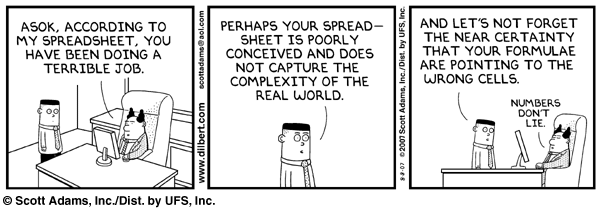
With the advent of social tools over the last 10 years or so, I was convinced we could break the spreadsheet and email habit and make businesses more effective. We talk a lot here about enterprise social networks and how these kinds of collaboration tools should be at the heart of any company’s digital transformation strategy, but let’s turn to that spreadsheet. At the very least our documents or spreadsheets can be properly shared by a group of users. We don’t have to have multiple copies of the same thing, getting out of date, sitting in every single email recipient’s inbox – who’s got the latest version? Wikis, Google’s G Suite, Office365, and even new products like Dropbox Paper mean we can collaborate on content in real time, but even with these tools to hand many businesses are still living in the spreadsheet swamp. Spreadsheets have their place, but too often they are used as a convenient repository for what is actually a database for collecting and reporting on information that is vital, but missing from the organisation’s core ERP systems. They are used for everything from product lifecycle management to contact management to human resources data. Actually these applications ought to have been created as a proper database, but the cost and time of set up and management means that the user goes a different way. As a medium for data storage spreadsheets are mightily insecure. Anyone who has access to the sheet could change the data layout, change the data, screw up the calculations. Even when carefully managed, with good intentions, there are many examples you can find of huge mistakes and big losses because of a spreadsheet error. As my good friend Dennis Howlett often says:

“Spreadsheets are general purpose tools that can do many powerful things but they are a programming environment and should be treated as such. That means testing and documenting according to good programming standards.”

Why do we let ourselves navigate in to this swamp without that mode of thinking? This is where a new category of applications, called Low-Code platforms, is springing up to provide a 21C, more safe, more secure, cloud native solution to these ad-hoc needs that every organisation is faced with. This is an emerging space, and we’ll be looking at it more over the coming months. The way I see it the current crop of products that allow you to build applications with no (or very few) lines of code fall in to two broad categories. Business Process Management apps that help implement business logic and workflows, and Data Driven apps that offer data management, reporting and data integration. There is overlap of course, and a whole range of user experience from drag and drop interfaces to more straightforward tabular set up and configuration.

This Thursday I will be working with the Ctrl O Team and their Low-Code solution called Linkspace, at a London event titled “Government Computing Presents: Digital Transformation for the Public Sector”. The event blurb suggests that with efficiency and modernization at the forefront of government policy, the need to share experiences, success stories and new ways of working has never been greater. Listening to our senior public sector contacts there is no doubt that Government suffers from the spreadsheet swamp just as much as the commercial world. As I said at the start we need new thinking to tackle digital disruption, and new Low-Code tools provide rapid development without upfront costs, and should definitely be part of your 21C kitbag for application development and delivery.

As a Low-Code example, Ctrl O’s Linkspace allows you to build your own data driven applications in a secure way on a cloud platform that can be accessed anywhere from any device. You create your data layouts, data entry forms, workflow, and reporting. You need no more technical expertise than for spreadsheets and office products, but Linkspace helps you lock down the security so that only the right people have access to add, change or delete things. Ctrl O is an independent UK cloud software provider who already work with a number of government departments. They are passionate about using open source tools to create lean, intelligent, unbreakable products. I’m delighted to be working with them. Go here if you want to find out more about how they deal with the spreadsheet swamp. More details on the Government Computing event can be found here. Please come and talk to us on Thursday.

Disclosure: David Terrar chair’s Ctrl O’s Advisory Board and Agile Elephant helps them on strategy.

Share this:

  • Tweet
  • Email

Filed Under: agile business, events, Low-Code, software tools Tagged With: Ctrl O, Excel, rapid application development, spreadsheet, spreadsheet hell, spreadsheet swamp

5 reasons why 2007 was a Tipping Point (and a Turning Point) in our Digital Journey

March 19, 2017 By David Terrar

5 reasons why 2007 was a Tipping Point (and a Turning Point) in our Digital Journey

Both really.  2007 was pivotal.  A big year in our digital history. It was also the year “An Inconvenient Truth” won the Oscar for best documentary, and Al Gore told us we only had 10 years to save the planet. It was the year my literary hero Kurt Vonnegut died. The Police and the Spice Girls both did reunion tours. J. K. Rowling published the 7th and final novel in the Harry Potter series (she’s on a reunion tour of sorts herself 10 years on), but these aren’t the reasons 2007 was so important.

I started thinking about this a few weeks back, on 14th February, when I celebrated 10 years on Twitter, but I’m getting ahead of myself. We’ve been talking digital since Nicholas Negroponte’s Being Digital book in 1995, with a steady build up of the technologies and associated behaviours that have changed marketing and insinuated themselves in to general business use, changing things completely in the intervening 22 years. Here are 5 reasons, though, why 2007 stands out during that seismic shift.

The iPhone was announced (but it was a slow burn)
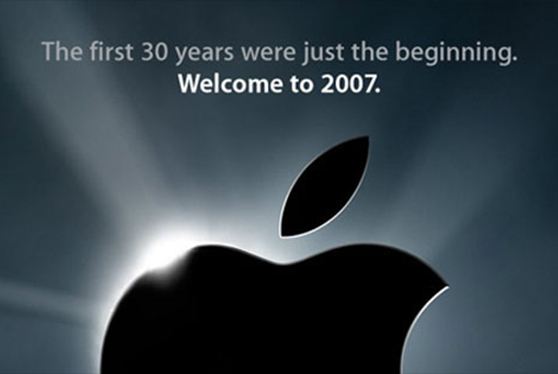
Invitations to the Macworld event on 9th January 2007 suggested that the last 30 years had been just the beginning, and everything was about to change. Actually we only realised this was true and not Apple marketing hype several years later. At the now famous keynote, after more than half an hour of other announcements, Steve Jobs explained:

“Well today, we’re introducing THREE revolutionary new products. The first one is a widescreen ipod with touch controls. The second is a revolutionary new mobile phone (the crowd went wild). And the third is a breakthrough internet communications device (they were less wild about that).”

And all 3 were the same device. But it was expensive. On top that we had to wait – it wasn’t going to be available until 29th June. It did, however, completely redefine the smart phone (and multi touch screen) user interface, but on initial announcement the iPhone was a closed device. It was only available on one US network, Cingular, and only available with a small collection of native apps. Steve told people that Apple and Cingular needed it to be that way because:

“You don’t want your phone to be an open platform. You don’t want it to not work because one of three apps you loaded that morning screwed it up” and “Cingular doesn’t want to see their West Coast network go down because of some app”.

Where would we be now if Steve had stuck with that position? Actually and thankfully, things had all changed before the end of 2007, but you also need to be reminded of the rest of the smart phone landscape of the time. The major smart phone players were Nokia, Motorola, Sony and BlackBerry (where are they all now?). The Nokia smart phone market share high point was in Q4 of 2007 at 50.9%! Personally, this was the year I upgraded from a Blackberry 8700 to a Blackberry Curve. At the time I considered the Nokia E61i, but not the iPhone. I tried the soft keyboard and just couldn’t get on with it. Actually, one of the coolest phones to own in 2007 was the Nokia n95 which, at the time, was the most powerful smart phone (with apps) you could buy as well as being a satnav, a camera, a player of music, and it was a phone too. If you look at the market share statistics going forward many of us continued to buy non Apple smart phones well in to 2009.

What made the iPhone a real game changer was Steve Jobs 180 degree turn around in June 2007, when he opened up the operating system to 3rd party developers. Then the SDK was announced in October, and once we had the associated app store and developer ecosystem, that really changed everything. In the discussion threads of the time Apple said “It will take until February (2008) to release an SDK because we’re trying to do two diametrically opposed things at once—provide an advanced and open platform to developers while at the same time protect iPhone users from viruses, malware, privacy attacks, etc. This is no easy task.” Collecting all of 2007’s iPhone announcements together, the smart phone market was recast and Android followed in its footsteps.

Twitter took flight (and became a company)
I mentioned above that I jumped on board the Twitter train on 14 February 2007, but at that stage it was only social media and “web 2.0 (remember that?)” type geeks who were using it. As you’ll know Twitter was started as a side project by Biz Stone, Evan Williams, and Jack Dorsey while they were working at Odeo during 2006. Most of the usage was in the US only, and at the start of 2007 it was creeping out to my UK and European friends by word of mouth. In March, at that year’s South by Southwest (SXSW) event, things began to take flight. The Twitter stream was set on two 60-inch plasma screens in the hallway between the sessions and it became the event’s back channel. Speakers at the event referenced it, and the bloggers got on board. All of the rest of the attendees told their friends. Twitter staff received the festival’s Web Award prize. As a result Twitter usage jumped from 20,000 tweets a day to 60,000. Suddenly Biz, Evan, Jack and their team realised they had something. Twitter was spun out in to a separate company the very next month – April 2007.

On 23rd August Chris Messina suggested using # for grouping tweets, inspired by old style IRC. Stowe Boyd dubbed that the hashtag a few days later. Twitter followed up by adding the functionality required. Hashtags were widely used that year in the tweet stream connected to the San Diego forest fires. Usage also took off in Japan as well as Europe. The year that Twitter became really mainstream was arguably 2009, but there is no doubt 2007 was the tipping point.

Zuckerberg had just turned down 1$Bn, but opened up Facebook instead
Remember where Facebook was back then. During 2006 their growth had tailed off approaching 8 million users. Yahoo came calling and offered (22 year old) Mark Zuckerberg $1Bn and he verbally agreed to sell in July 2006. To put things in context, Yahoo had hundreds of millions of users at that time. MySpace was at 100 million users by August 2006. Yahoo’s timing was poor, though. Just after the offer to Zuckerberg they reported slower sales and earnings growth, and delays launching their new advertising platform. Their share price dropped 22% overnight, and Terry Semel, the CEO, subsequently cut their offer for Facebook down to $800m. They put the offer back up a couple of months later, but the damage was done and Zuckerberg didn’t sell – how different would things be now if that set of circumstances hadn’t happened?

Zuckerberg convinced his board they could do better, and started to focus beyond students, opened up membership to everyone, created the news feed and started mapping everyone’s social graph, with an emphasis on real identity and putting more of your personal information online. By January 2007 they had jumped to 14 million users, but the key move happened on 24th May 2007. At a massive press and developer event in San Francisco, they officially launched Facebook Platform, opening up for developers to build apps to help make it even easier for friends to communicate and do more. By the end of August they were at 36 million users, signing up at the rate of 1 million new users a month! It was during 2007 that I first started overhearing “normal” people on the Tube in London talking about Facebook. The die was cast. Facebook became a phenomenon in its own right rather than being lost inside of Yahoo… and MySpace who?

We all started talking Cloud
Clouds had been used in network communications and IT diagrams right back to the 60s, but the first use in the context of distributed computing was by Andy Hertzfeld in a Wired article in 1994. Quite some while later in a Q&A on 9 August 2006, at the Search Engine Strategies Conference, Eric Schmidt of Google talked of an emergent new model. He said:

“It starts with the premise that the data services and architecture should be on servers. We call it cloud computing – they should be in a “cloud” somewhere.”

A couple of weeks later on 25th August 2006, Amazon announced a limited public beta test of something called Elastic Cloud Compute or EC2. Infrastructure as a Service was here alongside the Software as a Service consumer and business applications that we were getting used to. Before this people were talking about webware and web 2.0, but suddenly Cloud was a great catch all term to use. Although the trend’s origin was in 2006, it was 2007 when Cloud Computing took hold in the language of technology. I trace my own usage of it back to that year, and that’s when I remember Simon Wardley and many others in the IT space talking cloud and utility computing for the first time. It wasn’t until 2009 or 2010 that the hype around the concept really started, but 2007 was when we all started talking Cloud.

It’s the year that Social Media started to really mean Business
The visionaries who wrote the Cluetrain Manifesto could see what was beginning to happen as far back as 1999, but 2007 was the year the momentum really picked up. Although I’d been blogging since 2005, and meeting up with like minded people at various events talking social media, web based tools and enterprise 2.0 as well as web 2.0, something different began to happen coming in to 2007. Behaviours started to change. In October 2006 I attended Ishmael Ghalimi’s (brilliant) first Office 2.0 Conference, which connected me to so many great people and helped kick off my 2007 with fresh thinking. I picked up organising and running a monthly meetup on using wiki technology in business called London Wiki Wednesdays in February 2007. I started attending Saul Klein’s weekly London OpenCoffee meetings. Although they had been set up to facilitate start-ups meeting VCs and angel investors, more and more people interested in the new stuff happening at the edge began to turn up too. Elsewhere Chinwag Live was happening. There was a buzz as marketing, communications and PR people wanted to understand the new approaches and how things were changing. Developers with an idea came looking for help or to share what they’d prototyped. Creativity was flowing and connections were being made.

During 2007 those OpenCoffee sessions got busier and busier, moving from the Starbucks in the Esprit on Regent Street, to the 5th Floor of Waterstones on Piccadilly. More and more people started working in cafés plugged in to wifi – suddenly I wasn’t the only one hunting for a power point. Actually the social media geeks that turned up to OpenCoffee during 2007 needed their own home, and when Lloyd Davis started thinking about a London form of Social Media Café, we all gravitated there. You can read Lloyd’s musings from August 2007 – the beginning of what became The Tuttle Club (after the character Harry Tuttle in the movie Brazil – find out why he was our hero here). Lloyd ran the first few sessions in 2007 and the savvy amongst us moved over from OpenCoffee to his place. It really took off during 2008 – by then the venue was the Coach and Horses in Soho and it was happening weekly, but the momentum for all of this definitely started in 2007. The social media oriented crowd in London were meeting, making new alliances, forming new companies, developing products, trying things out, and connecting with people from all over the World. Suddenly we were talking about Social Media Marketing, Social Media in Business and influencers. I can only talk in detail about London, but from my connections I know similar things were happening in San Francisco, but also New York, LA, Boston, Paris, Munich, Milan, Vancouver, all over. I’m sure you will have your own stories, but I can trace a lot of my ideas and network of friends and collaborators back to that seminal year.

So, there’s my case for 2007. It’s only been 10 years, yet it seems longer. So much of what we talked about that year has moved from the edge to mainstream business thinking today. The rate of change is only accelerating and we have a raft of emerging technologies to consider with amazing potential. Every business is (or should be) planning for disruption and new business models, and figuring out how to harness more digital technology in to the products and services they provide. I wonder how much longer we’ll be using the digital term, and I wonder what what will replace it – what comes next?

By the way, I’ve been one of several volunteers proof reading Cecil Dijoux’s soon to be published book on Hyperlean and all things digital. In his prologue to the book he says (will say):

“If there is a year to be marked as a milestone, as the kick-off of the major innovations we have witnessed recently, 2007 is a great contender.”

Like minded – absolutely! I recommend you check out his book as soon as it is published – some great content and ideas in there.

And if you want some help making sense of digital please just ask or contact us.

Share this:

  • Tweet
  • Email

Filed Under: digital disruption, future, ideas Tagged With: Apple, cloud, digital transformation, Facebook, iPhone, social media, Twitter

10 years on, why I haven’t fallen out of love with Twitter (yet)

February 14, 2017 By David Terrar

10 years on, why I haven’t fallen out of love with Twitter (yet)

“If you live to be a hundred, I want to live to be a hundred minus one day, so I never have to live without you.”

A very sweet thought from Winnie-the-Pooh. Disney by the way, not A.A. Milne. Well it is Valentine’s Day and it’s exactly 10 years to the day since I started my love affair with the one-to-many messaging service called Twitter. Am I still that passionate? Could I live without it? Actually, we had a fantastic honeymoon period and some amazing highs, but our relationship has hit rocky patches recently. We used to talk all the time, but we don’t communicate quite like we used to. Can we change together? I’m not giving up though. Like all relationships of any value you have to work at it. But what have I learned looking back from my 10th anniversary? What’s the context, both in terms of the backdrop of digital history, and in what happens next? Let’s see.

Do you have a Cluetrain?
When I meet marketing or media professionals at some point I ask them whether they’ve heard of the Cluetrain Manifesto. Their answer presents a digital divide. Those that know of, or have read the 95 theses have a better understanding of digital marketing (and the Internet) as a network of networks of conversations. Those that haven’t heard of it have old style marketing thinking – the Internet in terms of a broadcast and traffic. I’m in awe of the book. Published in 1999 Cluetrain is as relevant today as the day it was first published almost 18 years ago. Let’s pick out 3 of the 95 tenets.

  • #1 Markets are conversations. (The foundation of all ingredients of social media and user generated content that has changed marketing forever.)
  • #6 The Internet is enabling conversations among human beings that were simply not possible in the era of mass media. (Technology allows two way, person to person communication across the globe in real time. And then the conversations have to adapt again when AI and machine learning mean that sometimes it’s a human talking to a bot.)
  • #12 There are no secrets. The networked market knows more than companies do about their own products. And whether the news is good or bad, they tell everyone. (Companies aren’t in control of their brands anymore, but they and we have huge opportunities from the vast amounts of data generated across the web for our analysis every second.)

Twitter has been at the leading edge of these changes over the last 10 years. Buying has changed, and so selling has had to change, and the key word is social. Now every sales person has to think social if they want to be effective, and Twitter is a channel you can’t ignore in the communications mix. Now every brand, event and TV show has a Twitter handle, alongside some other social channels. Twitter has become an essential route to get the message out and feedback from both B2B and B2C marketing. It’s part of the marketing fabric, in most geographic markets, now. Most billboard adverts you see will have the brand’s Twitter alongside their web address. For the fanbase of most TV shows it’s an essential component. Season 6 of The Walking Dead averaged 435,000 tweets per episode. Even that can be topped – the premier episode of season 7 generated 4.7 million tweets, when two of the beloved characters died. That’s buzz of a different colour!

The short message is the medium
Why 140 characters, and why is that so important? There is a magic to microblogging, and a magic to the economy required in a short message. But let’s have some history. Twitter (which started as Twittr, after the fashion of web 2.0 startups dropping their vowels) was envisioned back in 2006 by co-founder Jack Dorsey as an SMS based messaging service for friend groups to keep up to date with each other. Jack sent the first message on Twitter on March 21st 2006. It read, “just setting up my twttr”.

An SMS message is 160 characters long, so Twitter (as it was eventually renamed) grabbed 20 for control characters, and provided 140 for messages. But why 160? Actually not everyone remembers how big text messaging was before Cluetrain and the age of social media. It was created within the protocols and standards of voice messaging in 1985 as part of Global System for Mobile Communications or GSM here in Europe. SMS was to use the voice optimised bandwidth to transport data messages on the signalling paths needed to control the telephone traffic during periods when no signalling traffic existed. That meant unused resources in the system could be used to transport messages at minimal cost. It was Friedhelm Hillebrand of Deutsche Telekom, working on the GSM standard, who defined 160 as the message length – to use the spare bandwidth cheaply, there had to be a hard limit. Apparently he sat at his typewriter back in 1985 typing example short messages, and none of them took more that 160 characters. Then he looked at messages on postcards he’d received, and even did some research on example Telex messages. They all matched the 160 limit, and so his argument was accepted. Even so it was a while before text messaging became a commercial reality. Hillebrand hit upon the Dunbar number equivalent for short form communication. A length that allows for true meaning and emotion in no more than a dozen words. Great for a status update or a strapline, but leaves enough room for elegance, humour and even poetry. Ideal for today’s world where the signal is struggling against so much noise, and that’s exactly why SMS and now Twitter have taken hold.

The first SMS message wasn’t actually sent until December 3rd 1992, from engineer Neil Papworth to Richard Jarvis of Vodafone. The following year Nokia made SMS capable phones, and then the first commercial SMS service was offered by Radiolinja in Finland, followed by Vodaphone launching a service in the UK in 1994. Because of the low cost SMS took hold, particularly with the younger demographic, and was a very big deal in its own right. By January 2001 more than a billion texts a month were being sent in the UK alone. In 2004, prime minister Tony Blair joined the text and mobile revolution when he took part in a live text chat with thousands of callers.

Who’s in charge?
The community, that’s who! Twitter’s power is decentralised and has given a voice and influence to users in ways no other social network has. Right from the start it was the users who were creating the utility. It was users who started to use IRC (internet relay chat) conventions like @ for names and # for topics, with Chris Messina and Stowe Boyd naming the hashtag, and Twitter followed up with the functionality to make that work. Shortly after I joined in 2007, Twitter really took off at that year’s South by South West. It jumped from 20,000 messages a day to 60,000 because there were plasma screens in the halls displaying as the conference back channel. From that point on it spread to over 200 million active users in the first seven years, and the pace has slowed to around 320 million active users now. It has changed history, playing a role in the Arab Spring or in campaigns like #BlackLivesMatter. It has changed world news gathering at a turning point in 2009 when Janis Krums tweeted a photo of US Airways Flight 1549 after it touched down on the Hudson River that went viral, before anywhere else had the story. It’s achieved a new focus of attention as Donald Trump has continued to use it as the way to talk to directly to the American Public as he moves from the campaign, through his inauguration to his first 100 days in office. However, Twitter only grew by 2 million active users in the 4th quarter of 2016, whereas Facebook grew by 72 million users in the same period.

After a wild successful IPO in 2013, Twitter began to struggle dealing with shareholders and market expectations and the stock took a downturn. Jack Dorsey, co-founder and author of that first tweet, who had been ousted in 2008, was brought back in as CEO in 2015. They’ve made changes, there has been talk of extending the 140 character limit, they’ve acquired Persicope for live streaming, but they haven’t articulated their direction anywhere near clearly enough. There have been rumours of acquisition by Disney, Salesforce and Google. From my vantage point they need to shift their balance of listening from the market and shareholders to their community of core (and new) users. Oh, and by the way, in October 2016 Twitter’s Chinese competitor Weibo just went past it in terms of market capitalisation.

Is Twitter dying?
To paraphrase Frank Zappa, Twitter is not dead, but it smells funny. Back in the late 2000s Twitter was like a village or the town square. I had real conversations with people on a regular basis. I’ve met and interacted with new, likeminded people from all over the world. It brought me business. It brought me friendships. It showed me ideas, music, books. It brought me speaking opportunities that would never have happened any other way. It helped me have impromptu meetings with cool people who spotted me on Twitter at a particular cafe. To make it even more personal, my particular Twitter community helped me enormously with support when my father was dying (they know who they are, and I thank them from the bottom of my heart). That’s value!

Now by 2017, the village has grown to a noisy urban sprawl and then a country of major cities and communities, with all of the hustle and bustle and impersonality that comes with that kind of territory, made worse by the fact that there isn’t much of a government or police force to control things. Too big for the kind of community policing that happens in smaller groups. The Jakob Nielsen 90-9-1 rule still applies, where 90% are lurkers, with 9% creating a little and 1% creating most of the content, but now the numbers are at a different scale. The conversations I used to have are now  happening elsewhere, on Facebook and LinkedIn and Slack. Umair Haque wrote about this in 2015 but added the key problem of abuse we now face on Twitter and the web. He said:

“The problem of abuse is the greatest challenge the web faces today. It is greater than censorship, regulation, or (ugh) monetization. It is a problem of staggering magnitude and epic scale, and worse still, it is expensive: it is a problem that can’t be fixed with the cheap, simple fixes beloved by tech: patching up code, pushing out updates.”

Twitter has given everyone a megaphone, and there are plenty of people who misuse it. We have mob rule. We have shaming in ways I’ve never seen before. We have a realtime communications mechanism that is highlighting the divisions and flaws in our societies, and this has been brought in to sharp focus by recent political events like Brexit in the UK or Trump’s election in the USA. When politics and religion get in the mix, emotions can run high in ways that I have difficulty understanding. I’m all for more passion, by I want my arguments rational.

So we’ve definitely got a problem, and we’ve definitely lost something, but I don’t believe that means Twitter will die. It’s become too embedded in to the nerve system of business, marketing, government, politics and the World to go away. Even in its current form it provides a service and gives value. It stills provides me with news sources and discovery and connections that add value. But Darwin is calling and it needs to evolve.

What next for Twitter?
I don’t know Jack…. but what would I do if I was in his place? Like it or not, as a Public company they need to manage the finances quarter to quarter, along with market expectations, otherwise he and his executive team will be overtaken by events and it will become someone else’s problem. However, I believe the larger focus of attention should be addressing the needs of their community of core users and remembering the key ingredients that helped build Twitter in the first 5 years. Actually Jack should be looking to lessons from my current favourite business book Team of Teams. Twitter’s community of active users is the complete opposite of a business grappling with a command and control management structure. There is no structure. By definition it is self organising. The users are already formed in to loose teams and tribes, but those teams need tools to help them do a better job of defining, moderating, guiding and organising those teams so that they get more value from their connections and their live conversations. If the abuse problem is the single biggest issue, then they need much finer grain tools to help treat and manage it at source – viewed as an infection, they need antibodies and antibiotics to kill it as it springs up. Not so much a police force as helping community self moderation. Just like in Team of Teams, the Twitter leadership needs to think like a gardener, creating the right environment for the teams to thrive. They’ve got smart product people who can add the functions needed, but they need to narrow their focus to help individuals and groups rather than considering the user base as a whole.

Another key ingredient to make the team approach work is a shared vision, and so Twitter needs a much clearer direction from the top, a much clearer annunciation of what it’s for and why. In those early years, that came from the community itself. More than anything Jack needs to do some listening.

This is the first of a sequence of posts from us Elephants on what’s next for the digital landscape, the future of mobile, group messaging, conversational commerce, artificial intelligence and more. What do you think? Contact us with suggestions, questions – we’d love for you to join the conversation.

image courtesy bookofthefuture.co.uk and digitaltrends.com

Share this:

  • Tweet
  • Email

Filed Under: future, social media, social tools Tagged With: 140 characters, Donald Trump, Jack Dorsey, SMS, social selling, The Walking Dead, Twitter, Winnie-the-Pooh

Elephants show off their Insights with HPE

February 6, 2017 By David Terrar

Elephants show off their Insights with HPE

We’ve just started working with Hewlett Packard Enterprise.  HPE is an organisation with a long track record and history in technology, tracing their roots back to a classic start up story of two guys in a garage – what some would argue was the birthplace of Silicon Valley itself. What started as Hewlett-Packard, like any firm, needed to evolve and adapt to survive as the market disruptions and transformations happen. The original organisation has been around as one of the major forces in IT since the start of the computer era. Over the decades they’ve floated off their electronic and bio-analytical measurement instruments businesses, acquired the likes of Compaq and EDS, as well as becoming a major force in PCs and printers. All this alongside their roots in manufacturing servers, mini computers, data storage, and networking hardware.

In 2014 they split the PC and printers business from its enterprise products and services business to form HP Inc, and HPE respectively – now two separate entities on the NYSE. Last year HPE spun off its “non-core” software business in a merger with Microfocus, as well as a similar spin-off and merge of their Enterprise Services business with CSC, in a series of moves that focuses them back on their computing infrastructure roots. Their new strategy is encapsulated in this paragraph lifted from their CEO Meg Whitman’s 7 September announcement of last year:

“I want to be crystal clear – HPE is not getting out of software. Software is still a key enabler of our go-forward strategy, but we need the right assets to win in our target markets. Moving forward, we will double down on the software capabilities that power and differentiate our infrastructure solutions and are critical in a cloud environment.”

The new HPE wants to be known as the industry’s leading provider of hybrid IT built on ultra secure, software-defined infrastructure.

As part of their new approach HPE launched the enterprise.nxt resource which can be found at the Insights tab of their main website, at insights.hpe.com and HPE.com/nxt. Agile Elephant is delighted to be contributing content to this site which aims to provide insights and resources to help IT pros shape the future of business. Here are the articles we’ve contributed so far:

  • 5 things Slack and Teams tell us about workplace collaboration
  • 5 steps to defining the ROI for your digital transformation project
  • 5 ways to transform your workplace for the digital age
  • Chatbots for business: 4 simple ideas to make your team and ops smarter

There’s some great content on there from a variety of HPE experts and technology journalists. The editors asked us to contribute content on digital transformation and emerging technologies. We’re delighted to be involved. Please contact us if you’ve got any suggestions for topics or if you want to hear more.

Share this:

  • Tweet
  • Email

Filed Under: digital transformation strategy, emerging technologies, ideas Tagged With: blog, Hewlett-Packard, Insights

« Previous Page
Next Page »

Sign up for our regular Agile Elephant Newsletter - news, posts, ideas and more.

My Tweets

From the Agile Elephant Blog

  • The Metaverse doesn’t exist yet, but…
  • Impossible Things get Disruptive
  • Clarity, Cloud, and Culture Change at IBM

What Next?
Take a look around our site, check out our approach, see how we can help, join the conversation on our blog or contact us to find out more.

About Us

Agile Elephant is a new kind of consultancy designed to help companies embrace the new digital culture of social collaboration, sharing and openness that is changing business models and the world of work.

Contact us to find out more!

Our founder's blogs:

broadstuff

@DT on Medium

Technotropolis

Our blog:

The Agile Elephant Blog

Site Log In | Site Log Out

Subscribe to Site RSS

Subscribe to our Blog via Email

Enter your email address to subscribe

Join 30 other subscribers

Copyright © 2026 ·Streamline Pro Theme · Genesis Framework by StudioPress · WordPress · Log in